


Most New Zealand student visa applications are decided within a few weeks, but the exact wait depends entirely on your education provider type and how complete your paperwork is when you submit it. Immigration New Zealand publishes an average (median) processing time alongside a “most completed within” figure for each provider category, and that second number is the one you should actually plan around, since it captures roughly four out of five applications rather than the middle case.
Your first move should not be guesswork. It should be checking the live INZ wait-times table for your specific provider type, then submitting through Immigration Online if your travel date sits within the recommended window. Here is what to do right now:
- Check the live figures. Open the INZ student visa wait-times page and find the row matching your provider (university, Institute of Technology, private training establishment, or school).
- Note both numbers. Record the average wait and the “most completed within” figure. Plan against the higher one.
- Apply online, not on paper. INZ’s own guidance states online applications move faster and paper submissions are no longer accepted for most student visa categories.
- Submit roughly three months before travel. INZ recommends this window for fee-paying international students, and it gives you a buffer if extra document checks come up.
- Keep your application complete on day one. Missing evidence is the single biggest self-inflicted delay applicants create.
Key Takeaways
New Zealand student visa processing time depends on your provider type and how complete your application is, so plan around INZ’s “most completed within” figure and apply about three months before travel.
| Point | Details |
|---|---|
| Check the live INZ table | Find your provider category’s average and “most completed within” figures before setting a travel date. |
| Apply three months out | INZ recommends this window for fee-paying students, giving buffer time for document checks. |
| Start checks early | Begin police certificates, medical exams, and translations weeks before submitting your application. |
| Confirm fees are correct | Pay the right fee type and keep your receipt to avoid payment-related processing holds. |
| Get a timeline estimate from Fewa | Fewa’s MARA-registered advisers review your documents and estimate a realistic decision date before you submit. |
Table of Contents
- How Long Does a New Zealand Student Visa Processing Time Actually Take?
- How Immigration New Zealand Prioritizes Student Visa Applications
- What Causes Most NZ Student Visa Delays (And How to Avoid Them)
- Tracking Your Application: When to Check In and When to Contact INZ
- When to Apply From Australia: Intake Timing That Actually Matters
- Do Visa Fees Affect Your NZ Student Visa Processing Time?
- How to Estimate Your Own NZ Student Visa Wait Time
- How Fewa Education & Migration Supports NZ Student Visa Applicants in Australia
- What Advisers Wish Every Applicant Knew Before Submitting
- Get Help Avoiding Delays on Your NZ Student Visa Application
- Where to Verify NZ Student Visa Processing Times and Requirements
- Sources
How Long Does a New Zealand Student Visa Processing Time Actually Take?
INZ measures processing time in working days, not calendar days, and reports it two ways. The average wait time is the median. Half of all applications for that provider type are decided faster than this figure, and half take longer. The “most completed within” figure is the 80th percentile.
That gap between the two numbers matters more than most applicants realize. If the median for university-bound students is, say, two weeks but the 80th-percentile figure is closer to a month, treating the median as your planning date is a mistake. You are essentially betting on being in the faster half of the queue, with no way to know in advance whether you will land there.
INZ breaks these figures down by provider category because processing genuinely differs across them. A straightforward university application with a clean offer letter and full financial evidence tends to move differently than a private training establishment application, which may involve additional checks on the institution’s own compliance status. Here is how to read a typical breakdown:
| Provider Type | What Tends to Affect Timing |
|---|---|
| Universities | Usually higher application volume; well-documented offers speed things up. |
| Institutes of Technology / Polytechnics | Processing can vary by campus and enrollment period. |
| Private Training Establishments (PTEs) | Additional provider-status checks sometimes apply. |
| Schools | Often needs guardianship and dependent documentation reviewed alongside the visa. |
INZ updates this table weekly and offers both a last-four-weeks snapshot and a six-month trend view, so a figure you saw last month may already be outdated.
Pro Tip: If the 80th-percentile figure for your provider category is noticeably higher than the median, build your calendar around the larger number, not the smaller one. A visa decided “early” is a bonus. A visa decided late because you planned around the median is a problem you cannot fix after the fact.
How Immigration New Zealand Prioritizes Student Visa Applications
INZ does not process every application in strict first-in, first-out order. Several factors push a file up or down the queue, and understanding them helps you avoid unnecessary friction.
- Completeness first. An application with every required document, the correct fee paid, and a valid offer of place is assessed far closer to the published average than one missing a single item.
- Travel urgency. Applicants with imminent, unavoidable travel dates sometimes receive expedited attention, though this is not guaranteed and is assessed case by case.
- Travel disruption responses. During confirmed disruption events (weather, transport strikes, geopolitical issues affecting travel corridors), INZ has previously adjusted handling for affected applicants.
- Onshore versus offshore status. Applicants already lawfully in New Zealand on another visa sometimes see different handling than first-time offshore applicants, since different verification steps apply.
- Outstanding medical or character checks. A file waiting on a medical certificate or police clearance effectively pauses at that step regardless of how complete everything else is.
Requesting priority handling outside these categories rarely succeeds. INZ reserves expedited processing for genuinely urgent or disrupted circumstances, not general impatience, so a request without a documented reason is likely to be declined and can waste time you could have spent fixing an actual gap in your file.
What Causes Most NZ Student Visa Delays (And How to Avoid Them)
The overwhelming majority of delays trace back to a small set of avoidable problems. INZ’s own application guidance notes that immigration officers can request any supporting document, including your original passport, and that incomplete evidence slows assessment considerably.
Here is the checklist, roughly ordered by how often each item trips applicants up:
- Missing or inconsistent documentation — names, dates, or amounts that don’t match across your offer letter, bank statements, and passport.
- Unpaid or incorrectly paid fees — a common and entirely avoidable hold-up.
- Delayed police certificates — these can take weeks to arrive from Australian authorities depending on your state and history of residence abroad.
- Delayed medical examinations — panel physician appointments book out, especially close to intake dates.
- Untranslated documents — any document not in English generally needs a certified translation attached.
- Incomplete offer-of-place evidence — a conditional offer or a letter missing required enrollment details.
- Passport validity issues — a passport expiring too close to your intended course end date.
Pro Tip: Start your police certificate and medical exam before you submit your visa application, not after. Police checks can take two to six weeks depending on where you’ve lived, and panel physician appointments in Australian cities often book out weeks in advance during peak intake season.
Advisers who work through these files regularly report that a large share of avoidable delay comes down to applicants submitting before their supporting documents are actually finished, rather than the visa assessment itself taking longer than expected. That distinction is worth sitting with: the queue usually is not the problem. The paperwork is.
Tracking Your Application: When to Check In and When to Contact INZ
Once you submit, Immigration Online becomes your main reference point. Here is how the process typically unfolds:
- Submission confirmation. You’ll receive an application number immediately. Save it. You’ll need it for every future interaction with INZ.
- Status updates in your online account. Immigration Online shows basic status changes, though it will not always explain exactly what stage of assessment you’re at.
- Wait through the published window before escalating. If you’re still inside the “most completed within” figure for your provider type, contacting INZ typically won’t speed anything up.
- Contact INZ once you’ve passed the 80th-percentile window. At that point, a status inquiry is reasonable. Have your application number, passport number, and payment receipt ready before you call or message.
- Check INZ’s service disruption notices if your file seems unusually delayed.
Occasionally, backlogs or system issues affect specific offices or application types, and INZ posts updates when that happens.
Contact your education provider first if the delay seems tied to something on their end, like a missing enrollment confirmation. Contact INZ directly for anything visa-specific. If your case involves unusual complexity, such as a previous visa refusal or a character issue, a MARA-registered adviser can help you interpret what’s actually happening and whether a formal request for update is warranted.
When to Apply From Australia: Intake Timing That Actually Matters
New Zealand education providers generally run on semester and trimester intake patterns, with peak demand clustering around the main February and July intakes. Application volume spikes in the weeks leading into these windows, and that spike can push processing times toward the higher end of INZ’s published range, even when nothing about your individual file is complicated.
Here is a practical timeline working backward from a course start date:
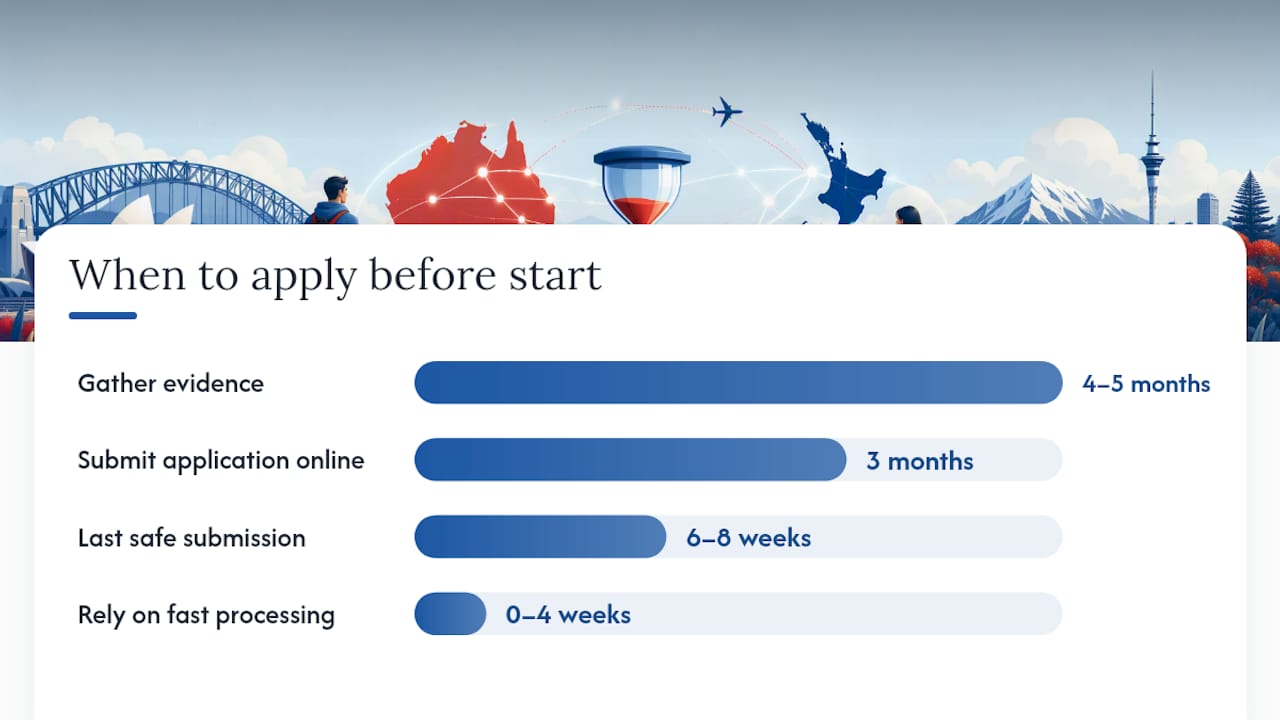
- Four to five months before your course starts — begin gathering financial evidence, arranging medical exams, and requesting police certificates. These take the longest and are entirely within your control to start early.
- Three months before your course starts — submit your visa application online. This matches INZ’s own recommended timing for fee-paying international students and gives you buffer room if a document check runs long.
- Six to eight weeks before your course starts — this is the last genuinely safe submission window if your documents are fully ready. Anything later starts eating into your margin for a slow-moving check.
- Inside four weeks of your course start — you’re now relying on faster-than-average processing to make it. Not impossible, but not something to plan around deliberately.
Pro Tip: If you’re applying from Australia, factor in postal or courier time for any document that needs to travel between Australian authorities and New Zealand institutions. A police certificate that takes three weeks to arrive domestically can add real time to your overall timeline even before INZ starts assessing your file.
Applicants already living in Australia on another visa (a working holiday visa, for instance) sometimes have slightly more flexibility on timing since they aren’t racing an expiring visa status at home. Those applying directly from overseas, with a firm departure date already booked, have the least room for error and should lean toward the earlier end of every window above.
Do Visa Fees Affect Your NZ Student Visa Processing Time?
Yes, indirectly but significantly. INZ requires payment before it will begin substantive assessment of an online application, so a fee problem doesn’t just delay payment processing. It delays everything downstream of it.
The most common fee-related issues Australia-based applicants run into:
- Paying the wrong fee type — student visa fees vary by category, and paying for the wrong one means a correction cycle before assessment can start.
- Failed transactions from Australian cards or banks — international payment declines happen more often than applicants expect, particularly with card verification mismatches.
- Missing or unclear payment receipts — if INZ can’t confirm payment cleared, your file can sit in a holding pattern until it’s resolved.
- Currency confusion — confirm you’re paying in the correct currency for your application type before submitting, since a currency mismatch can trigger a failed or partial transaction.
If you suspect a payment issue, contact INZ with your application number, the payment date, and your bank’s transaction reference ready. Vague messages like “I think my payment didn’t go through” take longer to resolve than a message with specific transaction details attached.
How to Estimate Your Own NZ Student Visa Wait Time
You can build a reasonably accurate personal estimate using INZ’s public data plus a few adjustments for your own situation. Here’s the method:
- Find your provider row in the INZ wait-times table. Confirm whether you’re applying to a university, ITP, PTE, or school.
- Start with the “most completed within” figure, not the average. This gives you a realistic outer bound rather than an optimistic best case.
- Add time if you’re offshore and it’s peak intake season. February and July intakes see higher volume, which can push real-world waits toward or beyond the published figure.
- Add time if any check is still outstanding. A pending police certificate or medical exam effectively pauses your file at that stage, independent of how fast INZ processes everything else.
- Subtract a small margin if your application is fully complete on submission, since INZ has noted that complete files tend to land closer to the median rather than the 80th-percentile figure.
Worked example: Say a student in Sydney is applying to a New Zealand university with every document ready and no outstanding checks. Starting from the university row’s “most completed within” figure, they can reasonably subtract a modest margin for completeness, landing closer to the median. A second student applying to a PTE with a police certificate still in progress should add time on top of that provider’s 80th-percentile figure until the certificate clears.
This method gives you a planning window, not a promise. INZ’s figures update weekly, and a sudden spike around an intake date or a travel disruption event can shift the numbers with little warning. Check both the recent four-week snapshot and the six-month trend before locking in travel bookings or accommodation.
How Fewa Education & Migration Supports NZ Student Visa Applicants in Australia
Fewa cannot make Immigration New Zealand process your file faster. No consultancy can. What Fewa does is remove the avoidable delays that push applicants toward the slower end of INZ’s published range, and give you a realistic estimate before you commit to travel plans or accommodation.
For Australia-based students, that support looks like:
- Document review before submission, checking that financial evidence, offer letters, and identity documents are consistent and complete.
- Application assembly, making sure every required field and attachment is in place before you submit online.
- Fee verification, confirming you’re paying the correct amount in the correct category before submission.
- Follow-up support, helping you interpret INZ status updates and knowing when a status inquiry is actually warranted.
- A free initial consultation to talk through your specific timeline and provider type before you commit to a submission date.
Fewa is a MARA-registered consultancy based in Sydney, which means its advisers are formally regulated to give immigration advice in Australia. For students juggling coursework, part-time work, and visa paperwork at the same time, having someone check the file before it goes to INZ is often the difference between a routine wait and an avoidable delay.
Fewa doesn’t control INZ’s queue. It controls whether your file gives INZ any reason to slow down.
What Advisers Wish Every Applicant Knew Before Submitting
Working through NZ student visa files repeatedly surfaces the same patterns, and most of them are preventable if you know to look for them early.
Translations get underestimated. Applicants routinely leave certified translations until the last week, not realizing that a rushed translation service can itself introduce errors that trigger a document request from INZ. Start this earlier than feels necessary.
Keep your original passport accessible, not stored away. INZ’s guidance notes officers may request original documents during assessment. If your passport is locked in a safety deposit box or with another agency for an unrelated process, that request can sit unanswered longer than it should.
Build in more cushion than the 80th-percentile figure suggests, especially around intake season. The published figures are useful, but they’re historical. If you’re applying into a known peak period, treat the “most completed within” number as your floor, not your ceiling, and add a couple of extra weeks if your travel date has any flexibility at all.
If your timeline is genuinely tight, that’s exactly the moment to run the estimation method above and, if the numbers still look uncomfortable, talk to a MARA-registered adviser rather than guessing. A short conversation early is cheaper, in every sense, than a missed course start date.
Get Help Avoiding Delays on Your NZ Student Visa Application
Reading INZ’s wait-time tables tells you what’s typical. It doesn’t tell you whether your specific file has a gap that will push you into the slower percentile. That’s the part Fewa handles for Australia-based students: a document review, a fee check, and a realistic timeline estimate based on your provider type and how complete your evidence is right now.
A free consultation with Fewa walks through your offer letter, financial evidence, and any outstanding checks like police certificates or medicals, and flags anything likely to trigger a request for more information before INZ ever sees it. From there, Fewa can assist with full student visa application support if you’d rather have your file assembled and checked by someone who does this daily. INZ still makes the final call on timing and outcome, but a clean, complete application is the single biggest lever you control. Book a free consultation with Fewa and get a realistic timeline for your situation before you lock in flights or accommodation.
Where to Verify NZ Student Visa Processing Times and Requirements
- INZ student visa wait times table — the live source for average and “most completed within” figures by provider type, updated weekly.
- Fee Paying Student Visa guidance — INZ’s official recommendation to apply three months before travel, plus eligibility details.
- INZ1013 Student Visa Application Guide — the document checklist and application instructions for what to prepare before you submit.
- Staying to work after finishing your study — post-study work visa rules and timing, useful once your student visa is approved.
This information is general guidance based on publicly available Immigration New Zealand data and does not replace personalized migration advice. Processing times and policy details change, so confirm current figures directly with INZ or a registered migration adviser before finalizing travel plans.
Frequently Asked Questions
How long does a New Zealand student visa take to process from Australia?
It depends on your education provider type. Check INZ’s live wait-times table for the average and “most completed within” figures for your specific category, since these vary and update weekly.
Does applying earlier guarantee faster processing?
No, but it gives you a safety margin. Applying around three months before travel, as INZ recommends, means a slow document check won’t threaten your course start date.
Can I speed up my New Zealand student visa by paying extra?
No. INZ does not offer a premium or expedited-fee service for student visas. Priority handling is reserved for documented urgent or disrupted travel circumstances, not general requests.
What happens if my police certificate or medical exam is delayed?
Your file effectively pauses at that step. Start these checks well before you submit your visa application to avoid this becoming your bottleneck.
Does a New Zealand student visa processing delay affect my post-study work visa eligibility?
Not directly. Post-study work visa rules and timing are assessed separately once you’ve completed your qualification.
This article is general information, not a substitute for advice from a qualified lawyer. Consult a qualified legal professional about your own circumstances before acting on anything here.
Sources
- Student visa wait times :: Immigration New Zealand
- Fee Paying Student Visa » Immigration New Zealand
- INZ 1013 Student Visa Paper Application Guide
- Staying to work after finishing your study :: Immigration New Zealand