


You can apply for the subclass 491 visa if you have a positive skills assessment in an occupation on the eligible list, score at least 65 points, and hold either a state or territory nomination or sponsorship from an eligible relative. Both pathways carry a mandatory nomination or sponsorship bonus, which most applicants need to clear the 65-point floor.
Before you do anything else, confirm you meet these baseline requirements:
- Positive skills assessment for an occupation on the relevant skilled list
- Minimum 65 points on the points test, including your 15-point nomination or sponsorship
- Competent English (broadly equivalent to IELTS 6.0 in each band)
- Under 45 years old at the time you’re invited to apply
Pro Tip: Submit your Expression of Interest (EOI) in SkillSelect the same week your skills assessment comes through, then immediately check the nomination portal for the state where you live, work, or plan to settle. Nomination rounds move fast, and an EOI sitting idle earns you nothing.
Key Takeaways
Meeting the 65-point minimum, holding a valid nomination or sponsorship, and tracking document validity windows together determine whether a 491 application succeeds.
| Point | Details |
|---|---|
| Nomination is mandatory | You need state/territory nomination or eligible-relative sponsorship to reach 65 points. |
| Validity windows matter | Skills assessments and English tests must stay current through nomination and lodgement. |
| States differ significantly | NSW, Victoria, and South Australia each run distinct pathways and occupation lists. |
| 65 points is a floor, not a target | Competitive occupations often need scores well above the minimum to get invited. |
| Fewa supports the full process | Fewa reviews EOIs, matches occupations to state pathways, and checks documentation before lodgement. |
Table of Contents
- What Are the Home Affairs Requirements for the 491 Visa?
- What Is the Difference Between State Nomination and Family Sponsorship?
- How Do NSW, Victoria, and South Australia Handle 491 Nominations?
- What Is the Step-by-Step Process to Apply for a 491 Visa?
- How Does the Points Test Work for the 491 Visa?
- Who Can Sponsor You for a Family-Sponsored 491 Visa?
- How Does the 491 Visa Lead to Permanent Residency?
- What Documents Do You Need for a 491 Visa Application?
- Get Expert Help With Your 491 Application
- Frequently Asked Questions
- Sources
What Are the Home Affairs Requirements for the 491 Visa?
The Department of Home Affairs sets the federal floor every applicant must clear, regardless of which state eventually nominates them. This is a points-tested, provisional visa valid for a provisional period, and it only works if the fundamentals line up before you touch SkillSelect.
The non-negotiables are:
- Age under 45 at the time of invitation
- A positive skills assessment for your nominated occupation, issued by the relevant assessing authority
- Your occupation appears on the correct eligible skilled occupation list
- A minimum of 65 points, which must include the 15 points from nomination or sponsorship
- Competent English or higher
- Health examinations and character checks (police clearances) passed
Here’s the number that trips people up: your skills assessment and English test results both carry a validity clock, and letting either lapse before nomination can sink an otherwise strong application. Home Affairs also publishes an eligible regional areas tool that confirms whether your address actually counts as regional, since Greater Sydney, Greater Melbourne, and Greater Brisbane are excluded. Check it before you commit to a location strategy, not after.
What Is the Difference Between State Nomination and Family Sponsorship?
State and territory nomination means a government agency selects you through its own process, usually a registration of interest followed by an invitation round tied to occupation priority lists. Eligible-relative sponsorship works differently: a qualifying family member living in a designated regional area vouches for you and takes on legal obligations in return.
The two paths aren’t interchangeable in practice:
- State nomination generally draws from a broader occupation list than family sponsorship
- Family sponsorship is restricted to occupations on the Medium and Long-term Strategic Skills List (MLTSSL)
- Sponsors accept two years of financial and accommodation responsibility, formalized through a statutory declaration
- Both routes deliver the same 15-point boost toward your 65-point minimum
Pro Tip: If your occupation only appears on a state list and not the MLTSSL, family sponsorship won’t be an option for you. Confirm your occupation’s list status before assuming you have both routes available.
How Do NSW, Victoria, and South Australia Handle 491 Nominations?
Each state runs its own selection logic, and the differences matter more than most applicants expect. New South Wales offers three separate pathways: one for regional employer employment, one through Investment NSW invitation rounds, and a regional graduate stream for recent local graduates. Pathway 1 typically requires a period of continuous regional employment, and employers can apply for TSMIT and CSIT concessions in specific cases, according to NSW Government guidance.
Victoria runs on a Registration of Interest system through Live in Melbourne, with batch-based selection rather than continuous rolling invitations. Applicants need evidence of regional residence or employment, and where earnings are claimed, an annual estimate backed by documentation.
South Australia nominates through its own occupation list and streams detailed on Migration SA, with invitation rounds that shift based on labor market needs.
| State | Selection Method | Typical Requirement |
|---|---|---|
| NSW | Employer, invitation, or graduate pathway | 6 months regional employment (Pathway 1) |
| Victoria | ROI batch selection | Regional residence or employment evidence |
| South Australia | Occupation list + invitation rounds | State-specific nomination criteria |
Queensland and Western Australia add further variation. Queensland asks for at least three months of post-qualification regional employment for onshore applicants and runs a separate Small Business Owner pathway, per Migration Queensland. None of these lists stay fixed for long, so treat every occupation list as something to verify the week you apply, not something to trust from memory.
What Is the Step-by-Step Process to Apply for a 491 Visa?
The sequence runs across two separate systems, and skipping a step or misjudging the order costs applicants months.
- Complete your skills assessment and English test, and confirm both have enough remaining validity to survive the nomination and invitation stages.
- Lodge your EOI in SkillSelect and record your EOI identification number for reference.
- Submit a state registration of interest or nomination application, or arrange eligible-relative sponsorship, depending on your occupation and circumstances.
- If successful, you’ll receive an invitation to apply for the visa.
- Lodge your visa application within the Department’s timeframe, typically 60 days from invitation, with every supporting document ready to go.
Pro Tip: Build your entire document file before you submit the EOI, not after the invitation lands. Missing the 60-day lodgement window sends your invitation back into the pool, and you start the wait over. One detail worth internalizing: an EOI is not an application. Submitting one only makes you visible to states and Home Affairs, it doesn’t obligate anyone to select you.
How Does the Points Test Work for the 491 Visa?
The points test rewards age, English proficiency, skilled work experience, qualifications, partner skills, regional study, and a handful of smaller factors like credentialed community language skills and completion of a professional year. The nomination or sponsorship bonus points sits on top of all of that.
Here’s the part people underestimate: 65 points is the legal minimum, not a realistic target for every occupation. Competitive occupation groups often need scores well above that floor to attract an invitation in practice, sometimes into the 80s or 90s. You’ll want documented evidence for every point you claim:
- Academic transcripts and degree certificates for qualification points
- Employment references, contracts, and payslips for skilled work experience
- NAATI or equivalent credentials for community language points
- Current English test results matching your claimed proficiency band
Run your own numbers through the official points calculator before you lodge anything, since a miscalculated claim can delay or derail your entire EOI.
Who Can Sponsor You for a Family-Sponsored 491 Visa?
Eligible sponsors include a parent, sibling, aunt, uncle, niece, nephew, grandparent, or first cousin who is an Australian citizen, permanent resident, or eligible New Zealand citizen aged 18 or older, usually living in a designated regional area.
- Sponsors commit to a period of accommodation and financial assistance obligations under a signed statutory declaration
- All declarations and attachments must be witnessed or certified by a prescribed authority
- Your occupation must sit on the MLTSSL, a narrower list than most state nomination streams
- Family sponsorship carries the same 15-point value as state nomination
How Does the 491 Visa Lead to Permanent Residency?
Subclass 491 is a provisional visa, not a permanent one, but it opens a direct route to subclass 191 after three years of living and working in a designated regional area.
- You must meet minimum income requirements for each of those three years, assessed against contemporaneous records
- Keep leases, utility bills, ATO records, and employment evidence organized as you go, since retroactive proof rarely satisfies the pathway requirements
- You can lodge your 191 application as soon as you’ve met the three-year and income conditions, without waiting for your 491 to expire
What Documents Do You Need for a 491 Visa Application?
A complete file covers five categories, and gaps in any one of them stall your nomination.
- Identity: passports, birth certificates, and any change-of-name documentation
- Skills evidence: positive skills assessment, academic transcripts, and professional registration where required (AHPRA for health occupations, for example)
- Employment evidence: references, payslips, and contracts covering your claimed work experience
- English test results, police clearances covering every country you’ve lived in for 12 months or more, and health examinations through an approved panel physician
- Nomination or sponsorship paperwork, including the sponsor’s statutory declaration if you’re going the family route
Pro Tip: Get certified translations done early for any document not in English, and double check your skills assessment and English test still have enough validity left when you submit your state nomination. English test requirements and validity periods differ by test provider, so confirm yours matches what the state you’re applying to actually accepts.
Get Expert Help With Your 491 Application
Fewa Education & Migration works through exactly this checklist with clients every week, matching occupations against the right state list, reviewing EOIs before submission, and mapping out the regional residence path toward subclass 191.
Nomination rules shift between states and change without much warning, and a single outdated occupation list or a skills assessment that expires two weeks too early can cost you an entire invitation round. Fewa’s MARA-registered consultants review your EOI, help you choose between NSW, Victoria, South Australia, and other state pathways, and check your documentation before you lodge anything. If your English test results need a boost first, Fewa also runs dedicated PTE and IELTS preparation. Visit the skilled migration service page to book a free consultation and get a clear plan for your specific occupation and state.
A Practical Note From the Field
The nomination mistake advisers see most often isn’t a weak points score, it’s timing: applicants secure their skills assessment or English test early, then let it lapse before the state nomination stage. Check your validity dates before every submission, not just once.

Frequently Asked Questions
What is the minimum points score for the 491 visa?
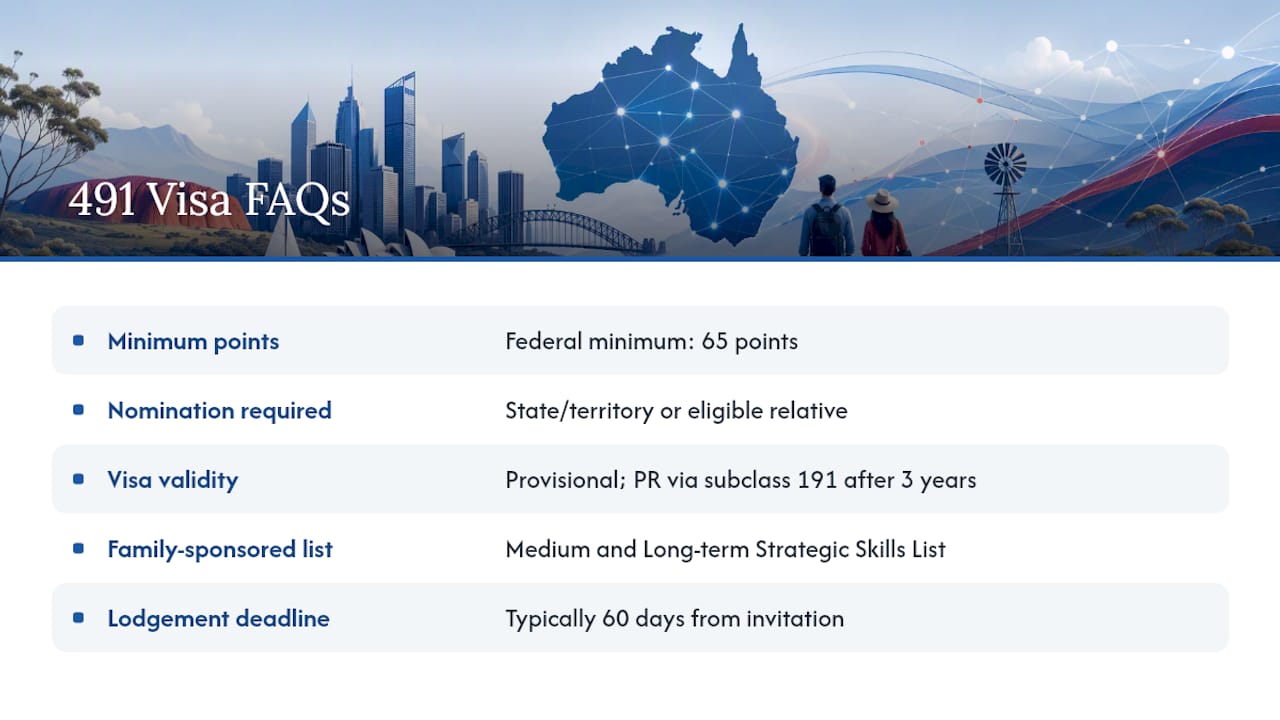
The federal minimum is 65 points, including the nomination or sponsorship bonus points, though many occupations need higher scores to actually receive an invitation.
Can I apply for the 491 visa without a state nomination?
No. You need either a state or territory nomination or sponsorship from an eligible relative living in a designated regional area, since both provide the mandatory nomination or sponsorship bonus.
How long does the 491 visa remain valid?
It’s a provisional visa valid for a provisional period, and it can lead to permanent residency through subclass 191 after three years of qualifying regional residence and work.
Which occupation list applies to family-sponsored 491 applications?
Family sponsorship is limited to occupations on the Medium and Long-term Strategic Skills List, which is narrower than most state nomination occupation lists.
How soon after invitation must I lodge my 491 visa application?
You typically have 60 days from invitation to lodge a complete application, so prepare your documents before you submit your EOI or nomination request.
This article is general information, not a substitute for advice from a qualified lawyer. Consult a qualified legal professional about your own circumstances before acting on anything here.
Sources
- Skilled Work Regional (Provisional) visa (subclass 491)
- Skilled Work Regional (Provisional) visa (subclass 491) — Live in Melbourne
- Skilled workers living in New South Wales (onshore) — NSW Government
- Skilled Work Regional (Provisional) visa (subclass 491) — Migration SA