


You need a skills assessment if you’re applying for a points-tested visa like the Skilled Independent (subclass 189), Skilled Nominated (190), or Skilled Work Regional (491), or for many employer-sponsored streams. It’s a mandatory checkpoint that verifies your qualifications and work experience meet the competency standard for your nominated occupation, and you need a positive result before you can lodge an Expression of Interest.
Here’s what to do right now, before you fill out another form:
- Find your ANZSCO code. Every occupation on Australia’s skilled lists has one, and it determines which authority assesses you.
- Identify your assessing authority. VETASSESS, Engineers Australia, ACS, TRA, AITSL, and ANMAC each cover different occupations. Guessing wrong wastes months.
- Check the occupation lists on Home Affairs before you commit to a nomination, because the authority and the visa pathway both hinge on this.
Pro Tip: Don’t assume your job title tells you which body assesses you. Two people with the same title in different industries can fall under different assessing authorities, so always confirm using the occupation’s actual ANZSCO code, not the name on your payslip.
Key Takeaways
A positive skills assessment from the correct authority, built on evidence that matches your occupation’s exact ANZSCO skill level, is the gatekeeper for most points-tested Australian visas.
| Point | Details |
|---|---|
| Confirm your authority first | Match your ANZSCO code to the right body (VETASSESS, TRA, Engineers Australia, ACS, AITSL, or ANMAC) before gathering documents. |
| Mind the Date Deemed Skilled | VETASSESS only counts employment after this date towards points, so document your career timeline precisely. |
| Fees and timelines vary by authority | TRA lists — for its Migration Skills Assessment; other authorities publish separate fee schedules. |
| Act fast if refused | TRA allows a 28-day review window; request written reasons before deciding on a review or new application. |
| Get support when the stakes are high | Fewa Education & Migration offers occupation mapping and evidence review to strengthen your application before you lodge. |
Table of Contents
- Which Assessing Authority Covers Your Occupation?
- How Do You Apply for a Skills Assessment?
- What Documents and Eligibility Rules Actually Matter?
- What Do Fees and Processing Times Actually Look Like?
- What Happens if Your Skills Assessment Gets Refused?
- What Applicants Consistently Get Wrong
- How Fewa Can Help With Your Skills Assessment
- Sources
Which Assessing Authority Covers Your Occupation?
Australia doesn’t run one central skills assessment body. Instead, the government designates specific organizations to assess specific occupation groups, and each one has its own criteria, application system, and turnaround time.
VETASSESS handles the largest slice of the skilled occupation list, covering most professional, managerial, and general skilled occupations that don’t have a dedicated authority. Trades Recognition Australia (TRA) assesses trade occupations through its Migration Skills Assessment (MSA) program, everything from electricians to chefs. Engineers Australia assesses engineering occupations exclusively. The Australian Computer Society (ACS) covers ICT roles like software engineers and network specialists. AITSL assesses teachers, and ANMAC handles nursing and midwifery.
| Authority | Occupations covered |
|---|---|
| VETASSESS | Most professional and managerial occupations |
| TRA | Trade occupations (documentary MSA program) |
| Engineers Australia | Engineering occupations |
| ACS | ICT and computing occupations |
| AITSL | Teaching occupations |
| ANMAC | Nursing and midwifery |
The Department of Home Affairs publishes the occupation lists that tie each ANZSCO code to its correct authority, but you should always confirm directly on the assessor’s own site.
Pro Tip: Use each authority’s “nominate an occupation” or occupation search tool and write down the exact ANZSCO code it returns. Mis-nomination is one of the most common, and most avoidable, reasons applications stall.
How Do You Apply for a Skills Assessment?
The process follows a similar shape no matter which authority you’re dealing with, though the details shift.
- Confirm your occupation and authority. Use the assessor’s occupation search tool to lock in your ANZSCO code.
- Gather your documents. Qualifications, transcripts, employment references, licenses, and certified translations where needed.
- Create an account and lodge online. TRA uses the TRA Online Portal; VETASSESS runs its own online application system.
- Pay the assessment fee. Applications typically aren’t processed until payment clears.
- Wait for the outcome, and respond quickly if the assessor requests clarification.
Being “decision-ready” means submitting everything the first time, correctly. That includes clear scans (not photos), certified translations for any non-English document, employment letters that spell out duties, dates, and pay, and every mandatory field completed before you hit submit.
TRA’s Migration Skills Assessment guidelines describe it as a documentary-based program, meaning assessors compare your paperwork against Australian standards rather than testing you directly. VETASSESS works similarly for most professional occupations, though some pathways (particularly trades) can involve a practical or technical interview component depending on the occupation.

Pro Tip: Scan documents in the order the checklist lists them, and name each file clearly. Assessors process thousands of applications, and a disorganized submission slows your own case down before anyone even reads it.
What Documents and Eligibility Rules Actually Matter?
Assessors aren’t just checking that you have a degree or a trade certificate. They’re checking whether your qualification sits in a field genuinely relevant to your nominated occupation, and whether your work experience matches the skill level ANZSCO assigns to that job.
VETASSESS compares your qualification against the Australian Qualifications Framework (AQF) and requires that qualification to be in a “highly relevant” field, not just adjacent to it. It also sets what’s called a Date Deemed Skilled, the point from which your employment starts counting toward points. Employment before that date generally doesn’t count, which surprises a lot of applicants who assumed their whole career would be credited.
Employment also has to be genuinely paid and full-time. VETASSESS defines full-time as at least 20 hours a week, and part-time or unpaid work generally won’t count toward your assessment.
Your document checklist should cover:
- Qualification certificates and full academic transcripts
- Apprenticeship completion records, if applicable
- Employment references detailing duties, dates, hours, and pay
- Relevant licenses or professional registrations
- Certified translations for anything not in English
What Do Fees and Processing Times Actually Look Like?
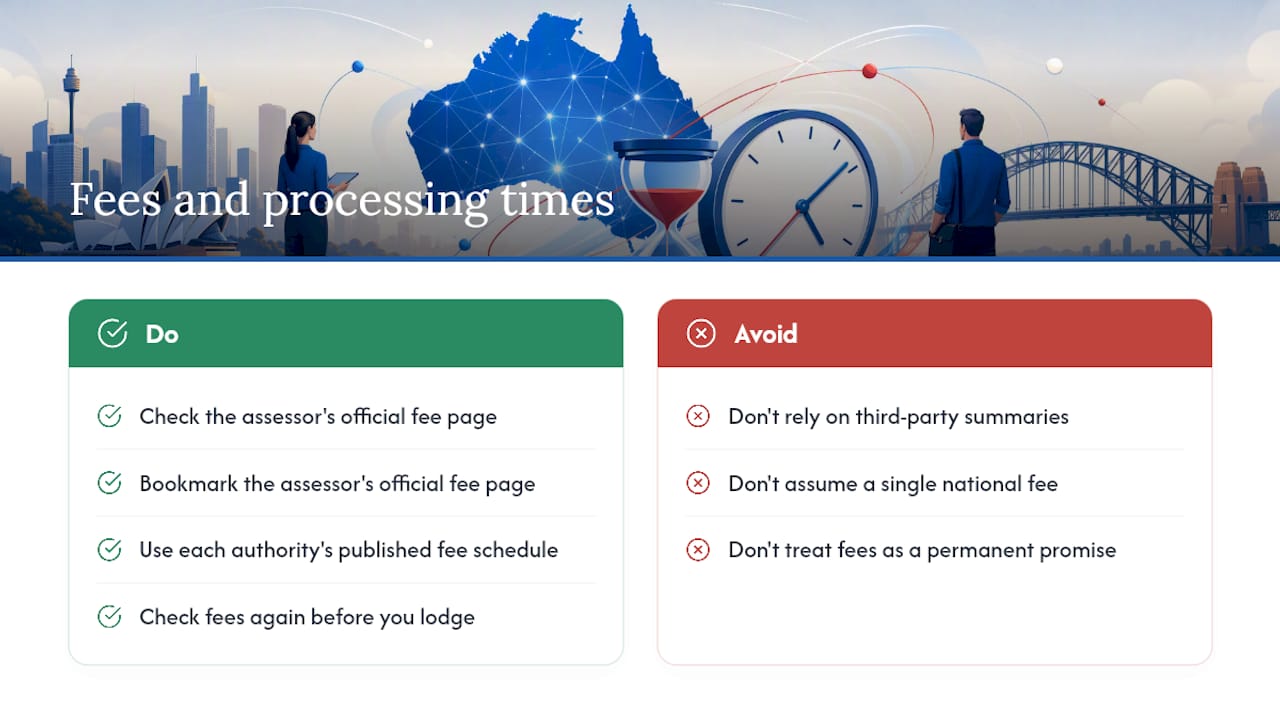
There’s no single national fee for a skills assessment. Each authority sets its own charges and its own timeframe, which means the “how much” question only has an honest answer once you know which authority applies to you.
Those TRA figures come straight from its applicant guidelines, but treat them as a snapshot, not a promise, since fees do get revised over time.
VETASSESS, Engineers Australia, ACS, AITSL, and ANMAC each publish their own fee schedules and processing windows on their own sites, and those are the only numbers you should ever rely on when budgeting your application. Bookmark the assessor’s official fee page rather than a third-party summary, and check it again shortly before you lodge.
What Happens if Your Skills Assessment Gets Refused?
A refusal isn’t the end of the road, but it does put you on a clock. TRA gives applicants a 28-day window to request a review of an unfavorable outcome, and other authorities publish similar timeframes on their own sites.
- Request the written reasons for refusal if they weren’t detailed enough to act on.
- Identify the gap, whether it’s a qualification relevance issue, missing employment evidence, or an ANZSCO skill-level mismatch.
- Decide between a review and a fresh application. A review challenges the original decision; a new application lets you submit stronger evidence or reconsider your nominated occupation.
- Speak with a MARA-registered migration agent if the case involves visa strategy, not just paperwork.
Pro Tip: A review only works if you’re correcting an assessor’s error or adding evidence you already had. If your actual employment doesn’t match the occupation’s skill level, a different occupation nomination is usually the faster path forward.
What Applicants Consistently Get Wrong
The single biggest mistake isn’t a missing document. It’s nominating an occupation that sounds close to your real job but doesn’t match the ANZSCO description’s actual duties. Assessors look for depth of task, not job titles, and a reference letter that lists responsibilities in vague terms gives them nothing to work with.
The fix is almost always the same: rewrite your employment references so duties map directly onto the ANZSCO major tasks for your occupation, attach pay evidence that backs up full-time paid status, and get translations done properly rather than informally. Small edits here, made before you lodge, change how an assessor reads your entire file.
How Fewa Can Help With Your Skills Assessment
Getting the occupation nomination right the first time saves months, and that’s exactly where a MARA-registered consultancy earns its fee. Fewa Education & Migration works through occupation mapping, evidence review, and application lodgement support so your file goes to VETASSESS, TRA, or whichever authority applies already shaped the way assessors actually read it, not the way you assumed they would.
That includes coordinating certified translations for non-English documents, a step our partner at CertiTranslate handles for clients who need NAATI-certified copies turned around quickly. Fewa also helps applicants strengthen employment references before lodging, which matters most when your Date Deemed Skilled or ANZSCO skill-level match is borderline. If you’re unsure which authority covers your occupation or your last application came back unsuccessful, book a consultation through Fewa’s skilled migration service page and get a second set of eyes on your case before you spend another fee lodging blind.
Sources
Confirm your requirements directly on Home Affairs and your assigned assessor’s portal, including current ANZSCO codes and AQF comparability guidance, before submitting anything.
This article is general information, not a substitute for advice from a qualified lawyer. Consult a qualified legal professional about your own circumstances before acting on anything here.
- Skills assessment – Smart Move Australia
- Nominate an occupation | VETASSESS
- Migration Skills Assessment Applicant Guidelines | Trades Recognition Australia
- Skills assessment | Department of Home Affairs
Recommended
- Why Study in Australia? Key Things to Know Before Moving to Australia – Fewa Consultancy
- Understanding Work Rights in Australia for International Students – Fewa Consultancy
- New English Language Tests Accepted for Australian Visas – Fewa Consultancy
- Immigration Skilled Occupation List Australia 2025 – Fewa Consultancy