


A certified copy is a photocopy that an authorised person has signed, dated and confirmed matches the original document. The Department of Home Affairs accepts certified copies for most ImmiAccount lodgements, so in the vast majority of cases you won’t need to hand over an original at all. Some assessing authorities, like certain skills assessors or overseas registration bodies, still want originals or an apostille, so it always pays to check before you certify anything.
TL;DR:
- Most visa documents can be certified by Justice of the Peace, solicitor, police officer, or migration agent, but the certifier must be current and authorized.
- Every page of a multi-page document must be numbered and signed or initialed by the certifier, who must physically sight the original in person.
- Certified copies require a proper statement, certifier’s details, and a signed, clear scan; digital photos or blurry copies lead to rejection.
- Offshore applicants should use embassy, consular, notary, or apostille certification, and always include an accurate, signed NAATI translation for documents not in English.
- Checking the certifier’s registration, authenticating the original, and verifying specific document requirements with authorities can prevent delays or rejections.
Table of Contents
- What counts as a valid certified copies visa document?
- Who can certify documents for a visa in Australia?
- How do you get documents certified for a visa, step by step?
- Overseas certification: missions, notaries and apostilles
- Do certified copies need translations for a visa?
- Why do certified copies get rejected, and how do you avoid it?
- How Fewa Education & Migration helps with certified documents
- What I’d tell a friend before they certify anything
- Official pages to check before you certify or lodge
- Sources
- FAQ
What counts as a valid certified copies visa document?
A certified copy only works if the certifier has actually done their job properly. The Australian Taxation Office sets out exactly what a valid certification statement needs, and Home Affairs applies the same standard to visa evidence. Get any element wrong and your certified copies visa documents can be knocked back at the worst possible moment, mid-application.
A properly certified page includes:
- A written statement confirming it’s a “true and correct copy of the original document sighted by me”
- The certifier’s full name, printed clearly (not just a signature)
- Their occupation or role (Justice of the Peace, solicitor, police officer, and so on)
- A contact phone number or address
- A registration or licence number, where their profession has one
- The date of certification
For multi-page documents, the certifier needs to number every page (think “Page 3 of 12”) and sign or initial each one, not just the front page. Every certification must cover both sides of a document if the reverse carries information, such as a driver’s licence. None of this works from a phone photo. The certifier has to physically sight the original in person; a digital image on a screen doesn’t meet the standard, no matter how clear it looks.
Who can certify documents for a visa in Australia?
Australia doesn’t have one single “certifying authority”. Instead, a defined list of professionals can certify copies, and each one takes on legal responsibility for confirming the copy is genuine. Justice Victoria and equivalent departments in other states publish the accepted categories, which typically include:
- A Justice of the Peace (JP)
- A solicitor or other legal practitioner
- A registered migration agent (must quote their MARN and confirm their registration is current, since a suspended MARN can’t legally certify anything)
- A police officer
- A medical practitioner
- A bank officer with sufficient years of continuous service
- A NAATI-accredited translator (for certifying translated documents specifically)
Finding a JP is usually straightforward. Most public libraries, courts and Australia Post outlets keep local JP registers, and many states run a “find a JP” search tool online. If you’re using a registered migration agent, you can verify their MARN is current and not under suspension before you rely on their certification.
Certifiers can, and sometimes do, refuse. If your photocopy is blurry, if pages are missing, or if they simply can’t get a clear look at the original, they’re within their rights to say no. Don’t take it personally. Fix the copy quality, bring the actual original, and try again with someone else if needed.
How do you get documents certified for a visa, step by step?
Getting this right the first time saves you weeks of back and forth with Home Affairs or an assessing body. Work through it in order:
- Photocopy every page clearly, front and back where relevant, and number each page before you go anywhere near a certifier.
- Bring both the originals and the copies to your chosen certifier. They need the original in hand to compare against.
- Ask them to write the full statement confirming they’ve sighted the original, along with their name, role, contact details and registration number.
- Get every page signed or initialled, not just the first one, especially for anything longer than a couple of pages.
- Scan the certified copy itself, not the original document, when you upload to ImmiAccount. The scan needs to show the certifier’s stamp, signature and statement clearly.
- Post originals only when specifically instructed. Most visa pathways never require this; some assessing bodies still do.
- Get three or four certified copies of your key documents in one sitting rather than one. Skills assessors, employers and Home Affairs may each want their own copy, and going back to a JP every time something new comes up wastes time you don’t have close to a deadline.
Pro Tip: Book your certification appointment before you start filling in visa forms, not after. Running out of time to get a JP appointment is one of the most common, and most avoidable, causes of last-minute lodgement stress.
Overseas certification: missions, notaries and apostilles
If you’re outside Australia, the Australian High Commission or nearest consulate can certify your documents, though most require a booked appointment and charge a consular fee. This is often the safest route for offshore applicants, because Home Affairs explicitly recognises consular certification.
Other overseas options include:
- A local notary public, which many countries accept as equivalent to Australian certification
- An apostille from your country’s competent authority, if that country is party to the Hague Apostille Convention, which streamlines recognition across member countries
- Combining embassy certification with a NAATI-accredited translation when the original is in another language
If you must post original documents back to Australia, always use a tracked courier service. Losing an original passport or birth certificate in the regular mail turns a simple certification job into a genuine crisis.
Do certified copies need translations for a visa?
Any document not in English needs a NAATI-accredited translation attached to the certified copy, not instead of it. The translator provides their own signed declaration confirming the translation is accurate and complete, along with their NAATI credential number.
In practice, this means submitting two linked pieces: the certified copy of the original-language document, and the certified NAATI translation stapled or scanned alongside it. A birth certificate issued in Nepali, for example, needs the certified original copy plus a separately certified NAATI translation into English before Home Affairs will accept it as valid evidence.
Why do certified copies get rejected, and how do you avoid it?
Most rejections come down to a handful of repeat mistakes, all fixable before you ever hit submit. Certifying a phone photo or screen image instead of a physical copy is one of the most common, since the certifier legally has to sight a real original in person. Poor-quality photocopies where text is cut off or blurred cause the same problem.
Other frequent errors include:
- Missing the certifier’s contact number or registration details
- Leaving later pages of a multi-page document unsigned or uninitialled
- Forgetting to number pages on longer documents
- Using a certifier whose registration has lapsed or been suspended
Run through this checklist before you submit anything: every page numbered, every page signed, certifier details complete, and the scan taken from the certified copy itself. A request for further evidence over a certification technicality can add weeks to your processing time, delay you can usually avoid entirely with a five-minute check before lodgement.
How Fewa Education & Migration helps with certified documents
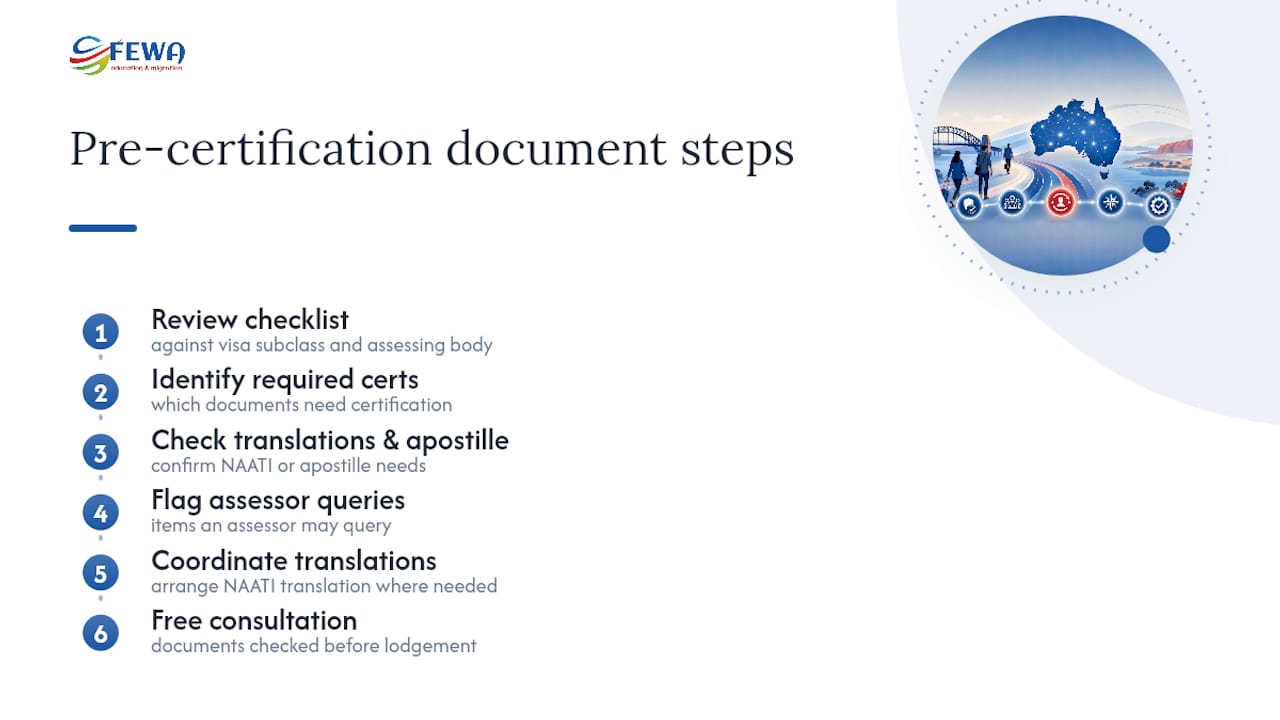
Our advisers can review your document checklist against the exact requirements of your visa subclass and the relevant assessing body before you certify anything. That review typically covers which documents genuinely need certification, whether a NAATI translation is required, and whether an apostille applies to your situation.
A document review engagement usually means going through your evidence list line by line, flagging anything an assessor is likely to query, and coordinating translation where needed. If you’re preparing a skilled migration visa application or working through the visa services process more broadly, a short consultation before you start certifying can save several trips back to a JP. Book a free consultation to have your documents checked before you lodge.
What I’d tell a friend before they certify anything
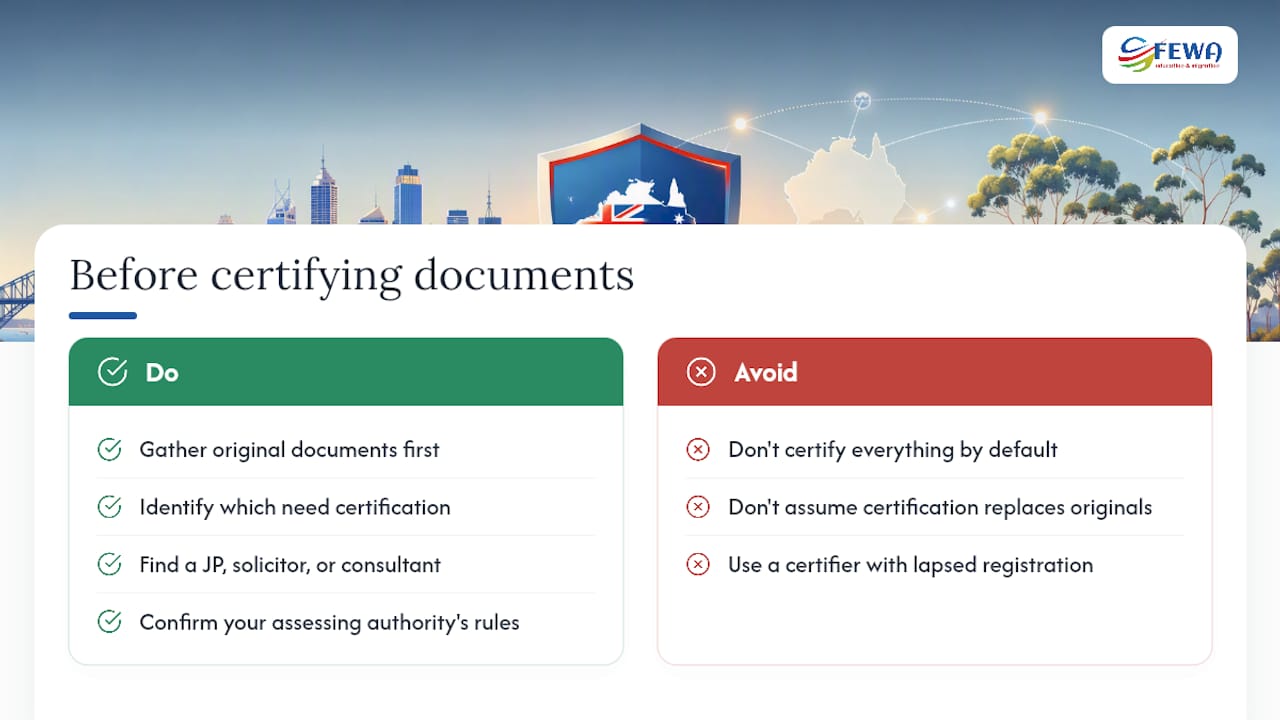
Certified copies work for almost every visa pathway through Home Affairs, and most people overthink this step far more than it deserves. The part that actually trips applicants up isn’t the concept, it’s the fiddly detail: page numbering, initialling every sheet, making sure the certifier’s registration hasn’t lapsed.
Start by gathering your originals and working out which documents genuinely need certification, not everything does. Find a JP or solicitor near you, or get in touch with a migration consultancy service if you’d rather have someone check your list first. Either way, confirm your specific assessing authority’s rules before you book that appointment. Some genuinely do want an original, and no amount of certification fixes that.
— Ronit
Official pages to check before you certify or lodge
- Home Affairs guidance on certified copies for ImmiAccount lodgement rules
- ATO identity document guidance on approved certifiers
- Justice Victoria’s certified copies page for state-based certifier lists
- MARA guidance on migration agents certifying documents
Sources
- Certified copy – Immigration and citizenship
- Copies of identity documents for applicants in Australia | Australian Taxation Office
- Certified copies of original documents | Department of Justice and Community Safety Victoria
- Certifying documents (MARA guidance)
FAQ
Who can do certified copies in Australia?
Justices of the Peace, solicitors, police officers, medical practitioners, bank officers with five or more years’ service, and registered migration agents with a current MARN can all certify documents in Australia.
How do I get a certified copy of my passport in Australia?
Bring your original passport and a clear photocopy of the relevant pages to an authorised certifier, who will sight the original and sign a statement confirming the copy matches it.
Is a certified copy as good as an original?
For most Australian visa lodgements through ImmiAccount, yes. Home Affairs accepts certified copies in place of originals, though some assessing bodies request originals or apostilles.
What counts as a certified copy of ID?
A valid certified ID copy needs the certifier’s signed statement, printed name, role, contact details, registration number where applicable, and the date, confirming they sighted the original document in person.