


Nursing means hands-on clinical care under AHPRA registration; social work means psychosocial casework and advocacy without national statutory registration. If you’re drawn to physical assessment, medication and shift-based patient care, nursing fits. If you’re wired for counselling, systems navigation and long-term advocacy, social work fits. The detail on study, pay and daily demands below will help you settle which one matches how you actually want to spend your working week.
TL;DR:
- Nursing requires three years of study and includes clinical placements, while social work demands four years of study with approximately 1,000 unpaid placement hours.
- Nurses must register with AHPRA to practice legally, whereas social workers rely on AASW accreditation without a national registration scheme.
- Nursing work involves physical shift work in clinical settings, while social workers focus on psychosocial assessment, advocacy, and long-term case management.
- Salaries are broadly comparable, but social workers often benefit from salary packaging, and both professions see high demand in areas like aged care, mental health, and community services.
- Both careers carry significant burnout risks, with nurses facing physical fatigue and social workers experiencing emotional exhaustion from complex cases.
Table of Contents
- Nursing vs social worker: a quick side-by-side comparison
- What nurses do: tasks, roles and specialisations in Australia
- What social workers do: assessment, counselling and advocacy
- Education, placements and getting registered or accredited
- Work settings and how each career progresses
- Pay, demand and job outlook for nurses and social workers
- Burnout, stress and the emotional weight of each career
- How to choose between nursing and social work: your practical checklist
- Getting guidance: Ronit and Fewa Education & Migration
- A personal view on choosing a people-facing career
- Turning your career decision into a study or visa plan
- Sources
- FAQ
Nursing vs social worker: a quick side-by-side comparison
Before you commit three or four years of study to either path, it helps to see the basics stacked up against each other. Both careers sit in the “people-facing” bracket, but they diverge fast once you look at regulation, workplace, and what a Tuesday actually looks like.
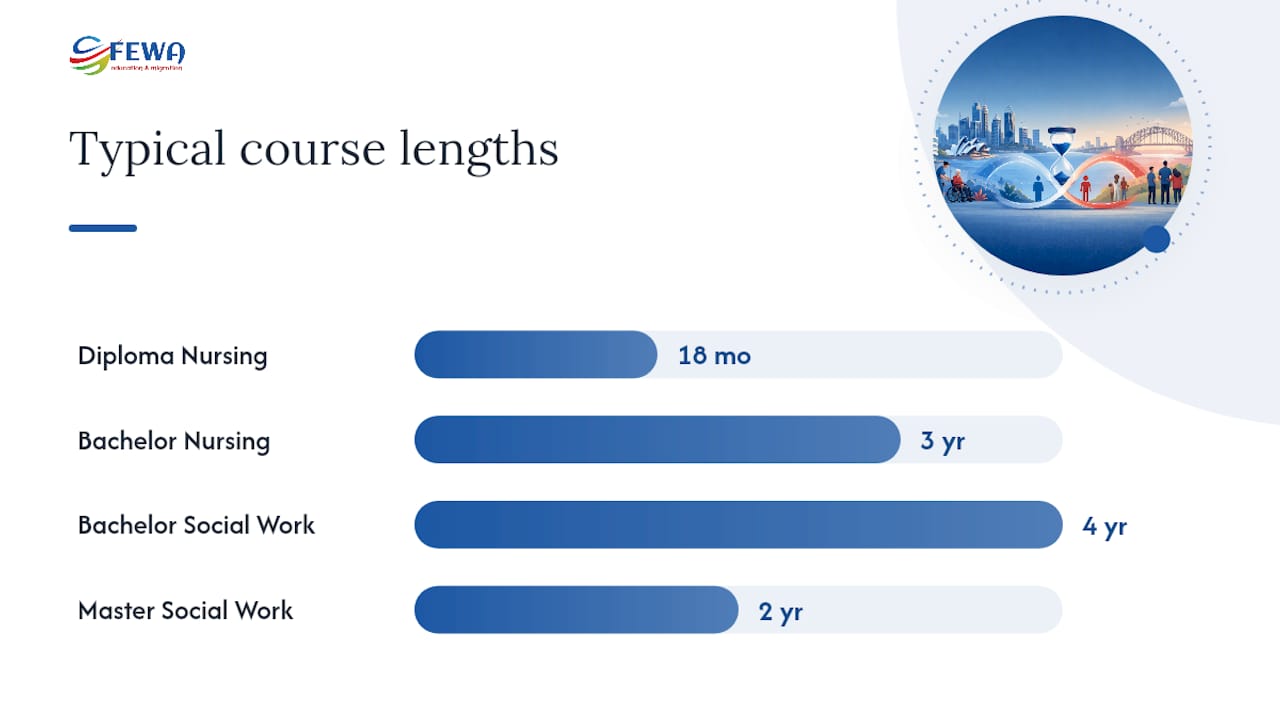
- Study length: Nursing typically runs three years (Bachelor of Nursing) or 18 months for a Diploma leading to Enrolled Nurse status; social work runs four years undergraduate or two years as a Master’s for career changers with a prior degree.
- Placement hours: Nursing degrees include clinical placement blocks throughout the course; social work degrees commonly require around 1,000 hours of supervised placement, usually unpaid.
- Regulation: Nurses must register with AHPRA to practise legally; social workers have no equivalent national scheme, but the Australian Association of Social Workers (AASW) accreditation is what most employers actually check.
- Common workplaces: Hospitals, aged care facilities and community health clinics for nurses; child protection agencies, NDIS providers, hospitals and community organisations for social workers.
- Pay bands: Broadly comparable, though sector and location shift both figures meaningfully, covered in detail further down.
- Demands: Nursing carries physical shift-work strain and clinical risk; social work carries emotional load from case complexity and, often, less predictable hours.
Neither path is objectively “easier.” They ask different things of you, which is exactly why the comparison matters more than the label.
What nurses do: tasks, roles and specialisations in Australia
Nursing is task-dense and physical. A registered nurse (RN) assesses patients, administers medication, dresses wounds, monitors vital signs, and makes clinical judgement calls that can shift within minutes. Scope of practice differs by registration level: Enrolled Nurses (ENs) work under supervision and within a narrower clinical scope, while RNs carry independent accountability for patient assessment and care planning. Nurse practitioners, a further postgraduate step, can prescribe medication and order diagnostic tests in ways ENs and standard RNs cannot.
Specialisation is where nursing careers really branch out. Medical and surgical nursing covers general hospital wards. Mental health nursing blends clinical care with de-escalation and psychiatric assessment, sitting closer to social work’s emotional terrain than most other nursing streams. Aged care nursing deals with chronic disease management and end-of-life care over long relationships with the same residents. Community nursing takes clinical skills out of the hospital and into people’s homes. Midwifery is its own registration pathway entirely, focused on pregnancy, birth and postnatal care.
Shift work defines the lived experience of nursing more than almost anything else. Rosters commonly include nights, weekends and public holidays, and hospital nurses work as part of a multidisciplinary team, coordinating constantly with doctors, allied health staff and social workers on discharge planning. Typical employers span public hospitals, private hospitals, residential aged care, general practice clinics and disability service providers, giving nursing graduates one of the widest employment footprints of any health qualification in Australia.
What social workers do: assessment, counselling and advocacy
Social work centres on the person within their whole system, not just a presenting clinical issue. A social worker’s core functions are psychosocial assessment, counselling, referral coordination, advocacy and, at senior levels, policy influence. Where a nurse treats a wound, a social worker might be working out why a client keeps missing medical appointments, then addressing housing instability, financial stress or family conflict sitting underneath that pattern.
Practice areas vary widely. Child protection work involves statutory intervention, court reports and high-stakes family assessments. Mental health social work runs alongside clinical teams in hospitals and community mental health services, focusing on recovery planning and social supports rather than diagnosis. NDIS-related roles have grown into one of the largest employers of social workers, helping participants navigate plans, funding categories and service coordination. Aged care social work supports transitions into residential care and family mediation around end-of-life decisions. Refugee and settlement services lean heavily on cultural competency and trauma-informed practice.
It’s worth distinguishing social workers from social service workers. A social worker typically holds an AASW-accredited degree and handles complex casework, court-related reports and clinical-adjacent counselling. A social service worker often holds a shorter vocational qualification (a Diploma, for instance) and provides frontline support, such as case coordination or community outreach, under a social worker’s broader oversight. The two roles overlap in daily tasks but differ in qualification depth and case complexity.
Social workers interact constantly with health services without being part of the clinical team themselves. In hospitals, they run discharge planning, family liaison and psychosocial risk assessment alongside nurses and doctors, which is exactly why the two careers so often get compared. NSW Health workforce guidance notes rising demand for these hospital-based social work roles, driven partly by NDIS reforms and an ageing population needing more coordinated aged care transitions.
Education, placements and getting registered or accredited
The qualification pathways for these two careers look similar on paper, three to four years of study, but the regulatory endpoint is completely different.
Nursing:
- Diploma of Nursing (around 18 months) leads to Enrolled Nurse registration.
- Bachelor of Nursing (three years) leads to Registered Nurse registration.
- Postgraduate routes (Master of Nursing, Nurse Practitioner programs) extend scope further.
- All practising nurses must hold current AHPRA registration, a legal requirement, not an optional credential.
Social work:
- Bachelor of Social Work (four years) is the standard entry point.
- Master of Social Work (Qualifying), typically two years, suits career changers with an unrelated undergraduate degree.
- AASW accreditation of your specific degree program is what employers check, since Australia has no national statutory registration scheme for social workers.
- Degrees require roughly 1,000 hours of supervised placement, split across at least two placement blocks in different settings.
That placement figure deserves attention on its own. A thousand unpaid hours is a genuine financial strain for students juggling rent, part-time work or family responsibilities, and it’s a common reason mature-age career changers underestimate how disruptive a social work degree will be to their income during study. Nursing placements are shorter individually but spread across the entire course, which softens the cash-flow hit but stretches out over more semesters.
Work settings and how each career progresses
Nurses commonly work in public and private hospitals, aged care residences, general practice, and increasingly in community and telehealth roles. Social workers cluster in government departments (child protection, housing), NDIS providers, hospitals, schools and non-government organisations delivering family and community services.
Progression looks different too. Nursing career ladders usually run through clinical specialisation (critical care, perioperative, mental health), then into nurse unit management or nurse practitioner status, which requires further postgraduate study. Social work progression often moves toward senior casework, program management, policy roles within government, or, after several years’ experience, private practice offering individual counselling or court-related assessment work.
Sector choice affects far more than title. A hospital nursing role means structured shifts and award-based pay; a private aged care employer might offer more predictable hours but different penalty rates. Government social work roles tend to follow health award scales, while NFP roles often trade a slightly lower base salary for salary packaging benefits, and private practice social work opens the highest earning ceiling but with none of the security of a salaried position.
Pay, demand and job outlook for nurses and social workers
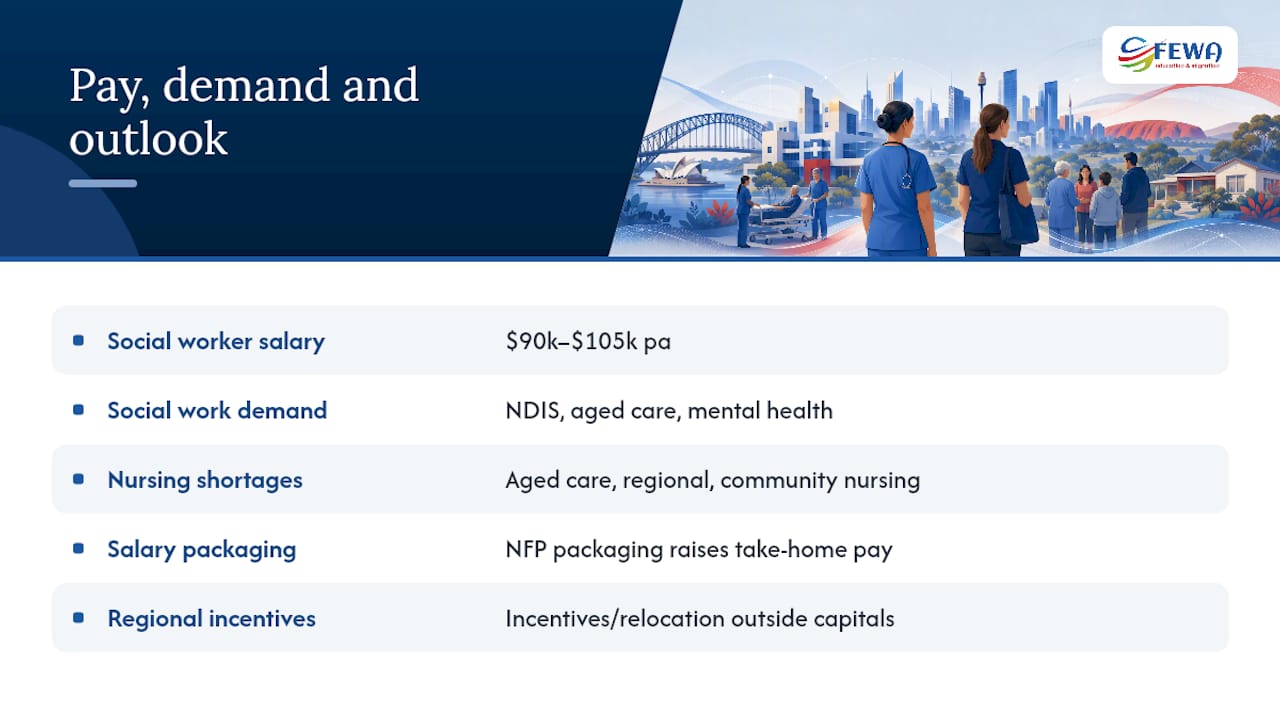
Advertised social worker salaries in Australia commonly sit between $90,000 and $105,000 annually, with meaningful variation by sector and state. Government and health-award roles tend to sit toward the lower end of that band; private practice and some corporate roles push higher.
Statistic snapshot: Jobs and Skills Australia projects strong ongoing growth for social work occupations, driven heavily by NDIS expansion, aged care reform and mental health service demand. Nursing faces comparable workforce pressure from the opposite direction: persistent shortages across aged care, regional hospitals and community nursing keep vacancy rates high across most states.
The salary packaging point is easy to miss but genuinely changes the comparison. Not-for-profit employers, common for social workers in community services, can offer packaging that lifts effective take-home pay well above the advertised base salary, sometimes closing much of the gap with higher-paying government or private roles. Regional and rural areas in both professions often carry incentive payments or relocation support, since workforce shortages tend to bite hardest outside metro Sydney and other capital cities.
Demand isn’t evenly spread. Child protection, NDIS coordination and aged care are consistently the highest-demand areas for social workers, while aged care, mental health and regional community nursing show the sharpest shortages for nurses.
Burnout, stress and the emotional weight of each career
Both careers carry genuine burnout risk, but the drivers differ. Nurses face physical fatigue from rotating shifts, understaffing on wards, and the cumulative weight of clinical decision-making under time pressure. Mental health nurses in particular report some of the highest burnout rates in the profession, given constant exposure to acute psychiatric crises alongside standard clinical workload.
Social workers carry a different kind of load: emotional exhaustion from prolonged exposure to trauma, complex family situations and, in child protection especially, decisions with life-altering consequences for the people involved. It’s often described as deeply purpose-driven work, and satisfaction surveys back that up, but that fulfilment sits alongside real emotional intensity that doesn’t switch off at knock-off time.
Both professions lean on structured supports to manage this: clinical supervision (mandatory in most social work roles), employee assistance programs, and increasingly, formal workload management policies in hospitals and community organisations.
Pro Tip: Before enrolling, ask a working professional in each field one specific question: “What does a bad day actually look like?” Their answer will tell you more about fit than any prospectus.
How to choose between nursing and social work: your practical checklist
- Assess your working style. Do you want fast, physical, task-based work (nursing) or slower-moving, relationship-driven casework (social work)?
- Ask about placement structure. Get specifics from any course provider on placement hours, whether they’re paid, and how placement blocks fit around part-time work.
- Ask about graduate outcomes. Request actual graduate employment data from the university, not just marketing claims.
- Map your finances. Budget for unpaid placement time, especially the 1,000-hour social work requirement, before you enrol.
- Consider migration relevance early. If you’re studying in Australia on a student visa, check how your chosen occupation lines up with skilled migration pathways before you lock in a course.
Getting guidance: Ronit and Fewa Education & Migration
This comparison draws on workforce data and regulatory detail to give you a straight answer, not a sales pitch. Fewa Education & Migration, registered with MARA, works with students and skilled migrants choosing between courses like nursing and social work, particularly where a skills assessment or visa pathway is part of the decision. If you’re weighing course accreditation against migration timelines, that’s exactly the kind of paperwork and planning Fewa reviews with clients before enrolment.
A personal view on choosing a people-facing career
Nursing suits people who want clear, immediate feedback: you fix the wound, the vitals stabilise, you see the result today. Social work suits people who can sit with unresolved problems for months or years and still find the work meaningful. Neither is more noble than the other, despite how each gets romanticised.
My honest advice: don’t choose based on the label. Choose based on whether you’d rather manage a crisis in the next ten minutes or navigate one over the next ten months. And whatever you pick, check the accreditation and placement structure of your specific course before you enrol, not after.
— Ronit
Turning your career decision into a study or visa plan
Once you’ve settled on nursing or social work, the next hurdle is usually paperwork: course accreditation, English-language test scores, and, for many students, a visa strategy that actually lines up with the occupation you’re targeting. Consultancy services can help you avoid piecing this together yourself course by course and form by form. Rather than researching AASW accreditation rules, skills assessment processes and student visa conditions separately, you get one consultation covering all three.
Fewa’s coaching services help with PTE and IELTS preparation, both commonly required for nursing and social work course entry or AASW assessment. For study-to-migration planning, Fewa’s visa services cover everything from student visas through to skilled migration once you’ve qualified. You may book a consultation to review course options, English test requirements, and what a realistic timeline looks like from enrolment to registration.
Sources
- Why social workers are needed more than ever in Australia
- Protecting our most vulnerable: does Australia need a social worker registration scheme?
- Social workers — Jobs and Skills Australia occupation profile
- Social work placements and practicum (Charles Sturt University)
FAQ
Is social work a good career choice in Australia?
Yes, for people suited to advocacy and casework: Jobs and Skills Australia projects strong growth, driven by NDIS expansion, aged care reform and mental health demand, with advertised salaries commonly between $90,000 and $105,000.
Which nurse has the highest burnout rate?
Mental health nurses tend to report some of the highest burnout rates in nursing, largely due to constant exposure to acute psychiatric crises combined with standard ward workload pressures.
What are the disadvantages of nursing?
Shift work, including nights, weekends and public holidays, physical fatigue, understaffing on wards, and high-stakes clinical decision-making under time pressure are the main downsides reported across the profession.
Does Australia have a shortage of social workers?
Yes. Demand consistently outstrips supply in child protection, NDIS coordination and aged care, and Jobs and Skills Australia data points to continued growth in these areas over coming years.