


Yes, OSHC is mandatory for most Student visa (subclass 500) holders in Australia. You need to buy it from an authorised OSHC insurer, make sure the policy dates cover your entire visa period, and keep your membership certificate ready for your visa application. Skip any of these steps and your visa application or your access to medical care can suffer.
TL;DR:
- OSHC must be purchased from one of six authorized insurers and kept active for the entire duration of the student visa, including any extensions.
- The minimum coverage typically includes general practitioner visits, hospital treatment, diagnostic tests, ambulance transport, and certain pharmaceuticals, but excludes dental, optical, and physiotherapy.
- Students must align their OSHC start and end dates with their visa period and renew before lapsing, especially during course or visa extensions.
- Fewa offers services to verify OSHC compliance with visa dates, prevent gaps, and assist with renewals amid course or visa changes.
- Allowing OSHC to lapse or using non-authorized providers risks claim denial and visa compliance issues, as most students are ineligible for Medicare.
Table of Contents
- What does the OSHC requirement actually cover?
- Who can sell OSHC in Australia?
- How do you buy OSHC and what documents do you need?
- What mistakes put your OSHC compliance at risk?
- Ronit’s notes from Fewa: common student cases and quick checks
- What the checklist misses
- If you need help, Fewa can check your OSHC and visa evidence
- Sources
- FAQ
What does the OSHC requirement actually cover?
The Department of Home Affairs sets OSHC as a condition of the Student visa (subclass 500), and it applies to you and any dependants listed on your visa for as long as your visa runs. This isn’t a box to tick once. Your cover has to stay active from the day you arrive until the day your visa ends, and you’ll need to show evidence of it when you apply for the visa itself.
Think of OSHC as a safety net for the medical bills you didn’t see coming, not a health membership that pays for everything. A basic policy protects you against the costs that can genuinely wreck a student budget: a hospital stay, emergency surgery, or an ambulance ride you never planned on.
The minimum OSHC policy typically covers:
- GP visits and consultations
- Inpatient hospital treatment and surgery
- Blood tests, X‑rays, and other diagnostic services
- Ambulance transport in most states
- A limited range of prescription pharmaceuticals
What it won’t cover is just as important to know upfront. Dental work, optical care, and physiotherapy usually sit outside the standard policy, so if you wear glasses, need ongoing physio, or are prone to dental issues, look at an Extras add-on or private supplementary cover. Policy pricing and structure also shift depending on your family status. Insurers price single, couple, single-parent, and family policies differently, so a partner or child travelling with you changes what you’ll pay and what the policy needs to include.
Who can sell OSHC in Australia?
Not every insurer can offer this product. Only insurers that are party to the Australian Government’s Deed for the Provision of Overseas Student Health Cover are legally permitted to sell you OSHC, and that Deed sets the rules they have to follow on policy types, obligations, and minimum benefits. If you’re offered “student health cover” from a provider outside this list, it isn’t OSHC and it won’t satisfy your visa condition.
Six insurers currently hold Deed status and can sell you OSHC:
- ahm
- Allianz Care Australia (Peoplecare)
- BUPA Australia
- CBHS International Health
- Medibank Private
- NIB
Each offers a basic policy that meets the visa minimum, plus optional Extras or comprehensive tiers for things like dental and physio. Many universities have preferred-provider arrangements with one of these six, which can simplify enrolment and sometimes brings perks like waived waiting periods for certain conditions. You’re not locked into your university’s pick, though. You can choose any Deed insurer, but check waiting periods carefully before switching, since some benefits reset if you move providers without transferring your history correctly.
How do you buy OSHC and what documents do you need?
Buy your OSHC before you fly, not after you land. The policy’s start date has to line up with your arrival and cover the full length of your visa, including any gap between when your course starts and when your visa was granted.
You’ve got three main ways to purchase it:
- Directly from the insurer — go straight to one of the six Deed insurers and buy online.
- Through an education agent — many agents, including Fewa, can arrange OSHC alongside your visa paperwork.
- Through your university — check if they have a preferred-provider arrangement, which can streamline enrolment and sometimes reduce waiting periods for existing conditions.
Whichever route you take, keep these documents on hand for your visa application and for any future dealings with your insurer:
- Your OSHC policy certificate or purchase receipt
- Your membership number
- The insurer’s contact details
- Clear start and end dates matching your visa period
If you extend your course or change your visa, renew or extend your OSHC before the old policy lapses, not after.
Pro Tip: Don’t wait for your current policy to expire before renewing for a visa extension. Confirm with your insurer that cover extends immediately on payment, so there’s no gap between your old and new visa periods.
What mistakes put your OSHC compliance at risk?
The single biggest misunderstanding among new arrivals is assuming Medicare will cover them, a misconception clarified on the Burrell College listing about Australian healthcare eligibility. It generally won’t. As a Privatehealth resource makes clear, most international students aren’t eligible for Medicare, which makes OSHC your primary cover for billing and claims from day one.
Letting your policy lapse or fall into arrears carries real consequences. Your insurer can refuse to pay claims for treatment received during a lapse, leaving you to cover the full cost yourself, and prolonged gaps in cover put your visa compliance at risk with the Department of Home Affairs.
A handful of simple habits can prevent almost every compliance problem:
- Set a calendar reminder well before your renewal date, not on the day
- Use recurring payments so a missed manual transfer doesn’t cause a lapse
- Keep every receipt and certificate in one folder, digital or physical
- Confirm waiting periods with a new insurer before you cancel your existing policy
If you do miss a renewal or arrive without cover already active, contact your insurer immediately to reinstate it, and if the gap affects visa evidence you’ve already submitted, get migration advice without delay.
Ronit’s notes from Fewa: common student cases and quick checks
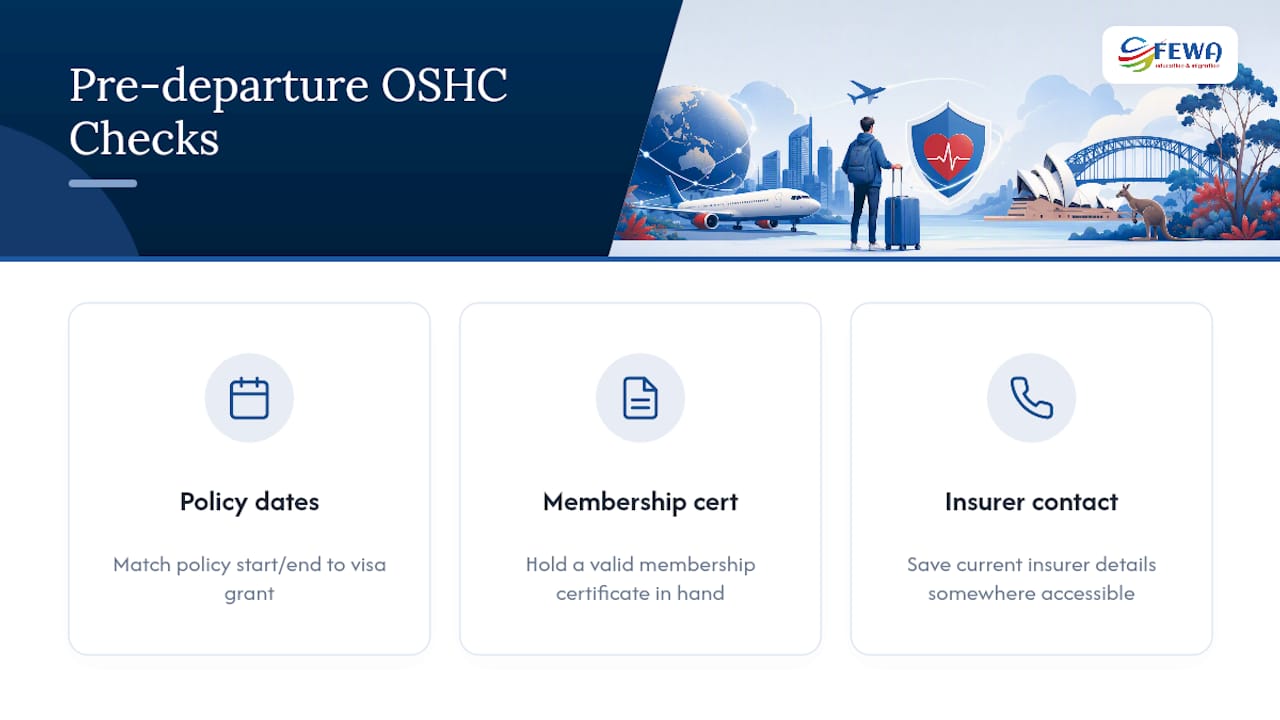
Before any client leaves for Australia, I run three quick checks: policy start and end dates against the visa grant, a valid membership certificate in hand, and current contact details for the insurer saved somewhere accessible, not just in an email buried in an inbox.
A common case involves students extending their course, often adding a second qualification, and forgetting their OSHC needs extending too. Some students have had gaps between their old policy’s expiry and their new visa grant. Contacting the insurer and backdating the renewal to the visa extension date, then resubmitting evidence can resolve compliance issues.
If your situation involves a course extension, a change of visa subclass, or dependants joining you partway through your studies, some consultancies offer a free initial check on your OSHC and visa evidence before anything becomes urgent.
What the checklist misses
Most OSHC guidance treats compliance as a one-off task: buy a policy, get your visa, forget about it. That’s the gap I see cause the most trouble. Your OSHC has to track your visa, not the other way around, and the moment those two timelines drift apart, usually through a course extension or a switch between providers, is exactly when students end up with a lapse they didn’t notice.

The conventional advice to “just buy the basic policy” also undersells how much family status and personal risk should shape your choice. A single student with no ongoing health needs can run comfortably on the minimum. A student with a partner, a child, or a known dental or vision issue is taking on real out-of-pocket risk by skipping Extras.
If you take one thing from this, prioritise the renewal date over the purchase date. Buying OSHC is the easy part. Keeping it aligned with every visa change afterwards is where compliance actually gets tested.
— Ronit
If you need help, Fewa can check your OSHC and visa evidence
Fewa is the alternative to sorting this out alone at 11pm before a visa deadline. Our student visa service includes checking your OSHC evidence against your actual visa dates, flagging gaps before they become refusals, and walking you through renewal when your course or visa changes.
You don’t need us to buy OSHC. You can go straight to any of the six authorised insurers and purchase a policy in minutes. Where Fewa adds value is in the parts that trip people up: matching your policy period exactly to your visa grant, preparing the right documentation for your application, and catching a lapse before it turns into a compliance problem with the Department of Home Affairs. If you’re unsure whether your current cover meets your visa condition, book a free initial consultation and we’ll check it against your actual visa dates before you submit anything.
Sources
For the primary rules, go straight to Study Australia’s OSHC guidance, the Department of Health and Aged Care’s OSHC fact sheet, PrivateHealth’s consumer page, and the Department of Home Affairs for visa condition enforcement.
- Overseas Student Health Cover (OSHC) | Study Australia
- Overseas Student Health Cover (OSHC) | PrivateHealth
FAQ
Is OSHC compulsory for all student visa holders?
Yes, OSHC is a condition of the Student visa (subclass 500) for the primary applicant and any dependants, and it must stay active for the full visa period.
Which insurers are authorised to sell OSHC?
Six insurers hold Deed status: ahm, Allianz Care Australia (Peoplecare), BUPA Australia, CBHS International Health, Medibank Private, and NIB.
Does OSHC cover dental and optical treatment?
No, the minimum OSHC policy generally excludes dental, optical, and physiotherapy, so students who need these should look at an Extras add-on.
Can I use Medicare instead of OSHC?
No, most international students aren’t eligible for Medicare, which makes OSHC your primary cover for medical and hospital costs while studying.
What happens if my OSHC lapses?
Your insurer can refuse claims for treatment received during the lapse, and a prolonged gap in cover can put your visa compliance at risk with the Department of Home Affairs.