


Yes, in Australia you can convert workplace skills into a nationally recognised qualification through Recognition of Prior Learning, but it’s an assessment process, not a shortcut. RPL is governed by the Australian Skills Quality Authority (ASQA) and the Australian Qualifications Framework, and it only works when your evidence proves competence. Start by checking a training organisation’s registration on training.gov.au, then book an initial consultation and begin building your evidence portfolio.
TL;DR:
- Recognition of Prior Learning requires substantial evidence proving competence, and it involves a formal assessment process governed by ASQA and the AQF.
- RPL assesses your actual skills through an interview and portfolio review, unlike credit transfer, which only recognizes previously certified qualifications without reassessment.
- The process includes verifying an RTO’s registration, building an evidence portfolio, and potentially undergoing practical checks, with timing heavily dependent on evidence quality.
- Valid, authentic, current, and sufficient evidence is crucial, with third-party reports and work samples offering the strongest support for demonstrated skills.
- Avoid providers that promise quick, assessment-free certificates or refuse to show qualification details, as genuine RPL assessment reflects actual workload and assessor expertise.
Table of Contents
- What RPL means under the AQF, and how it differs from credit transfer
- Who can apply, and when RPL might not be the right fit
- What does the RPL process actually look like, step by step?
- What evidence do you need, and what are the rules of evidence?
- How do you choose a legitimate RTO and avoid dodgy providers?
- What happens after your assessment, and can you appeal it?
- Practical help from a MARA registered consultancy: what a consultant actually adds
- How Fewa helps you prepare for RPL
- Where to verify everything yourself
- Sources
- FAQ
What RPL means under the AQF, and how it differs from credit transfer
RPL is a formal assessment method within the Australian Qualifications Framework (AQF) that lets a Registered Training Organisation (RTO) evaluate skills you’ve already got, whether you picked them up on the job, through informal training, or overseas, against the requirements of a nationally recognised unit or qualification. It sits inside the vocational education and training (VET) sector, and every RTO delivering it must follow the Standards for RTOs and the Principles of Assessment.
RPL and credit transfer often get confused, but they work differently:
- RPL assesses your actual demonstrated competence against unit requirements, usually through a portfolio and an assessor interview.
- Credit transfer simply recognises a unit or qualification you’ve already completed and had certified, with no new assessment involved.
- RPL suits people with real workplace skills but no paper trail; credit transfer suits people who already hold the paperwork.
Who can apply, and when RPL might not be the right fit
Anyone with formal, informal, or on-the-job learning that matches a unit of competency can apply, whether that experience came from a trade, a supervisory role, or years of hands-on practice without a ticket to show for it.
RPL isn’t always available, though:
- Some licensing or regulatory rules (particularly in safety-critical trades) require supervised practical assessment rather than a paper-based RPL pathway.
- Certain training packages explicitly restrict RPL for specific units, especially where safety outcomes depend on observed, real-time performance.
- Most RTOs need you to enrol or submit initial documentation before the RPL process formally begins, so budget time for that admin step.
If your industry is heavily regulated, ask your prospective RTO directly whether the qualification you want even permits RPL before you invest hours building a portfolio.
What does the RPL process actually look like, step by step?
Applicants consistently underestimate how much preparation RPL takes. It follows five structured stages, and knowing them upfront saves you from wasted effort:
- Select your qualification and verify the RTO’s scope. Confirm on training.gov.au that the provider is actually registered to deliver and assess that specific qualification.
- Initial consultation and self-assessment. You’ll usually complete a checklist mapping your experience against unit requirements, so the RTO can gauge whether RPL is realistic for you.
- Build your evidence portfolio. This is the heaviest stage, gathering documents, samples, and third-party statements that map directly to each unit’s elements and performance criteria.
- Assessor interview and practical checks. A qualified assessor questions you on your evidence and may observe a practical demonstration to confirm authenticity.
- Assessment decision. You’ll get a competency outcome. If gaps show up, most RTOs offer supplementary or “gap” training rather than a flat rejection.
Timing depends on how complete your evidence is walking in. A well-organised applicant with clean records can move through relatively quickly; someone starting from scratch on documentation might take considerably longer.
Pro Tip: Don’t wait for the assessor interview to think about your evidence gaps. Ask the RTO for the unit’s performance criteria early and map your documents against each one before you submit anything.
What evidence do you need, and what are the rules of evidence?
Assessors work from four tests: your evidence needs to be valid (it actually proves the skill), authentic (it’s genuinely yours), current (it reflects your skills now, not a decade ago), and sufficient (there’s enough of it to cover every element of the unit).
Acceptable evidence typically includes:
- Work samples, photographs, or video of completed tasks
- Third-party reports or references from supervisors and clients
- Performance records, logbooks, and safety or quality checklists
- Existing licences, tickets, or prior assessment records
- Assessor observation during a practical demonstration
Third-party verification carries real weight here. A supervisor’s signed statement confirming you performed a task to standard is far stronger than your own written account of the same task. Weak evidence usually looks like a single undated photo with no context, or a certificate from a course with no assessment component behind it.
Where units are clustered within a qualification, ask your RTO early whether related units can be assessed together. It cuts down on duplicating evidence across nearly identical unit requirements.
How do you choose a legitimate RTO and avoid dodgy providers?
Start with training.gov.au. It’s the national register, and it will tell you whether a provider is actually authorised to assess the qualification you’re after, not just whether it exists as a business.
Before signing anything, ask the RTO for its RPL policy in writing, the credentials of the assessor who’ll review your case, and a sample of what assessment documentation looks like. A properly run RTO should have no hesitation showing you this, because ASQA auditors expect the same documented policies and support strategies on file.
Watch for these red flags:
- Guaranteed or “assessment-free” certificates, or promises of results within days
- Refusal to show you the RPL policy or assessor qualifications
- Unregistered providers or offshore-only operators with no verifiable Australian presence
- Prices that seem too low for the assessment work actually involved
The government has been explicit about this risk: shortcuts that skip genuine assessment can jeopardise your employment outcomes and, for some applicants, your visa standing. If you’re weighing up a skills assessment alongside RPL, the same red flags apply.
On cost, expect a non-refundable application fee plus a per-unit assessment charge. What pushes the total up is the number of units you’re claiming, how much evidence-mapping support you need, and whether gap training gets added on afterwards.
Pro Tip: A provider that quotes you a single flat fee for “the whole qualification” without asking a single question about your experience first is worth a second look. Genuine RPL pricing tracks the actual assessment workload, not a blanket rate.
What happens after your assessment, and can you appeal it?
A successful outcome gets recorded as either individual competency units, a statement of attainment, or, if you’ve covered the whole qualification, the full certificate itself, and it goes on your official student record exactly like any other completed training.
For overseas students, RPL outcomes can affect reported course duration, so check with your RTO how any granted credit interacts with your visa conditions before you rely on it.
If you disagree with an assessment decision, every RTO must have a documented appeals process, use it first. If concerns go beyond a single decision, ASQA accepts complaints through its official channels.
Practical help from a MARA registered consultancy: what a consultant actually adds
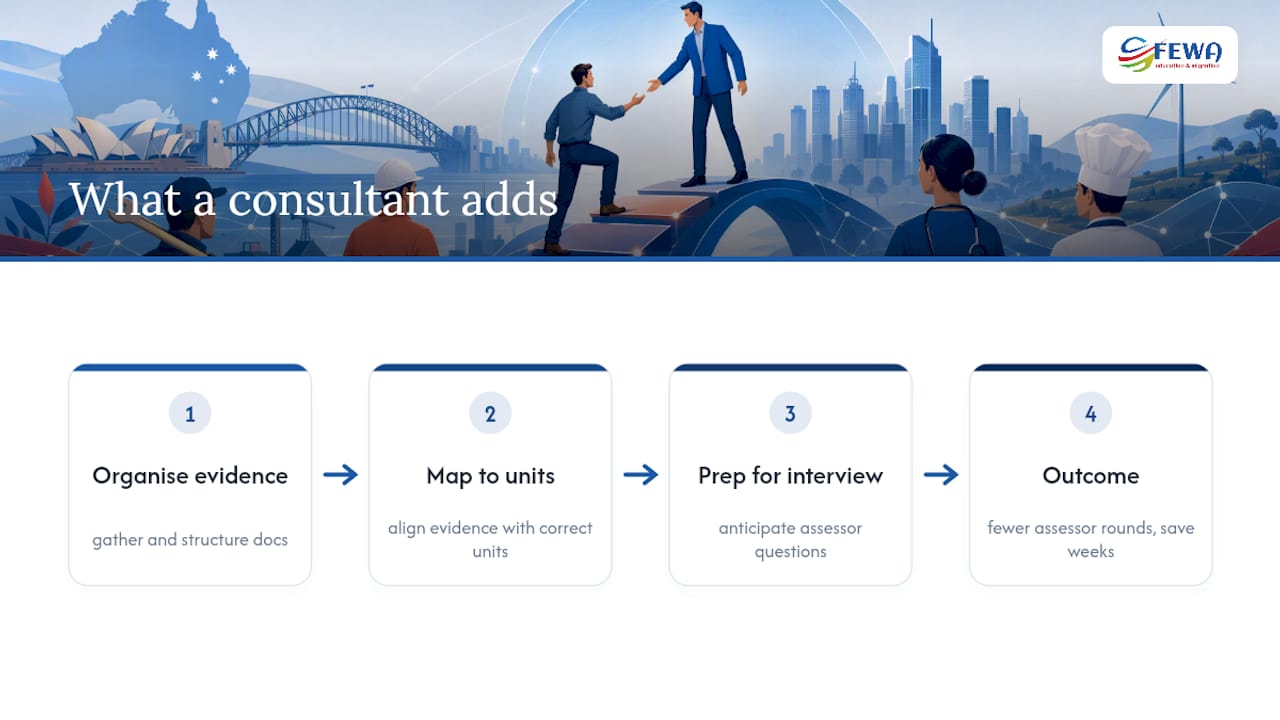
A consultant doesn’t assess your competence, the RTO does that, but a good one organises your evidence, maps it against the right units before you submit anything, and preps you for the assessor interview so you’re not caught out on questions you should have anticipated.
The most common issue we see isn’t a lack of skill. It’s applicants submitting evidence that’s technically real but poorly mapped, forcing a second or third round with the assessor. Structured preparation up front, speeding the evidence mapping process rather than the assessment itself, cuts that back-and-forth substantially. It won’t replace the RTO’s judgement, but it can save you weeks.
— Ronit
How Fewa helps you prepare for RPL
A consultancy can assist with RPL by helping you prepare a portfolio that meets assessment requirements, but the assessment itself is always conducted by an RTO. Consultants can help you choose a qualification pathway, map your work history against unit requirements, and prepare you for the assessor interview to optimize your chances.

If your RPL outcome is part of a bigger plan, feeding into a skilled migration visa or a broader study and settlement strategy, that’s exactly where our advice earns its keep, because a qualification that doesn’t align with your visa pathway can cost you more time than starting from scratch. Book a free initial consultation through our coaching services and let’s work out whether RPL is the right move before you spend a dollar on assessment fees.
Where to verify everything yourself
Check any RTO’s registration and scope directly on Training, the national register for qualifications and providers. ASQA’s RPL guidance and reporting channels cover provider complaints, the AQF’s RPL page explains credit and recordkeeping, the Department of Employment and Workplace Relations outlines national RPL policy, and Western Australia’s RPL fact sheet breaks down the process stage by stage.
Sources
- Recognition of Prior Learning (ASQA)
- Fact sheet: Recognition of prior learning
- Recognition of Prior Learning (Department of Employment and Workplace Relations)
- Recognition of prior learning (AQF)
FAQ
Is RPL recognised in Australia?
Yes. RPL is a formal assessment pathway under the AQF, and any qualification or statement of attainment awarded through it carries the same national recognition as one earned through classroom study. It’s regulated by ASQA, so the qualification only holds up if the RTO assessing you is properly registered for that specific course.
How much does it cost to get an RPL in Australia?
Costs vary by RTO and by how many units you’re claiming, typically a non-refundable application fee plus a per-unit assessment charge. Current pricing isn’t standardised across providers, so ask your chosen RTO for a written quote based on your actual evidence and unit count before committing.
How do you get an RPL certificate in Australia?
You select a qualification, confirm the RTO’s registration on training.gov.au, complete an initial self-assessment, then build and submit a portfolio of evidence mapped to each unit’s requirements. An assessor reviews your portfolio, often through an interview or practical check, before issuing a statement of attainment or full qualification.
Which RPL provider is best in Australia?
There’s no single “best” provider, the right RTO depends on your industry, the qualification you need, and whether that RTO’s scope on training.gov.au actually covers it. What matters more than a provider’s marketing is whether they can show you a documented RPL policy, qualified assessors, and honest timelines, red flags include guaranteed or assessment-free certificates. A consultancy like Fewa can help you shortlist and prepare for a legitimate RTO rather than choosing the fastest-sounding option.