
Yes, most F and M student visa applicants must pay the I-901 SEVIS fee before their visa interview, and the standard amount is US$350. The quickest route from Australia is to pay online at fmjfee.com with a credit or debit card, then printing the confirmation immediately. You’ll need to present that printed receipt at your visa interview, so don’t skip the print step.
TL;DR:
- Paying the SEVIS fee online via fmjfee.com is the fastest method, requiring exact personal and SEVIS details to avoid delays.
- Payment verification takes at least three business days, so applicants should not schedule their visa interview before this period finishes.
- For Australian applicants, paying with a credit or debit card is generally straightforward, but they must inform their bank to prevent transaction blocks.
- Errors like mismatched SEVIS IDs or misspelled names can be fixed by email, but delayed corrections may impact visa processing or travel plans.
- Preparing and double-checking all details, including printing two receipts, reduces common mistakes that often delay visa issuance.
Table of Contents
- What you need from your I-20 or DS-2019 before paying
- How to pay the SEVIS fee from Australia
- How long verification takes and printing your receipt
- Fixing errors, duplicate payments, and transfers
- Consultant perspective: what trips students up most
- Get your SEVIS payment and visa paperwork checked before you interview
- Sources
- FAQ
What you need from your I-20 or DS-2019 before paying
You can’t complete Form I-901 without your Certificate of Eligibility in hand. Whether that’s an I-20 (for F and M students) or DS-2019 (for J exchange visitors), it holds every reference number the payment form demands.
Before you open fmjfee.com, gather these details from the document:
- Your SEVIS ID number, found at the top of the I-20 or DS-2019, usually starting with “N0000” followed by digits.
- Your school or program’s SEVIS code, listed next to the institution’s name.
- Your full legal name exactly as printed on your passport, plus date of birth and country of citizenship.
- Your current mailing address, which fmjfee.com uses for its records, not for posting anything back to you.
If a parent, agent, or your school is paying on your behalf, they need the same SEVIS ID, name, and date of birth as it appears on your I-20 or DS-2019. Mismatched spelling between the payment form and your document is one of the most common causes of processing delays, so double check before submitting. Third-party payment is accepted, but the person paying by credit card may face extra verification steps, so it’s worth confirming their card will work before relying on it.
How to pay the SEVIS fee from Australia
You have three official ways to pay, and which one suits you depends on what you’re carrying: a working international credit card, cash for a Western Union agent, or patience for a mailed money order.
- Pay online at fmjfee.com. Fill out Form I-901 with your SEVIS ID, school code, and personal details exactly as they appear on your I-20 or DS-2019. The site accepts Visa, Mastercard, and American Express issued by Australian banks in most cases. Once payment clears, print the confirmation page straight away. Don’t rely on receiving anything by post.
- Pay by Western Union Quick Pay. You still have to complete Form I-901 online first to generate a payment coupon with a control number. Take that printed coupon to a participating Western Union branch, hand over the cash equivalent in Australian dollars, and keep the receipt they give you alongside your original coupon.
- Pay by mail. Print the payment coupon from fmjfee.com, attach an international money order or a US dollar check payable to “I-901 Student/Exchange Visitor Processing Fee,” and post it to the address on the coupon. This is the slowest option and rarely makes sense if your interview date is close.
Not every Western Union outlet in Australia offers Quick Pay, and availability varies by location, so ring ahead or check the Western Union locator before you commit to this method over paying by card.
Pro Tip: Call your Australian bank before paying online and tell them to expect an international transaction in US dollars. Overseas card blocks are one of the most avoidable reasons a SEVIS payment fails on the first attempt, and reversing a false decline can cost you a full day.
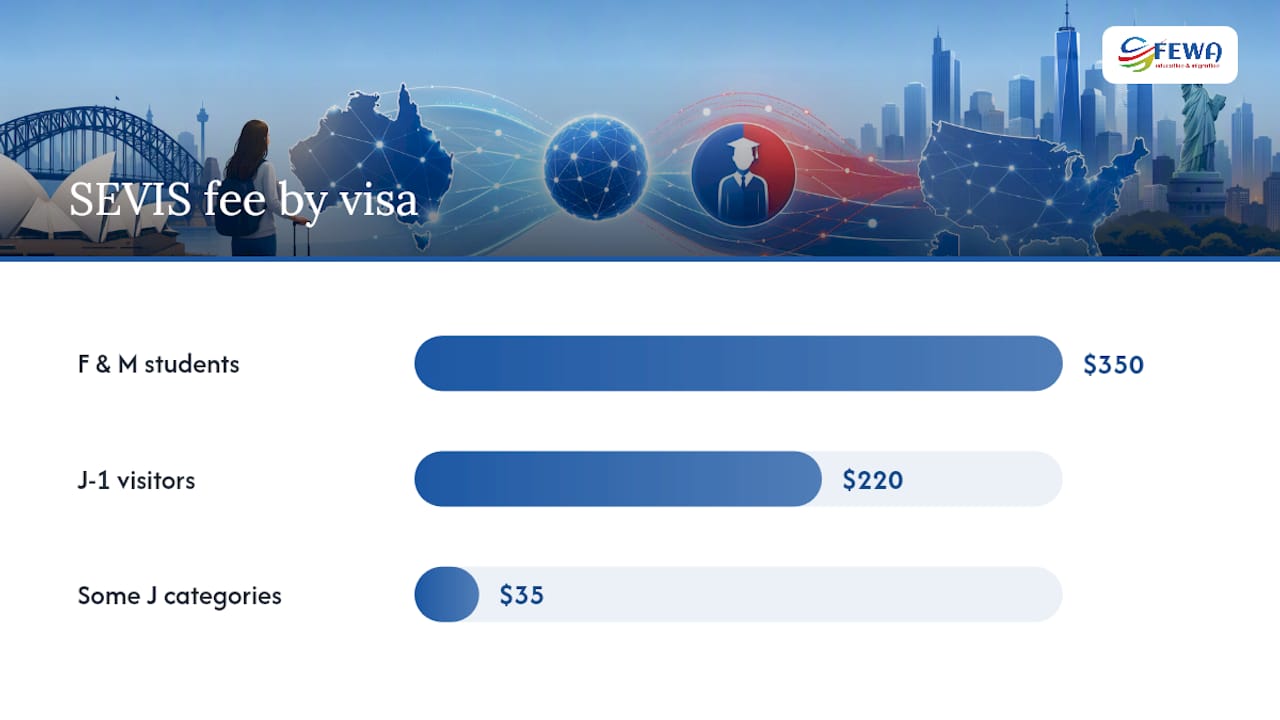
Most F and M students pay the flat US$350 fee, while most J-1 exchange visitors pay $220, and some exchange categories sit at $35 or are exempt altogether. Check your visa classification against the fee chart before assuming the amount, since paying the wrong figure creates its own correction headache.
How long verification takes and printing your receipt
Once you’ve paid online, give it time. SEVP advises allowing at least three business days for your payment to be received and verified before booking or attending a consular interview.
Your printed confirmation from fmjfee.com is the official proof of payment now, replacing the mailed I-797C receipt applicants once relied on. Keep both a digital copy and a printed one:
- Reprint your receipt anytime at fmjfee.com by entering your SEVIS ID, last name, and date of birth.
- Bring the printed confirmation to your visa interview, and keep a second copy for port of entry.
- If the SEVIS ID on your receipt doesn’t match your I-20 or DS-2019, don’t attend your interview assuming it’ll sort itself out. Email fmjfee.sevis@ice.dhs.gov before your appointment.
Under 8 CFR §214.13, the fee must be paid before visa issuance or a port-of-entry decision, so a verification delay caused by rushing the payment can genuinely push your travel plans back.
Fixing errors, duplicate payments, and transfers
Payment problems are fixable, but only if you act on them rather than hoping a visa officer will sort it out on the day.
- Wrong SEVIS ID or misspelt name: email fmjfee.sevis@ice.dhs.gov with your receipt number, the correct details, and a copy of your I-20 or DS-2019 attached.
- Duplicate payment: check your fmjfee.com records first, then request a refund or a transfer to a different SEVIS record through the same email address, explaining which payment should stand.
- No response after a reasonable wait: contact the SEVP Response Center, which will ask for your SEVIS ID, payment date, and receipt number to track down the record.
- Terminated SEVIS record or a complicated correction: this is where it’s worth getting professional eyes on your file rather than guessing, particularly if your interview is close and a simple email fix won’t resolve it in time.
Consultant perspective: what trips students up most
The mistakes I see most often aren’t complicated. A student types their SEVIS ID with a transposed digit, pays days before an interview instead of a week out, or their card gets blocked mid-transaction because their bank flagged an unfamiliar US charge. Each one is preventable with five minutes of preparation.
Before booking your interview, confirm your SEVIS ID matches your I-20 character for character, pay at least a week ahead, and print two copies of your receipt. A MARA-registered education and migration consultancy often assists students with these checks to help prevent payment errors from delaying their visa applications; for example, this guide to changing your visa status in the UAE offers useful insights for students managing multinational plans.
— Ronit
Get your SEVIS payment and visa paperwork checked before you interview
Some education and migration consultants offer document checks and payment confirmation reviews to help applicants avoid SEVIS ID mismatches or declined card issues before their interview.
We offer document checks, payment troubleshooting support, and a free consultation for students preparing US study visa applications from Australia. If you’re also managing dependents on the same application, we handle student dependent visa queries alongside your own paperwork. Book time with our team through the student visa page and get your SEVIS payment and interview documents reviewed before you commit to a date.
Sources
Confirm every figure and instruction against the primary source before you rely on it:
This article is general information, not a substitute for advice from a qualified lawyer. Consult a qualified legal professional about your own circumstances before acting on anything here.
FAQ
How can I pay for my SEVIS fee?
You can pay online at fmjfee.com with a credit or debit card, by Western Union Quick Pay after generating a coupon online, or by mailing an international money order or US dollar check. Online card payment is the fastest option for students paying from Australia.
How much is the SEVIS fee payment?
Most F and M students pay US$350, while most J-1 exchange visitors pay $220, with some exchange categories at $35 or exempt. Check your visa classification against the official fee chart, since the amount depends on your program type, not a flat rate for everyone.
Where do I pay the SEVIS fee for an F-1 visa?
F-1 students pay through fmjfee.com, the official payment portal linked to Form I-901. This replaced older paper-based receipts, so the printed confirmation from fmjfee.com is now your only proof of payment for the visa interview.
How long does SEVIS fee verification take?
Allow at least three business days after paying online before your visa interview, giving the system time to verify and register your payment. If your SEVIS ID doesn’t match your I-20 or DS-2019 once verified, contact fmjfee.sevis@ice.dhs.gov before your appointment date.
Can someone else pay my SEVIS fee for me?
Yes, a parent, sponsor, or school can pay on your behalf using your SEVIS ID and personal details exactly as they appear on your I-20 or DS-2019. Third-party card payments sometimes face extra verification, so confirm the payer’s card details are ready before starting the transaction.