


Scholarships in Australia for international students fall into three main categories: government-funded awards like Australia Awards, university-administered research grants like the RTP, and provider-based merit scholarships that cut tuition fees. Start your search on Study Australia’s scholarship tool, check DFAT’s country pages if you’re eligible for Australia Awards, and keep your visa evidence in mind from day one.
TL;DR:
- Most scholarships in Australia are partial, covering tuition only, so students must budget for living costs, transport, and health cover separately.
- Australia Awards are highly competitive, require a commitment to return home post-study, and have strict application timelines separate from university admission cycles.
- The Research Training Program funds research-based postgraduate students but depends on university admissions before eligibility is determined.
- Finding and applying for scholarships involves checking course registration on CRICOS, monitoring country-specific opening dates, and preparing documents early.
- Visa evidence must align with scholarship timing, and applicants should demonstrate comprehensive financial capacity beyond scholarship support to meet Genuine Student requirements.
Table of Contents
- Types of scholarships you can apply for in Australia
- How to find and apply for scholarships in Australia
- Eligibility, visa implications and evidence you must prepare
- Managing funding gaps: budgeting and alternative funding options
- Research Training Program (RTP) explained for prospective HDR students
- What Fewa sees in scholarship and visa planning
- How Fewa can help you apply with confidence
- Sources
- FAQ
Types of scholarships you can apply for in Australia
Not every scholarship suits every applicant, and knowing the difference early saves you weeks of wasted searching.
Australia Awards Scholarships sit at the top of the prestige ladder. They’re long-term, government-funded awards for students from participating developing countries, and they come with a catch most applicants don’t expect: you’re required to return home for a set period after finishing your studies. The 2027 intake opened on 1 February 2026 and closed on 30 April 2026, so timing matters more than almost anything else with this program.
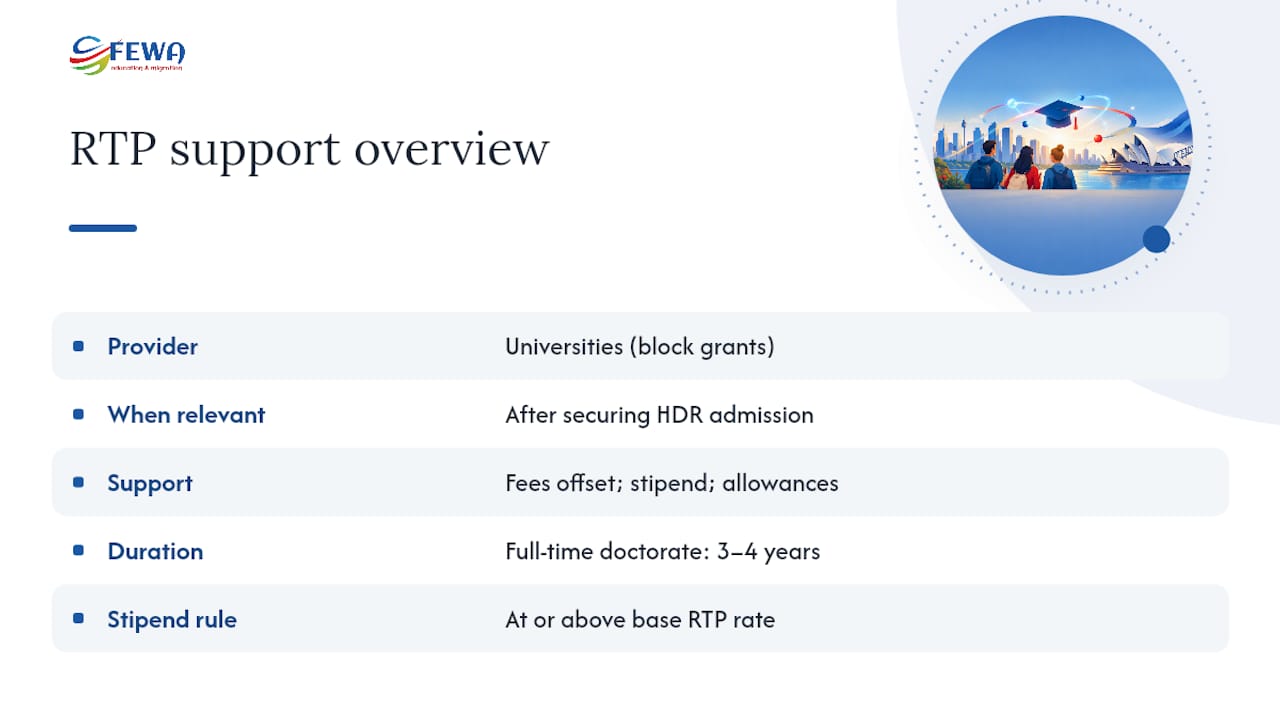
The Research Training Program (RTP) funds higher degree by research (HDR) students, meaning PhDs and research masters. Universities administer it themselves, and support typically includes fee offsets, stipends, and allowances rather than a single lump payment.
University and provider scholarships are the most accessible category for undergraduate and coursework masters students.
Beyond these three, look for:
- Destination Australia scholarships for regional campus study
- Country-specific bilateral awards (such as Australia-China scholarships)
- Private foundation grants tied to specific fields or nationalities
How to find and apply for scholarships in Australia
Finding the right scholarship opportunity in Australia is less about luck and more about working through the right channels in the right order.
- Search Study Australia and confirm your course on CRICOS. The Study Australia scholarship search lists more than a thousand awards across government, university, and private providers. Cross-check any course against CRICOS to confirm the provider is registered to teach overseas students, because a scholarship attached to an unregistered course won’t support your visa application.
- Check DFAT’s country profile if Australia Awards applies to you. DFAT publishes opening and closing dates by country, along with priority fields of study for each participating nation.
- Contact the right university office. For undergraduate and coursework scholarships, that’s the international office. For RTP, that’s the postgraduate research office, and you’ll want to ask about supervisor availability and quotas well before the deadline.
- Prepare your documents early. Transcripts, a CV, referee details, and (for HDR applicants) a research proposal all take time to assemble properly. Australia Awards applicants use the OASIS online system, which has its own quirks worth testing before the deadline crunch.
Pro Tip: Country-specific intake windows for Australia Awards can open and close months before general university deadlines. If you’re eligible, treat that date as your real deadline, not the university’s standard admissions cycle.
Eligibility, visa implications and evidence you must prepare
A scholarship offer doesn’t replace your visa evidence. It supports it, but only if you understand what the Genuine Student requirement actually asks for.
The Department of Home Affairs wants to see a coherent study plan that connects your course to your career goals back home, and a scholarship letter is one piece of that story, not the whole thing. Most scholarships only cover tuition, so you’ll usually still need to show you can fund your own living costs and Overseas Student Health Cover, even with an award in hand.
A few things catch applicants off guard:
- Australia Awards is restricted to applicants from participating countries and excludes intending migrants and Australian permanent residents, and awardees must return home for a minimum period after finishing.
- Your scholarship offer needs to line up with your Confirmation of Enrolment (CoE) before you lodge your visa, so timing the two together matters.
- Losing a scholarship partway through study can affect your ability to demonstrate ongoing financial capacity, so keep records updated.
Getting your financial capacity evidence right from the start avoids delays later, scholarship or not.
Managing funding gaps: budgeting and alternative funding options
Most scholarships in Australia are partial, not full-ride. That gap between what’s covered and what you’ll actually spend catches out even well-prepared students.
Rent, groceries, transport, OSHC, textbooks, and lab or studio fees rarely appear on a scholarship’s coverage list. If your award only covers tuition, you’re funding everything else yourself.
A few realistic options to close that gap:
- Part-time work under your student visa work rights, within the conditions attached to your visa
- University-specific bursaries or emergency hardship funds
- Home-country foundation grants that top up an Australian scholarship
- Short-term mobility grants for research trips or conference travel
Pro Tip: Build a three-month buffer into your budget before you land. Partial scholarships and deferred payments are common, and a gap of even a few weeks between arrival and your first stipend payment can catch you out.
Research Training Program (RTP) explained for prospective HDR students
RTP funding doesn’t come from a central government pool you apply to directly. Universities receive block grants and decide who gets support, which means you need to secure HDR admission first before RTP becomes relevant at all.
Support can include a fees offset, a stipend, and allowances, and durations follow set guidelines: a full-time research doctorate typically runs a minimum of three years and a maximum of four. Stipend rates vary by university but must sit at or above the base RTP rate. Talk to the postgraduate research office and, ideally, a prospective supervisor early.
What Fewa sees in scholarship and visa planning
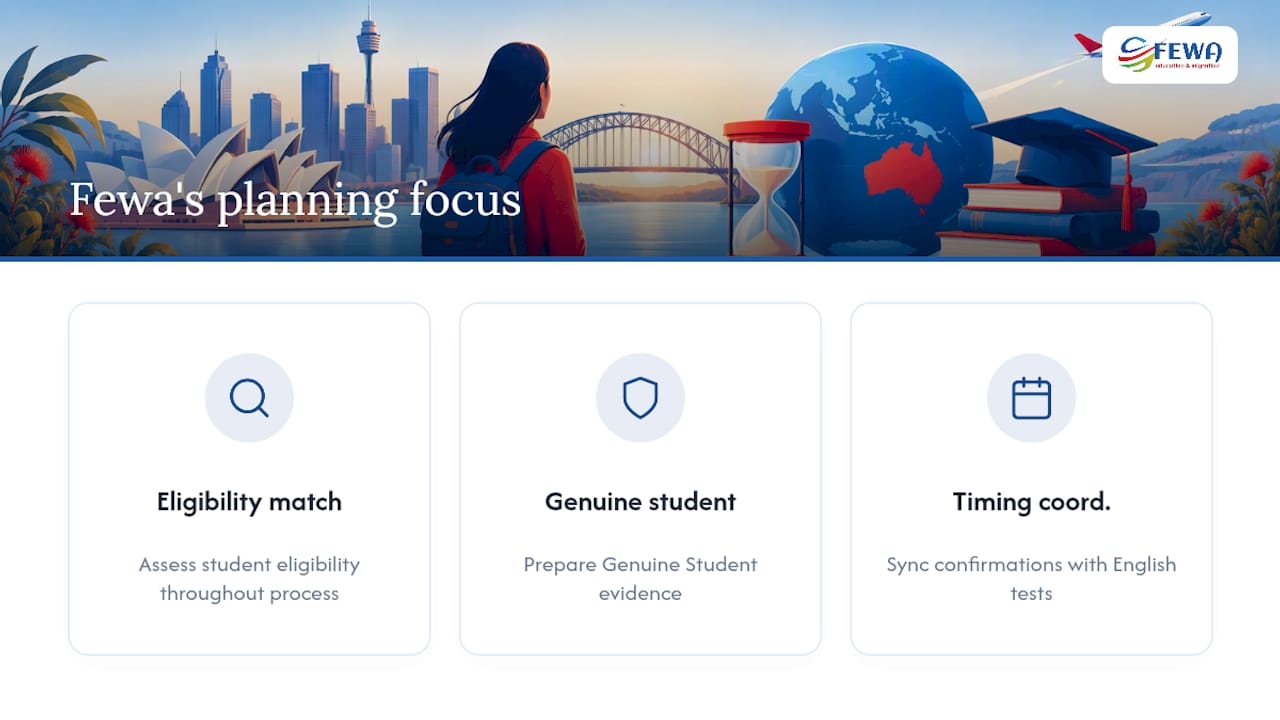
A registered migration consultancy provides assistance to international students throughout the application process, focusing on eligibility matching, Genuine Student evidence, and coordinating confirmation timing with English test bookings.
— Ronit
How Fewa can help you apply with confidence
A scholarship offer is one document in a much bigger application. Fewa is the alternative to piecing this together alone: instead of juggling university portals, DFAT timelines, and visa forms separately, you get one point of contact who understands how they all fit together.
Fewa’s relevant services include help with student visa applications, English test preparation through IELTS or PTE coaching, and guidance on assembling financial evidence that satisfies both your scholarship provider and the Department of Home Affairs. To get started, book a free consultation and bring what you already have: academic transcripts, any Confirmation of Enrolment, and your scholarship offer letter if you’ve received one. Fewa helps you prepare a strong, well-evidenced application, but no consultancy can guarantee a scholarship outcome, and any firm that claims otherwise isn’t being straight with you. Visit Fewa to book your consultation and find out where you stand.
Sources
- Australia Awards opening and closing dates — DFAT
- Research Training Program – Frequently Asked Questions for students — Department of Education
- Scholarships — Study Australia
FAQ
What are the main scholarships in Australia for international students?
The three main categories are Australia Awards (government-funded, for eligible developing countries), the Research Training Program for HDR students, and university or provider merit scholarships that reduce tuition fees. Each has different eligibility rules and application pathways.
How do I search for scholarships in Australia?
Start with the Study Australia scholarship search tool, which lists over a thousand awards, then confirm your chosen course is CRICOS-registered before applying. University international offices can also point you to scholarships not listed publicly.
Do scholarships affect my student visa application?
A scholarship supports your Genuine Student evidence but doesn’t replace the financial capacity requirement for living costs and OSHC. You’ll typically still need to show you can fund expenses the scholarship doesn’t cover.
What does the Research Training Program actually cover?
RTP funding can include a fees offset, a stipend, and allowances, with support periods generally running three to four years for a full-time research doctorate. Universities manage eligibility and selection themselves, so admission comes first.
Can Fewa guarantee I’ll win a scholarship?
No consultancy can guarantee a scholarship outcome, and Fewa doesn’t claim to. What Fewa offers is help preparing strong evidence, coordinating visa timing, and clarifying eligibility so your application is as competitive as it can be.