


If you are studying, working or applying for a visa in Australia, take PTE Academic, not PTE Core. PTE Academic is the test the Department of Home Affairs accepts for visa evidence, and it is the test Australian universities and many registration boards recognise. PTE Core exists mainly for Canadian immigration pathways, so choose it only when a Canadian authority specifically asks for it.
TL;DR:
- PTE Academic is the only suitable test for Australian visas, universities, and professional registration, as PTE Core is only recognized for Canadian immigration pathways.
- PTE Academic scores from 10 to 90 are accepted by the Department of Home Affairs for visa applications and align with CEFR and IELTS bands, unlike PTE Core which aligns with Canadian benchmarks.
- Test preparation should focus on either academic content for PTE Academic or workplace scenarios for PTE Core, depending on the intended outcome, with timing and scoring details differing.
- Candidates must verify their target scores and minimum component thresholds directly with the receiving body, as requirements may vary and are updated periodically.
- Booking at least six to eight weeks before deadlines is recommended to allow time for resits, with practice emphasizing weak skills and timed testing.
Table of Contents
- At-a-glance comparison of purpose and scoring
- Recognition and visa acceptance in Australia
- How the test format and scoring actually work
- Australian visa English categories and what to target
- How to choose the right PTE test for your situation
- Booking, timing and preparation tips for Australian candidates
- How Fewa helps you prepare and apply with confidence
- A closing thought on choosing the right test
- Get support choosing and preparing for the right test
- Official pages to check before you book
- Sources
- FAQ
At-a-glance comparison of purpose and scoring
Both tests come from Pearson and both feel similar on the day: computer-based, all four skills tested, and scored on the same 10 to 90 scale. What separates them is who accepts the result and what the content is built around.
- Purpose: PTE Academic assesses academic English for university study and professional registration; PTE Core assesses everyday and workplace English for migration purposes.
- Acceptance: PTE Academic is accepted for Australian university admissions, Australian visa evidence and many professional bodies; PTE Core is designed for Canadian immigration and citizenship applications.
- Duration: Both run under two hours, though task mix and timing differ by section.
- Scoring: Both report scores from 10 to 90 across speaking, writing, reading and listening.
- Result timing: Results are typically issued within two business days, though Pearson allows up to five.
If you are applying for an Australian student visa, a skilled migration visa or a partner visa, PTE Academic is the only sensible choice. PTE Core simply is not on the table for Australian purposes.
Recognition and visa acceptance in Australia
The Department of Home Affairs lists PTE Academic among its accepted English tests for visa applications, and it is the test most Australian universities name in their entry requirements. PTE Core does not appear on that list because it was built for a different market entirely.
- PTE Core aligns to the Canadian Language Benchmarks, which is why Immigration, Refugees and Citizenship Canada requires it for certain programs.
- PTE Academic aligns to CEFR and IELTS bands, which is what Australian institutions and Home Affairs reference.
- Home Affairs changed its PTE Academic scoring tables from 7 August 2025, so applicants must check the current thresholds rather than relying on older figures found online.
Always confirm directly with the receiving body. Whether that is a university admissions office, a skills assessing authority, an employer or a professional registration board, requirements can differ slightly from the general Home Affairs categories, and it is the receiving body’s rule that ultimately counts.
How the test format and scoring actually work
PTE Academic and PTE Core share a structure but differ in scale and content. PTE Academic runs across speaking and writing (76 to 84 minutes), reading (23 to 30 minutes) and listening (31 to 39 minutes), with roughly 65 to 75 questions spread across 22 question types. PTE Core is shorter, with speaking and writing at 50 to 65 minutes, reading at 27 to 37 minutes and listening at 22 to 37 minutes, covering 52 to 67 tasks across 19 task types.
- Both tests are scored by Pearson’s automated system, with some integrated items double-scored for reliability.
- PTE Academic draws on lecture excerpts, academic texts and campus scenarios.
- PTE Core draws on workplace emails, everyday conversations and community scenarios.
- Pearson publishes alignment tables mapping both tests to CEFR, IELTS and, for PTE Core, the Canadian Language Benchmarks.
Knowing the task mix matters for preparation. A reader chasing an academic outcome should not be practising with workplace-style content, and vice versa.
Australian visa English categories and what to target
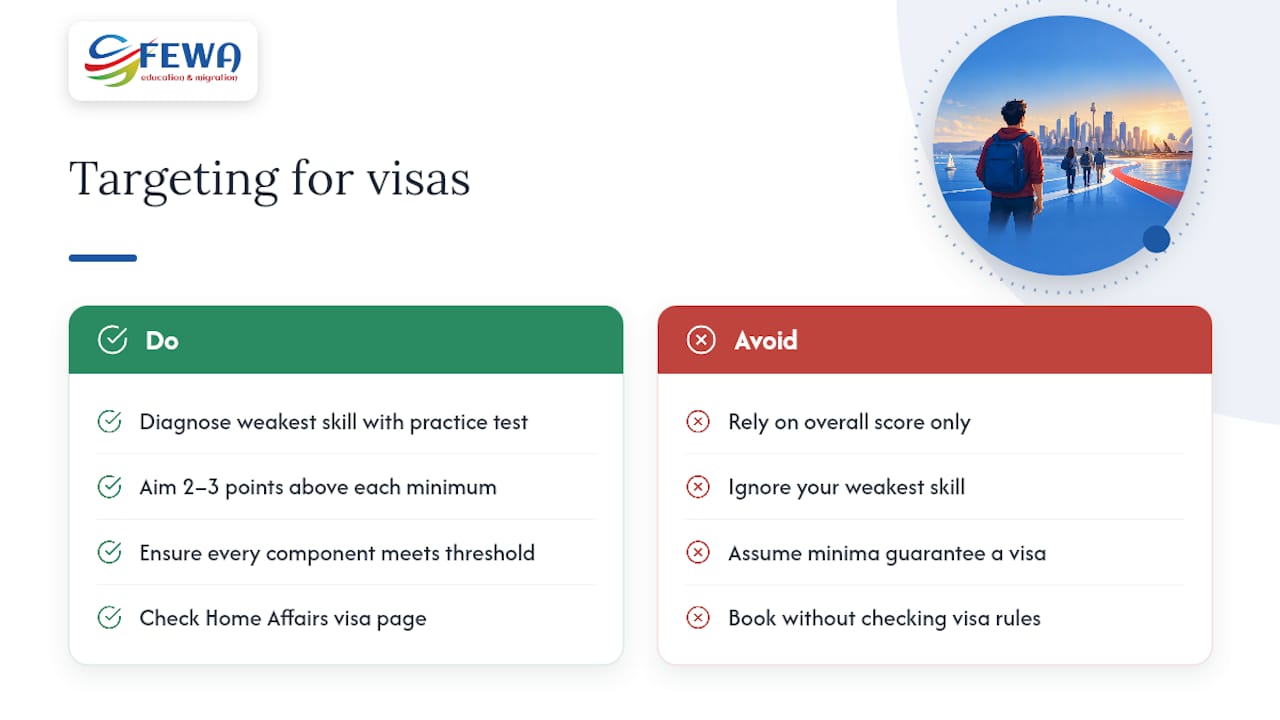
Since 7 August 2025, Home Affairs has published component minima across three English categories, each requiring every individual skill to meet the threshold, not just the overall average.
Meeting a category’s component minima does not automatically guarantee eligibility for a specific visa. Each visa subclass has its own rules on top of the English category, so treat this table as a planning benchmark, not a final answer, and check the relevant Home Affairs visa page before you book.
Start by diagnosing your weakest skill with a practice test. Most candidates are stronger in reading or listening and weaker in speaking or writing, and it is the weak skill that decides whether you clear the category.
Pro Tip: Aim two or three points above the minimum in each component, not just the overall score, so a single flat day on test day does not cost you the category.
How to choose the right PTE test for your situation
Work through these steps in order rather than jumping straight to booking.
- Identify the accepting body. Confirm whether it is Home Affairs, a university, a skills assessing authority or an employer, since each may quote slightly different requirements.
- Confirm the component minima and overall target. Use the Home Affairs category tables if a visa is involved, or the institution’s published entry score if it is a course.
- Check test availability and result timing in Australia. Book early enough that a resit is still possible if your first attempt falls short.
- Default to PTE Academic unless a Canadian authority has explicitly told you PTE Core is required. For Australian study, work or migration, PTE Core is not a substitute.
If anything looks inconsistent, such as an agent or a website suggesting PTE Core will satisfy an Australian visa requirement, treat that as a red flag and verify directly on the Home Affairs site before proceeding.
Booking, timing and preparation tips for Australian candidates
Check the live Pearson booking pages for your nearest Australian test centre before locking in a date, since fees and available slots vary by location and time of year. Build in room for delay: while two business days is typical for results, Pearson allows up to five, so plan your booking date around your actual deadline, not the fastest-case scenario.
- Focus PTE Academic preparation on lecture-style listening, academic reading passages and structured essay writing.
- Focus PTE Core preparation on workplace emails, everyday conversation and practical, short-form writing tasks.
- Practise under timed conditions, since pacing per question type often matters as much as raw knowledge.
- Revisit your weakest skill weekly rather than only doing full practice tests.
Pro Tip: Book your test at least six to eight weeks before your visa or enrolment deadline, so there is time for one resit if a single component falls short.
How Fewa helps you prepare and apply with confidence
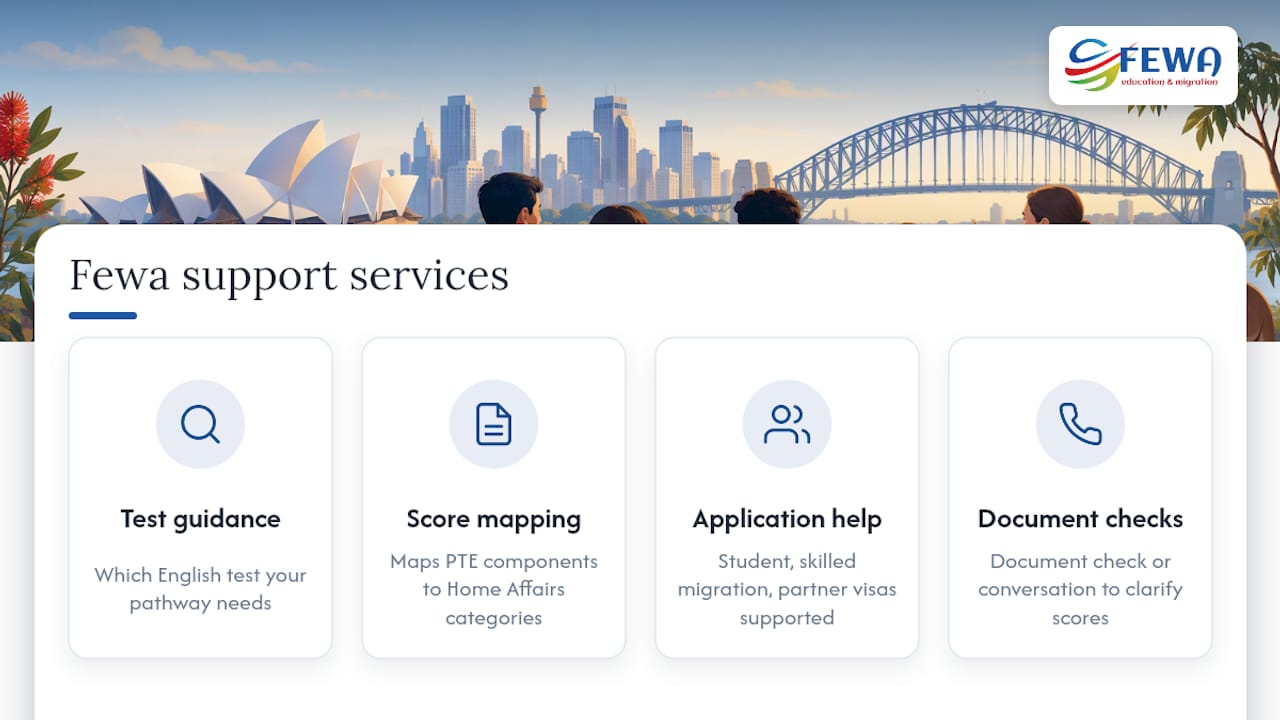
Fewa Education & Migration works with students and skilled migration applicants, guiding them on which English test their pathway actually needs and how each PTE Academic component maps to the Home Affairs categories. Their team has supported clients through student visa applications, skilled migration coaching and partner visa preparation, using case studies from past applicants to explain what typically trips people up. If you are unsure which test or score band applies to you, a document check or a conversation with a professional team can clarify it quickly.
A closing thought on choosing the right test
The decision is simpler than it looks: PTE Academic for anything Australian, PTE Core only when a Canadian authority names it specifically. Always cross-check your target score against the current Home Affairs tables and the receiving institution’s own requirements, since these can shift. If one skill consistently lags in practice tests, targeted coaching on that skill alone often closes the gap faster than repeating full mock exams.
— Ronit
Get support choosing and preparing for the right test
Working out which test to take is only the first step. The harder part is hitting every component minimum on a fixed timeline, especially when a visa deadline is involved. PTE coaching programs can be built around the current Home Affairs component tables, so practice time goes directly into the skill holding a score back.
- Get a free consultation to confirm which test and score band applies to your visa or course.
- Work through PTE coaching sessions focused on your weakest component.
- Pair test preparation with document support through our visa services once your score is locked in.
Book a free consultation with Fewa today to get a clear plan for your PTE Academic score and your visa application.
Official pages to check before you book
Before booking or relying on a score, check the Department of Home Affairs English language requirements for the current category tables, and Pearson’s PTE Academic and PTE Core pages for format, scoring and live booking details for Australian test centres.
Sources
FAQ
Is PTE Core easier than PTE Academic?
Neither test is inherently easier, since both use the same 10 to 90 scoring scale and similar task types. PTE Core’s content leans on everyday and workplace scenarios while PTE Academic uses academic material, so difficulty depends on which content style suits you better.
Is PTE Core acceptable for permanent residency in Australia?
No. PTE Core is designed for Canadian immigration pathways and is not listed by the Department of Home Affairs as an accepted test for Australian visas, including permanent residency. Australian applicants need PTE Academic instead.
Does a score of 65 in PTE Academic equal band 7 in IELTS?
Pearson publishes alignment tables mapping PTE Academic scores to IELTS bands, and a 65 typically sits around the range associated with IELTS 7 on those tables. Always check the current Pearson score guide rather than relying on a rule of thumb, since alignment tables are periodically updated.
Which PTE test is best for an Australian permanent residency application?
PTE Academic is the test to sit for Australian permanent residency, since it is the one recognised on Home Affairs’ English language pages. Your target score depends on which English category, Competent, Proficient or Superior, your visa subclass requires.