


The Australian Qualifications Framework (AQF) is a national system of ten qualification levels ranking study from the most basic to the most advanced. Certificate I to IV sit at Levels 1 to 4, Diploma at Level 5, Advanced Diploma or Associate Degree at Level 6, Bachelor at Level 7, Bachelor honours, Graduate Certificate or Graduate Diploma at Level 8, Masters at Level 9 and Doctorate at Level 10. TEQSA regulates how these levels apply to higher education providers, and the Undergraduate Certificate now sits permanently across Levels 5 to 7.
TL;DR:
- The Undergraduate Certificate can be completed in about six months and counts as half of a full-time year of study, offering a quick pathway into higher education.
- AQF levels 1 through 4 focus on practical, supervised tasks, while levels 5 and 6 involve autonomous application of technical and theoretical knowledge in managing projects or teams.
- The framework emphasizes the development of independent problem-solving skills at Level 7 and advanced research expertise at Level 9, with Level 10 reserved for original contributions.
- Credit transfer and recognition of prior learning allow students to progress faster by combining qualifications across levels, particularly when moving from diplomas to bachelor degrees.
- International qualifications are assessed based on content, duration, and outcomes, rather than qualification titles, which can differ significantly between countries.
Table of Contents
- AQF level at a glance
- What each AQF level requires
- How the AQF defines outcomes: knowledge, skills, application and volume of learning
- Pathways and credit transfer, including the Undergraduate Certificate
- Who uses AQF levels and what they signal
- What Expert guidance on choosing a study path
- Guidance for international students and qualified workers
- Why the AQF matters more than the qualification name
- How Fewa helps you turn an AQF level into a study or visa plan
- Sources
- FAQ
AQF level at a glance
If you are comparing courses or trying to work out where a qualification fits, this table gives you the shortcut. Each level signals a step up in how complex the knowledge is and how much independence you are expected to show once you graduate.
| AQF level | Common qualification | Graduate outcome summary |
|---|---|---|
| Level 1 | Certificate I | Basic knowledge and skills for defined, routine tasks |
| Level 2 | Certificate II | Foundational knowledge applied in known, structured contexts |
| Level 3 | Certificate III | Broader technical knowledge, some discretion in familiar settings |
| Level 4 | Certificate IV | Specialised knowledge and skills with some leadership of others |
| Level 5 | Diploma | Technical and theoretical knowledge applied with autonomy |
| Level 6 | Advanced Diploma or Associate Degree | Broad knowledge base, managing projects or supervising others |
| Level 7 | Bachelor Degree | Coherent body of knowledge, independent problem solving |
| Level 8 | Bachelor honours, Graduate Certificate or Graduate Diploma | Advanced specialisation, applying knowledge to new situations |
| Level 9 | Masters Degree | High-level expertise, independent research or practice |
| Level 10 | Doctoral Degree | Original contribution to knowledge, full autonomy as a researcher or practitioner |
The Undergraduate Certificate does not sit at a single level. It spans Levels 5 to 7, giving students a short, accredited way into higher study without committing to a full degree up front.
What each AQF level requires
The jump between levels is not only about how much you study. It is about how much you are expected to think for yourself once you finish. Grouping the ten levels makes the pattern easier to see.
- Levels 1 to 4 (Certificates I to IV): You follow set procedures, build practical skills in a defined trade or task, and work under supervision that gradually loosens as you progress.
- Levels 5 to 6 (Diploma, Advanced Diploma, Associate Degree): You apply technical and theoretical knowledge with real autonomy, often managing a small project or supervising a team.
- Level 7 (Bachelor): You work with a coherent, often broad body of knowledge and solve problems independently, usually the entry point for professional registration in fields like nursing or engineering.
- Level 8 (Honours, Graduate Certificate, Graduate Diploma): You take specialised knowledge from a Bachelor and apply it to new or research-related problems, often as a bridge into a Masters.
- Level 9 (Masters): You demonstrate high-level expertise and can plan and carry out substantial projects or research with minimal oversight.
- Level 10 (Doctorate): You work at the frontier of a field and are expected to make an original contribution to knowledge, with full autonomy as a researcher or practitioner.
These groupings are a plain-language translation. For the formal wording, the AQF level descriptors set out exactly what knowledge, skills and application look like at each level, and they are worth reading closely if you are comparing two qualifications that sound similar but sit at different levels.
How the AQF defines outcomes: knowledge, skills, application and volume of learning
Every AQF level is built from three dimensions: knowledge, skills, and the application of knowledge and skills. Knowledge describes depth and breadth of understanding, skills cover cognitive, technical and communication ability, and application covers the autonomy, responsibility and accountability expected of a graduate. These three combine to set where a qualification sits.
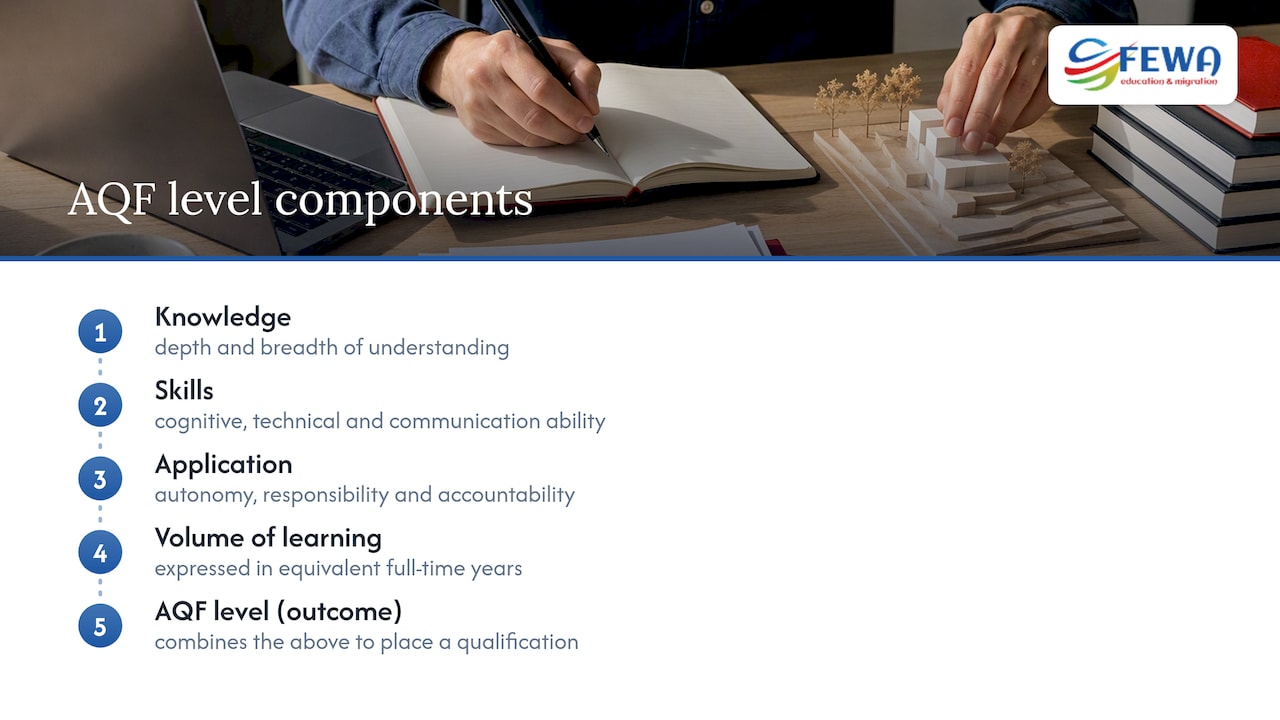
Alongside these, volume of learning matters. It is expressed in equivalent full-time years and gives course designers a notional duration for the qualification type, which is one reason a Diploma and a Bachelor differ in both depth and length even when they share some content. The formal detail sits in the AQF levels criteria and qualification type descriptors.
Pathways and credit transfer, including the Undergraduate Certificate
Moving between qualifications is built into the AQF by design. The AQF Qualifications Pathways Policy encourages providers to offer credit transfer, recognition of prior learning and clear articulation routes so students are not forced to start from scratch when they move between VET and higher education, as outlined in Department of Education research on credit pathways.
One clause in that policy, 2.1.10, is commonly used as a starting point for negotiating how much credit a Diploma or Advanced Diploma earns toward a Bachelor. In practice, institutions interpret it differently: some use it generously, others apply it as a firmer cap, so it pays to ask a provider directly rather than assume.
The Undergraduate Certificate is the clearest example of a fast pathway in action. It typically runs for six months and counts as 0.5 EFTSL, often built from four units of an existing accredited course, and it articulates into further study at Levels 5 to 7.
Who uses AQF levels and what they signal
TEQSA checks that a higher education course’s learning outcomes genuinely match its claimed AQF level, and reviews qualification titles so a course cannot call itself something it is not, under the HES Framework. For employers and admissions staff, a Level 7 label signals independent problem solving within a defined field, while Level 8 signals deeper specialisation or early research capability. Before enrolling anywhere, check that the provider is registered and the specific course is accredited rather than relying on the qualification name alone.
What Expert guidance on choosing a study path
Pick the level that matches your goal, not the one that sounds most impressive. A short Diploma or Undergraduate Certificate can be the smarter move when you need a fast route into a skills assessment or further study, while a full Bachelor suits a longer-term career or migration pathway. Match the level to the outcome you actually need.
Guidance for international students and qualified workers
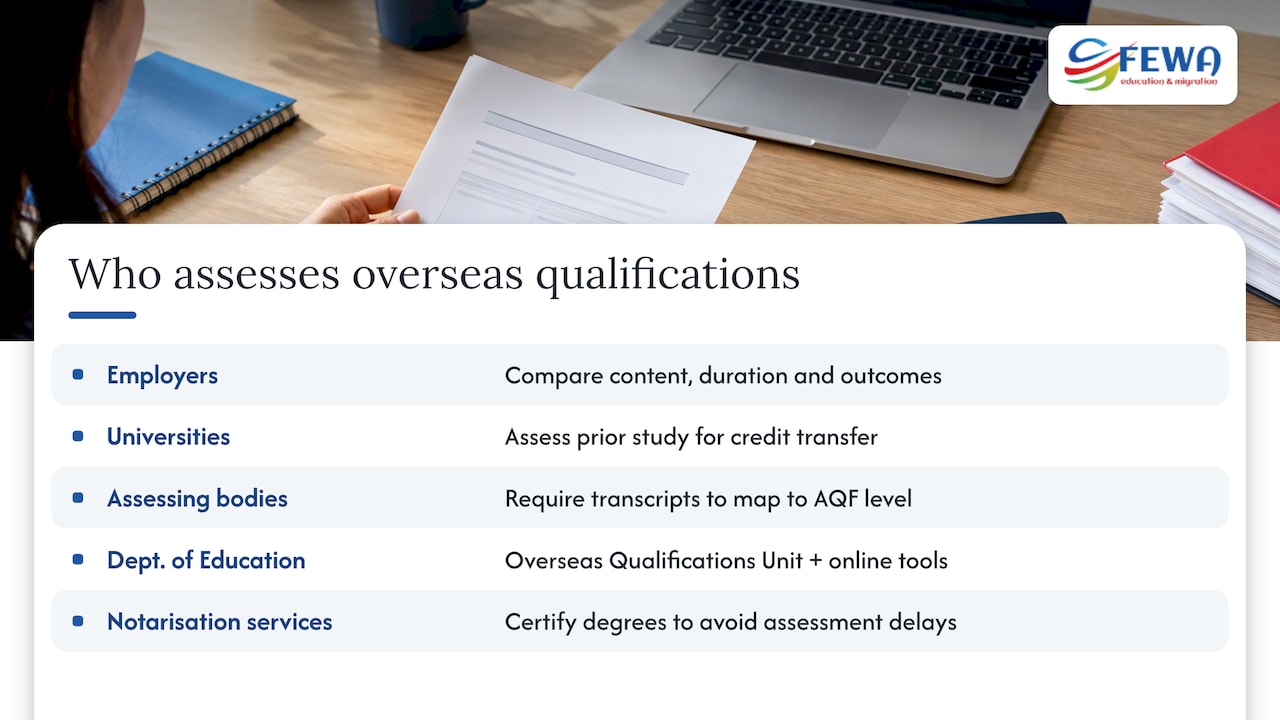
If you hold an overseas qualification, the AQF level alone will not tell you how it compares. Australian employers, universities and skills assessing authorities look at the content, duration and outcomes of your qualification, not just its name, which is why a three-year Bachelor from one country can sit differently to a four-year Bachelor from another.
The Department of Education supports this comparison work through its Overseas Qualifications Unit network and online tools, which help organisations translate overseas study into Australian terms. If you are applying for a skilled visa, the assessing authority for your occupation will generally ask for your academic transcripts, not just your certificate, so it can map your study against the AQF level it most closely resembles.
For students planning to study in Australia, this matters at enrolment too. Universities assess your prior study to decide what credit you can bring into a Bachelor or Masters, and the outcome varies depending on how closely your previous course matches an AQF-equivalent level here. If you need your existing degree certified for this process, services like online degree certificate notarisation can help you avoid delays while your documents are assessed.
Qualified workers moving to Australia face a similar question when it comes to skilled migration pathways: the occupation’s skills assessing body will decide whether your overseas qualification is comparable to the AQF level required for that occupation, and that decision shapes which visa pathway is realistic.
Why the AQF matters more than the qualification name
Most people fixate on the qualification title: Bachelor sounds better than Diploma, Masters sounds better than Graduate Certificate. That instinct misses the point. The AQF level tells you what a graduate can actually do, and two qualifications with similar names can sit at different levels depending on their content and volume of learning.
The bigger gap in how people use this framework is pathway planning. Readers treat the AQF as a static ladder when it is really a negotiable map: credit transfer and recognition of prior learning mean you rarely have to repeat content you have already mastered elsewhere. Before committing to a three or four-year Bachelor, it is worth asking whether a Level 5 or Level 6 qualification, stacked with credit, gets you to the same outcome faster.
If you take one thing from this, let it be this: choose your starting level based on the credit and pathway options available, not just on how prestigious the final title sounds.
— Ronit
How Fewa helps you turn an AQF level into a study or visa plan
Working out which AQF level suits your goals is only half the job. Once you know whether a Diploma, Bachelor or Masters fits your plan, Fewa offers free consultations to help you choose the right course, understand what credit you might carry across, and prepare a student visa application that matches your study level.
If English testing or exam preparation stands between you and enrolment, our IELTS, PTE and other coaching services can help you meet entry requirements. And if your plans extend beyond study into skilled migration or a graduate visa, our visa services cover the full range:
- Course and pathway advice matched to your AQF level and goals.
- Document and visa support through Fewa.
- Exam preparation through Fewa when entry requirements call for it.
Book a free consultation whenever you are ready to talk through your options.
Sources
- AQF levels | AQF
- Australian Qualifications Framework | TEQSA
- Credit pathways in VET and Higher Education (Department of Education research)
FAQ
What exactly are AQF levels?
AQF levels are a ten-level national scale describing how complex a qualification’s knowledge and skills are and how much autonomy its graduates are expected to show. Level 1 is the most basic and Level 10, the Doctorate, is the most advanced, as set out in the AQF level descriptors.
What is AQF level 7 equivalent to?
AQF Level 7 is the Bachelor Degree level, where graduates work independently with a coherent body of knowledge in their chosen field. It is the standard entry qualification for most professional careers and for further study at Level 8 or Level 9, according to the AQF qualifications structure.
What is an AQF level 6 qualification?
AQF Level 6 covers the Advanced Diploma and Associate Degree, qualifications that sit between a Diploma and a Bachelor. Graduates at this level apply broad technical and theoretical knowledge with real autonomy, often managing projects or supervising others, as described in the AQF qualification types.
What AQF level is a PhD equivalent to?
A PhD sits at AQF Level 10, the highest level in the framework, reserved for Doctoral Degrees. Graduates at this level are expected to make an original contribution to knowledge and work with full autonomy as researchers or practitioners, per the AQF level criteria.
How does the Undergraduate Certificate fit into the AQF?
The Undergraduate Certificate is a permanent AQF qualification that spans Levels 5 to 7 rather than sitting at one fixed level. It typically takes six months and counts as 0.5 EFTSL, giving students a quick, accredited entry point into further study, as confirmed by TEQSA’s guidance.