


Most Australian universities start international students in two main intakes: Semester 1 in late February or early March, and Semester 2 in July. A smaller number of providers also run a third start in November or use trimesters and blocks that open throughout the year. If you are reading this in late October 2026, the next realistic starts are February/March 2027 and July 2027, and the right choice depends on your course, your documents and your visa timeline.
This guide explains how each intake works, what to do and when, and how to choose without second-guessing yourself.
TL;DR
- February/March (Semester 1) is the biggest intake, with the widest choice of courses. July (Semester 2) is the second main intake and suits many business, IT and science programs.
- November (Trimester 3) exists only at some providers and mostly for pathway, diploma and vocational courses. Do not assume your course has one.
- Deadlines are set by each university, sometimes by each faculty. Always confirm them on the course page before you plan anything.
- Start your application and visa preparation 6 to 12 months ahead. An incomplete visa application is the most common cause of delay.
- Choose the intake that gives you time to prepare English test results, financial evidence and documents, not just the one that sounds most popular.
Table of Contents
- How the Australian academic year works
- The three intakes compared
- When to apply: a realistic timeline
- How the intake connects to your student visa
- How to choose your intake
- Mistakes that cost students an intake
- Our view: pick the intake you can prepare for properly
- Get help planning your intake
- FAQ
- Sources
How the Australian academic year works
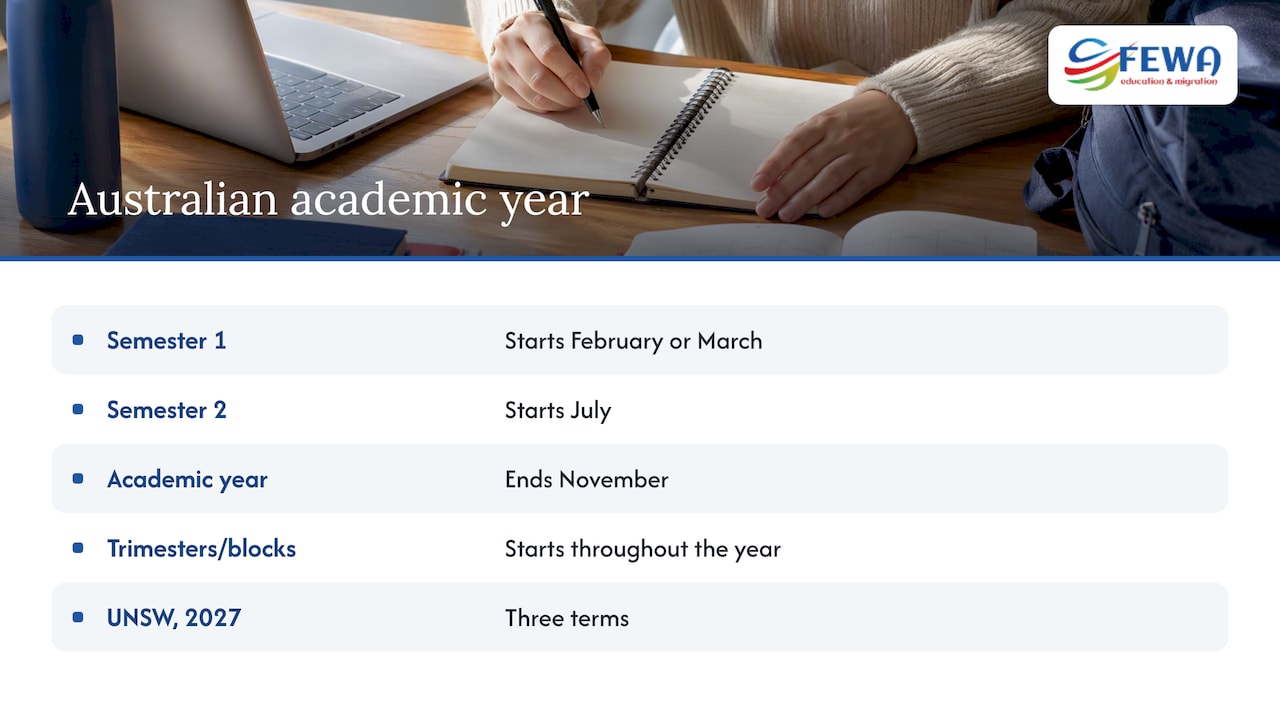
The Australian academic year starts in February or March and ends in November, with the option of a mid-year start in July. That is why you will hear students talk about “the February intake” and “the July intake”: they are simply the start of Semester 1 and Semester 2.
There is one wrinkle worth knowing early. Not every university uses two semesters. Many now teach in trimesters or blocks, so start dates can fall throughout the year. UNSW Sydney, for example, runs three terms a year, and its international admissions page lists separate offer rounds for Term 1, Term 2 and Term 3 of 2027.
Universities Australia also points out that its published calendar shows only principal dates for standard teaching sessions, and that faculties such as Business, Medicine and Health Sciences often run their own timetables. The practical rule: use general intake names to orient yourself, then check the handbook entry for your exact course.
The three intakes compared
| February/March | July | November | |
|---|---|---|---|
| Also called | Semester 1, Term 1 | Semester 2, Term 2 or 3 | Trimester 3, Term 3 |
| Size | Largest | Second largest | Small |
| Course choice | Widest | Many courses, fewer than February | Limited, often pathway, diploma or VET |
| Typical reader | School leavers, most postgraduates | Mid-year graduates, those who need more preparation time | Students bridging into a degree |
| Main risk | Competition for places and busy visa periods | Some programs not offered | Course may not exist at your preferred provider |
Treat the table as a guide. Start months differ between institutions and between courses at the same institution.
February/March intake (Semester 1)
This is the main intake. It lines up with the end of the Australian summer break, nearly every program is open, and first-year students begin together, which makes orientation and making friends easier.
It suits you if:
- you are finishing school or a bachelor degree in the second half of the year and want to start straight away
- your course is only offered once a year, often the case for competitive or professional degrees
- you have your English test result and academic transcripts ready well before the deadline
The trade-off is competition. Popular courses can fill, and many students lodge visa applications at the same time.
July intake (Semester 2)
The mid-year intake is a proper start, not a consolation prize. Applications for a July start generally open around April, and for some students a mid-year start works out better.
It suits you if:
- your final results or English test score will not be ready in time for February
- you need extra months to organise financial evidence or documents
- you want to work or save before you start
- your program is offered in July, which is common in business, IT and science
Check before you commit. Some degrees, especially those with a strict first-year sequence, only start in Semester 1.
November intake (Trimester 3)
This is the smallest option. It appears at some universities and colleges, mostly for diplomas, foundation and pathway programs, and vocational courses. Treat it as a bridge: some students use it to complete a pathway and move into a degree in the following February. If a website lists a November start for your course, confirm that it is a genuine commencement and ask what the next step is after you finish.
When to apply: a realistic timeline
You will see different advice about timing, so here is a plan that works whichever intake you pick. Applying 6 to 12 months ahead is a sensible target, and it gives you room if something needs fixing.
If you want to start in February or March 2027
If you are only starting now, in late October 2026, speak to the course page first. Some universities will already have closed their main rounds for Semester 1, while others accept applications into the new year. UNSW’s schedule, for instance, lists rounds with deadlines running into late 2026 and beyond, which shows how much institutions differ. If your first choice has closed, ask whether a late round exists, whether a similar course is open, or whether July 2027 is the better target.
If you want to start in July 2027
You have time, and you should use it well. Applications generally open around April. Before that, use the months ahead to:
- Shortlist three to five courses and read each course page and entry requirements.
- Book your English test, such as IELTS or PTE, early enough to retake it if needed.
- Collect academic transcripts, certificates and identification.
- Prepare your Statement of Purpose and financial evidence.
- Apply for admission, accept your offer and then lodge your visa.
How the intake connects to your student visa
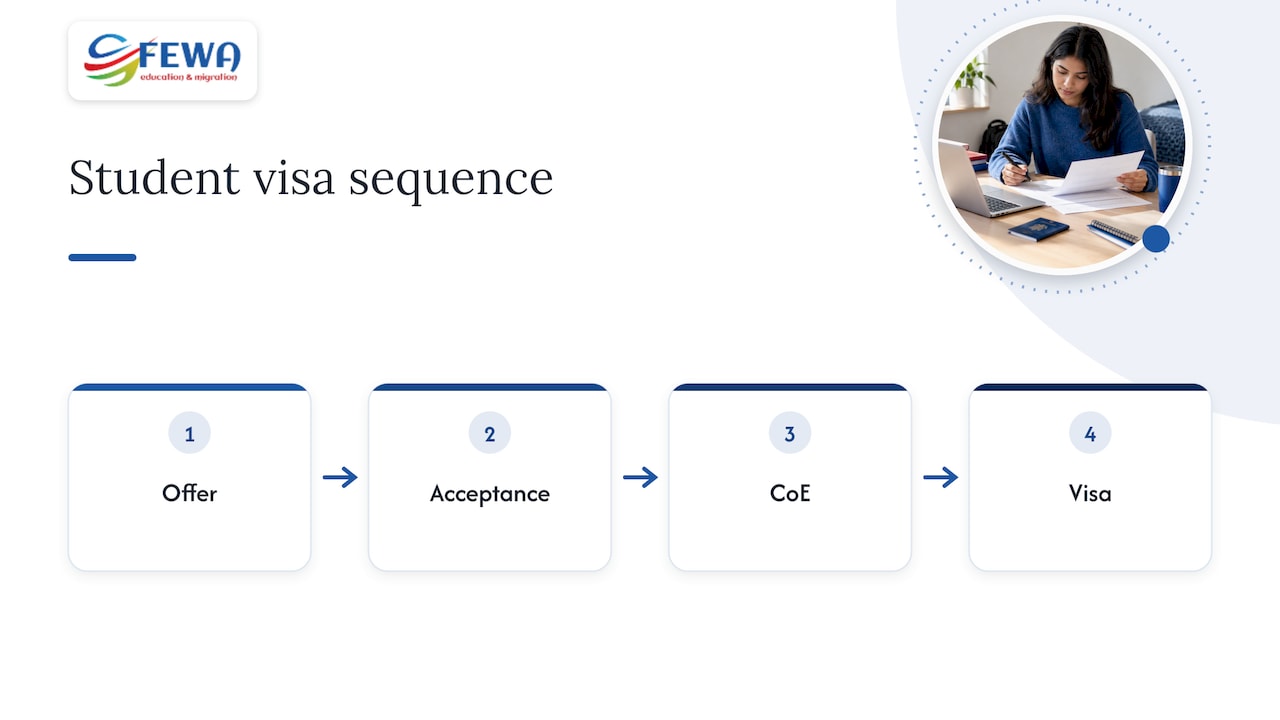
The intake you choose sets your visa deadline. You need a Confirmation of Enrolment (CoE) to make a valid application, and the Department of Home Affairs’ document checklist tool lists what you must provide as evidence of your intended study. That means the order is always: offer, acceptance, CoE, visa.
On timing, as of August 2026 the median processing time for a Student visa (subclass 500) was 22 days. Home Affairs stresses this is a guide only. An incomplete application is the most common cause of delay, so include every document, including financial evidence and Overseas Student Health Cover (OSHC) details, when you lodge. Home Affairs’ check twice, submit once guidance explains how to prepare a decision-ready application.
For the 2026 program year, the government set a National Planning Level of 295,000 new international student commencements, 25,000 more than 2025. This is a prioritisation system for visa processing, not a cap on individual applications, and Home Affairs says a Ministerial Direction is not a visa cap. Genuine students who meet the requirements are still encouraged to apply. The sensible response is simply not to leave things to the last month.
For more detail, see our guides on how to apply for a student visa in Australia, the average processing time for a student visa and the current student visa cost.
How to choose your intake
Ask yourself these questions in order.
- Is my course offered in this intake? If not, the decision is made for you.
- Will my documents be ready? An English test result, transcripts and financial evidence are the three things that most often slip.
- Do I have enough time for the visa? Count back from the start date, then add a buffer.
- Does the intake affect my study plan? Starting in July can change when you finish and which units you can take in sequence. Ask the faculty.
- Does it suit my life? Accommodation, work, family and finances all matter. If you are coming to Sydney, our note on why a short first stay helps overseas students may help.
The popular answer is that February is best for most people. That is often true because of course choice. But a well-prepared July application beats a rushed February one every time.
Mistakes that cost students an intake
- Relying on one blog’s dates. Dates change each year and differ by faculty. Use the university’s own page.
- Assuming every course has every intake. Many do not.
- Waiting for the perfect English score. If a retake is likely, book it early or move to the later intake deliberately.
- Lodging an incomplete visa application. Missing evidence slows everything down.
- Switching courses after arrival without checking the rules. If this might apply to you, read about the six-month rule and changing course first.
- Choosing a provider by intake alone. Compare the course, fees and outcomes. Our comparison of TAFE and university is a good place to start.
Our view: pick the intake you can prepare for properly
At Fewa we work with students and families every week, many from the Nepali community in Sydney. We register our advice under MARA, and the pattern we see is consistent: students rarely lose a place because they chose the “wrong” intake. They lose time because a document, an English score or a visa form was not ready.
That is why we start the conversation with your timeline, not a start date. If you are three months from a February deadline and your test result is not in, we will tell you honestly that July is the stronger plan. If your course only runs in Semester 1, we will map the preparation backwards from there.
One more thing we say often: a visa refusal or a missed intake is a setback, not the end of your pathway. If you have had a refusal, our guide on what to do after a student visa refusal walks through your options calmly. And please remember that Study Australia advises applying directly through the education provider and verifying any agent’s credentials and fees, because no agent can guarantee a visa. We would rather you ask us hard questions than trust us blindly.
— Ronit
Get help planning your intake
If you are weighing February against July, or you are not sure your course and visa timeline match, we can go through it with you. Fewa offers student visa (subclass 500) assistance, student dependent visa support for families, and IELTS and PTE coaching if your English test is the bottleneck. You can book a free online consultation through our website.
FAQ
Which intake is best for international students in Australia?
February/March is the best choice for most students because it has the widest range of courses and is the main commencement for first-year students. July is a strong alternative if your course is offered then or you need more preparation time. The best intake is the one where your course, documents and visa timeline line up.
When should I start applying for an Australian university?
Start six to twelve months before your intended start date. For a July start, applications generally open around April. For February or March, many universities open applications in the second half of the preceding year, but deadlines vary by university and faculty, so check your course page.
Can I still apply for February 2027 now?
It depends on the university and course. Some have closed their main rounds, while others run later rounds or accept applications close to the start. Check the specific course page today, and if it has closed, ask the university about late rounds or consider July 2027.
Is the November intake available at every university?
No. It is offered by only some providers and is mostly for diplomas, pathway and vocational programs. Many universities use trimesters or blocks instead, so always confirm the start dates in the course handbook.
Sources
- Understanding mid-year entry, Study Australia
- Increased student intake for Australia in 2026, Study Australia
- How to apply to study, Study Australia
- Teaching calendars, Universities Australia
- Academic calendar 2026-27, Universities Australia
- International student admissions, UNSW Sydney
- Visa processing times, Department of Home Affairs
- Student visa processing priorities, Department of Home Affairs
- Document Checklist Tool, Department of Home Affairs
- Applying for a student visa, Department of Home Affairs