


The subclass 482 is temporary, capped at four years, and tied to one employer. The subclass 186 is permanent from the day it’s granted. If you want permanent residence and your employer will commit to nominating you, aim straight for the 186. If you don’t yet have two years with a sponsor, aren’t on the right occupation list, or your employer isn’t ready to commit long term, the 482 is your practical entry point. Three things decide your path: your timeline for PR, your employer’s willingness to sponsor permanently, and where your occupation sits on the relevant skills list.
TL;DR:
- The 482 visa is temporary, limited to four years, and requires ongoing employment with the sponsoring employer, which restricts job mobility early in your Australian career.
- The 186 visa offers permanent residency, with no expiry date or work restrictions, but requires a skills assessment and a genuine employer nomination, usually under age 45.
- Transitioning from 482 to 186 through the TRT pathway demands at least two years of continuous employment with the same employer after the 482 grant, alongside proper record-keeping.
- The median processing time is approximately 47 days for the 482 and around 11 months for the 186, influencing the decision based on whether immediate work or long-term residence is priority.
- Careful planning with an adviser is recommended before employer sponsorship, as missed documentation or misaligned timing can delay or jeopardize visa approval.
Table of Contents
- What the subclass 482 visa covers and who it suits
- What the subclass 186 visa covers and who it suits
- 482 vs 186 differences at a glance
- The TRT pathway: how 482 leads to 186
- How to choose between 482 and 186
- Tax and residency implications for 482 and 186 holders
- Processing times, fees and documents to prepare
- Renewal and extension options for the 482 visa
- Fewa’s approach to employer‑sponsored visa planning
- How Fewa can help you choose between 482 and 186
- Sources
- FAQ
What the subclass 482 visa covers and who it suits
The subclass 482, now largely operating under the Skills in Demand framework, is a temporary employer‑sponsored visa. It runs for up to four years depending on your occupation and stream, and it ties you to the employer who nominated you. You must work in the nominated occupation for that sponsor or an associated entity, which is a real constraint if you’re hoping to job‑hop early in your Australian career.
There are a few distinct streams worth knowing:
- Core Skills stream — the main pathway for most nominated occupations, replacing what used to be the Short‑Term and Medium‑Term streams.
- Specialist Skills stream — for high‑income specialists earning above a set threshold, with fewer occupation restrictions.
- Labour Agreement stream — used when an employer has a bespoke agreement with the government, often for occupations not on standard lists.
Employers carry real obligations here. They must nominate a genuine position and, in many cases, satisfy labour market testing before they can sponsor you. That process affects how quickly a job offer becomes a visa outcome, and it’s part of why hiring for a 482 role rarely happens overnight. This visa suits people who need to start working in Australia quickly, haven’t hit the employment length required for permanent sponsorship, or are still building the experience their occupation demands.
What the subclass 186 visa covers and who it suits
The subclass 186, the Employer Nomination Scheme, grants permanent residence on approval. There’s no renewal cycle, no countdown on your work rights, and no tie to a fixed expiry date. It runs through two main streams: Direct Entry, for people who haven’t held a qualifying 482, and Temporary Residence Transition (TRT), for those who have.
Eligibility hinges on a few core factors:
- A positive skills assessment in your nominated occupation (required for Direct Entry, generally not for TRT).
- A genuine employer nomination for a role that matches your skills and experience.
- Meeting age requirements, usually under 45 at time of application, with some exemptions for high‑income earners and certain occupations.
- Enough relevant work experience to satisfy the nomination criteria Home Affairs sets for your stream.
Permanent status changes your life beyond work rights. You get access to Medicare without conditions, a pathway to citizenship, and the ability to sponsor family members without the ticking clock a temporary visa carries. For anyone planning to put down roots in Australia, this is the visa that actually delivers that outcome.
482 vs 186 differences at a glance
Laid side by side, the trade‑offs become obvious fast.
| Factor | Subclass 482 | Subclass 186 |
|---|---|---|
| Status | Temporary, up to 4 years | Permanent |
| Streams | Core Skills, Specialist Skills, Labour Agreement | Direct Entry, TRT |
| Pathway to PR | Via TRT after qualifying period | Already permanent |
| Employer obligation | Nomination, often labour market testing | Nomination, skills assessment for Direct Entry |
| Job mobility | Restricted to nominated occupation and sponsor | Unrestricted once granted |
| Age limit | Generally none | Usually under 45, with exemptions |
Home Affairs publishes median processing times showing skilled temporary visas (including the 482) clearing in around 47 days, against roughly 11 months for skilled permanent visas like the 186. That gap alone explains why many applicants take the 482 first: it gets you working sooner, even if the destination is the same.
For someone who needs to start work fast: the 482 wins on speed, even though it delays permanence.
For someone with a committed long‑term employer: going straight for the 186 via Direct Entry avoids paying for two visas.
For someone unsure if the job will last: the 482 limits your exposure if the role or the employer doesn’t work out.
The TRT pathway: how 482 leads to 186
Most people who move from temporary to permanent status do it through TRT, and the rule that governs it is simple to state but easy to get wrong in practice.
- Confirm the two‑year rule. Home Affairs requires at least two years of employment with your sponsoring employer, following your 482 grant, before TRT nomination.
- Check which stream applies. If you don’t meet the TRT employment history, Direct Entry may still be open, but it usually demands a skills assessment TRT doesn’t.
- Keep continuous records. Payslips, employment contracts, and superannuation statements matter more than most applicants expect.
- Time your nomination. Employers should lodge the 186 nomination once the two‑year threshold is met, not before, and not long after.
The most common mistake is patchy employment history, gaps, changed hours, or a change in duties that no longer matches the original nomination.
Pro Tip: Ask your employer to flag your two‑year anniversary on their own calendar, not just yours. Nominations lodged the same week you hit eligibility move faster than ones filed months later.
How to choose between 482 and 186
Work through this checklist before you commit to either pathway.
- How soon do you need permanent residence? If it’s urgent, and your employer will nominate for the 186 now, skip the 482 entirely.
- Will your employer commit long term? A 482 nomination is a lower‑stakes ask for an employer than a 186 nomination.
- Is your occupation eligible for both visas? Some occupations sit on lists for one but not the other.
- Are you near or over the age threshold? This can rule out 186 Direct Entry sooner than you’d think.
- Do you have family you want to bring permanently? Permanent status gives your family more certainty than a temporary visa tied to your job.
Take these questions straight to your employer: When do you plan to lodge the nomination? Has labour market testing been done? Is the salary consistent with what Home Affairs expects for this occupation? If the answers are vague, that’s worth flagging.
Pro Tip: See a MARA‑registered migration adviser once your employer has verbally agreed to sponsor you, not after you’ve already started the job. Bring your employment contract, qualifications, and any skills assessment paperwork to that first conversation.
Tax and residency implications for 482 and 186 holders
Visa status and tax residency are not the same thing, and mixing them up costs people money. The ATO applies its own residency tests, including the domicile test and the 183‑day test, regardless of whether you hold a 482 or a 186.
- A 482 holder who spends most of the year in Australia can still be a tax resident, with worldwide income obligations.
- A 186 holder isn’t automatically a tax resident just because their visa is permanent; the same ATO tests apply.
- Superannuation treatment and access to the tax‑free threshold both depend on your residency status, not your visa subclass.
Practitioners flag one recurring error: assuming visa grant equals tax residency. It doesn’t, and getting it wrong on a tax return is harder to fix than getting it right from the start. Keep records of travel dates and living arrangements, and get tax advice early if your situation is anything but straightforward.
Processing times, fees and documents to prepare
Realistic timelines start with Home Affairs’ own figures: around 47 days median for skilled temporary visas like the 482, and roughly 11 months for skilled permanent visas like the 186.
- Fees typically include the visa application charge, a skills assessment fee (Direct Entry 186), police checks, and medical examinations.
- Who pays varies by employer policy. Some employers cover nomination costs; visa application charges are often the applicant’s responsibility.
- Documents to prepare include your employment contract, qualifications and skills assessment, police clearances from every country you’ve lived in for 12 months or more, and payslips proving continuous employment for TRT.
Missing or inconsistent documentation is the single biggest cause of requests for more information, and each request adds weeks to your file.
Renewal and extension options for the 482 visa
Unlike the 186, the 482 doesn’t expire into nothing. If you’re still short of TRT eligibility, or your employer wants to keep you on temporary sponsorship for now, you generally have three options.
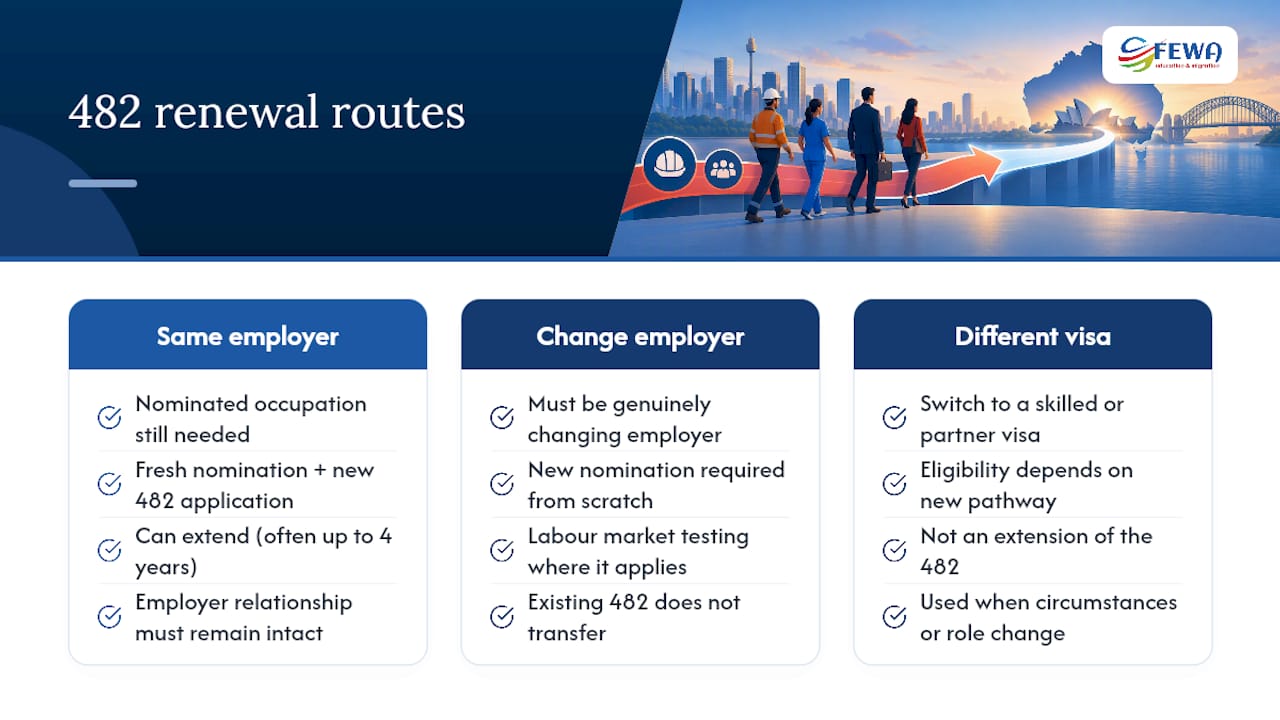
Apply for a new 482 with the same employer. If your nominated occupation is still needed and the employer relationship is intact, a fresh nomination and application can extend your temporary status, often up to another four years depending on your occupation’s stream.
Change employer and get re‑nominated. The 482 is tied to a specific sponsor, so a genuine change of employer means a new nomination process from scratch, including fresh labour market testing where it applies. Your existing 482 doesn’t simply transfer.
Move onto a different visa entirely. Some 482 holders whose circumstances change, a shift in occupation, a partner visa application, or eligibility for another skilled pathway, use that opportunity to pursue a skilled migration visa instead of renewing the 482.
There’s no automatic “extension” button on a 482. Each renewal is a fresh application, assessed against the rules current at the time you lodge, which matters given how often labour agreement and occupation settings change. Applicants who leave renewal to the last few months of their visa often find themselves scrambling for updated payslips, a fresh nomination, or evidence their employer hasn’t kept on file. Starting the renewal conversation with your employer six months out gives everyone room to sort out labour market testing, nomination paperwork, and any changes to salary benchmarks before your current visa runs out.
Fewa’s approach to employer‑sponsored visa planning
Our approach starts with an honest eligibility scan before anything else. We look at your occupation, your employer’s readiness to sponsor, and your realistic timeline, then map out whether 482, 186, or a staged TRT plan actually fits, backed by employer engagement and application support the whole way through.
How Fewa can help you choose between 482 and 186
Choosing between a four‑year temporary visa and permanent residence isn’t a decision to make from a government webpage alone; your occupation list status, your employer’s appetite for long‑term sponsorship, and your own timeline all shift the answer. We work through employer‑sponsored visa options with you directly, including TRT planning if you’re already on a 482 and document preparation if you’re heading toward Direct Entry.
A consultation starts with a straightforward assessment of where you stand: your occupation, your employer’s position, and how close you are to meeting TRT’s two‑year requirement or Direct Entry’s skills assessment threshold. From there, we help you and your employer sequence the nomination correctly instead of guessing at timing. If you’re weighing up a 482 now against holding out for a 186, book a visa consultation to get a clear answer specific to your occupation and employer, not a generic one.
This article is general information, not a substitute for advice from a qualified lawyer. Consult a qualified legal professional about your own circumstances before acting on anything here.
Sources
- Your tax residency — ATO
- Migration Amendment (Labour Agreement Requirements (Subclass 186, 482 and 494 Visas)) Regulations 2024 — Federal Register of Legislation
FAQ
Is It Easy to Get 186 After 482?
It’s straightforward if you meet the two‑year employment rule under TRT and your employer nominates you promptly. Delays usually come from patchy employment records or an employer that hesitates on the nomination, not from the process itself.
What Are the Disadvantages of the 482 Visa?
The main drawbacks are that it’s temporary, tied to one employer, and limits you to your nominated occupation. It also means paying for a second visa application later if you want to reach permanent residence via TRT or Direct Entry.
Is 482 Leading to PR?
Yes, through the TRT stream, but only once you’ve completed at least two years of employment with your sponsoring employer after the visa is granted. The 482 doesn’t lead to PR automatically; your employer has to lodge a fresh 186 nomination.
Do 186 Visas Get Rejected?
They can be, most often due to an incomplete skills assessment, an employer nomination that doesn’t match the role’s genuine requirements, or gaps in employment evidence for TRT. Working with a MARA‑registered adviser before lodging reduces these risks considerably.