


You get permanent residency in Australia mainly through three doors: skilled migration, family (partner or parent), or business/investor streams, with student-to-PR and humanitarian routes as additional options for specific circumstances. If skilled migration fits your profile, SkillSelect and your Expression of Interest (EOI) become the engine driving everything else. Start today by checking your options on Home Affairs and creating or updating your ImmiAccount.
TL;DR:
- Skilled migration requires a high points score, often well above the minimum, especially in competitive occupations like accounting or software engineering.
- Employer-sponsored pathways rely on securing a job offer from a sponsor, which can provide more certainty but depend on employer readiness and visa eligibility.
- Family partner visas demand strong relationship evidence and can take several years, while parent visas have lengthy waits and high costs.
- Studying in demand sectors can help build toward permanent residency through post-study work visas and employer sponsorship.
- Choosing the right pathway depends on accurate assessment of occupation demand, points, family ties, and current visa conditions to avoid delays or refusals.
Table of Contents
- What Are the Main PR Pathways in Australia?
- How Does Skilled Migration Work in Practice?
- What Are the Employer-Sponsored Routes to PR?
- What Family and Partner Visa Options Lead to PR?
- Can International Students Reach PR Through Study?
- What Business and Talent Pathways Exist?
- How Do You Choose the Right PR Pathway?
- Why Getting the Pathway Right the First Time Matters
- How Fewa Can Help You Move Forward
- Where to Verify Current PR Rules Yourself
- Sources
What Are the Main PR Pathways in Australia?
Australia’s permanent residency system runs through three primary streams, each with a different logic for who gets in.
Skilled migration rewards points, occupation demand, and often a state or employer backing. It covers points-tested visas like Subclass 189 (no sponsor needed) alongside nominated options such as 190 and 491. Family migration covers partner visas (onshore Subclass 820/801 or offshore 309/100) and parent visas, built around relationship evidence rather than points. Business and investor streams target people who can bring capital, business acumen, or exceptional talent to Australia, though eligibility here has tightened in recent years.
- Points-tested routes: no nomination required, but competition is fierce
- Sponsor or nomination routes: a state government or employer vouches for you
- Discretionary or talent-based routes: assessed on merit rather than a points formula
State nomination and regional pathways sit underneath most of these categories, not beside them. Each stream has its own eligibility test, and the Department of Home Affairs confirms that a granted permanent visa gives indefinite residence, though your travel rights still depend on the visa’s specific travel facility.
How Does Skilled Migration Work in Practice?
SkillSelect is the online system where skilled workers submit an EOI, and it’s the gateway for nearly every points-tested visa Australia offers. Submitting an EOI does not guarantee anything. The government issues invitations in rounds, and it invites the highest-scoring candidates in each occupation category first, not simply anyone who clears the pass mark.
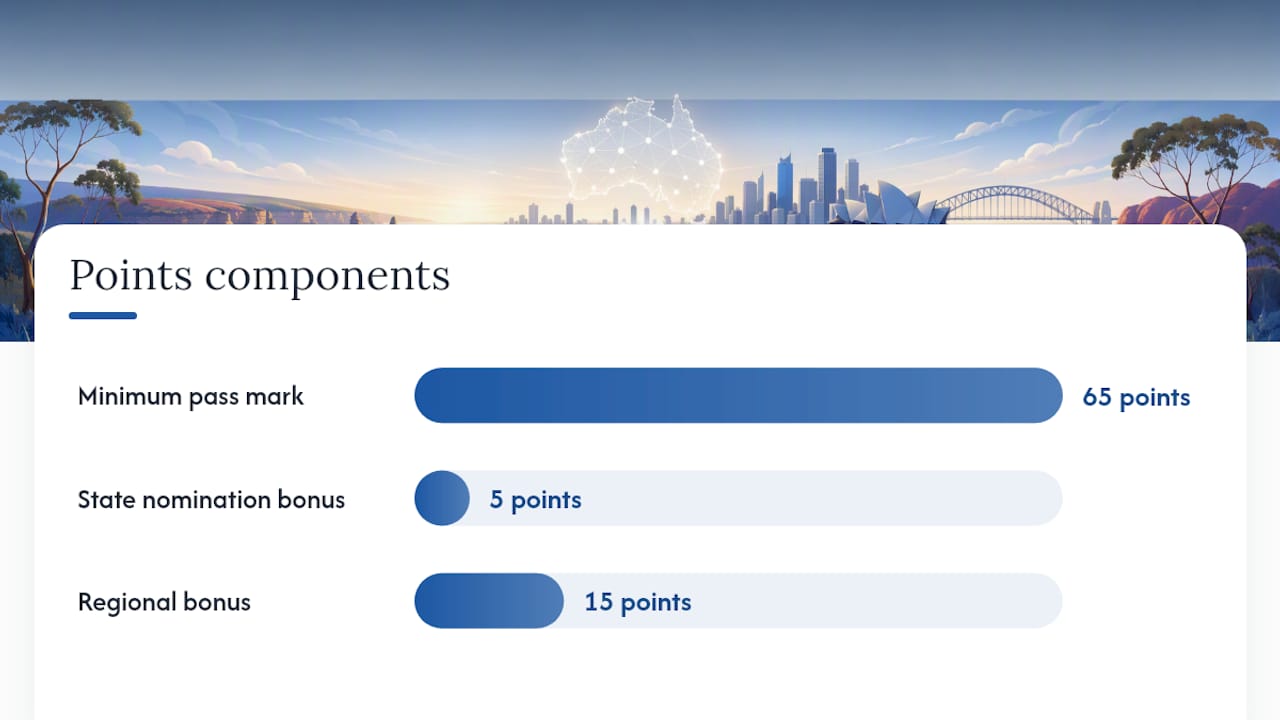
That distinction trips up a lot of applicants. Meeting the minimum 65 points technically qualifies you for the pool, but in competitive occupations like accounting or software engineering, invitation rounds have historically favored scores well above that floor. State nominations add a separate layer of timing, since states run their own Registration of Interest processes with their own occupation priorities.
Three visas dominate this space:
- Subclass 189 (Skilled Independent): no nomination, no sponsor, points-tested only.
- Subclass 190 (Skilled Nominated): state nomination adds 5 points but comes with a residency expectation in that state.
- Subclass 491 to 191: a provisional regional visa that converts to permanent residency after a period, provided you meet income and residency conditions. The 15-point regional bonus makes this route genuinely competitive for mid-career applicants who might not clear the bar for 189.
Pro Tip: Check your occupation against the current skilled occupation list before you invest time in a skills assessment. Occupation lists shift yearly, and an occupation that qualified last year might not this year.
Before you touch SkillSelect, get your skills assessment done, sit English testing, and calculate your points honestly rather than optimistically.
What Are the Employer-Sponsored Routes to PR?
Employer sponsorship removes the guesswork of EOI invitations, but it shifts the burden onto finding an employer willing to commit. The Subclass 482 (Temporary Skill Shortage) visa is the common entry point, and after enough time in that role, many workers transition through the Temporary Residence Transition (TRT) stream into Subclass 186 permanent residency.
Regional employers have their own version: Subclass 494, which leads to permanent residency through Subclass 491.
- Confirm your employer holds active sponsorship approval before signing anything
- Check the required contract length and whether training benchmarks apply to the employer
- Ask whether the role sits on the relevant occupation list for TRT eligibility
- Confirm the labour agreement route if your employer operates under one
Employer-sponsored paths give reliability that EOI-based routes can’t, since a committed employer takes the invitation lottery off the table. The trade-off is that your PR timeline now depends on someone else’s readiness to sponsor, not just your own preparation.
What Family and Partner Visa Options Lead to PR?
Partner visas split into onshore (Subclass 820, moving to permanent 801) and offshore (Subclass 309, moving to permanent 100) categories, and which one applies depends entirely on where you’re living when you lodge. Both require solid evidence of a genuine, ongoing relationship, not just a marriage certificate or a shared lease.
Parent visas move much slower, with wait times that can stretch across many years for the lower-cost options and shorter but far more expensive processing for contributory streams.
- Gather joint financial records, correspondence, and social evidence spanning your relationship’s timeline
- Confirm your sponsor meets the character and financial requirements before lodging
- Expect onshore processing to typically run longer than offshore given caseload volumes
- Avoid submitting inconsistent statements between partners. It’s one of the most common refusal triggers
Sponsors carry real obligations here, including financial responsibility undertakings that outlast the visa grant itself.
Can International Students Reach PR Through Study?
Studying in Australia doesn’t hand you permanent residency, but it builds a realistic bridge toward it. The Subclass 485 Temporary Graduate visa gives you post-study work rights, and that work experience often becomes the foundation for a skilled points score or an employer sponsorship offer down the line.
The common sequence looks like this: complete a qualifying course, move onto a 485 visa, work in your field, then pursue either state nomination or employer sponsorship once you have enough experience to strengthen your EOI.
- Course selection matters. Study in an occupation with strong demand, not just personal interest
- Regional study can extend your 485 visa duration and add points toward regional pathways
- Track how your work experience aligns with your intended skilled occupation before you graduate
What Business and Talent Pathways Exist?
Business and investor streams exist for people who bring capital or established enterprise experience, though eligibility criteria have narrowed in recent program years. For related housing support options, see our Guide to First Home Guarantee Australia. Always verify current settings directly with Home Affairs before assuming an older pathway still runs the way it used to.
The Global Talent visa (Subclass 858) moves fast for people who clear a genuinely high bar. It targets applicants with an internationally recognized record in specific target sectors, and processing can be quicker than skilled or employer routes for those who qualify.
- Business/investor routes suit people with capital and a track record of enterprise
- Global Talent suits established professionals with recognized standing in priority sectors
- Skilled or employer-sponsored routes remain the more realistic option for most applicants without either of these profiles
How Do You Choose the Right PR Pathway?
Picking a pathway comes down to matching your real circumstances against what each stream actually rewards, not what sounds most appealing.
- Check whether your occupation appears on a current skilled occupation list and how much competition it faces.
- Calculate your points honestly, including age, English score, and work experience, rather than assuming the best case.
- Confirm your current visa doesn’t carry a “no further stay” condition before planning an onshore transition.
- Assess whether you have family ties, an employer offer, or investment capital that opens a faster route.
- Check state nomination requirements if you’re considering 190 or 491, since residency obligations vary by state.
Pro Tip: Before submitting anything, confirm your visa’s travel facility conditions. Some temporary visas restrict re-entry, and that detail can quietly derail a pathway you’ve spent months building toward.
Once you’ve narrowed it down, update your EOI, book a skills assessment if you haven’t already, and consider getting advice from a MARA-registered migration agent if your case involves more than one stream or a complicated visa history.
Why Getting the Pathway Right the First Time Matters
Most refusals and long delays don’t come from bad luck. They come from applicants choosing a pathway that didn’t fit their actual points score, occupation demand, or family situation, then discovering the mismatch only after lodging. A second look from someone who reviews these applications daily usually catches the gap before it costs you a visa fee and a year of waiting.
Fewa is MARA-registered, and that registration exists specifically so families and skilled workers have a way to verify who’s giving them advice.
— Ronit
How Fewa Can Help You Move Forward
Fewa works through MARA-registered advice, which means every consultation starts from a verified standing, not a guess. If you’re weighing a skilled visa, Fewa’s skilled migration coaching helps you map your points score against real occupation demand before you touch SkillSelect. If an employer has floated a sponsorship offer, the employer-sponsored visa service walks through contract terms and TRT timing so nothing gets missed. Students weighing a study-to-PR sequence get the same structured review through Fewa’s broader visa services.
Every case is different, and a fifteen minute conversation often reveals which pathway actually fits, not just which one looks fastest on paper. Book a free consultation with Fewa and get a clear read on your options before you commit to an EOI or an application fee.
Where to Verify Current PR Rules Yourself
Policy details shift, so confirm anything time-sensitive directly with official sources before you lodge.
- Home Affairs visa listings for current eligibility and travel facility conditions
- Visa Finder and ImmiAccount to check options and manage applications
- ABS’s Pathways to Permanency for a statistical overview of migration routes
Sources
- Permanent resident (Department of Home Affairs)
- Visa Finder (Department of Home Affairs)
- Pathways to permanency (ABS)