


There is no single IELTS score for permanent residency in Australia. The score depends on your visa. For the main skilled visas (subclasses 189, 190 and 491), you need at least 6 in each of the four components to meet Competent English. Scoring 7 in each (Proficient) or 8 in each (Superior) earns extra points. In practice, those points often decide whether you are invited at all.
This guide explains the thresholds, how the points work, what changed on 7 August 2025, and how PTE compares. If your result is lower than you hoped, there are still sensible next steps.
TL;DR
- Competent English for skilled visas means IELTS 6 in each component (listening, reading, writing, speaking) for tests taken on or after 7 August 2025.
- Superior English means 8 in each component. It gives the maximum English points in the skilled points test.
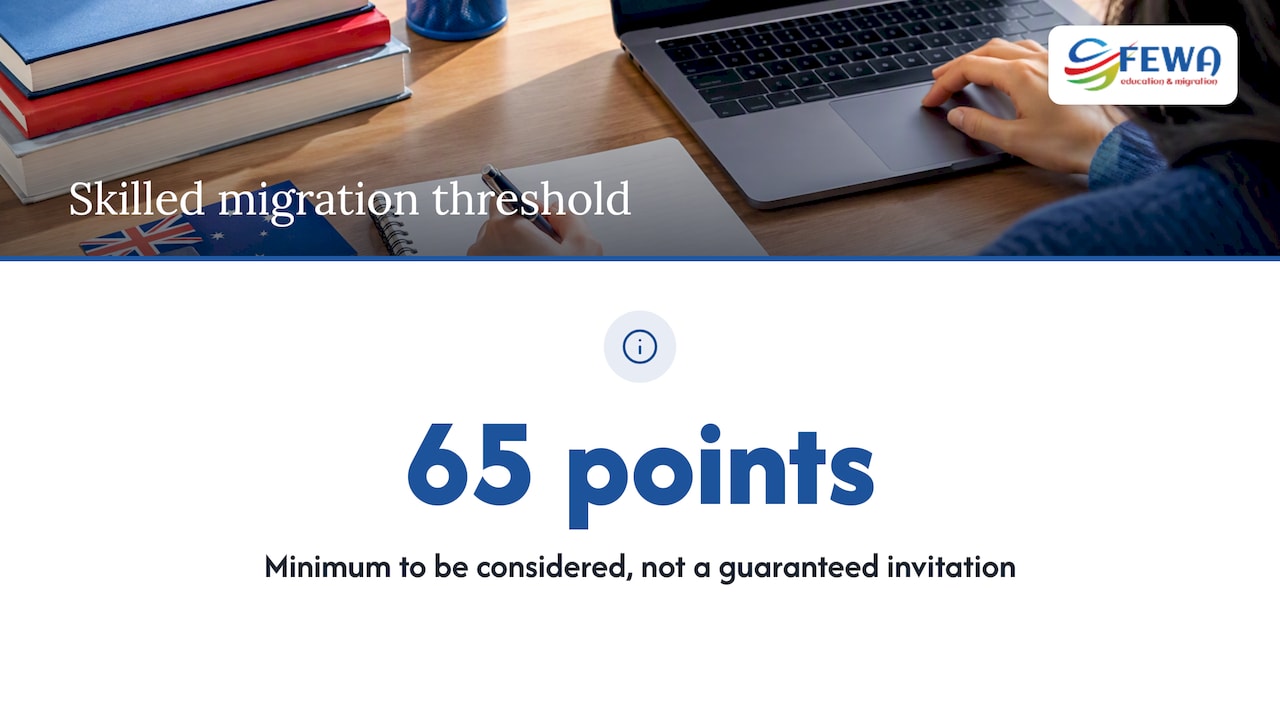
- You need 65 points to be invited, but reaching 65 does not guarantee an invitation.
- Family members and some dependants may only need Functional English, an average of 4.5.
- Some passport holders do not need to sit a test at all (see below).
Table of Contents
- The three English levels Home Affairs uses
- Why the score matters so much for skilled PR
- What changed on 7 August 2025
- IELTS score by visa type
- Do you need to sit a test at all?
- What about PTE?
- Your score is lower than you hoped: next steps
- Our perspective: treat English as a points strategy
- Get your English plan checked before you test
- FAQ
- Sources
The three English levels Home Affairs uses
The Department of Home Affairs does not ask for “a PR score”. It sorts English ability into levels, and each visa names the level it needs. For IELTS (Academic or General Training), for tests taken on or after 7 August 2025, the levels look like this:
| Level | IELTS requirement | Where you typically see it |
|---|---|---|
| Functional | Average band of at least 4.5 | Family members and some dependent applicants |
| Competent | 6 in each of the four components | Minimum for skilled invitations |
| Superior | 8 in each of the four components | Maximum English points |
Proficient English sits between Competent and Superior, at 7 in each component. Home Affairs also accepts IELTS One Skill Retake for eligible visas. That helps if one component let you down.
The key phrase is in each component. An overall band of 7 is not enough if your writing is 6.5. Many people who say “I got 7” actually have an uneven profile, so check your four individual scores first.
Why the score matters so much for skilled PR
Skilled migration through subclasses 189, 190 and 491 is points-tested. You submit an Expression of Interest (EOI) and must reach at least 65 points to be considered. English is one of the factors. Competent English adds nothing on top of the pass mark, while Proficient and Superior English add points (see the subclass 491 points table for the current figures).
Here is the part many applicants miss. Meeting 65 is the entry ticket, not the finish line. The government uses points to rank candidates against the workforce and demographic needs of each state and territory, so 65 does not guarantee an invitation. Applicants who sit at the minimum can wait a long time.
That is why English is one of the most controllable parts of your score. You cannot make yourself younger or add five years of experience this month. You can prepare for a retest.
A simple way to think about it
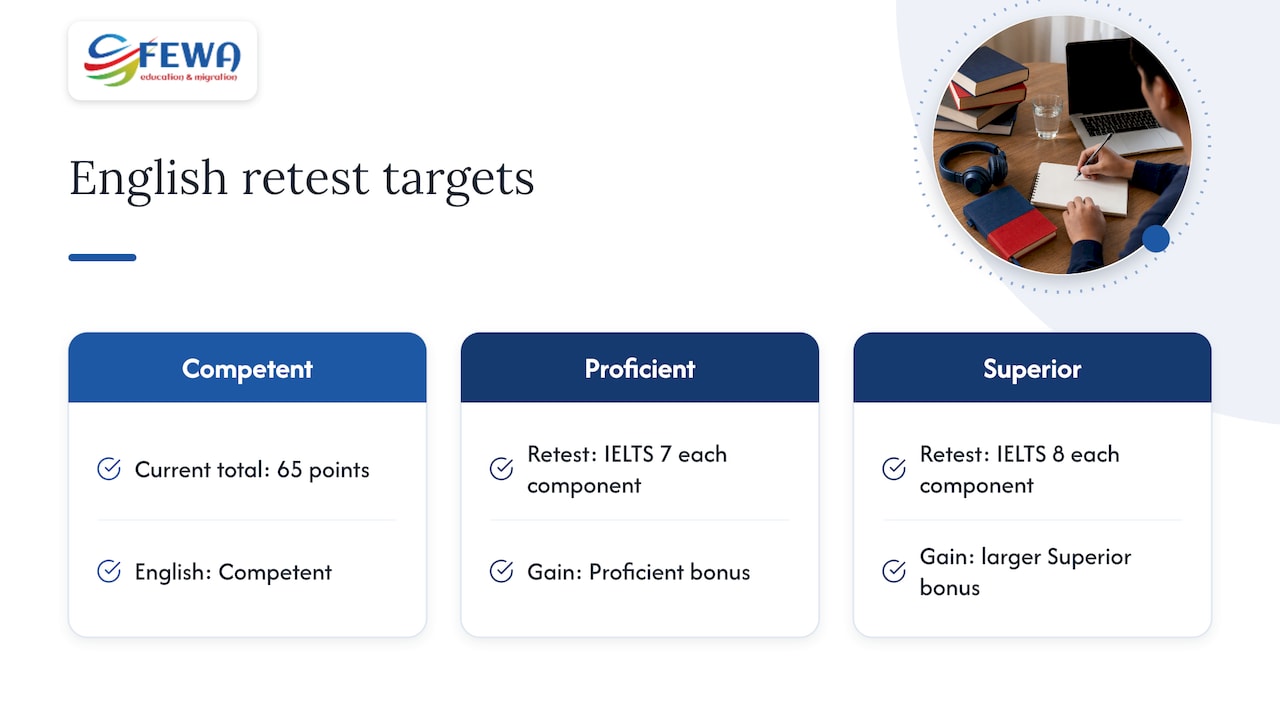
Suppose your points total is 65 with Competent English. If a retest lifts every component to 7, you gain the Proficient bonus without changing anything else in your profile. If you can reach 8 in each, you gain the larger Superior bonus. For some people, the retest does more than a second qualification would, and it costs far less time.
To see where you stand, work through the points calculator on the Home Affairs EOI pages, then book a check with a registered adviser before you pay for another test.
What changed on 7 August 2025
On 7 August 2025, the list of approved English tests and the required scores changed. The rules are set out in the Migration (Specification of Language Tests, Test Scores and Passports) Instrument 2025.
What this means for you:
- Check your test date. A result from before 7 August 2025 may still be valid, often for up to 3 years depending on the visa, but different score rules and validity periods can apply.
- Check the subclass. Validity differs by visa. The Functional English page, for example, says an older result may stay valid for up to 12 months depending on the subclass.
- Do not assume an old score still counts at the same level. If you are close to the line, confirm on the visa’s own page before you lodge.
We cover the newly accepted tests in more detail in our guide to English language tests accepted for Australian visas.
IELTS score by visa type
The level depends on what you are applying for. Home Affairs advises checking the specific eligibility page for your visa, because some visas ask only for Functional English from secondary applicants while primary skilled applicants must meet higher standards.
Skilled Independent (189), Nominated (190) and Regional (491)
Competent English is the floor. Higher bands raise your points. State nomination for 190 and 491 adds its own conditions, and states can set their own English expectations on top of the federal minimum. If you are comparing the two, our article on 190 vs 491 explains the trade-off between a points boost and a regional path. The 491 requirements checklist covers nomination. Home Affairs also publishes state and territory nomination allocations, which show how limited places are.
If you are aiming for the 189, our subclass 189 checklist walks through the steps after invitation, including the 60-day window.
Family members and dependants
Family members included in a skilled application may only need Functional English, an average of 4.5, though the exact rule depends on the visa and the person’s age. Check the visa page. For student dependants, see our guide to student visa dependants.
Student visas and graduate visas
Student visa English requirements are a different matter from PR. They vary by course and provider. We explain them in what is the English requirement for a student visa. Many PR plans start here, so it helps to know that the score you needed to get in is rarely the score you need to get points later.
Do you need to sit a test at all?
Possibly not. Home Affairs treats a valid passport from Canada, New Zealand, the Republic of Ireland, the UK or the USA as evidence of Competent English for many visa classes. If you hold one of those passports, you may not need a test for the minimum level.
A passport does not always earn you the higher points. Check that before you assume you can skip IELTS or PTE. The Home Affairs English language page sets out which levels a passport can and cannot prove.
What about PTE?
Many readers also ask what PTE score they need for PR. PTE Academic is accepted for Australian visas, and the same three levels apply. The difference is that PTE scoring is not a copy of the IELTS bands. Since the August 2025 changes, the component minimums for PTE are set separately, and some are not the same across listening, reading, writing and speaking.
Because those numbers are specific to each test and level, read them from the official instrument or from our breakdown in PTE Academic vs Core component minima rather than from an old blog post. The comparison with IELTS is in PTE vs IELTS. Duolingo is a separate question, which we answer in Duolingo vs IELTS.
Which test should you choose?
Use these criteria:
- Your weakest skill. If speaking is your lowest score, a computer-marked test and a face-to-face test can suit you differently.
- Your target level. If you need 8 in each for Superior, practise under real exam conditions in the format you choose.
- Timing. Results from different dates fall under different rules, so book with your lodgement plan in mind.
- Retake options. Check whether you may qualify for a one-skill retake for your visa.
Your score is lower than you hoped: next steps
A disappointing result is a setback, not the end of the pathway. Here is a calm way to respond.
- Read the four components, not just the overall band. Often a single skill, usually writing, holds everything back.
- Find the gap to the next level. If you have 6.5, 6.5, 7 and 6, you may be one retest away from Proficient English.
- Run your points both ways. Calculate your total with your current score and with a target score. This tells you whether retesting is worth the effort and cost.
- Look at your partner’s profile. If your partner has stronger credentials, they may submit the EOI as the primary applicant while you accompany them as a family member.
- Review other point sources. Regional study can add points too, as we explain in claiming regional study points.
- Check your EOI is clean. Errors in an EOI can cost you. Our SkillSelect EOI checklist lists the common ones.
You also need a skills assessment in your nominated occupation before you submit your EOI. Check that your occupation is on the relevant list using our skilled occupation list guide.
Our perspective: treat English as a points strategy
We see the same pattern often in our Auburn and Sydney consultations. People spend months on qualifications and work history, then treat English as a box to tick. The Department’s own guidance says higher English levels directly lift your EOI points, so we recommend planning the test before you plan anything else that is expensive.
Our advice, as MARA-registered advisers:
- Decide your target level first. Work out whether Competent, Proficient or Superior is realistic, then prepare for that.
- Match preparation to your weakest component. Four evenly strong skills matter more than one brilliant one.
- Do not book the test until you have checked the rules for your visa and your test date. Rules changed in 2025, and a good score under the wrong rules is a frustrating discovery.
- Keep a plan B. Points are competitive. A partner profile, a regional pathway or a different visa may fit you better.
Many of our clients are from the Nepali community in Sydney. They tell us what worries them most is not the exam itself but not knowing which result will count. That is a fair worry, and it is easy to resolve with a short, honest conversation before you pay for anything.
— Ronit
Get your English plan checked before you test
If you want a second pair of eyes on your points, we offer free online consultations for individuals and families. We can review your EOI, discuss the visas we handle (including skilled migration) and help you decide your target. We also run IELTS and PTE coaching. See all our visa services or start at our home page to book.
FAQ
What IELTS score do I need for Australian PR?
For the main skilled visas you need at least 6 in each component for Competent English. A score of 7 in each is Proficient and 8 in each is Superior, and both earn extra points. Your visa page confirms the exact requirement.
Is IELTS 6.5 enough for PR?
If all four components are at least 6, you meet Competent English. But 6.5 does not earn Proficient points, which start at 7 in each component. Whether it is enough depends on your total points and the invitation cut-offs for your occupation.
Is my old IELTS result still valid?
Possibly. A result from before 7 August 2025 may still count, often for up to 3 years depending on the visa, but the rules differ by subclass. Check the visa’s English page or ask an adviser before you lodge.
Can I skip IELTS with a UK or US passport?
For many visa classes, a valid passport from Canada, New Zealand, Ireland, the UK or the USA counts as Competent English. It may not prove higher levels, so check if you need points above the minimum.
Is PTE accepted for PR as well as IELTS?
Yes, PTE Academic is an approved test. The component scores differ from IELTS, so read the current minimums rather than converting bands yourself.
Sources
- English language visa requirements, Home Affairs
- Competent English, Home Affairs
- Superior English, Home Affairs
- Functional English, Home Affairs
- Expression of interest, Home Affairs
- Submitting your Expression of Interest, Home Affairs
- Points table for subclass 491, Home Affairs
- State and territory nomination allocations, Home Affairs
- Migration (Specification of Language Tests, Test Scores and Passports) Instrument 2025