


The Student Guardian (subclass 590) visa lets a parent, legal custodian, or approved relative live in Australia to care for an international student under 18. Start now by asking the student to complete Form 157N, creating your ImmiAccount, and generating your HAP ID for the health exam. You cannot work while holding this visa, and you must live with the student throughout your stay.
TL;DR:
- The guardian must provide clear, current proof of relationship, like recent birth or custody certificates, and ensure all documentation is in English or certified translations.
- Applicants need to demonstrate sufficient funds of AUD29,710 annually for living costs, plus additional proof if a partner’s income is counted, and pro-rata calculations are required for shorter stays.
- Submitting a matching Form 157N that accurately names the student and aligns with primary application details is crucial to avoid delays or refusals.
- Completing health and police checks in advance, especially generating the HAP ID before lodgement, helps reduce processing times.
- The application must convincingly show genuine intent to return home, supported by employment, property, and travel history evidence, to satisfy the Genuine Temporary Entrant requirement.
Table of Contents
- What Does the Student Guardian Visa Allow?
- Who Can Apply for a Guardian Visa?
- Which Documents Do You Need to Apply?
- How Much Money Do You Need to Show?
- What Health and Character Checks Are Required?
- How Do You Apply for the Guardian Visa Step by Step?
- What Is the Genuine Temporary Entrant Requirement?
- What Conditions Apply to the Guardian Visa?
- Where Do Guardian Applications Go Wrong?
- Why the Standard Advice on This Visa Falls Short
- How Fewa Can Help With Your Guardian Visa Application
- Sources
What Does the Student Guardian Visa Allow?
The subclass 590 visa exists for one purpose: letting you provide welfare and support for a child under 18 studying in Australia. Its length tracks the student’s own visa, so if your child’s course runs three years, your visa is generally granted to match that period.
You qualify as a parent, a legal custodian, or a relative aged 21 or older who the student’s family has formally nominated. Picture two common scenarios: a mother accompanying her 15-year-old son through his entire secondary schooling, or an aunt stepping in because both parents work overseas and can’t relocate. Either path works, provided the relationship and nomination paperwork line up.
Who Can Apply for a Guardian Visa?
Eligibility hinges on three things: your relationship to the student, your age, and where you’re applying from. You must be at least 21, and you need to prove the relationship through certified documents, not a verbal claim.
Here’s what trips people up. If you’re already in Australia on certain visa types, particularly some visitor or bridging visas, you may be excluded from applying onshore and need to lodge from your home country instead. Check your current visa conditions before you assume you can simply switch categories.
Exceptions exist for students with additional support needs, medical conditions, or disabilities where a guardian’s presence is considered essential regardless of age technicalities on the student’s side. In these cases, the Study Australia guidance on bringing family outlines the welfare and accommodation obligations you’ll need to demonstrate.
One more detail that matters: your relationship proof needs to be current. A birth certificate from 20 years ago is fine for proving parentage, but marriage certificates, custody orders, or guardianship deeds should reflect your present legal status, not an outdated arrangement.
Which Documents Do You Need to Apply?
Every guardian application lives or dies on paperwork completeness. Here’s the core checklist:
- Form 157N, completed and signed by the student, with one form submitted per student you’re accompanying.
- Passports and identity documents for both you and the student, plus certified copies of birth or marriage certificates proving your relationship.
- Certified translations for any document not originally in English.
- Welfare evidence, including your accommodation address, a written explanation of daily support arrangements, and school or education provider contact details.
- Police certificates covering your residence history.
- Proof of Overseas Visitors Health Cover (OVHC) for the duration of your intended stay.
The Form 157N requirement is where many applications stumble. Case officers match this form against your visa application, and a mismatch, like naming a different student than the one on your primary application, generates a request for more information almost every time.
How Much Money Do You Need to Show?
You need to show enough funds to cover living costs for both yourself and the student, and the numbers are set in legislation rather than left to guesswork.
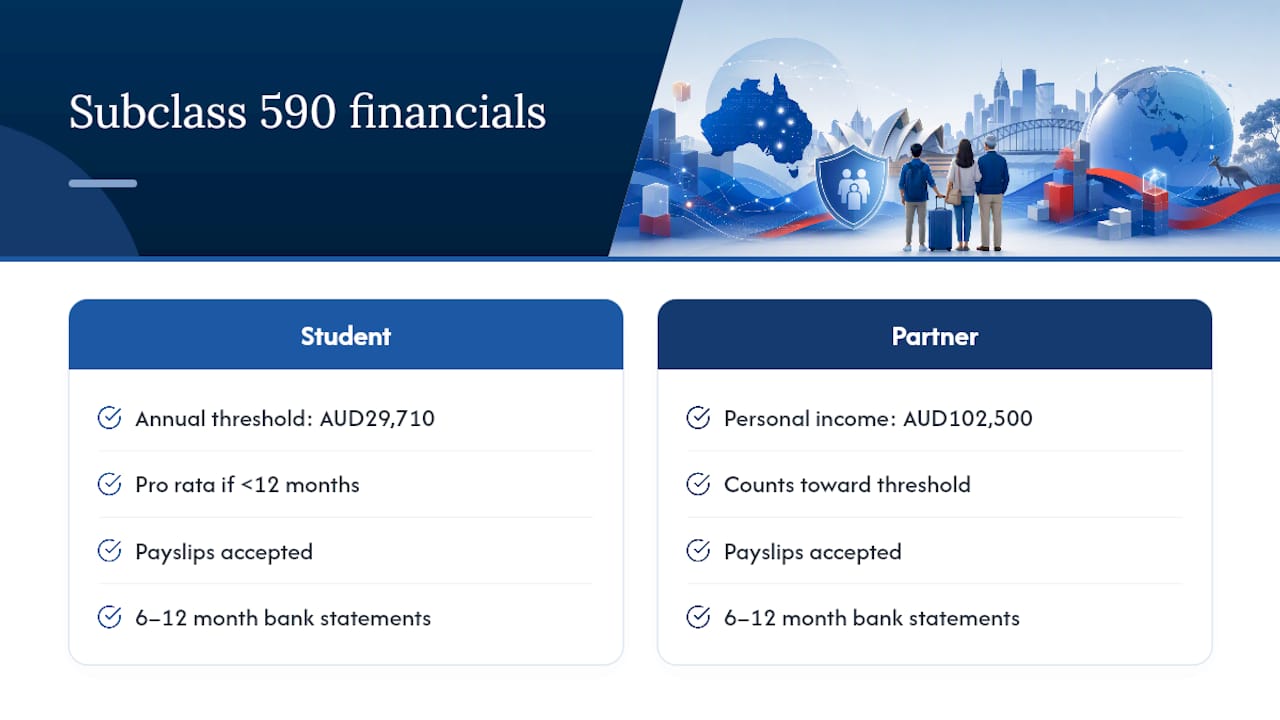
The annual living-cost benchmark for the nominating student when you, as guardian, plan to stay 12 months or longer is AUD29,710, according to the legislative instrument governing subclass 590 financial requirements. If a spouse or de facto partner’s income is being counted toward this threshold, that person’s personal annual income needs to reach AUD102,500 under the same instrument.
Acceptable evidence includes recent payslips, six to twelve months of bank statements showing consistent balances, and official tax notices. If you’re staying for less than a full year, calculate a pro rata figure rather than assuming the full annual amount applies. You’ll also need separate evidence for course fees already paid and realistic travel cost estimates. Reviewing Fewa’s guide to meeting the student visa financial capacity test can help you understand how case officers weigh these numbers against your documentation.
What Health and Character Checks Are Required?
Generate your HAP ID through ImmiAccount and complete your medical exam before you lodge, if at all possible. Applicants who wait until after lodgement to book their exam routinely add weeks to their processing time.
Police certificates need to cover every country where you’ve lived for 12 months or more in the past 10 years. If you’re an Australian resident applying for the first time, the Australian Federal Police provides National Police Certificate guidance directly. Your OVHC needs to be active from the date you intend to arrive in Australia, not backdated or purchased after you land. Insurers won’t backfill coverage gaps, and Home Affairs expects continuous cover for the visa’s full duration.
How Do You Apply for the Guardian Visa Step by Step?
Follow this sequence, and you’ll avoid most of the delays that trip up first-time applicants:
- Confirm the student’s Form 157N is complete and matches the details on your own application before you touch ImmiAccount.
- Create your ImmiAccount through the official Home Affairs portal and begin a new application under the Student Guardian category.
- Book and complete your health exam, generating the HAP ID first, so results are ready by the time you lodge.
- Lodge your application, then follow the biometrics instructions that arrive after you receive your Visa Application Number. Many applicants, including those applying through Vietnam’s Australian embassy checklist, need to attend an Australian Visa Application Centre for fingerprints and photos.
- Monitor VEVO and your email for the grant letter, and check every condition listed once it arrives.
As a rule of thumb, lodge at least two months before the course start date, and no earlier than four months out. Lodging too early means your supporting documents (bank statements, police checks) may age past their useful window before a decision is made.
Pro Tip: Book your health exam the same week you create your ImmiAccount. Medical results can take longer than expected to process, and a completed HAP ID at lodgement is one of the clearest signals to a case officer that your file is ready for a quick decision.
What Is the Genuine Temporary Entrant Requirement?
Every Student Guardian application gets assessed against the Genuine Temporary Entrant requirement, which asks a simple question: do you genuinely intend to return home once your purpose in Australia ends? Case officers don’t take your word for it. They weigh it against a documented set of factors.
Direction No. 106, which took effect in March 2024, tells decision makers to consider your ties to your home country, your immigration history, and how long you’ve previously stayed in Australia, among other circumstances. A guardian with a strong job to return to, property held at home, and a clean visa history presents a straightforward case. Someone with prior overstays or unexplained gaps in their travel history faces closer scrutiny.
Strengthen your file with employment letters confirming your position is being held, evidence of property or financial commitments at home, and a personal statement that addresses your prior visa history honestly rather than glossing over it.
What Conditions Apply to the Guardian Visa?
Once granted, your visa carries conditions you need to follow for its full duration. The student typically holds condition 8532, which ties their enrollment to a specific education provider, while you as guardian face your own living and work restrictions.
You must live with the student at the address you declared in your application, and you generally cannot work while holding this visa. Your visa length matches the student’s course duration, and it does not automatically extend to cover additional family members. Check your specific conditions on your grant letter or through VEVO. Ignoring even a minor condition can jeopardize the visa for both you and the student you’re supporting.
Where Do Guardian Applications Go Wrong?
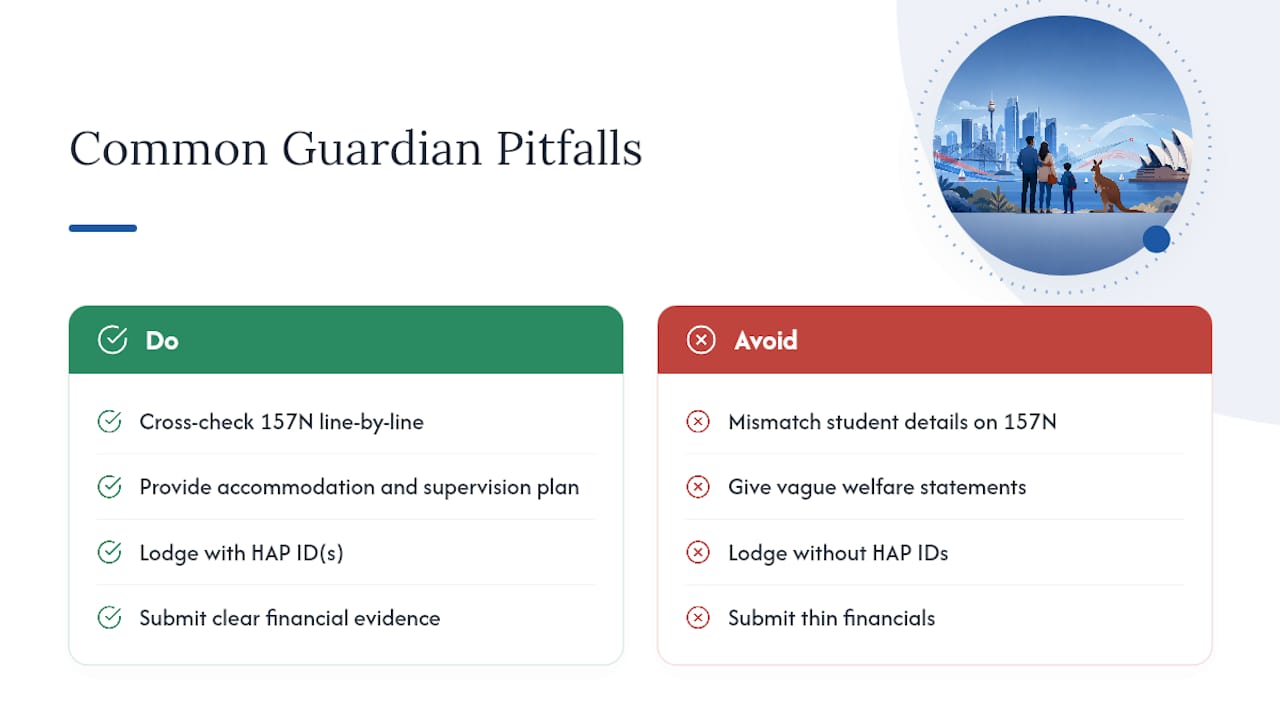
Refusals and requests for more information cluster around a handful of predictable mistakes. Mismatched Form 157N details, where the guardian’s application names a different student than the nomination form specifies, is the single most common trigger. Weak welfare evidence runs a close second. The Department expects a documented plan covering accommodation and daily supervision, not a general statement that you’ll “be there” for the student.
Missing HAP IDs at lodgement, thin financial documentation, and vague GTE statements round out the list. Each is avoidable with the right preparation.
Pro Tip: Have someone cross check the student’s 157N against your own application line by line before you submit. A single mismatched date of birth or address can bounce your file straight into RFI territory.
A pre-lodgement compliance review from a MARA-registered consultant catches these issues before Home Affairs does, reviewing your 157N details against your primary application, financial evidence against the current benchmark, and helping draft a GTE statement that addresses your history directly rather than skirting around it. If your application has already been refused, our guide on what to do after a student visa refusal walks through your review options.
Why the Standard Advice on This Visa Falls Short
Most guidance treats the Student Guardian visa like a paperwork exercise: fill in the forms, attach the certificates, submit. That misses what actually decides these cases. Case officers aren’t grading your form completion. They’re building a picture of whether your welfare plan is real and whether your GTE story holds together.
The financial figures get treated as a checkbox too. Meeting the AUD29,710 benchmark on paper means little if your bank statements show a single large deposit right before you applied rather than sustained savings. Officers notice the difference, and Direction No.106’s ties-to-home-country factors apply just as much to your financial history as to your travel record.
What should you prioritize first? Get the 157N locked down before anything else. It’s the one document that has to match perfectly across two applications, and it’s the easiest thing to fix early and the hardest thing to fix after an RFI lands. Everything else, the medicals, the financial evidence, the GTE statement, can be built around a clean, confirmed nomination.
— Ronit
How Fewa Can Help With Your Guardian Visa Application
Getting a Student Guardian visa right the first time comes down to matching details precisely and presenting welfare and financial evidence the way case officers expect to see it, not just the way it feels natural to write. A MARA-registered consultancy can review your 157N against your application, check your financial documents against current benchmarks, and help you build a GTE statement grounded in your actual circumstances.
Our advisors work through the welfare arrangement details case officers scrutinize most, then walk you through realistic timelines so you know when to lodge relative to your child’s course start date. If your family situation involves additional complexity, a relative guardian rather than a parent, or a student with support needs, that nuance deserves a proper file review rather than a generic checklist. Book a free consultation through Fewa’s visa services page and get your application reviewed before you submit it, not after Home Affairs sends back questions.
Sources
- Subclass 590 Student Guardian visa
- Form 157N — Student guardianship arrangements
- Legislative instrument (financial capacity amounts) — Subclass 590