


Form 888 is the Department of Home Affairs statutory declaration a supporting witness completes for your Partner or Prospective Marriage visa application. Download the current Form 888 PDF from Home Affairs today, choose two witnesses who genuinely know both of you, and gather their identity documents before you ask them to write a word. False statements carry real penalties under the Migration Act, so accuracy matters more than polish.
TL;DR:
- Supporting witnesses must be at least 18 years old with credible, demonstrable knowledge of the relationship and valid identity documents, ideally over months or years.
- Including specific dates, locations, and observable events in the witness statement significantly strengthens its credibility and reduces delays.
- Common issues like vague language, contradictory dates, missing signatures, or poor document quality can lead to delays or credibility problems and should be checked before submission.
- Electronic completion and clear, labeled attachments are recommended for smooth submission and easier verification by case officers.
- Hiring a migration agent is advisable only for complex situations involving conflicting evidence, international witnesses, or gaps in relationship history, to reduce processing delays.
Table of Contents
- What Is Form 888 and Why Does Home Affairs Require It?
- Who Can Complete Form 888 and What Identity Evidence Do They Need?
- How Do You Complete Each Section of Form 888?
- What Do Strong Sample Answers Actually Look Like?
- What Mistakes Cause Delays or Credibility Problems?
- How Do You Attach and Submit Form 888 in ImmiAccount?
- What Should You Prepare Before Asking Witnesses for Help?
- Who’s Behind This Guide and How Can Fewa Help?
- When Does It Make Sense to Hire a Migration Agent for Form 888?
- Sources
What Is Form 888 and Why Does Home Affairs Require It?
Form 888 exists for one reason: to let someone outside your relationship vouch for it in writing. Home Affairs calls it a “supporting statement,” but functionally it’s a sworn statutory declaration that helps a case officer assess what the department describes as the social aspects of your relationship, meaning how your friends, family, and community actually see you as a couple.
This isn’t a formality you can rush through the night before lodgment. The official Form 888 PDF carries a design date, and Home Affairs updates it periodically, so always confirm you’re using the current edition from the departmental forms hub rather than a version you saved months ago or found on a forum.
The form itself is blunt about the stakes. It quotes the Migration Act 1958, which sets penalties for false or misleading statements, including fines and prison terms of up to ten years in serious cases. Home Affairs prints that warning directly on the form your witness signs, and it means witnesses need to understand they’re making a legal declaration, not just doing you a favor.
A few operational details shape how the form works in practice:
- The department can request multiple supporting statements during your application as needed.
- Home Affairs may contact a witness directly for clarification or, in some cases, an interview.
- The form asks for identity evidence from the witness, which we cover in detail in the next section.
- Personal information collected on Form 888 is handled under the department’s privacy obligations, so witnesses aren’t handing information into a void, it goes into your case file.
Because a case officer can follow up with any witness, treat Form 888 as a live document, not a box to tick. If your witness’s account contradicts photos, messages, or your own visa forms, that gap becomes a problem for the department to resolve, and delays follow. The Partner visa pathway already runs on detailed documentation. Form 888 is where an outside voice either reinforces that picture or, if handled carelessly, muddies it.
Who Can Complete Form 888 and What Identity Evidence Do They Need?
Not just anyone can sign a Form 888. Home Affairs expects the witness to be at least 18 years old and to know both partners well enough to speak credibly about the relationship’s history and current state. A witness who met you both twice at a barbecue won’t add much weight. A witness who’s watched your relationship develop over months or years, and can point to specific moments, will.
Strong witness categories include:
- Close friends who’ve spent time with you as a couple across different settings and occasions.
- Family members, either yours or your partner’s, who’ve observed the relationship at home or at family events.
- Colleagues or workmates who’ve interacted with you both outside strictly professional settings, such as work functions or shared social outings.
- Neighbors or long-term acquaintances who’ve seen the relationship unfold over an extended period.
Identity evidence is where a surprising number of applicants trip up. Home Affairs requires the witness to prove their current name, age, and, where relevant, their Australian citizenship or permanent residency. Acceptable documents typically include an Australian passport, a birth certificate combined with photo ID, or evidence of permanent residency such as a visa grant notice. If your witness holds a foreign passport and isn’t a citizen or permanent resident, they can still complete the form. They just need to provide whatever identity document is appropriate to their status, and you should flag this early so there’s no scramble later.
If your ideal witness lives overseas, that’s not disqualifying, but it adds friction. You’ll want to plan for postal signatures, scanned document exchanges, and enough lead time to account for time zones and slower communication. A strong witness ultimately comes down to two things: genuine, demonstrable knowledge of your relationship, and the ability to produce clean identity documents without a last-minute chase. Pick people who can deliver both.
How Do You Complete Each Section of Form 888?
Form 888 breaks into distinct sections, and each one asks for something specific. Treat it like a checklist your witness works through methodically, rather than a blank page they’re expected to fill from memory. Here’s how to approach each part.
Declarant details. The witness fills in their full name, date of birth, occupation, and contact information, including an email address. Home Affairs prefers electronic communication where possible, so make sure this section includes a working email the department can actually reach.
Relationship to the applicant and sponsor. The witness states how they know both of you, whether as a friend, family member, or colleague, and roughly how long they’ve known each of you individually and as a couple. Vague answers without specific dates or events are weaker than those providing concrete timing and context.
Knowledge of the relationship. This is the heart of the form. The witness describes what they’ve personally observed, not what you’ve told them. Good answers cite specific events: a birthday dinner, a family Christmas, a weekend trip, a hospital visit when one partner was unwell. Bad answers restate generic claims like “they love each other very much” with nothing behind them.
Belief in the genuineness of the relationship. Here the witness explains why they believe the relationship is genuine and continuing, drawing on what they described in the previous section. This should read as a natural conclusion from the specific evidence already given, not a legal-sounding declaration bolted on top.
Other relevant matters. Optional space for anything else worth noting, such as knowledge of shared finances, joint travel, or support during a difficult period. Skip it if there’s nothing new to add.
Attachments. If the witness runs out of room, they should note “see attachment” in the relevant section and clearly label any extra pages with their name and the section they relate to.
Signature and date. The witness signs and dates the declaration, ideally on the same day they complete the form electronically, or as close to it as possible if handwritten and scanned later.
The department’s own instructions push witnesses toward specificity over sentiment, and that’s the single biggest lever you have to improve a statement’s quality. A vague statement doesn’t get flagged as fraudulent, it just gets treated as thin evidence, and thin evidence invites more questions.
On formatting: witnesses should type their answers directly into the PDF where possible, since Home Affairs designs the form to be filled electronically. If a witness prefers to handwrite it, block capitals are essential for legibility, and it should still be completed in English. A handwritten form in cramped cursive that a case officer struggles to read doesn’t help anyone, least of all you.
Pro Tip: Before you send the blank form to a witness, fill in a one-page timeline of your relationship yourself, listing key dates, trips, and milestones. Hand that timeline to each witness as a reference. It won’t put words in their mouth, but it stops three witnesses from accidentally giving three different dates for when you moved in together.
Space runs out fast in sections three and four, especially for witnesses who’ve known you for years. When that happens, attach a separate page, write “continued on attachment” in the form, and make sure the attachment references the section number it continues. Case officers reviewing dozens of these forms need that connection to be obvious, not something they have to infer.
What Do Strong Sample Answers Actually Look Like?
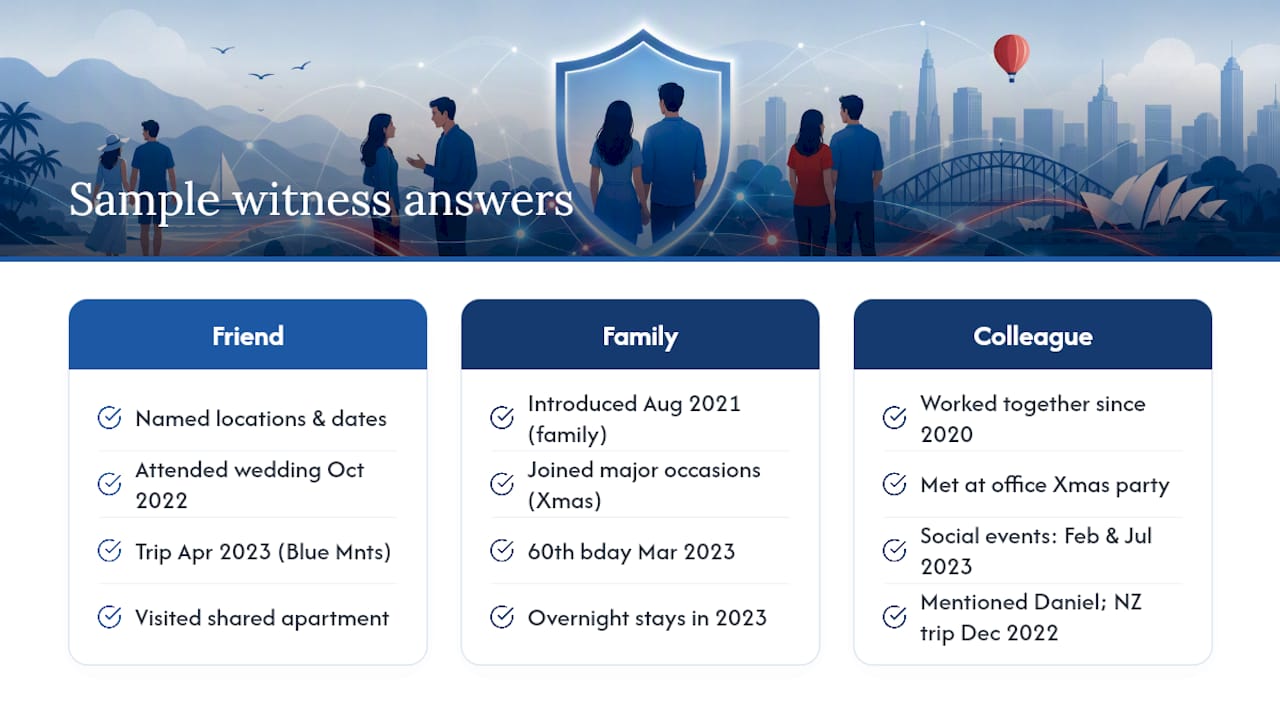
Generic advice about “being specific” only goes so far. Seeing how a specific answer actually reads makes the difference between a witness who understands the assignment and one who freezes at a blank text box. Below are three adaptable examples, each suited to a different relationship with the couple.
From a close friend:
“I’ve known Priya since 2019, when we worked together at a marketing agency in Parramatta. I met Daniel in June 2021, shortly after they started dating, at a mutual friend’s birthday dinner in Sydney. Since then I’ve seen them together regularly, including at my own wedding in October 2022, where Daniel gave a speech as Priya’s partner, and during a weekend trip to the Blue Mountains in April 2023 that the four of us took together. I visited their apartment in Ashfield in early 2023 and noticed they’d combined their belongings and set up the space as a shared home. Based on what I’ve personally seen, including how they support each other through work stress and family visits, I believe their relationship is genuine and ongoing.”
Notice what’s doing the work here: named locations, specific months and years, a concrete shared event with independent corroboration (a wedding the friend also attended), and a direct observation about the shared home rather than a secondhand claim.
From a family member:
“I am Daniel’s mother. I first met Priya in August 2021 when Daniel brought her to a family dinner at our home in Liverpool. Since then, Priya has joined nearly every major family occasion, including Christmas in 2021 and 2022, my husband’s 60th birthday in March 2023, and regular Sunday lunches roughly twice a month. I have stayed overnight at their apartment on two occasions in 2023 and observed them managing household responsibilities together, including grocery shopping and cooking. Priya has also supported Daniel through a difficult period following his father’s surgery in 2022, staying at the hospital with him for several evenings. I have no doubt their relationship is genuine.”
The strength here is the household detail and the frequency claim (“twice a month”), which gives a case officer something concrete to weigh rather than a general assurance.
From a colleague:
“I have worked alongside Priya since 2020 at a logistics firm in North Sydney. I met Daniel in late 2021 at our office Christmas party, where he attended as Priya’s partner. Since then I’ve socialized with them both outside of work on several occasions, including a barbecue at a colleague’s house in February 2023 and a group dinner in July 2023 to celebrate a mutual friend’s promotion. Priya has mentioned Daniel regularly in everyday conversation over the past two years, referencing shared plans like their trip to New Zealand in December 2022. Based on these interactions, I believe theirs is a genuine, committed relationship.”
A colleague’s statement carries less inherent weight than a family member’s, simply because the relationship is more limited, but naming specific social events outside the workplace, and citing details the colleague could only know if the couple actually discusses their life together, closes that gap.
Across all three samples, the pattern holds: dates instead of “a while ago,” named places instead of “somewhere,” and observed behavior instead of borrowed opinion. Avoid legal-sounding phrases like “I hereby attest” that a witness wouldn’t naturally use. Case officers read hundreds of these statements and can usually tell when language has been coached rather than lived.
What Mistakes Cause Delays or Credibility Problems?
Most Form 888 problems fall into a handful of predictable categories, and nearly all of them are avoidable if you catch them before submission rather than after a case officer flags them.
- Vague language with no anchor points. Statements like “they seem very happy together” or “I’ve known them for a long time” give the department nothing to verify. Fix it by asking witnesses to name at least three specific dated events.
- Contradictions with other evidence. If your witness says you moved in together in January 2023 but your lease shows March 2023, that gap invites scrutiny. Reconcile every date across your Form 888 statements, your own application forms, and your documentary evidence before anything gets submitted.
- Missing signatures or dates. An unsigned or undated declaration isn’t a valid statutory declaration, and it will come back to you as incomplete.
- Missing identity evidence. A witness who forgets to attach a passport copy or citizenship evidence creates an easy, entirely preventable gap in your file.
- Overly polished or identical-sounding statements. When three witness statements read like they were written by the same hand, case officers notice. Keep each witness’s voice and level of detail distinct.
A pattern worth flagging directly: the errors above aren’t rare edge cases. They’re common enough that filing guides across the migration sector repeatedly single out the same handful of issues, from incomplete fields to mismatched dates, as the recurring cause of extra scrutiny on otherwise solid applications.
Before you submit anything, run a short final check: does every witness statement have a signature and date, does every witness have valid identity evidence attached, and does every date mentioned match your own timeline exactly? If you can answer yes to all three, you’ve closed off the most common sources of delay.
How Do You Attach and Submit Form 888 in ImmiAccount?
Once your witnesses have completed their statements, the submission process itself is fairly mechanical, but a few details are worth getting right the first time.
- Confirm you have the current form. Download it fresh from the Home Affairs forms hub rather than reusing an old saved copy, since editions change.
- Complete it electronically where possible. Typed text is easier for case officers to read and reduces the risk of a rejected upload due to illegibility. If handwritten, scan it clearly at a reasonable resolution.
- Save it as a PDF with a clear filename, such as “Form888_JaneSmith_Witness1.pdf,” so it’s identifiable if the department requests clarification later.
- Attach it in ImmiAccount under the supporting documents section of your application, either at initial lodgment or later if the department specifically requests additional statements.
- Keep a personal copy of every statement and its attachments in case you need to reference it during a follow-up request or an interview.
If your witness is overseas, factor in extra time for signing and scanning, and check whether the department has raised any notarization expectations for your specific case, since requirements can vary. Most partner visa applicants submit some Form 888 statements at lodgment and hold others in reserve, ready to provide if the department asks for more evidence during processing.
What Should You Prepare Before Asking Witnesses for Help?
A little preparation on your end saves your witnesses enormous time and produces noticeably stronger statements. Build this checklist before you contact anyone:
- The current Form 888 PDF, downloaded fresh from Home Affairs.
- A list of acceptable identity documents so each witness knows exactly what to attach.
- A one-page relationship timeline covering key dates, trips, and milestones.
- Relevant photos, message screenshots, or event invitations that jog a witness’s memory of specific occasions.
- Each witness’s preferred contact details, particularly a working email address.
On timing, reach out to witnesses at least three to four weeks before you plan to lodge or respond to a department request. Rushed statements tend to read thin, and a witness juggling a tight deadline is more likely to write something generic.
A short template helps enormously here. Something like:
“Hi [Name], I need your help with a supporting statement for my partner visa application. I’ve attached the official Form 888, a short list of ID documents that qualify, and a rough timeline of key dates in our relationship to jog your memory. Could you fill it out with your own observations and send it back by [date]? Happy to answer any questions.”
Pro Tip: Send the timeline as a separate one-pager, not buried inside a long message. Witnesses are far more likely to actually use a reference document they can glance at while writing than one they have to scroll back to find.
Who’s Behind This Guide and How Can Fewa Help?
This guide comes from Fewa Education & Migration, a Sydney-based consultancy operating under Migration Agents Registration Authority registration. That MARA status matters because it means the advice here reflects obligations agents are formally accountable for, not just general commentary scraped from forums.
Form 888 is one small piece of a much larger partner visa file, and it’s rarely the only thing standing between an applicant and a decision. Where Fewa adds practical value is in the parts that are hard to self-check: reviewing witness statements for consistency against your other evidence, advising on which witnesses will carry the most weight for your specific circumstances, and handling lodgment through Fewa’s visa services so nothing gets missed in ImmiAccount.
If you’re weighing whether your Form 888 statements are strong enough on their own, a document review is often the fastest way to find out before you submit rather than after a case officer raises a question. Fewa offers a free initial consultation to walk through exactly that.
When Does It Make Sense to Hire a Migration Agent for Form 888?
Most straightforward relationships don’t need a migration agent to complete Form 888. If your timeline is clean, your witnesses are local, and your evidence lines up without contradiction, a careful DIY approach usually works fine.
The calculation changes when your situation has friction built into it. Conflicting evidence between your own forms and a witness’s account, witnesses scattered overseas with document or notarization complications, or a relationship history with gaps that need careful explanation are all signals that professional input is worth the cost. A MARA-registered agent’s real value on Form 888 specifically isn’t writing the statement for your witness, since it has to be the witness’s own words. It’s quality control: catching a contradiction before a case officer does, advising which witness order strengthens your file, and knowing what level of detail actually satisfies a case officer versus what merely feels thorough.
Costs vary by the complexity of your case and the scope of support you need, so ask for a clear, itemized quote before committing. For a file with real complications, the value usually shows up as fewer delays and fewer requests for additional evidence, which is often the more expensive outcome in time and stress. Fewa’s team, including agents registered with MARA, can review your Form 888 drafts alongside your broader partner visa file so any inconsistencies surface early.
— Ronit
Sources
- 888 – Supporting statement in relation to a Partner or Prospective Marriage visa application
- Departmental forms (PDF) — Home Affairs
- Code of conduct — MARA