

Most Australian visa applicants must meet the health requirement, and if you’re applying from within Australia, that means booking through Bupa Medical Visa Services using your HAP ID. Don’t have one yet? Wait for the Department to issue it, or check whether your visa subclass allows an upfront exam through My Health Declarations before you try to book anything.
TL;DR:
- Applicants aged 15 or older applying for permanent visas need HIV and kidney function tests, while those aged 11 or older require chest x-rays.
- The Department reviews the complete medical file to determine if applicants meet health requirements, not the panel physician who conducts the exam.
- Health clearance is generally valid for 12 months, and delays often stem from administrative errors like mismatched details or booking issues.
- In Australia, health exams are booked through Bupa Medical Visa Services, using a HAP ID that links results to the visa application.
- Extra costs can arise from additional tests, courier fees, or specialist referrals, and applicants should prepare by bringing all necessary documents and medical history.
Table of Contents
- What Health Exams Does Your Australian Visa Require?
- How Do You Book a Health Exam in Australia and Overseas?
- What Happens During and After Your Medical Exam?
- How Long Is Your Health Clearance Valid, and What Does It Cost?
- How Should You Prepare for Your Health Exam Appointment?
- How Fewa Helps You Get the Health Exam Steps Right
- Sources
What Health Exams Does Your Australian Visa Require?
The Department doesn’t apply one blanket test to every applicant. What you’re asked to complete depends on your visa subclass, your age, and sometimes your intended occupation.
The standard immigration medical examination (IME) usually includes a general physical exam and a chest x-ray for tuberculosis screening, along with additional pathology depending on circumstances. Some applicants also need HIV testing, hepatitis B and C screening, kidney function tests, and in certain cases a syphilis test. Healthcare workers and those heading into aged care or disability support roles often face an expanded panel.
Age matters more than most applicants expect. Chest x-rays generally become relevant from age 11, and HIV and kidney function testing typically apply from age 15 onward for permanent visa applicants. If you’re applying for a temporary visa, the legislative instrument governing exam requirements set a different, usually lighter, testing threshold than permanent pathways.
One condition stands apart from the rest: active tuberculosis. Under the Panel Member Instructions, TB is the only condition specified in the Regulations that precludes visa grant until you’ve completed treatment and been cleared. Every other health condition gets weighed against a broader policy test.
Here’s what commonly triggers extra scrutiny:
- Applying for a permanent visa at age 15 or older (HIV, kidney function)
- Turning 11 or older at time of assessment (chest x-ray)
- Working or planning to work in healthcare, aged care, or disability services
- Coming from a region with higher TB prevalence
- Having a chronic condition that could raise long-term treatment costs
How Do You Book a Health Exam in Australia and Overseas?
If you’re in Australia, everything runs through Bupa Medical Visa Services. In Australia, you must arrange health examinations with Bupa and you need your HAP ID to make or modify a booking, since that number links your test results to your specific visa application in eMedical.
Here’s the booking sequence that actually works:
- Wait until the Department issues your HAP ID (or confirm your visa subclass allows an upfront exam via My Health Declarations).
- Head to the Bupa Medical Visa Services online booking portal and enter your HAP ID exactly as it appears on your eMedical referral.
- Select a clinic near you. Bupa operates panel clinics across Greater Sydney and other major Australian cities.
- Call Bupa’s contact centre on 1300 794 919 if you need to reschedule, cancel, or arrange a special-case assessment (such as a pregnancy accommodation or interpreter request).
- Attend your appointment with your original passport and any requested prior medical records.
If you’re applying from outside Australia, you’ll need a Department-approved panel physician in your country, not Bupa; for example, travellers from the UK can learn about the Dubai Visa Medical Test process as a comparative reference. Your visa application will list which panel clinics are approved for your location. Costs are generally your responsibility, though the Australian Government does cover exam costs for a limited category of offshore humanitarian applicants.
Pro Tip: If you don’t have reliable internet access to book online, Bupa’s phone line can process the booking for you. Have your HAP ID and passport number ready before you call, it speeds things up considerably.
What Happens During and After Your Medical Exam?
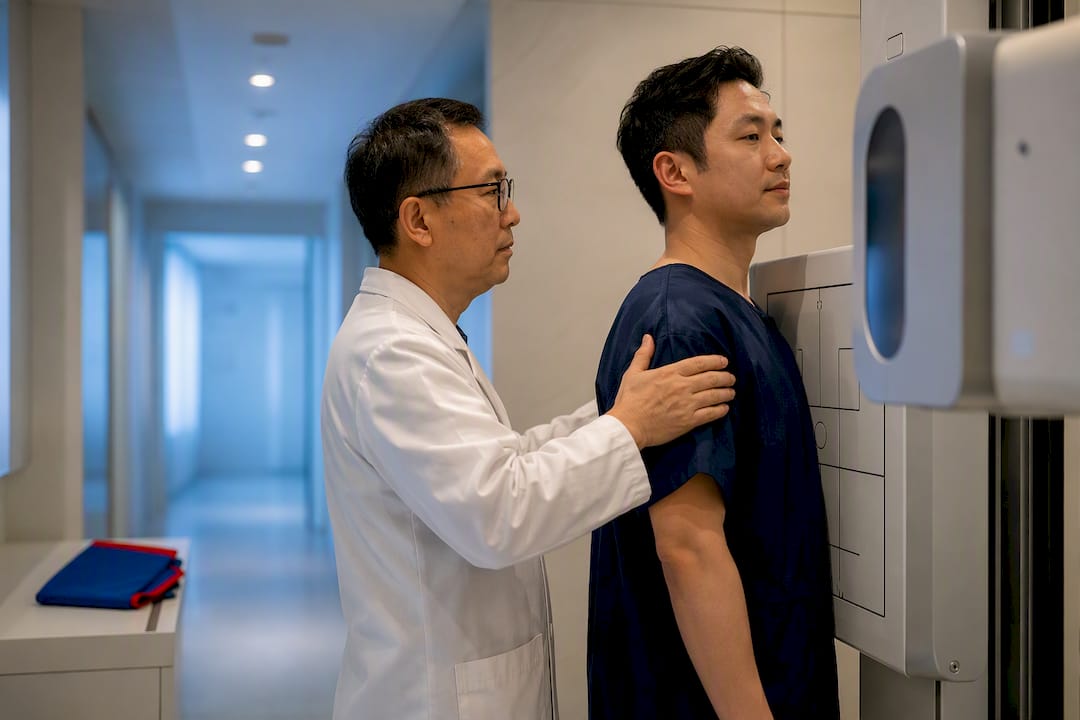
At the clinic, the process follows a fixed structure. You’ll complete Part A and Part B of your health declaration forms before arriving (Part C gets filled out with the physician present), then move through the physical exam, blood draw, and chest x-ray if required. The panel physician attaches your pathology and radiology results directly into your eMedical file.
Here’s the part many applicants misunderstand: the panel physician who examines you doesn’t decide whether you meet Australia’s health requirement. Panel physicians conduct the IME but the Medical Officer of the Commonwealth (MOC) reviews the complete eMedical file and issues the formal opinion back in Australia.
That opinion lands in one of a few categories:
- Meets the requirement — no further action needed
- Deferred — usually pending additional tests or specialist review
- Does not meet the requirement — triggers further assessment or a health undertaking
- No further assessment required — sometimes paired with a health undertaking for ongoing monitoring
If a chest x-ray suggests active TB, the MOC can refer you to a state or territory chest clinic for further clinical and radiological review before finalizing anything. The Department retains your medical records after your visa decision, partly for audit purposes, so it’s worth keeping your own copies of every result and letter.
How Long Is Your Health Clearance Valid, and What Does It Cost?
Health examination results are typically valid for 12 months. If your visa processing drags on longer than that, expect to redo the exam, and expect to pay for it again yourself in most cases.
Applicants generally cover their own clinic fees. The exceptions are narrow, limited mainly to certain offshore humanitarian cases where the government picks up the cost. Extra tests, courier fees for sending results, or specialist referrals can add to the bill beyond the standard IME price.
A quick reality check: the single biggest cause of delay isn’t the medical exam itself, it’s administrative mismatches. Details on your HAP ID must match your passport exactly; a misspelled name or wrong date of birth can bounce your results out of the system entirely.
Common pitfalls worth avoiding:
- Booking before your HAP ID arrives, which can create an unlinked, unusable result
- Passport details that don’t match what’s recorded in eMedical
- Failing to formally cancel or reschedule instead of simply not showing up
- Letting your 12 month validity window lapse mid-processing
How Should You Prepare for Your Health Exam Appointment?
Preparation is straightforward if you tackle it in order.
- Bring your original passport and your HAP ID or eMedical referral letter. The clinic will use both to confirm your identity.
- Complete Parts A and B of your health declaration at home. Part C gets signed in front of the physician.
- Gather any relevant prior medical records, especially if you have a chronic condition or previous TB treatment history.
- Confirm whether you need to fast before your blood test, and mention any pregnancy or the need for an interpreter when you book.
- Expect the clinic to photograph you, collect your signed declaration, and attach your pathology results directly to your eMedical record before you leave.
Students arranging cover alongside their exam should also check the requirements for Overseas Student Health Cover, since it’s often assessed around the same time as your visa health checks.
How Fewa Helps You Get the Health Exam Steps Right
We’ve seen how often a small administrative slip, a name that doesn’t quite match between HAP ID and passport, or a booking made a day too early, turns a routine health exam into weeks of delay. That’s usually where our support matters most.
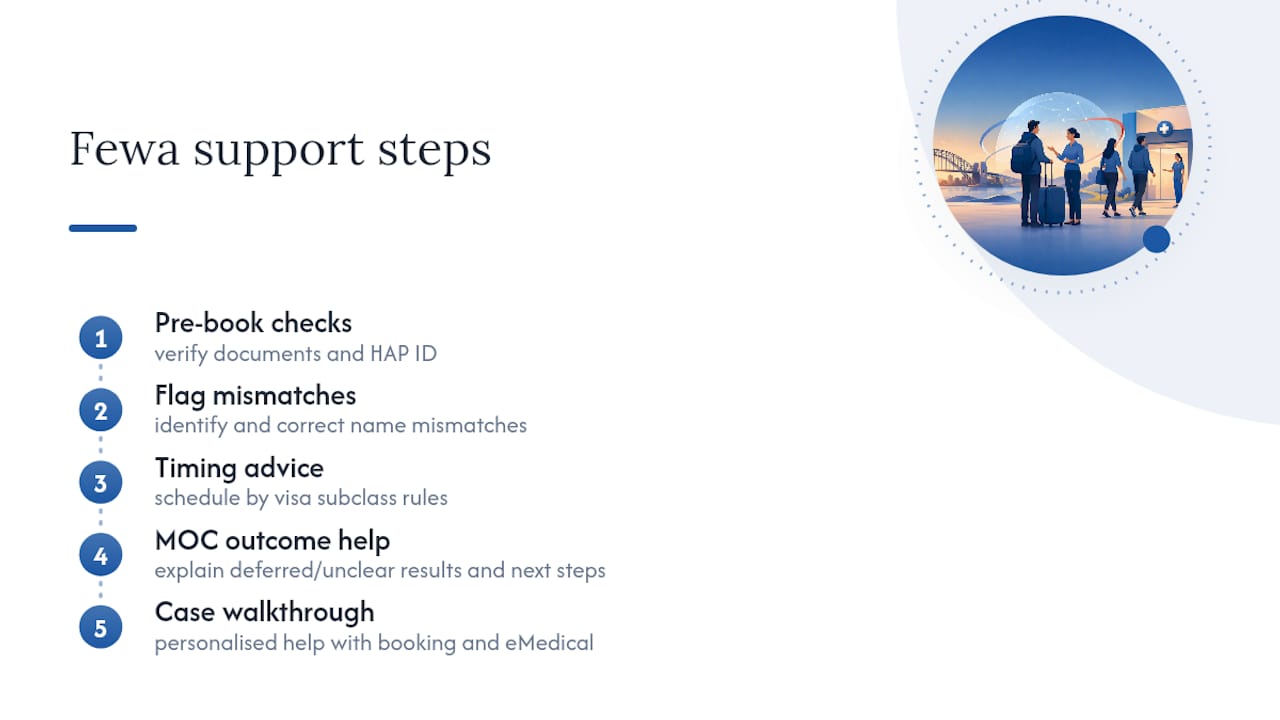
We check your paperwork before you book, flag mismatches between your HAP ID and passport, and advise you on the right moment to schedule your appointment based on your visa subclass. When a MOC outcome comes back deferred or unclear, assistance can be provided to help you understand what it actually means for your application and what happens next.
This isn’t a substitute for reading the Department’s own requirements. It’s practical support for getting through them cleanly. If you’d rather not navigate booking windows and eMedical quirks alone, our visa services team can walk through your specific case.
Sources
- Arrange your health examinations – Department of Home Affairs
- Migration Regulations / legislative instrument (examinations and age milestones)