

Condition 8516 means you must keep meeting the requirements you met when your student visa was granted. In practice, you stay a genuine student, stay enrolled in a course that fits your visa, and keep the financial capacity to support your study and stay. If you hold a Student visa (subclass 500), you have this condition. It is easy to overlook because it does not list a number of hours or a dollar figure. That is also why it catches people out.
We are a Sydney-based, MARA-registered education and migration consultancy, and we regularly meet students who first read about 8516 on their grant letter and are unsure what it asks of them. This guide explains it in plain language, shows what a breach looks like, and gives you steps to stay on the right side of it. If you are worried about a situation right now, you are not alone, and most problems are easier to fix when you act early.
TL;DR
- Condition 8516 applies to Student visa (subclass 500) holders and requires you to continue to satisfy the criteria your visa was granted on.
- The main risks are changing to a course that no longer fits your grant, losing real study progress, and a major change in your finances.
- A breach can lead to visa cancellation, so check before you switch courses or providers, not after.
- If your circumstances change, get advice from a registered migration agent early rather than waiting for a notice.
Table of Contents
- What condition 8516 actually says
- Where to find it on your own visa
- What “continuing to satisfy the criteria” covers
- How 8516 gets breached in real life
- What happens if you breach it
- Practical steps to stay compliant
- Our perspective: ask before you act
- How we can help
- Frequently asked questions
- Sources
What condition 8516 actually says
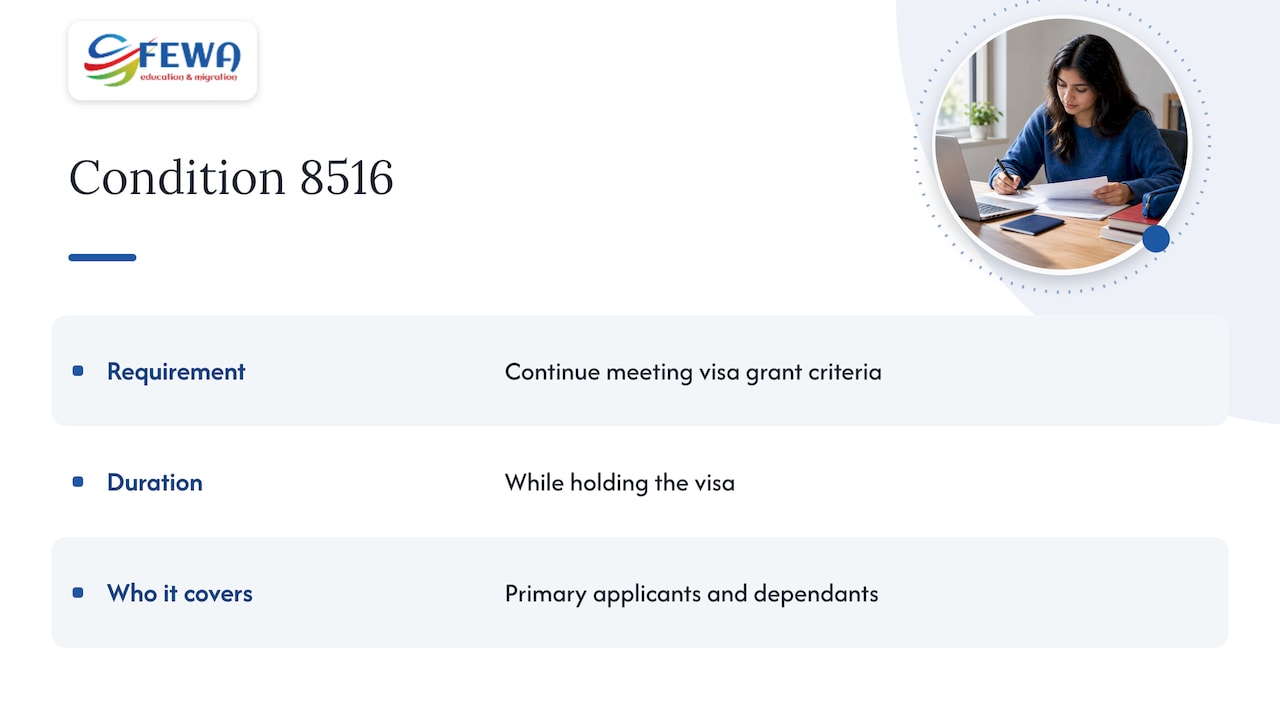
The wording of the condition is short. The holder must continue to be a person who would satisfy the primary or secondary criteria, as the case requires, for the grant of the visa. A Federal Court matter on the meaning of the word “continue” is summarised by Migration Law Updates, and the wording above is the one that case discusses.
The Department of Home Affairs lists 8516 among the conditions that attach to student visas. Think of it as a continuing test. You passed it on the day of grant. The condition asks you to keep passing it for as long as you hold the visa.
The condition applies to you if you are the primary applicant. Dependants on the same visa are covered too, because the wording refers to the primary or secondary criteria. If you are bringing family, our guide to student visa dependants explains what applies to them.
Where to find it on your own visa
You do not need to guess whether you have it. Check your own record:
- Open your visa grant letter and look for the list of conditions.
- Or use Home Affairs’ check visa details and conditions page, which points you to VEVO.
- Note every condition number, not only 8516. Work limits, enrolment and health cover each have their own conditions.
If your conditions look different from what you expected, take the letter to a registered migration agent before you make any changes to your course or work.
What “continuing to satisfy the criteria” covers
Three areas matter most in day-to-day life. They are the same areas the Department assessed when it granted your visa.
1. You remain a genuine student
Applications lodged on or after 23 March 2024 are assessed under the Genuine Student requirement, which replaced the Genuine Temporary Entrant test for those applications. It looks at your circumstances, your study history, your reasons for choosing the course and provider, and what the course will do for your future.
Condition 8516 carries that thinking forward. Studying should remain the main reason you are in Australia. That means attending, progressing and treating your course as the centre of your stay.
2. You stay in a course that fits your grant
Your visa was granted for a particular course and level. If you move to a different course, the question is whether you would still have met the criteria for that visa with the new course. This is the area where we see the most accidental problems, and we cover it in detail below.
3. You keep your financial capacity
When you applied, you showed funds for travel, living costs and tuition. Under 8516, that is not a one-off box ticked at the grant. If a sponsor can no longer support you or promised funds become unavailable, you may no longer meet the criteria. Our guide to the student visa financial capacity test shows how the evidence is assessed, and our 12-month budget guide helps you plan beyond tuition.
How 8516 gets breached in real life
Most breaches are not dramatic. They come from reasonable decisions made without checking the visa consequences. Here are the patterns to watch.
| Situation | Why it can raise an 8516 issue | What to do |
|---|---|---|
| Moving from a higher education course to a lower-level or vocational course | The new course may not match what your visa was granted for, and you may need a new visa rather than a simple enrolment update | Get your options assessed before you enrol |
| A long gap between courses, even if you are enrolled in both | A significant gap can call your genuine student status into question | Plan start dates so there is no avoidable break |
| Staying enrolled but making no progress | Substance matters more than a name on an enrolment list | Speak to your provider’s support team about progress early |
| A sponsor withdraws funding | Your financial capacity may no longer match what you showed | Seek advice and document your new funding |
| Using study as a way to stay while the real purpose is something else | Studying must remain the primary reason for your stay | Be honest with yourself and your adviser about your goals |
The course-change and gap scenarios above are described in Home Affairs’ own conditions list guidance and in practitioner commentary. Education providers have also been told to watch for it: the Department ran an education campaign on course hopping and 8516, which a university published for its education agents.
A note on the word “continue”
Students sometimes read “continue” as “study every day without a break”. That is not how it is usually understood. Scheduled course breaks are normal. The legal commentary on the Federal Court decision suggests that decision makers look at the substance of what you are doing: are you genuinely progressing towards a qualification, or only keeping an enrolment alive? Your status as a student needs to be legitimate and unbroken in terms of enrolment.
What happens if you breach it
A visa can be cancelled under section 116(1)(b) of the Migration Act if the decision maker is satisfied the holder did not comply with a condition. The Department’s conditions page also states that failing to comply can lead to cancellation.
That is the serious end of the range. A breach does not mean cancellation will automatically follow, and your circumstances matter. Ministerial Direction No. 106 tells decision makers to consider the relevant factors together when assessing the genuine student criterion, rather than looking at a single fact in isolation. Your history, your reasons and your evidence all count.
If you receive a notice of intention to consider cancellation, treat the response deadline seriously. Gather your evidence and speak to a registered migration agent or migration lawyer straight away. That is the situation where professional help matters most.

Practical steps to stay compliant
These habits take little time and protect your visa.
- Keep your grant letter and conditions list in one folder. Save a copy of your VEVO result too.
- Check before you change course. Ask your provider about the new course level, then ask whether it affects your visa. Our guide on changing course safely on a student visa walks through the steps and the six-month rule.
- Avoid gaps. Line up your next enrolment before your current course ends.
- Keep your academic record healthy. If you are struggling, talk to your provider’s student support before progress slips.
- Review your finances once a year. If your funding source changes, record how you are now covered.
- Keep your work within your limits. 8516 is separate from work conditions, but breaches in one area can draw attention to the others. Our work-hours guide explains how to track your fortnights.
- Plan your next visa early. If you are nearing the end of your course, read how to extend a student visa in Australia.
Our perspective: ask before you act
In our experience, the students who run into 8516 trouble are rarely trying to bend the rules. They are people who changed course because the first choice did not suit them, or because a friend recommended a cheaper college, or because family finances shifted. Each decision was sensible. Nobody told them it needed a visa check.
We built our service around that gap. As a Sydney consultancy registered with MARA, we place a lot of weight on authentic, personalised guidance. For us that means looking at your actual visa grant, your course history and your funding, not offering a generic answer. It also means being honest when a plan carries risk.
Our advice is simple. Treat your grant letter as the baseline. Before any change to your course, provider, funding or study plan, ask whether you would still meet the criteria you were granted on. If the answer is unclear, that is the moment to talk to someone. A conversation costs far less than a visa problem.
A setback with a course, a provider or your finances is not the end of your plans. There is usually a pathway forward, and it is clearer the earlier you look at it.
— Ronit
How we can help
If you want a registered agent to review your conditions, your course plans or your funding, our team handles Student visa (subclass 500) matters from application through to extension and change of course. You can see the full range of visas we assist with on our visa services page, and you can book a free consultation to talk through your situation.
Frequently asked questions
Does condition 8516 apply to every student visa holder?
Yes, it is a condition that attaches to subclass 500 student visas, according to the Home Affairs conditions list. Check your own grant letter or VEVO to confirm the conditions on your visa.
Can I change courses without breaching 8516?
Often you can, but it depends on the new course and your circumstances. A move to a lower-level course, or a significant gap between courses, can mean you no longer fit your original grant and may need a new visa. Check before you enrol, using our course change guide as a starting point.
Does 8516 mean I have to prove my finances again?
Not on a schedule. But the financial capacity you showed at grant is part of the criteria you must continue to meet, so a major change, such as a sponsor withdrawing support, can matter. Keep records of how you are funded, and seek advice if something changes.
Is condition 8516 the same as the work limit condition?
No. The work limit sits in a separate condition. 8516 is about continuing to satisfy the grant criteria. You can read how to track your hours in our work-hours guide.
What should I do if I think I have already breached it?
Do not ignore it and do not make rushed changes. Gather your enrolment, progress and funding documents, then speak to a registered migration agent or migration lawyer promptly. Being open about what changed and why is usually better than waiting for a notice.
Sources
- Home Affairs: check visa details and conditions (conditions list)
- Home Affairs: see your visa conditions, subclass 500
- Home Affairs: Genuine Student requirement
- Home Affairs: Document Checklist Tool
- Home Affairs: Ministerial Direction No. 106
- Migration Law Updates: Condition 8516, term continue interpreted
- Jaspreet Singh (Migration) [2018] AATA 4952
- University of South Australia: Course hopping notice for agents