

Most people applying for an Australian visa need at least one police certificate. If you are 17 or older and have spent a combined 12 months or more outside Australia since turning 16, Home Affairs will generally ask for one from each country involved. If you have lived in Australia for 12 months or more, that usually means an Australian Federal Police (AFP) National Police Certificate as well. This guide explains who needs what, how to apply, and where applications most often go wrong, so you can respond to a request with confidence rather than worry.
TL;DR
- Home Affairs asks for police certificates from each country where you lived or travelled for a cumulative 12 months or more since turning 16. The department can also request one even if you fall below that threshold.
- For an Australian certificate, apply through the AFP, choose the Commonwealth employment/purpose option and use code 33. The AFP lists the fee as $57, or $114 if fingerprints are required.
- Certificates not in English must be uploaded with a certified English translation, and the original must be included too.
- A clean certificate supports your character assessment but does not guarantee a visa. You must still declare any charges or convictions yourself.
- Start early. Fingerprint checks take much longer than the routine digital check.
Table of Contents
- When Home Affairs asks for a police certificate
- Which certificates you may need
- How to get an Australian police certificate (AFP check)
- Getting your Nepalese police certificate
- Translations: the step people forget
- What a clean certificate does and does not do
- Common mistakes and how to avoid them
- Our view: treat police certificates as part of your timeline
- Need help with your visa application?
- FAQ
- Sources
When Home Affairs asks for a police certificate
There are two triggers. The first is a direct request: the department can ask you for a certificate at any point, including after you lodge. The second is the time-outside-Australia rule. Home Affairs guidance says applicants aged 17 or older generally need a penal clearance certificate or police check from each country they visited or lived in where the total time reaches 12 months or more, counted from the age of 16 over the past 10 years.
Two details trip people up.
The time is cumulative, not consecutive. Three months here, five months there and four months on another visit can add up to 12 months in the same country. List every stay, however short.
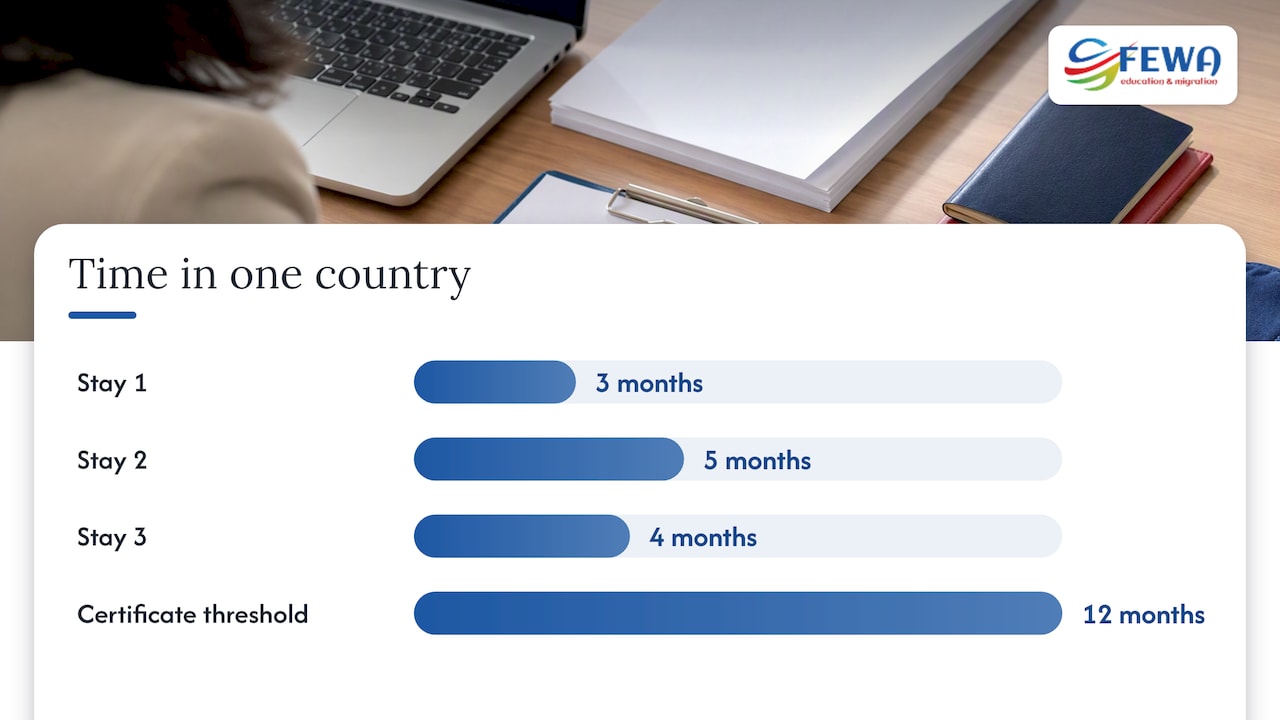
The 12-month rule is a screening rule, not a promise. Even if you think you are below the threshold, Home Affairs reserves the right to ask for a certificate later. If your travel is complicated, you hold more than one passport, or you are unsure of old residence dates, build a full address-and-travel timeline before you lodge. It will save you scrambling when the request arrives.
Skilled visa applicants and family members
For skilled visas the checklist is specific. You must provide certificates for you and your family members over 16, covering every country where you lived for 12 months in the past 10 years since turning 16. Family members included in your application are covered by the same requirement, so each person needs their own timeline.
Which certificates you may need
Think of it in two groups: Australia, and every other country on your timeline.
| Where you lived | Who issues the certificate | What to keep in mind |
|---|---|---|
| Australia | Australian Federal Police (AFP) | State police checks are not accepted for immigration. Use the AFP National Police Check. |
| Nepal | Nepal Police, through the OPCR online system | Download the file from your account and keep the electronic original. |
| Any other country | That country’s official police or justice authority | Check the Home Affairs page for the country, and translate if not in English. |
If you are already in Sydney and have lived here for 12 months or more, you will normally need the AFP certificate plus one from your home country, and from any third country where you spent a combined 12 months or more.
How to get an Australian police certificate (AFP check)
The Home Affairs instructions are clear: complete the AFP National Police Check application and, when asked about the purpose, choose the Commonwealth employment/purpose option. Do not pick an ordinary employment or volunteer purpose. That can produce a certificate that does not match the immigration request, and you would have to pay and wait again.
Step by step
- Go to the AFP’s National Police Check page. Use the official AFP service, not a reseller, unless you are comfortable paying an extra handling fee for convenience.
- Select the Commonwealth purpose and enter code 33. This tells the AFP the certificate is for immigration.
- Gather your identity documents. The AFP needs several forms of ID. Have your passport, and your other identity documents ready, and scan them clearly.
- Decide whether fingerprints are needed. If your name matches or your identity cannot be confirmed through the standard check, you may be asked for a fingerprint-based check. That changes the application channel and the fee.
- Pay the fee. The AFP lists $57 for each application, or $114 when fingerprints are required.
- Wait for your digital certificate. It is emailed to you once the check is complete.
How long it takes
Most digital certificates are finished within about 48 hours, though some take longer. Fingerprint checks are a different story: allow at least 15 working days, and plan for 15 to 30 business days. The AFP advises that you wait at least 15 business days before asking about a hard-copy certificate, check your junk folder, and do not submit a duplicate application while you wait.
The practical lesson: never plan a visa deadline around the 48-hour figure. If Home Affairs gives you a date in ImmiAccount, apply the same day.
Getting your Nepalese police certificate
If you lived in Nepal, the official route is the Nepal Police Online Police Clearance Registration (OPCR) system. You apply through your account and, once issued, download the certificate from that same account. Keep the original downloaded file as well as any printout, because online uploads and later requests may need the electronic version.
The OPCR site lists phone support on +977 01-5719865 and 9851285920, and the email opcr@nepalpolice.gov.np, during office hours of 10:00am to 5:00pm Nepal time. Keep the time difference in mind if you are ringing from Sydney.
We suggest you use the official system yourself rather than an informal intermediary. The certificate comes straight from the issuing authority and can be retrieved from your account again if Home Affairs asks for it later. If you are planning the wider move, our Kathmandu checklist for moving to Australia shows where the police certificate fits among the other documents.
Translations: the step people forget
A genuine certificate can still be treated as incomplete if the translation is wrong. Home Affairs says that if a document is not in English you must submit a certified English translation with it.
- Translated in Australia: use a NAATI practitioner and make sure their practitioner number appears on the translation.
- Translated overseas: include the translator’s full name, address, phone number, qualifications and experience.
- Always upload both: the original certificate and the translation. Do not replace the original with the translation.
If you also need certified copies of other documents, our guide to certified copies for Australian visas explains who can certify what.
What a clean certificate does and does not do
A police certificate is evidence for the character requirement. It is not a visa guarantee. Under the character provisions of the Migration Act 1958, visas can be refused or cancelled where the character requirements are not met. The department may also ask for more, such as Form 80, Form 1563, military records or a letter of good conduct, even after you supply a certificate.
Declare everything
You must answer character questions truthfully, including charges awaiting legal action and convictions. Do not assume an old offence will not appear. The AFP explains that a National Police Certificate generally will not disclose spent convictions, but there are exceptions, and immigration or citizenship purposes can be among them. Disclosure rules also differ between jurisdictions.
If something in your history worries you, speak to a registered migration agent before you lodge, not after a refusal. If you need to explain your circumstances in writing, our guide to statutory declarations for visa applications shows how to present them properly.
Common mistakes and how to avoid them
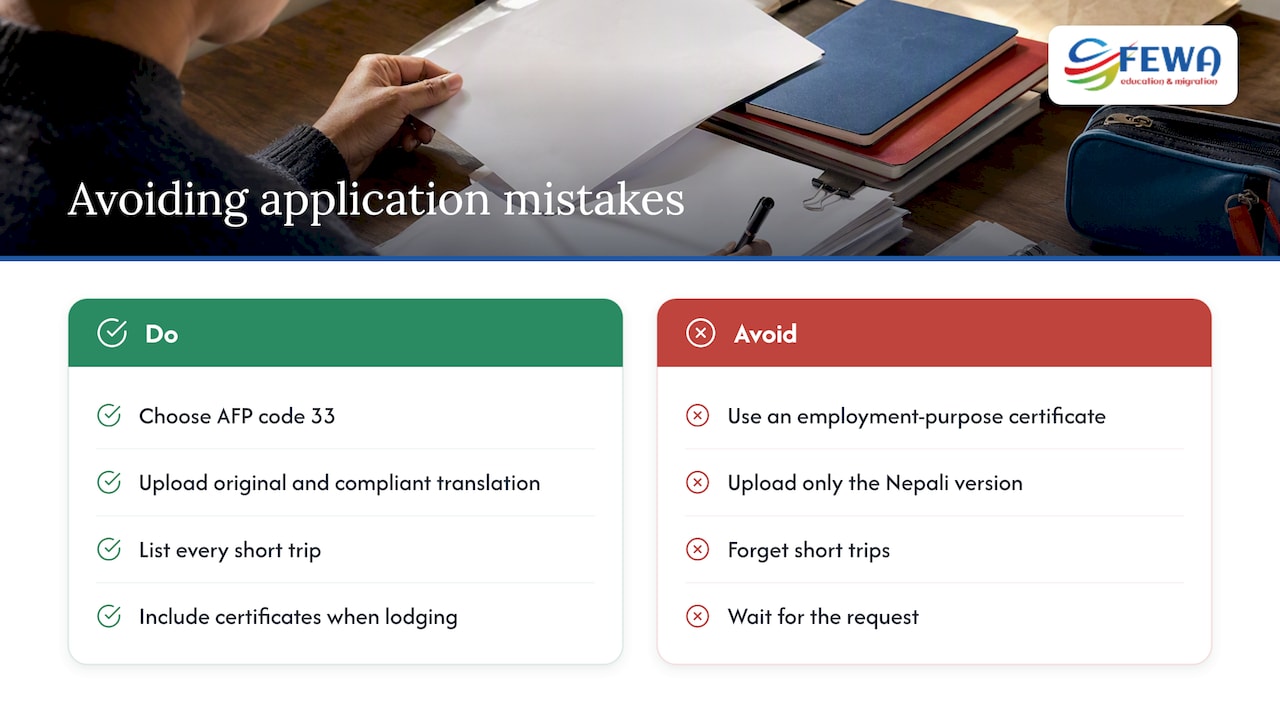
Applying for the wrong purpose. An AFP certificate issued for employment is not the Commonwealth purpose certificate Home Affairs expects. Choose code 33.
Uploading only the Nepali version. Always upload the original and a compliant English translation together.
Forgetting short trips. Because travel time is cumulative, a handful of stays in one country can cross the 12-month line.
Waiting for the request. You can include certificates when you lodge, which usually keeps the process moving. Check the visa checklist for your subclass and respond by the deadline shown in ImmiAccount. If you have not set one up, here is how to set up ImmiAccount in six steps.
Treating the certificate as the whole character story. A clean certificate does not replace honest answers on the form.
Letting certificates go stale. Certificates are evidence of a point in time. If your application takes a while, the department may ask for a fresh one, so keep your account details and original files handy.
Our view: treat police certificates as part of your timeline
We see the same pattern again and again. Clients focus on the big pieces, such as the skills assessment, English test or sponsorship, and leave the police certificate until the department asks. Then they discover that one country needs weeks, another needs a translation, and a deadline is already running.
Our advice is simple. Before you lodge, write a one-page timeline: every country you have lived in or travelled to since turning 16, with dates in and out. Add up the time per country. Where you are near 12 months, get the certificate anyway. It costs far less than a lost fortnight at the end of your application.
We also encourage honesty about anything on your record. A disclosed, explained matter is something we can work with. An undisclosed one is what tends to turn a straightforward application into a difficult one. As a MARA-registered consultancy based in Sydney, we would rather have that conversation early, when there are more options.
— Ronit
Need help with your visa application?
If you would like a second pair of eyes on your document list before you lodge, Fewa Education & Migration can walk you through it. We assist with student, visitor, family, partner, skilled and employer-sponsored visas, and we offer free online consultations for individuals and families. If your application involves a partner, our guide to partner visa evidence is a good place to begin, and you can read more about our skilled migration visa service if you are applying on your skills.
FAQ
Do I need a police check for an Australian visa?
Usually, yes, if you are 17 or older and have spent a combined 12 months or more in one country since turning 16. Home Affairs can also request a certificate even if you are below that threshold, so check your visa checklist in ImmiAccount.
Can I use a state police check instead of the AFP check?
No. For immigration you should apply for the AFP National Police Certificate using the Commonwealth purpose and code 33. A certificate issued for another purpose, such as employment, may not match what Home Affairs asked for.
How long does an AFP police check take for a visa?
Most digital certificates arrive within about 48 hours, though some take longer. If fingerprints are required, allow 15 to 30 business days. Apply as soon as you know you need it.
What if my police certificate is not in English?
Upload the original certificate together with a certified English translation. In Australia, use a NAATI practitioner and include their number. Overseas translators must include their name, contact details, qualifications and experience.
Does a clean police certificate guarantee my visa?
No. It supports the character requirement, but Home Affairs can ask for more information and decides each case on its merits. You must also declare any charges or convictions truthfully.
Sources
- Home Affairs: Character history, evidence of
- Home Affairs: How to get a police certificate
- Home Affairs: Applying for a skilled visa
- Home Affairs: Character requirements for visas
- AFP: Apply for a National Police Certificate
- AFP: Check the progress of a National Police Check
- AFP: Spent convictions laws and police checks
- Nepal Police: Online Police Clearance Registration System