


The section 48 bar is a rule in the Migration Act 1958 that stops you lodging most new visa applications while you are in Australia, once you have had a visa refused or cancelled and you no longer hold a substantive visa. It is a serious setback, but it is not the end of every pathway. A short list of visas stays open, you may have review rights, and leaving Australia to apply from offshore is sometimes the cleanest way forward.
This guide explains, in plain terms, who the bar applies to, which applications you can still make, how it connects to the letters Home Affairs sends during processing, and what to do in the first weeks.
TL;DR
- Section 48 limits the visas you can apply for inside Australia after a refusal or cancellation, if you do not hold a substantive visa.
- A short, prescribed list stays open, including Partner, Child, Protection and some Bridging and Medical Treatment applications. Student, skilled and most visitor applications do not.
- The bar is not a lifetime ban. It restricts onshore applications. You can still apply from offshore if you meet that visa’s criteria.
- It cannot be “waived” on request. The Minister’s intervention power exists only for Protection visas and is personal and non-compellable.
- Check your review rights and deadlines first, then get advice from a registered migration agent before you lodge anything.
Table of Contents
- What the section 48 bar actually says
- Who is caught by the bar
- Which visas you can still apply for
- Partner visas: the most common open door
- Section 48A and 48B: the Protection visa rules
- Review rights: check these before anything else
- Where the s56 and s57 letters fit
- Leaving Australia and applying offshore
- A step-by-step plan for the first weeks
- Our perspective: set the bar aside as a label and look at the facts
- How Fewa can help
- FAQ
- Sources
What the section 48 bar actually says
Section 48 of the Migration Act 1958 applies to a non-citizen who does not hold a substantive visa and who has been refused a visa (other than a Bridging visa) or had a visa cancelled since last entering Australia. Such a person may apply only for a visa class prescribed for this purpose, and not for any other class.
Three words in that description matter.
- Substantive visa. In this context, it means any visa other than a Bridging visa or a criminal justice visa. If you are on a Bridging visa waiting for an outcome, you do not hold a substantive visa.
- Since last entering Australia. The bar looks at your current stay. The Home Affairs form 1026i, Limitations on applications in Australia, sets out the circumstances in which the limit applies.
- Prescribed classes. The Act leaves the actual list to the regulations. That list is short.
The Department of Home Affairs describes the purpose of the rule as protecting the integrity of the system, so that repeated applications are not used to prolong a stay. In its own ministerial instructions on section 48B, the Department frames the system as an integrity measure, not as another avenue for applications.
Who is caught by the bar
You are likely to be affected if all of these are true:
- You are in Australia.
- A visa application of yours has been refused, or a visa you held has been cancelled, since you last entered the country.
- You now hold no substantive visa. Many people in this position are on a Bridging visa while a review is pending, or are unlawful.
Typical situations we hear about include:
- An international student whose Student visa was cancelled for a course or attendance problem.
- A graduate whose onshore application was refused and who has run out of valid visa time.
- A visitor who applied for a visa onshore, was refused, and now wants to switch to study or work.
- A worker whose sponsored visa was cancelled after an employment change.
If you are not sure whether the bar applies to your case, do not guess. Applying for a visa that you are barred from applying for results in an invalid application, and an invalid application is not a minor error. It can cost you time you may not have, and any application charge paid may not be refundable.
Which visas you can still apply for
According to the Home Affairs limitations form and the Act, the visas that remain available from within Australia are a limited prescribed list. The research we have reviewed identifies these as the main categories:
| Visa category | Still possible onshore under the bar? | What to know |
|---|---|---|
| Partner (temporary and residence) | Yes | You must meet every criterion, including relationship evidence and character requirements |
| Child (residence) | Yes | Criteria still apply in full |
| Protection | Yes, subject to section 48A | A refused or cancelled Protection visa blocks further Protection applications |
| Medical Treatment (visitor) | Yes | Narrow and purpose-specific |
| Bridging visas (A to E) | Yes | Helps you stay lawful while a matter is decided |
| Special Eligibility (residence) | Yes | Rare, for specific circumstances |
| Student, skilled, most visitor and employer-sponsored | No | Not available onshore while the bar applies |
Two cautions belong right beside this table.
First, the list is set in the Migration Regulations and can change. Check the current list or ask a registered agent before relying on any table, including this one.
Second, being allowed to apply does not mean being likely to succeed. As the Department’s form makes clear, you must still meet all the criteria of the visa you choose. A complicated immigration history, including earlier refusals or cancellations, can make that harder, particularly on integrity and character criteria.
Partner visas: the most common open door
For many people in Australia with a refusal or cancellation behind them, the Partner visa is the realistic onshore option. It is also one where thin evidence is the usual reason for refusal, so preparation matters more than speed.
Three practical points:
- Genuine relationship evidence. Build it across several areas: finances, household, social recognition and the nature of your commitment. Our guide to partner visa evidence walks through the four pillars we check before anything is lodged.
- Choose the right subclass path. If you are in Australia, the onshore pathway differs from the offshore one, and the difference affects timing and your status while waiting. See 309 versus 820 and Direction 117 for how that decision plays out.
- Know the visa itself. Our Partner visa page explains the two stages and what we help with.
If your relationship is genuine and well documented, the bar does not stand in the way of lodging. If the relationship began only recently, or its main purpose looks like staying in Australia, the application will face close scrutiny. In that case, an honest conversation with an adviser before you lodge is far better than a second refusal.
Section 48A and 48B: the Protection visa rules
The Act has a related provision. Section 48A prevents a further Protection visa application in Australia after a Protection visa has been refused or cancelled. Section 48B lets the Minister decide that 48A does not apply, but with strict limits.
The Department’s ministerial instructions describe the power as personal and non-compellable. In practice:
- The Minister has no legal duty to consider a request.
- The power is intended for a narrow set of circumstances, involving genuine protection claims that could not reasonably have been raised earlier.
- It is not a general waiver, and it does not apply to Student, skilled or visitor visas.
If you hear that the bar can simply be “waived” for a fee, treat that with caution. The research we have found points to no such general mechanism. Anyone claiming otherwise should be able to name the exact legal provision and show how it applies to you. Protection matters are specialised, so seek advice from a registered migration agent or a lawyer experienced in this area, not a general education consultant.
Review rights: check these before anything else
Before you plan around the bar, check whether you can challenge the original decision. If a review succeeds, the refusal or cancellation may be set aside, which changes the picture.
The Administrative Review Tribunal reviews many migration and protection decisions. Not every decision can be reviewed, and deadlines are short. Your decision letter should state whether you have review rights and by when you must apply. Read it the day it arrives.
If you are a student, these two guides cover the ground in more detail:
- Student visa refusal in Australia: what to do next
- Student visa appeals and the 28-day lodgement window
The Tribunal’s own practice direction notes that errors in an application for review can have serious consequences, including invalidity. So lodge on time, use the correct form, and keep proof of lodgement. Given how technical this area is, get advice before you lodge, not after.
Where the s56 and s57 letters fit
Many readers arrive here because of a letter, not a refusal. During processing, Home Affairs may send two kinds of letter.
- A section 56 request for information. The Department asks for more documents or details so it can keep assessing your application. Typical examples are updated police checks, identity documents or evidence of your circumstances.
- A section 57 natural justice letter. The Department tells you it has information that could lead to a refusal, and invites you to respond before deciding.
These letters matter for the bar because they are the last chance to fix a problem before a refusal. A refusal is what can trigger section 48 if you then hold no substantive visa.
How to respond well:
- Note the deadline in the letter and diarise it. Check the exact date, not an approximate one.
- Answer every point raised. A partial reply leaves the decision-maker with the same concern.
- Give evidence, not only explanation. Documents, dated records and statements from third parties carry more weight than assertion.
- Be consistent with what you said in earlier forms and interviews. Inconsistencies are a common reason for adverse findings.
- Be honest. Do not submit anything you cannot stand behind. Incorrect information can itself lead to refusal or cancellation.
- Ask for help early if the letter raises credibility, genuine student or relationship concerns.
If the letter puts at risk a visa that you currently hold, the stakes are higher still, because a cancellation can also bring the bar into play.
Leaving Australia and applying offshore
A common misconception is that the bar permanently blocks you from every visa. It does not. According to the Home Affairs form, it restricts what you can apply for while you are in Australia. It does not stop you leaving and applying for a new visa from offshore if you meet the criteria.
That can be the right call when:
- None of the onshore visas fits your situation.
- You would otherwise stay without lawful status, which brings its own consequences.
- The visa you want, such as a Student visa, can be applied for from outside Australia.
Before you leave, ask about two things. First, whether your departure triggers any exclusion period or debt that affects future applications. Second, how your previous refusal or cancellation will be assessed in the new application, since you will need to address it honestly. Both depend on your facts, so do not leave until you have had individual advice.
A step-by-step plan for the first weeks
- Find your decision letter and write down the date, the decision type and any stated review deadline.
- Confirm your status. Do you hold a Bridging visa, and does it have conditions or an end date?
- Decide on review. If you have rights, act within the deadline.
- List your realistic options. Review, an open onshore visa such as a Partner visa, or an offshore application.
- Gather documents for the option you choose: identity, financial, relationship, health and character records.
- Get advice before lodging anything, because an invalid or weak application can narrow your options further.
- Keep records of everything you lodge and receive.
If you are a student, some pitfalls start long before a refusal. Our notes on student visa work limits cover a common route to cancellation, and are worth reading if your visa is still valid.
Our perspective: set the bar aside as a label and look at the facts
We meet people at their lowest point after a refusal. The first reaction is usually panic, followed by a hunt for a quick fix. In our experience, the quick fix does not exist, and chasing one is where people lose the most time.
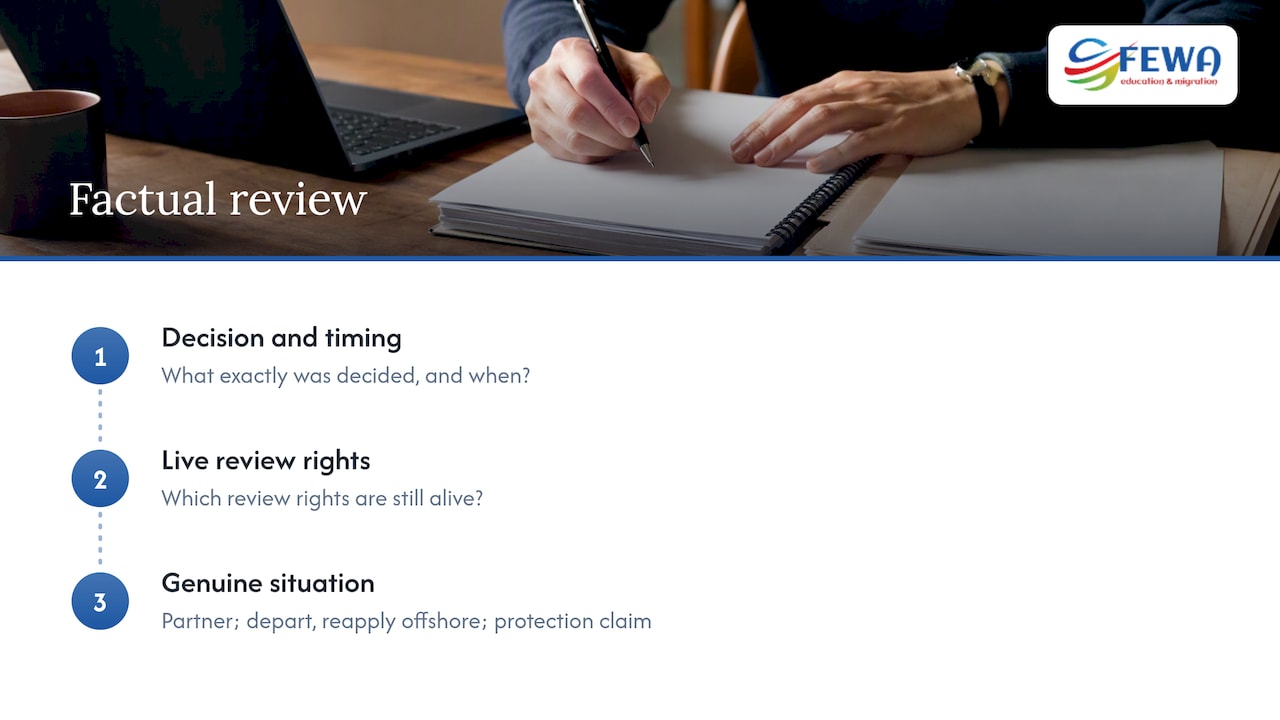
What helps is a calm, factual review. We ask three questions. What exactly was decided, and when? What review rights are still alive? What does your genuine situation support: a Partner application, a departure and fresh offshore application, or a protection claim? Our practice is built on authentic, transparent guidance, and as MARA-registered advisers we will tell you plainly when an option is weak, instead of lodging it to collect a fee.
We also encourage you to be involved. You know your history better than anyone. The strongest cases we see are those where the person provides full, honest information early, including the parts that feel uncomfortable.
A refusal is a setback, not a verdict on you. With accurate information and a realistic plan, there is almost always a constructive next step.
— Ronit
How Fewa can help
If you are in Greater Western Sydney or anywhere in Australia and want a clear view of your options, we offer free online consultations for individuals and families. We support Partner, Family, Student, Visitor, Skilled and Employer Sponsored applications from assessment to lodgement. Start on our visa services page to see what we handle, or go to our home page to book a consultation. We do not publish prices for these services, so ask us about fees during your consultation.
FAQ
Can the section 48 bar be waived?
Not in a general sense. The only related mechanism is the Minister’s personal intervention power under section 48B, and it concerns Protection visa applications. The Minister is not required to consider a request, so it should never be your main plan.
What is a 48 bar in simple terms?
It is a restriction in the Migration Act 1958. If you have had a visa refused or cancelled since last entering Australia and you do not hold a substantive visa, you can apply only for a short list of prescribed visas while you are in Australia.
Which visa can I apply for with the section 48 bar?
The main onshore options include Partner, Child, Protection and Medical Treatment visas, plus Bridging visas and some Special Eligibility categories. You must still meet every criterion for the visa. You cannot apply onshore for Student or skilled visas while the bar applies.
Does the bar stop me applying from outside Australia?
No. It limits applications made while you are in Australia. If you leave, you can apply for a visa offshore, provided you meet its criteria and address your earlier refusal or cancellation honestly. Get individual advice before departing.
What is the difference between an s56 and an s57 letter?
An s56 letter asks you for more information or documents. An s57 letter warns you of adverse information that could lead to refusal and invites a response. Both have deadlines, so reply fully and on time.
Sources
- Migration Act 1958, Federal Register of Legislation
- 1026i, Limitations on applications in Australia (Home Affairs)
- Ministerial Instructions for requests under subsection 48B(1) (Home Affairs)
- Immigration and citizenship (Administrative Review Tribunal)