


If your student visa has been cancelled, or you have received a letter saying the Department of Home Affairs is thinking about it, the first thing to know is that you still have options, and the next few days matter. Cancellation is usually the end of a documented process, which means there is normally a paper trail you can read, respond to and, in many cases, challenge. This guide explains why student visas are cancelled, what the different notices mean, how review works, and what you can do before and after a decision.
We are Fewa, a Sydney-based education and migration consultancy, and we know how heavy this news feels. Take a breath, then work through the steps below in order.
TL;DR
- Read the notice first and note the deadline in it. Review time limits are strictly enforced, and the Tribunal generally cannot extend them.
- Common triggers are no longer being enrolled in a registered course, unsatisfactory attendance or progress, and breaching work conditions such as the 48 hours a fortnight limit.
- If your education provider has told you it intends to report you, you may be able to use its internal appeal process, or complain to the Commonwealth Ombudsman, before the report is made.
- Many cancellations are voluntary and harmless, for example when you finish a course and leave Australia.
- Get advice from a registered migration agent or lawyer early. Waiting makes every option harder.
Table of Contents
- Why student visas get cancelled
- The notices you might receive
- Before it reaches the Department: protect yourself at the provider stage
- If you receive a notice of intention to consider cancellation
- If your visa has been cancelled
- Voluntary cancellation: when you choose to cancel
- Our perspective: most cancellations are preventable
- How Fewa can help
- FAQ
- Sources
Why student visas get cancelled
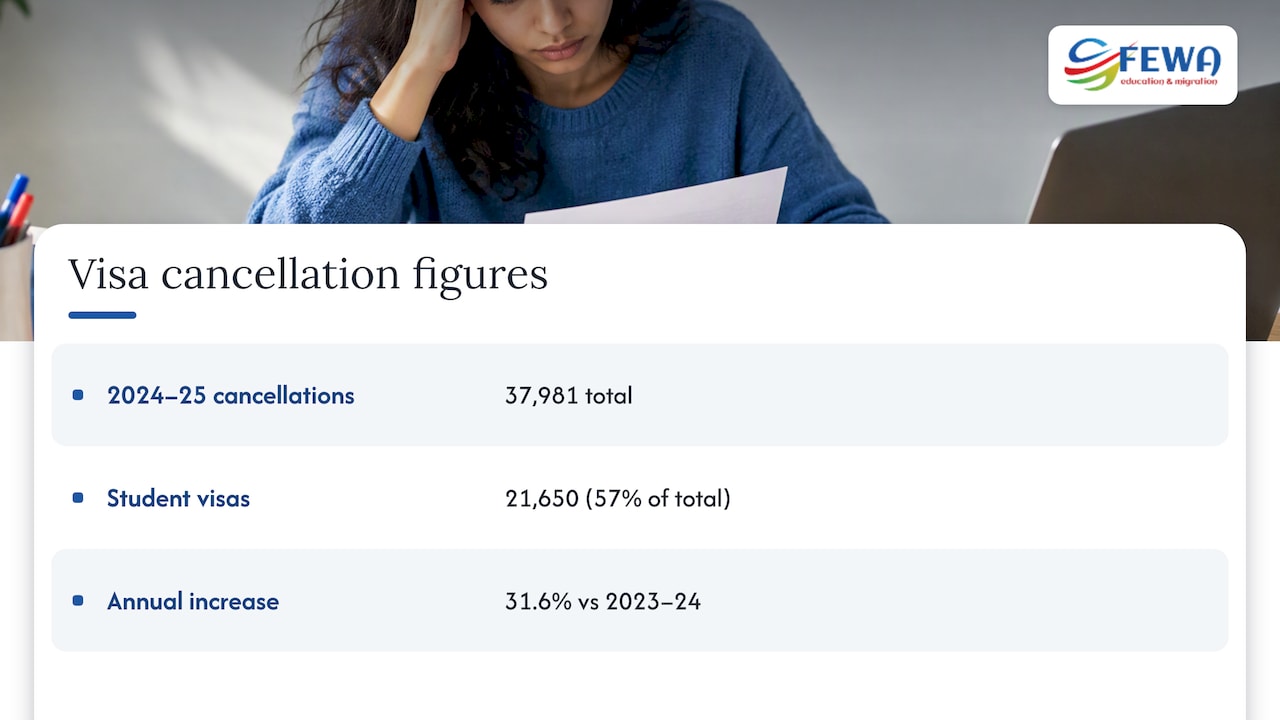
Student visa cancellation is not rare. In 2024–25 there were 37,981 visa cancellations in Australia, and 57% (21,650) were student visas. That is a 31.6% rise on 2023–24. The same report shows that many of these are not punishments: students who finish early, complete their course or no longer need the visa often ask the Department to cancel it, and it is counted as a cancellation in the statistics.
So the headline number looks frightening, but it covers very different situations. The ones that cause trouble for students fall into a few groups.
You are no longer enrolled in a registered course
The Department says it may cancel your student visa if you are no longer enrolled in a registered course. Your enrolment also ends when you complete the course, so you need a plan for what visa you will hold after your last day. If you want to stay, see our guide on how to extend a student visa in Australia and check your options early.
Your education provider reports you
Providers must report certain events through the Student Course Variation process. The Department’s Student Course Variation report options guide lists the situations, including non-payment of fees, and notes where an internal appeals process is required before a report can be made. Poor attendance and unsatisfactory course progress are the situations we see most often.
You breached a visa condition
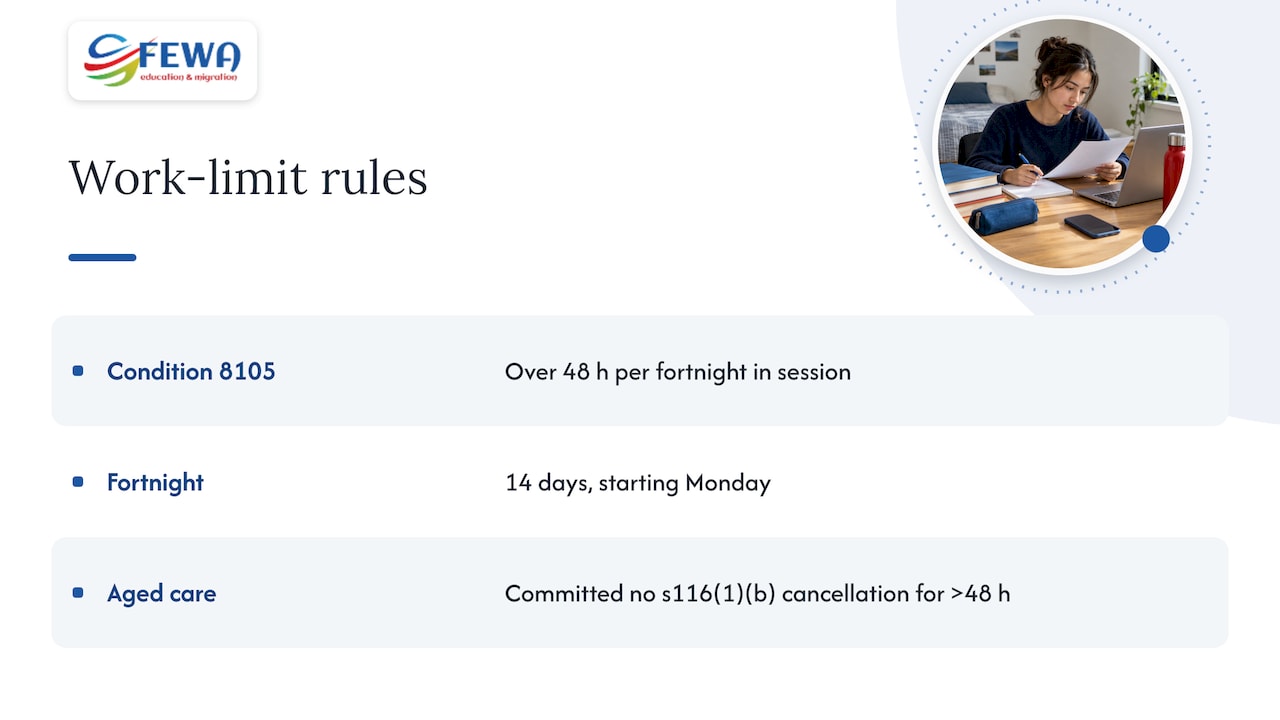
Working more than 48 hours per fortnight while your course is in session breaches condition 8105. The Department’s page on work restrictions for student visa holders explains the limit, which has applied since 1 July 2023. A fortnight is a 14-day period starting on a Monday, so two busy weeks with two employers can tip you over without you noticing. Our article on tracking the 48-hour student visa work limit shows how to count your hours, and our overview of work rights for international students covers the wider rules.
There is one carve-out worth knowing. For students working in aged care, the Department of Home Affairs and the Australian Border Force have committed not to cancel visas under section 116(1)(b) of the Migration Act 1958 for exceeding the 48-hour limit. Check the current arrangements on the Department’s website before relying on this, because they can change.
You applied for another visa
Sometimes a student visa ends because you applied for something else, such as a partner visa. When one visa is cancelled, any other visa you hold, including a bridging visa, can be affected. Always check your status in VEVO and get advice before you lodge a new application onshore. Our guide to bridging visas and VEVO explains what to check, and the no further stay condition article covers a restriction that can block some onshore applications.
The notices you might receive
Cancellation usually does not arrive without warning. Understanding which stage you are at tells you what to do.
| Stage | What it means | Your move |
|---|---|---|
| Provider’s notice of intention to report | Your education provider plans to report you for a breach such as poor attendance or progress | Use the internal appeal process, speak to the provider, gather evidence |
| Notice of intention to consider cancellation | The Department is considering cancelling and invites a response | Respond in writing by the deadline, with evidence |
| Cancellation decision | The visa has been cancelled | Check the review time limit in the letter immediately, and get advice |
| Refusal of a new visa | A different matter, covered separately | See our student visa refusal guide |
If you are unsure which stage you are at, read the letter again. It states the reason, the facts relied on and the deadline. Keep every email and attachment.
Before it reaches the Department: protect yourself at the provider stage
This is the most overlooked part of the process, and it is where students have the most power.
Ask for help early
Experts and the Department’s own guidance point the same way: visa cancellation is often the result of a documented process of non-compliance. If illness, family problems, a work clash or a poor course fit is affecting your progress, tell your provider’s student support team early. Once the provider issues a notice of intention to report, the situation becomes harder and much more time-sensitive.
Use the internal appeal
Providers must follow an internal and external appeals process before reporting a student for certain breaches, as set out in the Student Course Variation guide. Many students do not realise they can challenge the intention to report. Starting an appeal can pause the reporting while it is resolved. Lodge it within the time stated in your provider’s letter, and attach evidence such as medical certificates, counselling letters or records showing why your attendance dropped.
Complain to the Commonwealth Ombudsman if the dispute is genuine
The Commonwealth Ombudsman supports future, current and former international students and can investigate complaints about private education providers. If you complain about a provider’s intention to report you, the provider is generally expected to wait until the investigation is finished before it reports. The Ombudsman also makes clear that a provider cannot report you to immigration merely because you complained. Making a complaint is your right.
If you receive a notice of intention to consider cancellation
This is a chance to respond, not a decision. A calm, well-organised reply is often the most useful thing you can do.
- Note the deadline today. Put it in your calendar with a reminder two days earlier.
- Identify the ground. The letter will say whether it is a work breach, a course progress issue, a change of course or something else.
- Collect evidence. For a progress issue: medical certificates, provider correspondence, attendance records, evidence of support sought. For a work issue: payslips, rosters, bank statements and employer letters showing your actual hours.
- Write a clear response. Explain what happened, why it happened, what has changed and what you will do to comply. Keep it factual and consistent with your records.
- Submit it properly. Follow the instructions in the letter and keep proof of lodgement.
- Get a second pair of eyes. A registered migration agent can check that the response addresses the exact ground the Department relies on.
A common mistake is to send an emotional letter with no documents. Feelings matter, but evidence is what changes decisions.
A changed course can look like a breach
Switching courses too soon can create problems if you do it without the right steps. Our guide to the six-month rule and changing course on a student visa explains how to do it safely, and it is worth reading before you enrol anywhere new.
If your visa has been cancelled
A cancellation decision is serious, but it is not necessarily the end of your time in Australia.
Step 1: Read the decision and find the time limit
The Administrative Review Tribunal states that time limits for review are strictly enforced. Missing the deadline in the Department’s letter can mean losing your right to review, and the Tribunal generally has no power to extend it. Check your letter the moment it arrives. We also explain the process for older and related decisions in our article on lodging an appeal on time.
Step 2: Check what the decision means for your stay
Ask a registered migration agent or lawyer what your immigration status is right now, whether you must leave and by when, and whether any bridging visa applies. Do not guess, and do not assume you can keep working or studying. Check your status in VEVO.
Step 3: Decide whether to seek review
The Tribunal can review some, but not all, decisions about visas. Review is not quick: for student cancellation reviews finalised between 1 October 2025 and 31 March 2026, the median time was 1 year and 3 months, and 95% were finished within 1 year and 11 months. That is measured from lodgement, and certain expedited character matters follow stricter timelines. Whether review is the right path depends on your status, your grounds and your goals, so get advice on this before you pay any fees.
Step 4: Think about your next application
If review is not available or not sensible, you may need to plan a fresh application, offshore or onshore. A cancellation can affect how a new application is viewed, and a refusal carries its own problems. Our article on what to do after a student visa refusal covers the thinking that applies to a new application, including addressing the earlier decision honestly.
Step 5: Look after yourself
This is a stressful time. Tell someone you trust, and keep your provider, sponsor or family informed as appropriate. If a matter involves a health or wellbeing assessment, general information on immigration psychological evaluations can help you understand how such assessments are structured, although you should confirm what, if anything, your own situation requires with a registered adviser. If you are struggling, speak to your GP or your provider’s counselling service.
Voluntary cancellation: when you choose to cancel
Not every cancellation is a problem. If you have finished your studies and are leaving, or you no longer need the visa, you can ask the Department to cancel it. The Department’s cancelling a visa page is the place to check the current process and forms.
Three practical points from our experience:
- Do not cancel in a hurry. If you plan to remain in Australia, cancelling can leave you without lawful status. Many people prefer to cancel only after they have left the country.
- Check what you are giving up. Cancelling ends your study and work rights and affects dependants on your visa. See our page on student visa dependants if family members hold or want to hold a visa attached to yours.
- Have your next visa sorted first. If you are moving to a different visa, such as a partner, skilled or employer-sponsored visa, confirm the order of events with an adviser so there is no gap.
Our perspective: most cancellations are preventable
We work with international students every week, many from Nepal and across the Greater Western Sydney community, and the pattern is consistent. Students rarely lose a visa because of one bad day. They lose it because several small things went unaddressed: an attendance warning in week four, a rostered double shift, an email from the provider sitting unread.
Our advice is practical:
- Treat provider emails like immigration emails. They can become the evidence the Department relies on.
- Keep a simple record. Hours worked each fortnight, attendance, medical certificates, and any approvals from your provider.
- Speak up early. Providers have support teams and formal options, and early conversations leave you far more room than a notice does.
- Do not rely on friends’ advice. A rule that applied to a friend last year may not apply to you, and visa conditions change.
- Use a registered adviser. We are registered with MARA, and we encourage anyone facing cancellation to speak to a registered professional, whether with us or elsewhere, before replying to the Department.
A setback is stressful, and you do not have to carry it alone. A calm, evidence-based response and a clear plan can change the outcome.
— Ronit
How Fewa can help
If you are worried about your enrolment, a work-hours problem or a letter from Home Affairs, you can talk to us before you reply. We offer free online consultations for individuals and families, and our team handles student visa matters from advice through to application support. Start with our student visa service, or see everything we handle on our visa services page. We do not publish fees, so ask about costs in your consultation.
FAQ
Why is Australia cancelling student visas?
The most common reasons are no longer being enrolled in a registered course, unsatisfactory attendance or progress reported by a provider, and breaches of conditions such as the 48-hour fortnightly work limit. Many cancellations are also voluntary, requested by students who have finished or are leaving. In 2024–25, 57% of all visa cancellations were student visas, so the count includes both kinds.
What happens if my student visa is cancelled in Australia?
Your study and work rights end, and your lawful stay is affected, so you may need to leave or apply for another visa. Other visas you hold can also be affected. Check your decision letter for the review time limit and speak to a registered migration agent or lawyer straight away about your status.
How can I cancel my student visa?
You ask the Department of Home Affairs to cancel it, using the process on its cancelling a visa page. Many people wait until they have left Australia, and you should only cancel if you do not need to stay lawfully. Confirm any next visa plan first.
Can I appeal a student visa cancellation?
Often you can seek review at the Administrative Review Tribunal, but only for certain decisions and only within the strict time limit in your letter. Median finalisation for student cancellation reviews recently was 1 year and 3 months, so plan around your status in the meantime.
Can my provider report me for complaining?
No. The Commonwealth Ombudsman says a provider cannot report you to immigration merely for complaining to the Ombudsman. If your complaint concerns a planned report, the provider is generally expected to wait for the investigation to finish.
Sources
- Australia’s Migration Trends 2024–25, Department of Home Affairs
- Cancelling a visa, Department of Home Affairs
- Student Course Variation report options quick reference guide
- Work restrictions for student visa holders, Department of Home Affairs
- Information for international students, Commonwealth Ombudsman
- Immigration and citizenship, Administrative Review Tribunal
- Processing times, Administrative Review Tribunal