


Australia and the USA both offer world-ranked universities, but they differ in ways that shape your budget, your timeline and your chances of staying on after graduation. Australia generally suits students who want a focused degree, a defined work-rights framework and a clear route from study to a temporary graduate visa. The USA suits students who want a broad, flexible degree, a very large choice of institutions and are prepared to fund it largely themselves. Below, we walk through the differences that matter, so you can decide with confidence.
TL;DR
- Course structure: Australian bachelor degrees focus on your major from the first year, while US degrees usually let you explore several subjects first.
- Cost: US institutions publish high all-in estimates (one university estimates USD 75,052 for a single academic year), so check each course’s fees before comparing countries.
- Work rights: Australia generally allows 48 hours of work per fortnight during study sessions. F-1 students in the US are typically limited to 20 hours a week on campus.
- After study: Australia has the Temporary Graduate visa (subclass 485). The US has Optional Practical Training, with longer periods for STEM fields.
- Decision rule: Choose on your course, budget and long-term plan, not on rankings alone.
Table of Contents
- How the two education systems differ
- Admissions and applications
- Costs: tuition, living and funding
- Side-by-side comparison
- Visa rules and work rights while you study
- After graduation: work and migration pathways
- Student life and the wider picture
- Which should you choose?
- Our perspective
- Talk to someone who handles these visas every day
- FAQ
- Sources
How the two education systems differ
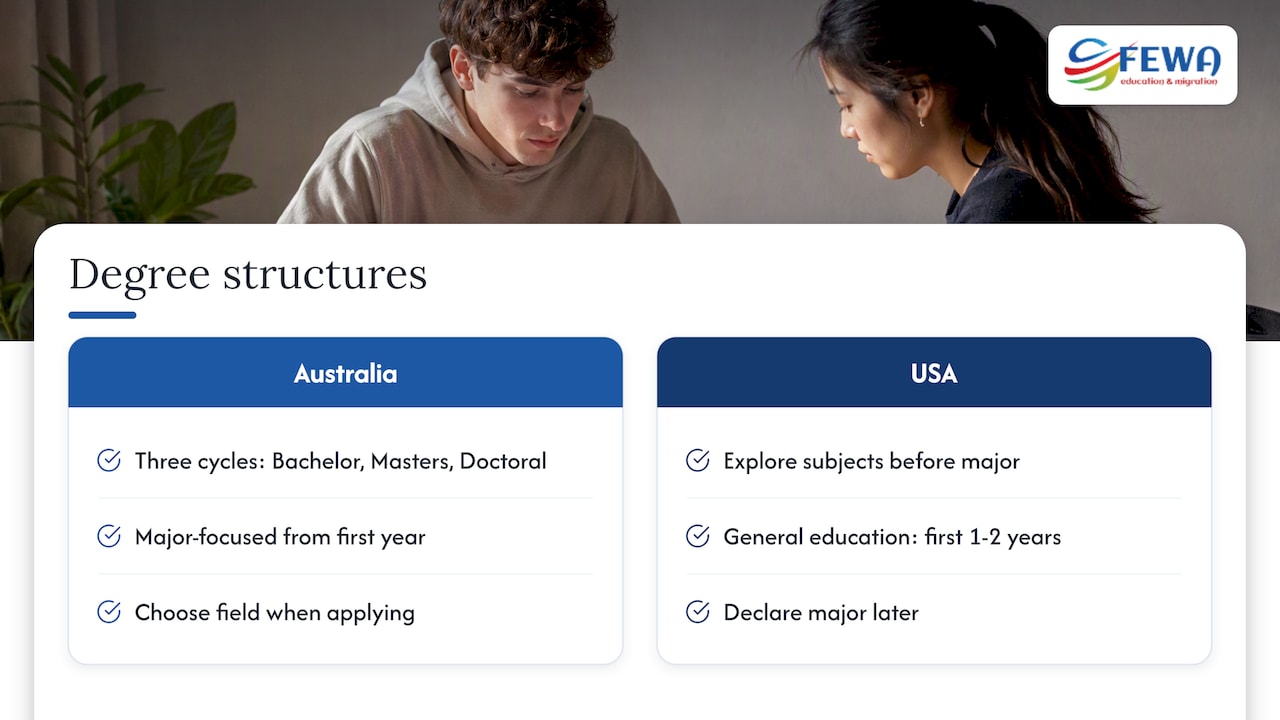
The biggest day-to-day difference is how a degree is built. Australia has three main higher-education cycles leading to Bachelor, Masters and Doctoral degrees, and bachelor degrees typically focus on the major from the first year. You choose your field when you apply and start studying it straight away.
The US model is broader. Students at US universities often explore more subjects, while students in Australia concentrate on one or two areas, a pattern that is common across the two systems. In practice, a US undergraduate may spend the first one or two years on general education and declare a major later. That is a real advantage if you are undecided. It is a cost if you already know you want, say, nursing, accounting or engineering, because you pay for subjects that are not part of your career path.
For students who know their direction, the Australian model is usually faster and more direct. If you are still exploring, the US model gives you room to change your mind.
Study duration
Many Australian undergraduate degrees run for three years of full-time study, while the US bachelor degree is built around four years. Professional fields differ again: medicine, law and some health degrees follow different structures in each country, so confirm the exact length of your course on the university page before you budget.
The length matters because tuition and living costs are charged for every year. A shorter degree can reduce your total outlay even when annual fees look similar.
Admissions and applications
In Australia you usually apply directly to the institution, often through an education agent or consultant. There is one notable exception: international students applying for undergraduate courses in NSW and the ACT can apply through UAC if they are completing Australian Year 12, the IB Diploma or New Zealand NCEA Level 3. Everyone else applies directly.
In the USA, applications typically involve an application portal, transcripts, essays and often standardised tests such as the SAT, depending on the college. Many Australian institutions focus more heavily on your academic results and English-language evidence, so the paperwork is usually lighter.
In both countries, apply early. You need an offer before you can apply for a student visa, and visa processing adds time.
Costs: tuition, living and funding
Both countries are expensive, and published figures differ by institution, city and course. The honest answer is that neither country is cheap, and the USA tends to be the higher-cost option at many institutions.
What the US asks you to show
The US process requires proof of funds for one academic year. As an example, Middlebury’s 2026–27 I-20 instructions state that financial documentation must cover first-year tuition and living expenses, with estimated costs of USD 75,052 for one academic year. The same institution expects students to hold health insurance for the length of the program and estimates it at USD 2,000 per year. That is one private institution, not a national average, but it shows the scale you may need to plan for.
EducationUSA also advises that there is no correlation between tuition level and the quality of a US institution, and that you should research financial aid carefully because it is rare at many public colleges.
What Australia asks you to show
Australia requires evidence of annual living costs as part of the student visa application, alongside tuition and travel costs. Because the amounts are updated by the Department of Home Affairs, check the current figures before you apply. Our guide to the student visa financial capacity test explains what evidence to prepare, and our article on the Australian student visa cost covers the application charges and recent changes.
If you are converting between your home currency and Australian dollars, use a current Australian dollar exchange rate before you set your budget, since a movement of a few cents changes the total on a multi-year degree.
Scholarships
Scholarships are competitive in both countries. In the US, less than half of bachelor’s institutions offer aid to international students. In Australia, many universities offer merit-based or targeted fee reductions. For example, Western Sydney University offered new international students commencing in 2024 scholarships of $3,000 a year, $6,000 a year or 50% of tuition fees a year. Offers change every year, so read the current scholarship page for your course.
Some universities are moving away from broad merit awards. CQUniversity notes that modern fee structures may reduce reliance on merit-based scholarships, with more targeted support for specific student groups. If a scholarship is central to your plan, ask the university directly whether it applies to your course and country of citizenship.
Side-by-side comparison
| Factor | Australia | USA |
|---|---|---|
| Degree structure | Focus on your major from year one | Broader first years, major often chosen later |
| Typical bachelor length | Often three years | Usually four years |
| Application route | Direct to institution; UAC for some NSW/ACT applicants | Application portals, often with essays and tests |
| Work during study | Generally 48 hours per fortnight in session | On-campus, up to 20 hours per week in session |
| Work during breaks | Unlimited hours | Full-time permitted |
| Post-study option | Temporary Graduate visa (subclass 485) | Optional Practical Training |
| Funding evidence | Annual living costs plus tuition | One academic year of funds |
Visa rules and work rights while you study
This is where many students are surprised. In Australia, student visa holders are generally limited to 48 hours of work per fortnight during the academic session, with unlimited hours during breaks. That includes off-campus work such as hospitality, retail or tutoring, which is a major reason students in Sydney can cover part of their living costs. Our guide to tracking the 48-hour student visa work limit shows how to count your hours so you do not breach a visa condition.
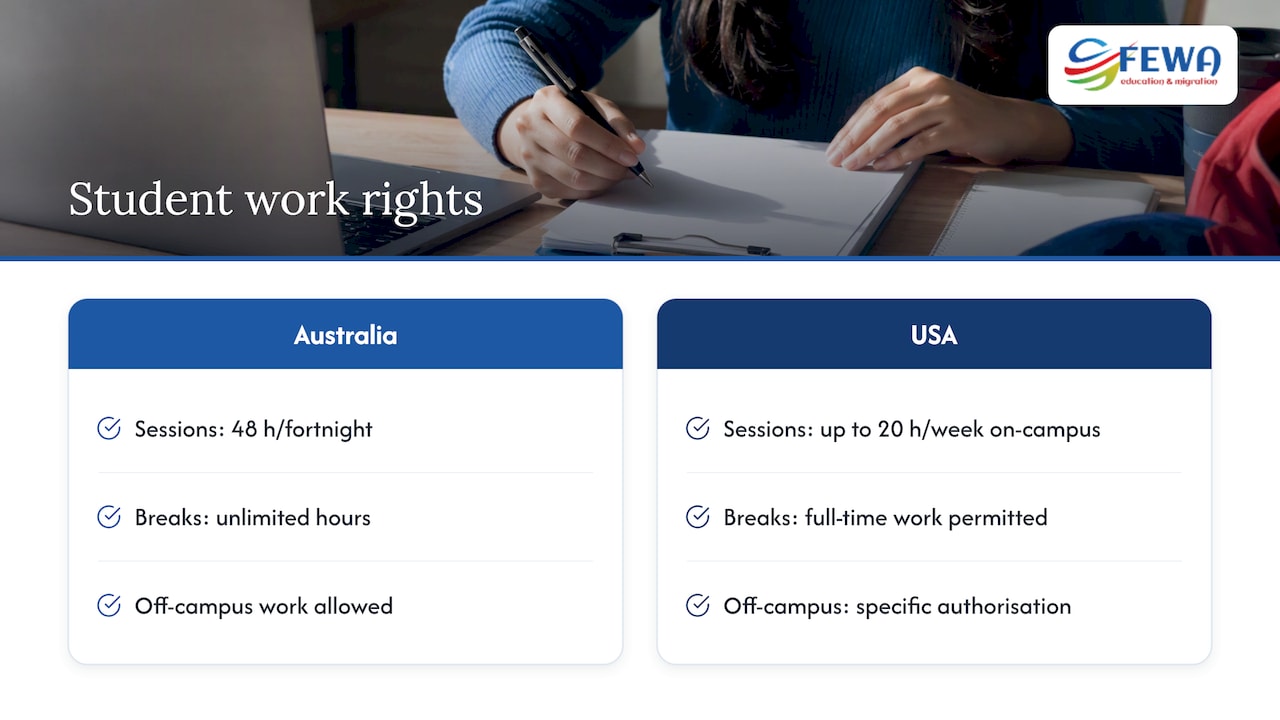
In the USA, F-1 students enrolled at universities are typically limited to on-campus employment of up to 20 hours per week while school is in session, with full-time work permitted during vacations and breaks. Off-campus work generally needs specific authorisation, so you should not plan to rely on it.
The genuine student requirement
Australia assesses whether you genuinely intend to study. The Genuine Student requirement replaced the Genuine Temporary Entrant requirement on 23 March 2024, and it looks at your intention to study in Australia. Your course choice, your academic progression and your reasons for choosing a particular provider should make sense together. A clear Statement of Purpose matters. Our step-by-step page on how to apply for a student visa in Australia covers the process from offer to lodgement.
After graduation: work and migration pathways
Australia
The Temporary Graduate visa (subclass 485) allows graduates to live and work full-time temporarily after study, with stays typically ranging from 2 to 3 years for the Post-Higher Education Work stream. Eligibility rules, including age and English requirements, change over time, so see our 485 visa requirements guide and the Temporary Graduate visa page for details.
The 485 is temporary. For permanent residence, graduates usually move to skilled or employer-sponsored routes, which depend on your occupation, points and sponsor. We explain the options in 3 PR pathways in Australia, and you can check whether your field appears on the skilled occupation list.
USA
The US equivalent is Optional Practical Training. Academic research notes that OPT was extended from 12 to 29 months for STEM fields in 2008, and to 36 months in 2016, so STEM graduates have traditionally had the longest post-study window. The same source notes that student visas are largely uncapped and higher-education institutions are exempt from the H-1B cap, an extra route into the labour market. Rules in this area are reviewed regularly, so confirm the current position on official US government pages before you commit.
The practical difference: Australia’s graduate visa is a clear, named step that many students plan around from day one. The US offers strong work-training options but a less predictable route to long-term status.
Student life and the wider picture
Both countries attract large international cohorts, and both felt the effects of recent disruption. The Australian Government’s comparison reports that Australia’s international student enrolments declined by 14 per cent in 2020, while the USA’s declined by nearly 2 per cent in 2019/20. That is older data, but it is a reminder that policy settings and global events can change your study conditions.
On lifestyle, Australia has English as the main language alongside more than 300 other languages, which is part of why cities like Sydney feel welcoming to students from Nepal, India and elsewhere. Established community networks around Auburn, Parramatta and the CBD make settling in easier: familiar food, places of worship and people who have taken the same steps. For more on daily life and what to expect, read why study in Australia.
Which should you choose?
Use these questions to decide:
- Do you know your field? If yes, Australia’s focused degrees save time. If not, the US offers more exploration.
- What can your family fund? Add tuition, living costs, insurance and travel for the full length of the course, not just year one.
- How much do you need to earn while studying? Australia’s work allowance is more generous for off-campus work.
- What is your long-term plan? If you want to build a career and possibly settle, map the post-study visa and skilled pathways before you pick a country.
- Can you meet the visa tests? Genuine Student in Australia, and funds evidence in both countries.
What if you are choosing between Australia and another country, such as Canada? The same method works: compare course structure, total cost, work rights and the post-study route, using official government pages for each.
Our perspective
We see the same pattern with many students from Nepal and across South Asia: they start by asking which country has the best ranking, and end up choosing on three practical things. Can the family fund the whole degree without stress? Does the course lead to a job that appears on a skilled occupation list? Is the visa path clear enough to plan around?
Australia often wins on those three for students who know their field. The shorter, focused degree, the work rights and the named graduate visa give you a plan you can write down. That does not make the USA the wrong choice. For a student with a scholarship, a STEM field and a strong application, it can be an excellent one. What we advise against is choosing a country first and a course second. Start with the career, then the course, then the country, then the visa.
As MARA-registered advisers based in Sydney, we also see how often a refusal comes from a weak Statement of Purpose or thin financial evidence rather than from the student’s ability. Prepare those early, and be honest about your plans. A well-prepared application is the most encouraging thing you can bring to the process.
— Ronit
Talk to someone who handles these visas every day
If Australia looks like the right fit, we can help you with course selection, your Statement of Purpose, financial evidence and the full student visa application. See our student visa service or book a free consultation through our site. If you need English-test preparation for your offer, we also run IELTS, PTE and other coaching.
FAQ
Is Australia cheaper than the USA for international students?
Often, yes, partly because many Australian bachelor degrees take three years rather than four. Costs still vary widely by institution, city and course, so compare the total for the full degree, including living costs and health cover, rather than a single year.
Can I work while studying in Australia compared with the USA?
In Australia, student visa holders are generally limited to 48 hours per fortnight during study sessions and can work unlimited hours in breaks. F-1 students in the USA are typically limited to 20 hours a week on campus during the session. Always check your own visa conditions.
Can I stay in the country after I graduate?
Both countries offer a temporary post-study option: the subclass 485 in Australia and Optional Practical Training in the USA. Neither guarantees permanent residence. In Australia, long-term stay usually depends on a skilled or employer-sponsored pathway.
Which country is easier to apply to?
Australian applications are usually more direct, often going straight to the institution with academic results and English evidence. US applications can involve essays, tests and a longer list of documents, depending on the college. Both require you to prove you can fund your studies.
Sources
- Country Education Profile Australia, Department of Education
- International applications and offers, UAC
- Middlebury Institute I-20 application instructions
- EducationUSA, Your Next Step guide
- FAQs for International Students, Western Sydney University
- International Students’ Study Guide, CQUniversity
- Student and Temporary Graduate visa program report, Department of Home Affairs
- School comparison chart, Study in the States (DHS)
- The globalization of postsecondary education, PMC
- Australia and USA international education comparison, Department of Education
- About Australia, DFAT