


You can defer or take a leave of absence on a student visa, but only in limited circumstances, and only with your education provider’s written approval. A deferral for compassionate or compelling reasons, recorded correctly, should not put your visa at risk. Stopping or delaying study without approval can. This guide explains what counts, how to ask, what happens to your visa and work rights, and what to do if deferral is not the right answer.
If you are feeling stressed about this, you are not alone. Many students hit illness, family emergencies or other hard moments. The pathway through it is clear if you take the steps in the right order.
TL;DR
- Your provider, not you, decides on a deferral or suspension. Keep attending classes until you have approval in writing.
- Approval is based on compassionate or compelling circumstances, assessed individually and backed by evidence.
- Your provider reports the change through PRISMS, and it can affect your visa, so speak to Home Affairs or a MARA-registered agent before you act.
- If your course is deferred or suspended under the National Code, work limits do not apply, but check your visa conditions first.
- Wanting a different course is not a deferral. Changing course has its own visa rules.
Table of Contents
- Deferral, suspension and leave of absence: what the words mean
- When a provider can approve a deferral
- How to ask for a deferral, step by step
- What happens to your CoE and your visa
- Work rights while your course is deferred or suspended
- Deferral is not the same as changing course
- If a deferral is refused, or your visa is affected
- Our perspective
- Getting advice on your situation
- FAQ
- Sources
Deferral, suspension and leave of absence: what the words mean
The terms are used loosely, and different providers use different names. The National Code of Practice, the national standard for providers of courses to international students, uses two main ideas in its Standard 9.
- Deferral means official permission to delay the start of your course. It usually applies before you begin.
- Suspension means an approved temporary break after you have started. Your provider may call this leave of absence, intermission or a break in study.
In both cases the key point is the same. The change has to be approved by your provider under its documented process and recorded in the official system. A quiet decision to stay home for a semester is not a leave of absence. It is a failure to attend, and that is treated very differently.
When a provider can approve a deferral
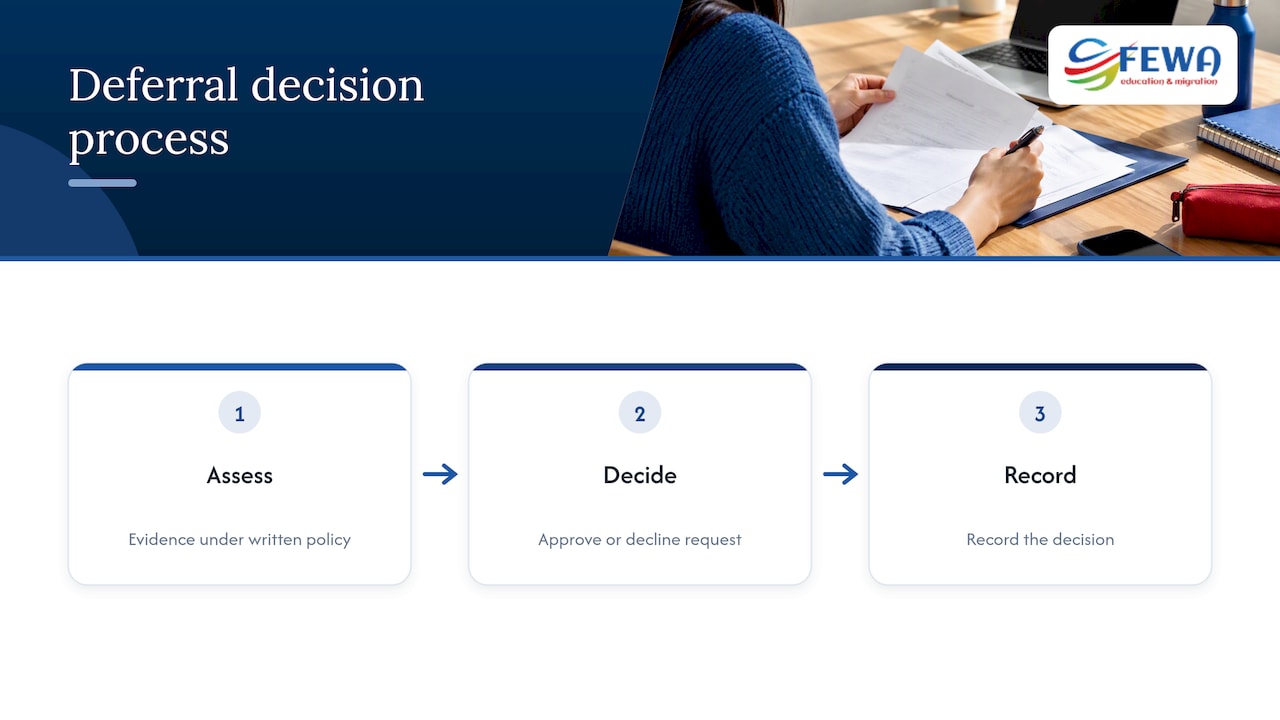
Under Standard 9 of the National Code, a provider can approve a student’s request to defer or suspend where compassionate or compelling circumstances apply. Each case is assessed individually under the provider’s own written policy, with evidence. Providers must also have a documented process for assessing, approving and recording these decisions.
Universities spell this out in practice. James Cook University says an onshore international student may take leave only in limited National Code circumstances. You need to give a statement explaining circumstances beyond your control that affect your course progress or wellbeing, and attach supporting documents.
Swinburne is equally direct. You must stay enrolled and keep attending until the university confirms leave has been granted, and holidays and work commitments are not acceptable reasons under its policy.
Reasons that tend to be taken seriously
Every provider decides for itself, so there is no universal list. In our experience, requests are strongest when they involve something outside your control that is clearly documented, for example:
- a serious illness or injury, supported by a medical certificate that says how it affects your study;
- a death or serious illness in your immediate family, with documents to match;
- a traumatic event, supported by a counsellor or similar professional;
- a delay that genuinely stops you starting on time, with proof of the cause.
Reasons that usually are not enough
A wish to travel, earn more money, avoid a hard subject or simply take a rest is unlikely to meet the standard. If your real situation is that you are struggling academically, speak to student support first. There may be better options, such as a reduced load where your course allows it or academic support.
How to ask for a deferral, step by step
- Read your provider’s policy. Search the website for “international student leave of absence” or “deferral”. Look for forms, deadlines and who to contact.
- Talk to student support or the international student office early. Do this before you stop attending, ideally before you submit anything. They can explain what evidence they expect.
- Write your statement. Explain what happened, when, why it is outside your control and how it affects your study. Keep it factual and specific.
- Attach evidence. Medical certificates, letters, death certificates, police reports or official correspondence, translated where needed. Monash notes that international students must give reasons and supporting evidence where applicable.
- Keep attending until you are told in writing. Do not assume approval. Your provider’s decision, with the dates of your break, is what protects you.
- Ask how your visa is affected. Your provider must record the change and advise you to seek advice from Home Affairs. Do it before the leave begins, not after.
- Accept any replacement offer. At Monash, once a deferral is approved you must accept the new offer so a new CoE can be issued. Failing to accept or to communicate may lead to enrolment and visa consequences.
What happens to your CoE and your visa
Your provider reports a deferral or suspension through PRISMS, the system that links providers with Home Affairs. If the end date on your Confirmation of Enrolment (CoE) is not affected, the CoE stays as it is. If the end date changes, PRISMS cancels the original CoE and the provider creates a new one.
The outcome for your visa depends on why the change was made:
| Situation | What the National Code says | What it means for you |
|---|---|---|
| Deferral or suspension for compassionate or compelling reasons, approved | Your visa would not be cancelled on that basis | You can usually stay, but confirm with Home Affairs |
| Deferral or suspension on other specified grounds | May lead to cancellation of your visa | Seek advice before agreeing to anything |
| Stopping study without approval | Treated as not complying with visa conditions | Serious risk to your visa and future applications |
The first two rows come from Standard 9 of the National Code. Providers can also suspend or cancel an enrolment on their own initiative for specified reasons such as misbehaviour, unpaid fees, or breaches of course progress or attendance requirements. That is a separate path from a deferral you ask for, and it carries more risk.
Home Affairs is clear that you should tell it about changes to your study before you make them, otherwise your stay in Australia might not be lawful. If you are unsure whether your situation counts, that is the moment to get advice, not after the break starts.
Work rights while your course is deferred or suspended
Study Australia states that a student may work unlimited hours if the course has been deferred or suspended in line with Standard 9. In ordinary course sessions the limit is 48 hours per fortnight. The same page tells students to check their actual conditions in VEVO or the visa grant letter.
Two cautions apply:
- This applies to an approved deferral or suspension. It does not apply if you simply stop attending.
- Before your course starts, a student visa holder cannot work unless another visa they hold at that time permits it. That matters if you are deferring a start date.
If you want to understand the usual limits in detail, our guide to work rights for international students covers them, and our page on tracking the student visa work hours limit explains how to count them.
Deferral is not the same as changing course
Some students ask about deferring when what they really want is a different course. That is a separate process. Study Australia says you must remain enrolled in a course at the same or higher level as the one your visa was granted for, and some visa conditions may require permission before you change your study plan.
In practice, a course change is a visa decision as well as an academic one. Check the condition on your visa before you withdraw or transfer. Our guide to the six-month rule and Form 8516 walks through the safe steps, and AQF levels explained helps you see whether a new course sits at the same or a higher level.
If a deferral is refused, or your visa is affected
A refusal from your provider is a setback, not the end of your options. Ask for the reasons in writing and check whether your provider has an appeal or review process. Sometimes the answer is that more evidence is needed.
If your visa is at risk or you have received a notice from Home Affairs, get advice from a MARA-registered agent promptly. Our guide on what to do after a student visa refusal explains how to respond. If your course will end later because of the break, you may also need to extend your student visa. If you hold the visa with family members, remember that dependants are affected too.
Our perspective
The most common mistake we see is acting first and asking later. A student is overwhelmed, stops going to class, and only then looks for advice. By that point the options are fewer and the explanations harder.
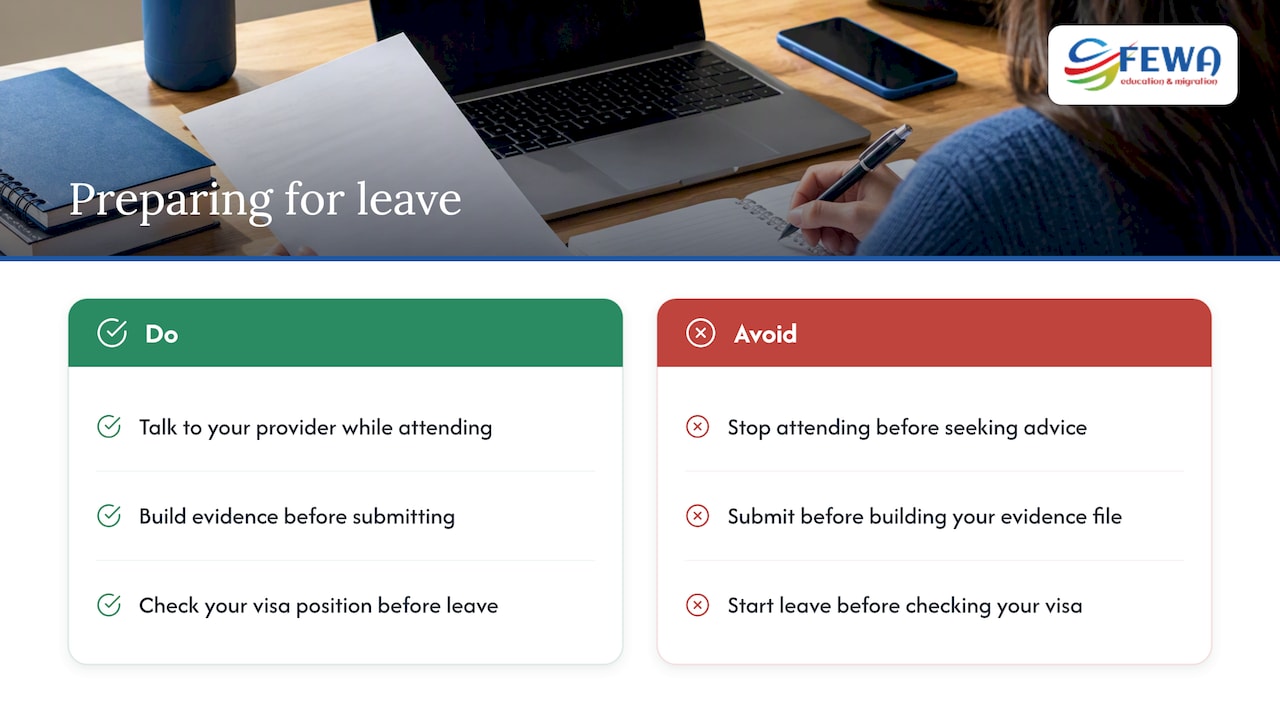
We suggest three habits. First, talk to your provider while you are still attending. Second, build the evidence file before you submit the request, not after. Third, get your visa position checked before the leave starts, because what the provider records and what your visa conditions say need to line up.
People often feel ashamed about needing a break. There is no need. The National Code has the compassionate or compelling pathway because life happens. What matters is that you use it properly, with the paperwork to match. If you want a second pair of eyes, we are happy to look at your situation and explain the options in plain language.
— Ronit
Getting advice on your situation
We are a Sydney consultancy, and our advisers are MARA-registered. We help students understand their student visa conditions, plan a course change or deferral, and respond if a visa is at risk. You can book a free online consultation through our visa services page. Bring your CoE, your visa grant letter and any messages from your provider so we can give you specific advice.
FAQ
Can I defer my course after my student visa is approved?
Only if your provider agrees and the circumstances are compassionate or compelling. Wanting to start later for convenience is unlikely to qualify. Ask your provider before the start date, and raise the visa effect with Home Affairs or a MARA-registered agent.
Can I take a leave of absence on a student visa?
Yes, in limited circumstances. Your provider must approve it under its documented policy, and you must keep attending until approval is confirmed. The provider records the break in PRISMS, which can affect your visa, so get advice first.
Can I work while my course is deferred?
Study Australia says a student may work unlimited hours if the course was deferred or suspended in line with Standard 9. Check your own conditions in VEVO or your visa grant letter. You generally cannot work before your course starts unless another visa you hold allows it.
What happens if I stop studying without approval?
It is treated as not complying with your student visa conditions. That can lead to visa cancellation and make future applications harder. If this has already happened, seek advice from a MARA-registered agent promptly.
Can I change my course instead of deferring?
Yes, but you must follow the correct process. You need to stay enrolled at the same or a higher level than the course your visa was granted for, and some conditions need permission first. Check your visa before withdrawing from anything.
Sources
- Standard 9: Deferring, suspending or cancelling overseas students’ enrolment (National Code 2018)
- Taking a break from study (leave of absence), James Cook University
- International students time off from study, Swinburne University
- Defer or change your course, Monash University
- Student visa (subclass 500), Study Australia
- Changing your course or provider, Study Australia
- Your study situation has changed, Home Affairs