


Australia and New Zealand both offer a route from study to work to permanent residence, but they are built differently. Australia has several points-tested, state-nominated and employer-sponsored streams. New Zealand leans heavily on skilled employment with an accredited employer. Which is “easier” depends on your occupation, your qualification, your age and whether you already have a job offer. This guide sets the two systems side by side, so you can see where you fit and what to do next.
TL;DR
- Australia’s permanent Skill stream has four parts: Employer Sponsored, Regional, State/Territory Nominated and Skilled Independent. That gives you more than one door to try.
- New Zealand’s skilled residence routes (Straight to Residence and Work to Residence) often depend on a job offer from an accredited employer.
- Both countries have a post-study work visa. Neither one is permanent residence, so plan what comes after it.
- New Zealand citizens moving to Australia are a separate case. Since 1 July 2023 many can go from a Special Category Visa (SCV) straight to Australian citizenship.
- The UK’s Graduate route does not count towards settlement, so you need to switch to another route such as Skilled Worker.
Table of Contents
- How the two systems think about permanent residence
- Studying first: does a degree lead to PR?
- Skilled migrants already working
- If you hold a New Zealand passport
- Where the UK fits in
- Costs, money and paperwork to check first
- Our perspective
- How we can help
- A simple way to decide
- FAQ
- Sources
How the two systems think about permanent residence
The biggest difference is structure. Australia runs a planned Migration Program, and its Skill stream includes Employer Sponsored, Regional, State/Territory Nominated and Skilled Independent components. Each has its own rules, points or sponsor requirements, and each suits a different profile.
New Zealand’s skilled pathways are described by Immigration New Zealand in two main forms: the Straight to Residence Visa for Tier 1 roles and the Work to Residence Visa for Tier 2 roles, after you meet New Zealand work-experience requirements. Eligibility often requires a job offer from an accredited employer.
In practical terms:
| Question | Australia | New Zealand |
|---|---|---|
| Main skilled routes | Employer Sponsored, Regional, State/Territory Nominated, Skilled Independent | Straight to Residence (Tier 1), Work to Residence (Tier 2) |
| Is a job offer essential? | Not for every stream. Skilled Independent and some nominated streams are points-based | Often yes, from an accredited employer |
| Post-study work visa | Temporary Graduate (subclass 485) | Post-Study Work Visa |
| Does post-study work lead to PR automatically? | No | No |
The table is a simplification. Occupation lists, points thresholds and fees change, so always check the official page before you lodge anything.
Studying first: does a degree lead to PR?
Neither country grants permanent residence for completing a course. What study gives you is time, local experience and access to a temporary work visa while you build a case.
Australia: the Temporary Graduate visa
In Australia, the Temporary Graduate visa lets recent Student visa graduates stay and work temporarily. Study Australia notes that graduates with a bachelor’s, master’s or doctoral degree may be eligible for the Post-Study Work stream of the subclass 485.
That 485 period is your window. Most graduates use it to do three things: gain skilled work experience in a nominated occupation, lift their English score, and decide between a points-tested visa and an employer-sponsored one. If you are close to finishing, our guides on 485 visa requirements for international students and the overseas student health cover you must hold on a 485 cover the practical details. You can also read about the Temporary Graduate visa in more depth.
New Zealand: the Post-Study Work Visa
Immigration New Zealand says its Post-Study Work Visa is for eligible graduates of level 7 or higher qualifications, completed in at least 30 weeks of full-time study, and allows you to stay and work for up to 3 years. The same page says that from late 2026 eligibility extends to graduates with an NZQCF Level 7 Graduate Diploma studied full-time in New Zealand, and to those with a bachelor’s degree completed in New Zealand or overseas.
That last change matters if you studied a bachelor’s elsewhere and are weighing a shorter course in New Zealand. Check the current wording on the official page before you enrol, because the rules are being updated.
What this means for you
A post-study work visa is a bridge, not a destination. Whichever country you choose, ask this before paying tuition: which occupation will I be able to nominate, and who might sponsor me? A course that does not link to a skilled occupation can leave you with work rights but no clear route to residence.
Skilled migrants already working
If you are an experienced professional rather than a student, the comparison looks different.
In Australia, you can look at the main routes side by side:
- Skilled Independent: points-tested, no sponsor.
- State or Territory Nominated, and Regional: a state or regional connection in exchange for extra points or a nominated pathway. Our comparison of 190 vs 491 explains the trade-off between a 5-point boost and a regional path.
- Employer Sponsored: a sponsor backs you. Our guide to 482 vs 186 shows how applicants and employers can reach PR faster.
For an overview of how these fit together, see 3 PR pathways in Australia and the skilled occupation list.
In New Zealand, you generally need an accredited employer first. If your role falls in the Tier 1 category, you may qualify for Straight to Residence. If it is Tier 2, you build New Zealand work experience first and then move to residence. For many people this makes New Zealand a good option when a job offer is already in hand, and a harder one when it is not.
The honest summary: Australia offers more ways to apply on your own merits, while New Zealand rewards having an employer ready. Neither is universally easier.
If you hold a New Zealand passport
Many searches for this topic come from Kiwis planning a move across the Tasman, and the rules for them are not the same as for other migrants.
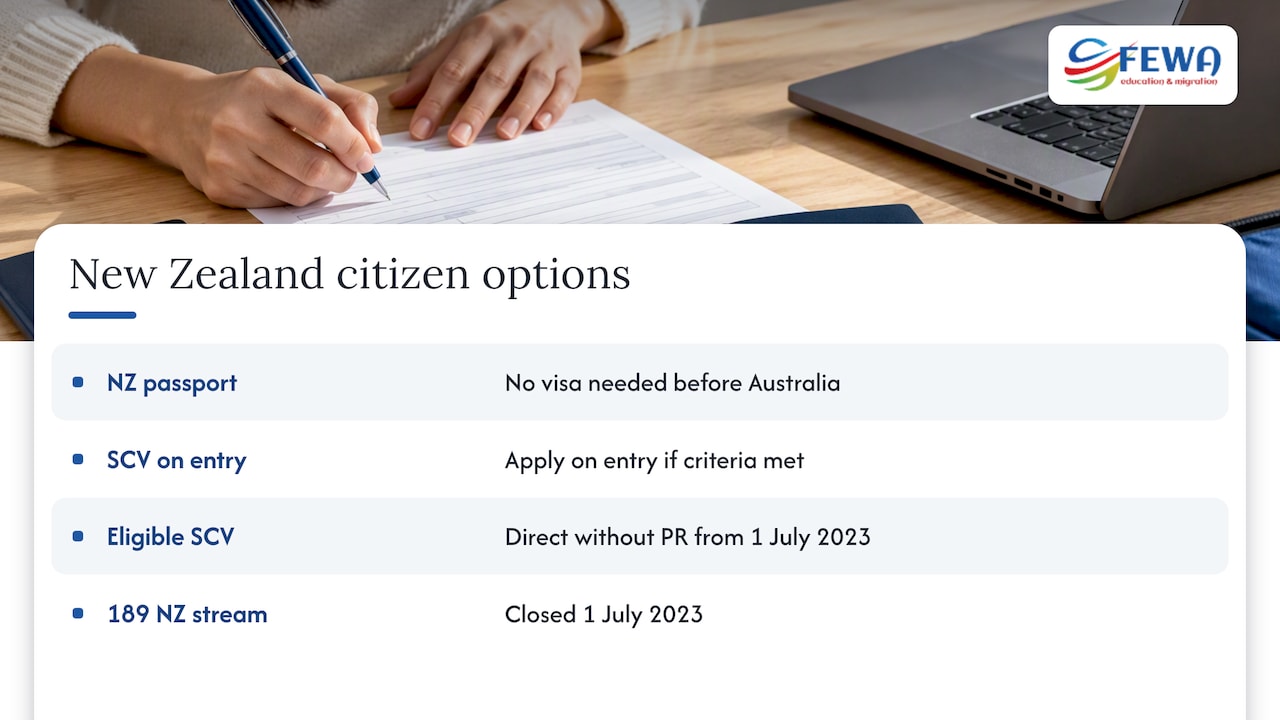
According to the Department of Home Affairs, New Zealand citizens with a valid New Zealand passport do not need to apply for a visa before coming to Australia, and can apply for an SCV on entry if they meet the criteria. The same page states that from 1 July 2023, SCV holders can apply directly for Australian citizenship without first obtaining a permanent visa, if eligible. The citizenship application form also notes that for citizenship purposes, New Zealand citizens holding an SCV are considered permanent residents.
One older route has closed. The New Zealand stream of the Skilled Independent (subclass 189) visa permanently closed to new applications on 1 July 2023. If you read an older article recommending it, that advice is out of date.
So for a New Zealand citizen, the question is rarely “which PR?” and more often “do I want citizenship, and does my family situation need a different visa?” Non-New Zealand family members, partners and people with character concerns can face a different process, and it is worth getting advice before you assume the SCV covers everyone.
Where the UK fits in
Some readers compare Australia with the UK rather than New Zealand. The UK’s Graduate route lets eligible international students who completed an undergraduate degree or above at a qualifying provider work or look for work for 2 years, or 3 years for doctoral students. It is important to know that the Graduate route does not count towards settlement, although graduates can move to other routes including Skilled Worker.
On the settlement side, UK guidance says skilled workers who have been continuously and lawfully resident on the Skilled Worker route or other eligible routes for 5 years or more may apply for indefinite leave to remain. Rules there have been changing, so check the current Home Office page.
If you are an Australian-based student considering the UK, read our note on UK student visa rules for Australians.
Costs, money and paperwork to check first
Before choosing, build a simple checklist for each country:
- Course fees and living costs for the exact city, not a national average.
- Visa application charges for each stage, from student visa to post-study visa to residence.
- English test results, since a better score can open more options. If you are choosing a test, see PTE vs IELTS.
- Health cover requirements for each visa.
- Document quality. Missing documents can delay an application, and fees are generally not refundable, as Study Australia notes in its guidance on applying after graduation.
If you expect to settle, think about housing early. Once you hold a visa that allows it, a guide to home loans for visa holders can show what lenders look at and how rates compare.
Our perspective
We see the same pattern again and again. People ask “which country has easier PR?” when the more useful question is “which pathway fits my occupation, my age and my savings?” A nurse with a job offer in Auckland and a cook finishing a diploma in Sydney have almost nothing in common, even though both would type this search.
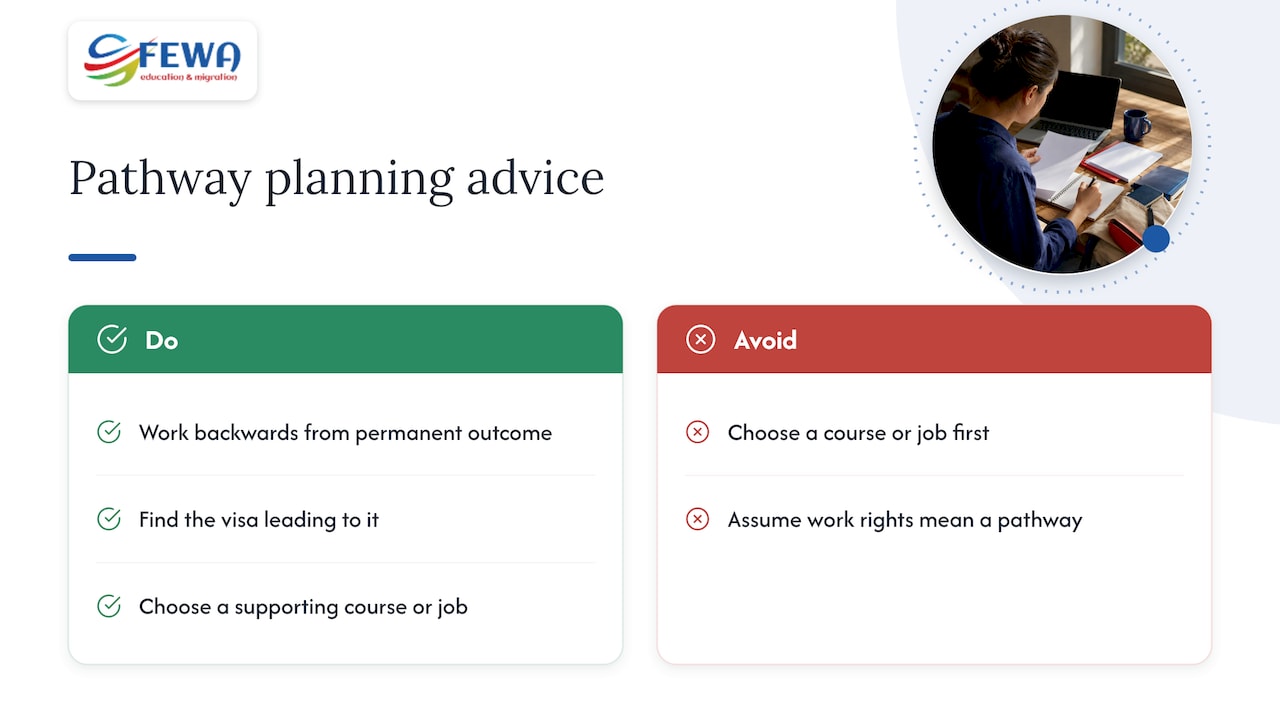
Our advice is to work backwards. Start with the permanent outcome you want, find the visa that leads to it, then choose the course or job that supports that visa. Too many students do the reverse and are left with work rights but no pathway.
We also encourage you to keep your options open. Australia’s several skilled streams mean that if one door closes, for example when your points fall short, another such as regional or employer sponsorship may still be possible. We are a Sydney-based consultancy registered with MARA, and we focus on Australian pathways, so we will tell you plainly when your situation suits Australia and when it may not.
— Ronit
How we can help
If you are weighing Australia against another country, or you are already here and planning your next visa, we offer free online consultations for individuals and families. We can look at your study history, work experience and goals, then map the visa options step by step. Our team handles student visas, skilled migration, employer sponsored visas, partner and family applications, and English test coaching. See all our visa services or get in touch to book a consultation.
A simple way to decide
Work through these questions in order:
- Do you already have a job offer from an employer in either country? If yes from an accredited New Zealand employer, New Zealand’s skilled routes become more realistic. If yes from an Australian sponsor, look at employer sponsored pathways.
- Do you hold a New Zealand passport? If so, your Australian route is likely the SCV, and citizenship may be available directly.
- Are you still choosing a course? Pick one that links to a skilled occupation and a post-study visa you are eligible for.
- Do you have a partner or family who could be part of the plan? Your visa choice may change what is available to them.
- How long can you realistically wait? Temporary visas buy time, but they do not guarantee residence.
FAQ
Is Australia or New Zealand better for PR?
Neither is better for everyone. Australia offers more streams, including employer sponsored, regional, state nominated and skilled independent, while New Zealand’s skilled routes often depend on an accredited employer job offer. Your occupation and circumstances decide which one fits.
Can a New Zealand citizen get Australian citizenship without PR?
In many cases, yes. From 1 July 2023, SCV holders can apply directly for Australian citizenship without first obtaining a permanent visa, if they meet the eligibility requirements. Check the Department of Home Affairs page for the current criteria.
Does a post-study work visa lead to permanent residence?
Not automatically. Australia’s Temporary Graduate visa and New Zealand’s Post-Study Work Visa both give you time to work, but you must qualify separately for a residence pathway. The UK Graduate route likewise does not count towards settlement.
Is the Australian 189 visa still open to New Zealanders?
The New Zealand stream of the subclass 189 visa closed to new applications on 1 July 2023. New Zealand citizens now look at the SCV, direct citizenship eligibility, or other permanent visas such as employer sponsored or partner options.
Sources
- Compendium: Australia’s Migration Trends 2023-24
- 2023-24 Migration Program Frequently Asked Questions
- Getting New Zealand residence through your skills
- Work after graduating, Study Australia
- Staying to work after finishing your study, Immigration New Zealand
- New Zealand citizens, Department of Home Affairs
- Application for Australian citizenship, form 1300t
- Fact sheet: Graduate Immigration Route, UK Home Office
- Sponsor a Skilled Worker guidance, UK Home Office