


Most Nepali applicants move to Australia through the student visa (Subclass 500), skilled visas (Subclass 189, 190 or 491), employer sponsorship (Subclass 482 or 186), or partner and family visas. If you are starting this process from Nepal, your first move is to open the relevant Home Affairs subclass page and begin gathering your identity documents, English test evidence, and, if you are going the skilled route, your qualifications for a skills assessment.
TL;DR:
- Matching your occupation to the correct ANZSCO code and completing a relevant skills assessment are crucial for skilled visa success, especially on Subclass 189, 190, or 491.
- Gathering current, valid English test results, police certificates, and medical reports before lodgement can prevent delays caused by expired or incomplete evidence.
- Prioritize sequencing your preparations by confirming your pathway and specific evidence requirements to avoid wasting time and money on unnecessary tests and assessments.
- Especially for students, demonstrating genuine intent and tying your course selection to your future plans improves your genuine student requirement assessment.
- Connecting early with settlement support services or Nepali community networks can facilitate smoother post-arrival integration in Australia.
Table of Contents
- Overview of visa pathways that suit Nepali applicants
- Step-by-step application process for applicants applying from Nepal
- Eligibility, documents and evidence checklist
- Processing times, likely costs and how to set realistic timelines
- Common pitfalls and practical tips to avoid refusals or delays
- How to prepare in Nepal before you lodge
- Updating or changing your visa conditions while in Australia
- Post-arrival settlement support and resources for Nepali migrants
- What the process really demands from Nepali applicants
- How Fewa Education & Migration can support your application from Nepal
- Sources
- FAQ
Overview of visa pathways that suit Nepali applicants
Choosing the right visa starts with being honest about your purpose: are you studying, working, joining family, or visiting? Each pathway has its own entry criteria, and matching yourself to the wrong one wastes time and money.
The student visa (Subclass 500) suits anyone enrolled in a registered course in Australia. You need genuine intent to study, evidence of financial capacity, and English proficiency. After finishing, many Nepali graduates move to the Temporary Graduate visa (Subclass 485), which allows a period of work experience linked to your qualification.
For those with in-demand skills, the points-tested skilled visas, Subclass 189 (independent), Subclass 190 (state or territory nominated), and Subclass 491 (regional), reward applicants with a relevant occupation, a positive skills assessment, and competitive English scores. Regional pathways (491) often have lower point thresholds and are worth serious consideration if you are open to living outside a major city.
Employer-sponsored visas, Subclass 482 and Subclass 186, depend on securing a genuine job offer from an approved Australian sponsor. Partner and family visas apply if you have an Australian citizen, permanent resident, or eligible New Zealand citizen spouse, de facto partner, or qualifying family member. Visitor visas (Subclass 600) suit short trips only and cannot be used as a backdoor into long-term migration.
- Students: prioritise course choice, genuine study intent, and financial evidence.
- Skilled applicants: confirm your occupation is on the relevant list before doing anything else.
- Sponsored or partner applicants: your case depends entirely on your sponsor’s or partner’s eligibility.
Each subclass has its own page on the Home Affairs website, and that page is where the definitive eligibility criteria live, not general summaries you find elsewhere.
Step-by-step application process for applicants applying from Nepal
Applying from Nepal follows broadly the same digital process as any other country, but a few local details matter.
- Confirm your subclass and gather core documents: passport, academic transcripts, English test results, and, for skilled visas, your skills assessment outcome.
- Create an ImmiAccount and complete the online application form for your chosen subclass. A “decision-ready” application, meaning every requested document is attached the first time, moves faster than one that invites a request for more information.
- Pay the visa application charge and submit.
- Complete biometrics. Home Affairs guidance explains that some applicants can provide biometrics through the Australian Immi App when their Visa Lodgement Number begins with “AUI”, while others must attend a Biometrics Collection Centre in person. Check your VLN before booking travel for this step.
- Book your medical examination with a panel physician once Home Affairs issues the request, and submit results promptly.
- Respond to any request for information within the given timeframe, with complete, specific evidence rather than a partial answer.
The Australian Embassy in Nepal does not process visas itself. It directs applicants to Home Affairs for the application and status checks, and written enquiries for Nepal-based applicants are often handled through the High Commission in New Delhi.
Pro Tip: Scan and label every document clearly (for example, “Passport_MainPage.pdf”) before you start your ImmiAccount application. It saves real time during upload and reduces the risk of submitting the wrong file.
Eligibility, documents and evidence checklist
Decision makers assess specific evidence against specific criteria, and knowing what they look for lets you build a stronger file from the start.
For students, the genuine student requirement replaced the old genuine temporary entrant test and is assessed under Ministerial Direction No. 106, which sets out factors such as the value of the course to your future, your ties to Nepal, and your immigration history. For skilled visas, your occupation must match an ANZSCO code listed on the Core Skills Occupation List, and a relevant assessing authority must confirm your qualifications and experience against that code.
- English evidence: IELTS, PTE Academic or another accepted test, with results scoring against the threshold for your subclass.
- Health checks: a medical examination through a panel physician, which may include a chest x-ray and, for some visa types, HIV testing.
- Police certificates: from Nepal and any other country you have lived in for a set period, obtained before you lodge where possible.
- Identity documents: passport, citizenship certificate, and any name-change evidence if relevant.
Nepal is one of the fastest-growing source countries for Australia’s migrant population. The Nepal-born community in Australia grew substantially over the decade to 2025, among the largest increases recorded among any overseas-born group in that period. That growth reflects how many of these pathways, particularly student and skilled visas, are already well-travelled routes for Nepali applicants.
Processing times, likely costs and how to set realistic timelines
Home Affairs publishes a visa processing times tool that gives estimates by subclass, and it explains that actual times vary with application completeness, ministerial directions, and priority processing arrangements. Always check the current figures for your specific subclass rather than relying on a general timeframe.
Budget for more than the visa application charge itself:
- Medical examination fees paid directly to the panel physician.
- Police certificate fees in Nepal and any other country of residence.
- Skills assessment fees charged by the relevant assessing authority.
- English test fees for IELTS or PTE Academic.
- Migration agent or consultancy fees, if you choose to use professional help.
Student visa decisions often move faster than skilled visa outcomes, which can involve additional verification steps. Partner visas typically take longer again, given the depth of relationship evidence required. Incomplete documentation is the single biggest cause of delay across every category.
Common pitfalls and practical tips to avoid refusals or delays
Most refusals and delays trace back to a handful of avoidable mistakes.
- Vague or generic GTE answers. Students who write broad, template responses to the genuine student questions give decision makers little to work with; be specific about your course, your career plan, and your ties to Nepal.
- Occupation coding errors. Claiming an ANZSCO code that does not match your actual duties or qualifications is one of the fastest ways to have a skilled visa application questioned or refused.
- Missing or uncorroborated evidence. A claim without a supporting document invites a request for more information and adds months to your timeline.
- Timing traps. Expired English test results, medical exams booked too late, or missed biometrics appointments can stall an otherwise strong application.
Pro Tip: Keep a simple spreadsheet tracking every document’s issue date and expiry date. Visa timelines move slowly enough that a test result or police certificate can lapse before you lodge.
How to prepare in Nepal before you lodge
Being decision-ready starts long before you open ImmiAccount.
- Book your English test (IELTS or PTE Academic) early, but not so early that your result expires before you lodge; most results stay valid for around two years.
- Start your skills assessment application as soon as you have your qualifications and work references together, since assessing authorities can take weeks to months to respond.
- Arrange your police certificate and medical exam booking with a panel physician once you know your subclass, so results arrive when Home Affairs requests them.
- Gather evidence of ties to Nepal, employment letters, family details, or property records, alongside financial evidence for student or partner applications.
Updating or changing your visa conditions while in Australia
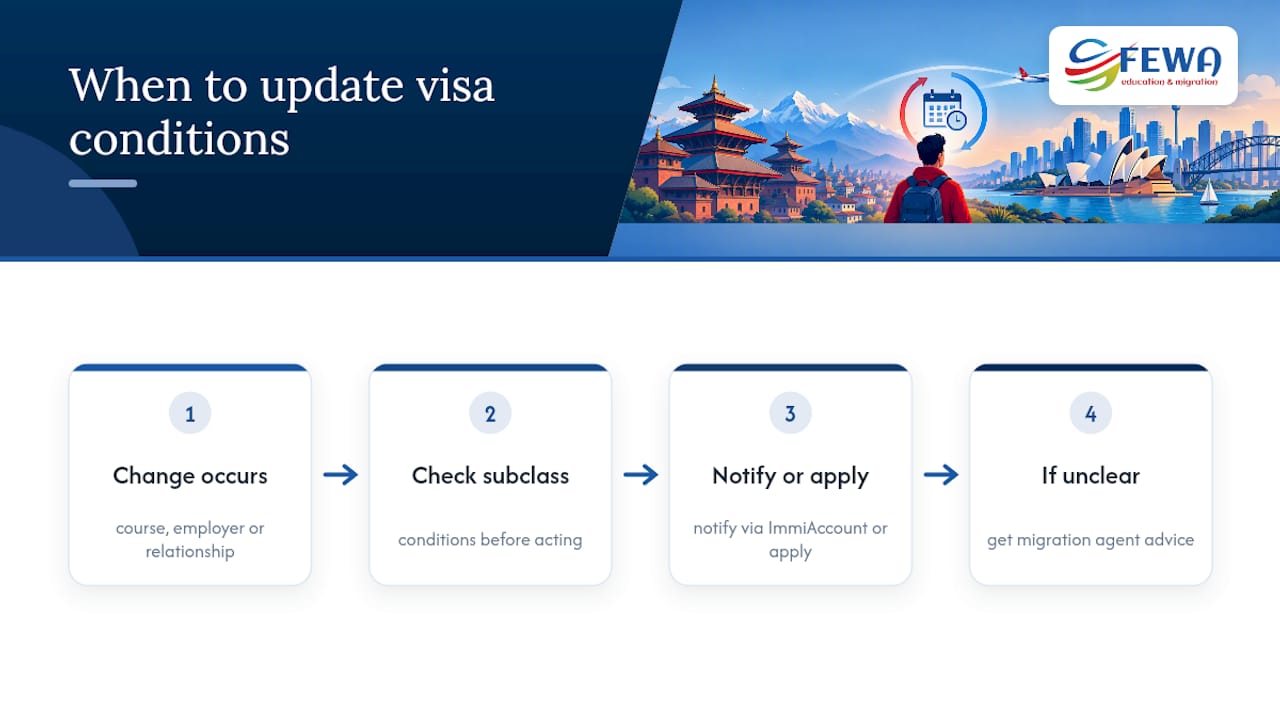
Visa conditions are not fixed for life. Some student visa holders need to update their course enrolment details or work hour conditions as their circumstances change, and some skilled or partner visa holders need to notify Home Affairs of address, contact, or relationship changes.
Any change to your circumstances that affects your visa conditions should be reported through ImmiAccount, using the same login you used to lodge your original application. This includes changes to your course provider, your employer if you hold a sponsored visa, or your relationship status if you hold a partner visa. Ignoring a condition, working beyond permitted hours on a student visa, for instance, can put your current and future visa applications at risk.
If your circumstances change significantly, such as a job change under an employer-sponsored visa or a new course under a student visa, check the specific subclass conditions before acting, since some changes require formal notification and others may need a new application altogether. Where the situation is not straightforward, getting advice from a registered migration agent before you make the change is far safer than assuming it will be fine.
Post-arrival settlement support and resources for Nepali migrants
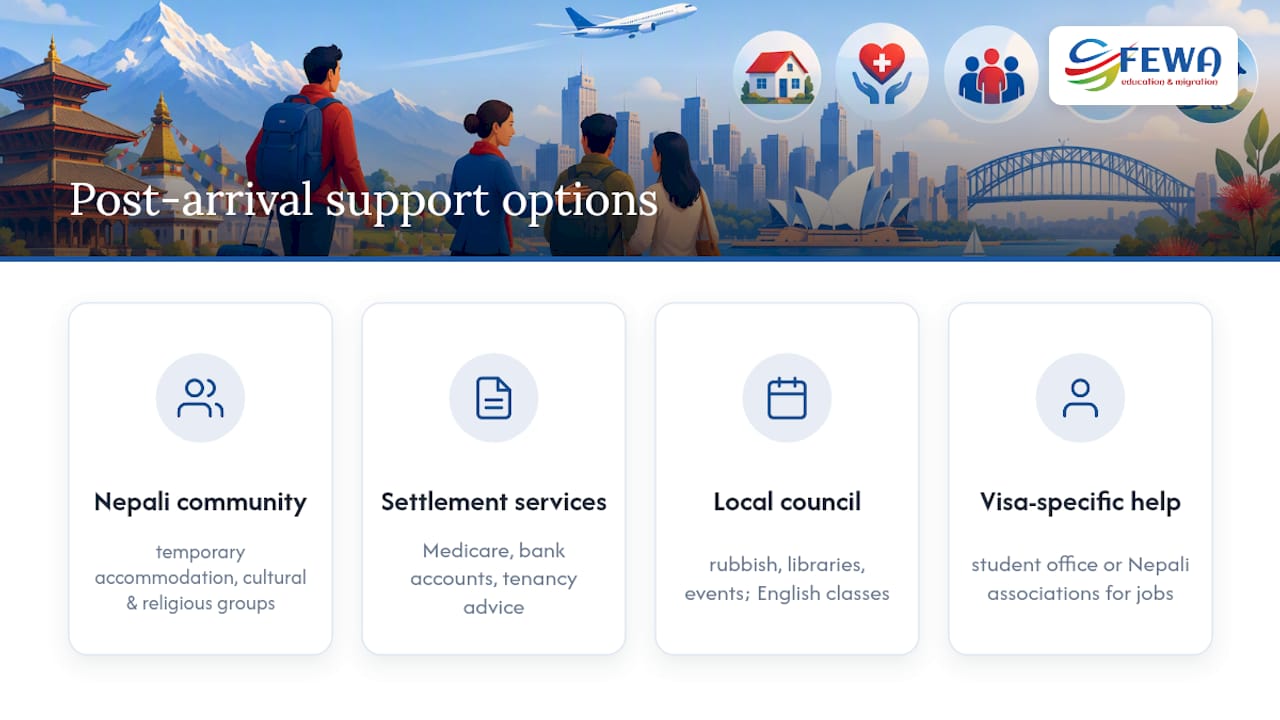
Arriving in Australia is the start of a new set of practical steps, not the end of the process. Many Nepali migrants settle initially in areas with established Nepali communities, which makes finding temporary accommodation, community groups, and cultural or religious organisations considerably easier.
Support services worth knowing about include settlement guidance services that help with everything from Medicare enrolment to opening a bank account, tenancy advice, and local council services covering rubbish collection, libraries, and community events. Many local councils across Sydney and other major cities run free or low-cost English classes and community integration programmes for new arrivals.
If you are on a student visa, your education provider’s international student support office is usually your first point of contact for both academic and welfare questions. If you are on a skilled or partner visa, look into local Nepali associations, which often run informal networks for job leads, housing shares, and cultural events. Settling well is as much about building a support network in your first months as it is about paperwork.
What the process really demands from Nepali applicants
The technical eligibility criteria get most of the attention online, but the applicants who move through this process smoothly are the ones who treat evidence as a story that has to hang together, not a checklist to tick off. A GTE answer that repeats generic phrases about “quality education” tells a decision maker nothing about you specifically, and a skills assessment that stretches your job title to fit a more favourable ANZSCO code usually creates more problems than it solves.
The conventional advice, “just gather your documents and lodge”, underestimates how much the order of operations matters. Booking an English test before confirming your subclass, or starting a skills assessment before checking the correct occupation code, wastes months. If there is one thing worth prioritising above all else, it is sequencing: confirm your pathway, confirm your exact evidence requirements against the current ministerial directions and occupation lists, and only then start booking tests and appointments.
— Ronit
How Fewa Education & Migration can support your application from Nepal
If you would rather not navigate ImmiAccount, ANZSCO codes, and ministerial directions alone, Fewa Education & Migration offers hands-on support at each stage of the process. As a consultancy with experience supporting Nepali clients, assistance includes checking your eligibility against the current criteria before you spend money on tests or assessments you may not need.
Services include:
- Eligibility checks and pathway selection for student, skilled, partner and family visas.
- Document review and preparation, including GTE statements and skills assessment applications.
- IELTS and PTE coaching to help you reach the score your subclass requires.
- End-to-end lodgement support through to decision.
Start with a free eligibility check on the Fewa visa services page to find out which pathway fits your situation and what to prepare first.
This article is general information, not a substitute for advice from a qualified lawyer. Consult a qualified legal professional about your own circumstances before acting on anything here.
Sources
- Australia’s population by country of birth — ABS
- Biometrics and the Australian Immi App | Department of Home Affairs
FAQ
Why are so many Nepalese moving to Australia?
Australia’s student and skilled visa pathways offer clear routes to study, work and eventually settle, and the Nepal-born population in Australia grew substantially over the decade to 2025. Established Nepali communities in cities like Sydney also make settling in easier for new arrivals.
How many Nepalese live in Australia currently?
The exact current figure is not publicly listed in a single confirmed dataset, but the Nepal-born community has been among the fastest-growing overseas-born groups in Australia over the past decade. Updated Australian Bureau of Statistics figures are released periodically and remain the most reliable source to check.
Is $10,000 enough to move to Australia?
It depends entirely on your visa pathway. Student visas require proof of funds covering tuition, living costs and travel, which typically exceeds that amount, while skilled and partner visas have different financial evidence requirements, so check the specific criteria for your subclass on the Home Affairs website before assuming any fixed figure is enough.
Do refugee entrants receive a fixed payment in Australia?
There is no fixed payment made to refugees or humanitarian entrants in Australia. Support for humanitarian entrants comes through settlement services, Centrelink payments and community programmes rather than a single lump sum, and eligibility depends on visa category and individual circumstances.
What documents do I need before I lodge my application?
At minimum you need a valid passport, English test results, and, for skilled visas, a positive skills assessment matched to an ANZSCO occupation code. Student applicants also need evidence of course enrolment and financial capacity, while police certificates and medical exam results are required across most pathways.