


For most Australian study or visa applications, IELTS is the safer choice. The Department of Home Affairs accepts IELTS across virtually all visa streams, while the Duolingo English Test (DET) remains accepted by a growing but still limited set of Australian universities for admissions purposes only. If your target university explicitly lists DET and you are not applying for a student visa that requires a government-approved test, DET can work. Otherwise, IELTS removes the risk entirely.
To orient yourself quickly: DET scores can be broadly associated with IELTS bands around these ranges, though these are estimates and not guaranteed conversions. These figures come from Duolingo’s own concordance documentation, and independent researchers caution that individual variation around these estimates can be significant.
- IELTS is accepted for Australian student visas, skilled migration, and most university admissions.
- DET is accepted by a growing number of Australian universities for direct admissions but is generally not accepted by the Department of Home Affairs for visa purposes.
- Score equivalence tables exist but carry meaningful uncertainty at the individual level.
- Both tests measure English proficiency; they differ substantially in format, cost, and institutional reach.
Key Takeaways
IELTS is the safer default for Australian applicants because it satisfies both university admissions and visa requirements, while DET works only when your specific institution and visa stream explicitly accept it.
| Point | Details |
|---|---|
| IELTS covers more ground | IELTS is accepted for Australian visas and all university admissions; DET acceptance is institution-specific and not valid for most visa streams. |
| DET costs significantly less | DET runs approximately AUD $70–$85 per sitting versus AUD $385–$420 for IELTS in Australia. |
| Score conversions are estimates only | A DET score of 120 maps roughly to IELTS 6.5–7.0, but individual variation is large enough to make conversions unreliable for high-stakes decisions. |
| Results arrive faster with DET | DET results are typically available within 48 hours; computer-delivered IELTS takes 3–5 business days. |
| Fewa verifies your requirements first | Fewa’s MARA-registered team checks your course acceptance list and visa subclass requirements before recommending a test or coaching program. |
Table of Contents
- How do Duolingo and IELTS compare for Australian applicants?
- What does each test actually involve?
- How do DET and IELTS scores convert to each other?
- Which Australian institutions and visa streams accept each test?
- What do fees, booking, and result timelines look like in Australia?
- Which test should you choose for your situation?
- What does independent research say about DET versus IELTS?
- A note from Fewa on choosing the right test for your Australian application
- Fewa’s test coaching and visa support services
- Sources
How do Duolingo and IELTS compare for Australian applicants?
| Dimension | Duolingo English Test (DET) | IELTS Academic / General Training |
|---|---|---|
| Score scale | 10–160 overall; four subscores | 0–9 in 0.5 band increments; four skill bands |
| Test format | Adaptive, integrated tasks | Fixed sections: Listening, Reading, Writing, Speaking |
| Delivery mode | At-home, online, proctored | Test center (Speaking face-to-face or online at select locations) |
| Australian university acceptance | Growing — check each institution | Widely accepted across all universities |
| Visa acceptance (Dept. of Home Affairs) | Generally not accepted | Accepted for student, skilled, and most other visa streams |
| Typical cost (AUD) | Approx. AUD $70 | Approx. AUD $385 |
| Result turnaround | ~48 hours | 3–5 business days (online); up to 13 days (paper) |
| Test duration | ~60 minutes | ~2 hours (plus Speaking, scheduled separately) |
| What it emphasizes | Vocabulary, syntax, integrated skills | Extended academic discourse, interactional speaking |
| Best for | Quick admissions check, budget-conscious, DET-accepting universities | Visa applications, broad university admissions, skilled migration |
Pro Tip: Before booking either test, check two separate lists: your target university’s course entry page AND the Department of Home Affairs language test requirements for your visa subclass. These are different requirements, and a test accepted for admissions may not satisfy your visa.
What does each test actually involve?
IELTS: Academic and General Training
IELTS comes in two modules. Academic is for university admissions and professional registration. General Training is for migration, vocational training, and secondary schooling. Both share the same Listening and Speaking components; Reading and Writing differ between modules.
The four sections are:
- Listening (30 minutes): Four recorded conversations and monologues, 40 questions
- Reading (60 minutes): Three passages for Academic; shorter, more practical texts for General Training
- Writing (60 minutes): Academic requires a graph/chart description plus an essay; General Training requires a letter plus an essay
- Speaking (11–14 minutes): Face-to-face interview with a certified examiner, or online at select Australian locations
The British Council’s IELTS pages and IDP Australia both administer IELTS in Australia, with test centers in every major city. Speaking is typically scheduled on the same day or within a few days of the written components.
DET: Adaptive, at-home, integrated
The DET runs for approximately 60 minutes and is taken entirely at home on a personal computer with a webcam. The format is adaptive, meaning the difficulty of questions adjusts based on your responses. According to Duolingo’s technical manual, the test uses automated scoring algorithms alongside human review of speaking and writing samples.
Task types include Read Aloud, Write About the Photo, Interactive Reading, Interactive Listening, and Speaking Sample prompts. There is no separate Speaking appointment. Proctoring is automated, and Duolingo flags sessions for human review when anomalies appear.
Practical considerations for Australian test-takers:
- You need a quiet room, a stable internet connection, and a functioning webcam and microphone
- The test can be booked any day, at any time, with no advance scheduling required
- Typing speed matters more than in IELTS, since most responses are typed rather than handwritten
How do DET and IELTS scores convert to each other?
DET scoring: overall and subscores
Duolingo’s scoring page documents the overall DET scale of 10–160 and four subscores: Literacy, Comprehension, Conversation, and Production. These subscores give institutions a more granular picture of a candidate’s skills than the overall score alone.
IELTS scoring: bands and skill scores
IELTS reports an overall band score from 0–9 in 0.5 increments, plus individual band scores for Listening, Reading, Writing, and Speaking. Many Australian universities and visa streams specify minimum scores for both the overall band and individual components. A common student visa requirement, for example, is an overall IELTS 6.0 with no band below 5.5.
Approximate DET to IELTS conversion
These mappings draw from Duolingo’s published concordance. Treat them as estimates. The Ielts found that correlations between DET and IELTS scores exist but that individual variation is large enough to make precise conversions unreliable for high-stakes decisions. A candidate who scores DET 120 could plausibly land anywhere from IELTS 6.5 to 7.5 on a given sitting.
Important: Never use a conversion table to substitute one score for another in an application. If an institution requires IELTS 7.0, a DET score that “maps” to 7.0 does not satisfy that requirement unless the institution explicitly accepts DET.
Which Australian institutions and visa streams accept each test?
University admissions
Most Australian universities now accept DET for direct admissions, though the minimum score thresholds and the specific courses covered vary. Some universities accept DET for undergraduate entry but not for postgraduate research programs. Always check the individual course entry page, not just the university’s general English proficiency policy.
For student visa English requirements, the picture is different. The Department of Home Affairs maintains its own approved list of English tests for visa purposes, and DET is generally not on that list for student visa subclasses. This means you may need DET for your university offer letter and IELTS (or another approved test) for your visa application, which is a significant planning consideration.
Visa streams and the Department of Home Affairs
For skilled migration, partner visas, and most other visa categories, the Department of Home Affairs specifies approved English tests. IELTS is accepted across these streams. If you are pursuing a skilled migration visa, you will almost certainly need IELTS, PTE Academic, or another government-approved test. DET does not currently satisfy these requirements.
Verification checklist:
- Check your target university’s course-specific English requirements page (not just the faculty page)
- Check the Department of Home Affairs website for your specific visa subclass’s approved English tests
- Confirm with the university admissions office whether DET is accepted for your intake year
- Ask your migration agent whether your visa stream permits DET or requires an approved test
Pro Tip: Policy changes happen. The list of accepted tests for Australian visas has been updated before, and it may change again. Verify directly with the Department of Home Affairs or a MARA-registered migration agent before booking any test.
What do fees, booking, and result timelines look like in Australia?
Cost comparison
IELTS in Australia is typically more expensive than DET, varying by test center and location. This covers one sitting; additional score reports sent to institutions may carry a small fee. The DET costs significantly less per sitting compared to IELTS, making it a more affordable option for many test-takers.
For applicants on a tight budget, taking DET first as a low-cost benchmark before committing to IELTS is a practical strategy, provided your target institution accepts DET for admissions. This approach is noted by independent guides as a sensible screening step.
Result timelines
DET results are typically available within 48 hours of completing the test. IELTS results for the computer-delivered version are available within 3–5 business days; paper-based IELTS results take up to 13 days. For IELTS in Australia, IDP and the British Council both offer computer-delivered sittings at major test centers, which shortens the wait considerably.
Booking flexibility
DET can be booked on demand, any day, at any time, with no advance scheduling. IELTS test dates are fixed and must be booked in advance; popular dates in Sydney, Melbourne, and Brisbane fill quickly, particularly in peak application periods (March to May and August to October). If your application deadline is tight, book your IELTS date well ahead and consider DET only if your institution confirms acceptance.
IELTS allows retakes with no mandatory waiting period, though each sitting requires a full fee payment. DET similarly allows retakes, with a minimum gap of 21 days between attempts.
Which test should you choose for your situation?
Pros and cons for Australian applicants
IELTS advantages:
- Accepted for virtually all Australian visa streams and every university
- Longer track record and broader institutional trust
- Covers extended academic listening and reading, which better reflects university study demands
- Speaking assessed by a trained human examiner
IELTS disadvantages:
- Significantly more expensive (roughly 5x the cost of DET)
- Requires test center attendance and advance scheduling
- Results take longer, which can affect tight application timelines
DET advantages:
- Much lower cost per sitting
- At-home convenience with on-demand scheduling
- Results in ~48 hours
- Accepted by a growing number of Australian universities for admissions
DET disadvantages:
- Not accepted for most Australian visa streams
- Narrower construct coverage compared to IELTS Academic (see research section below)
- At-home proctoring raises credibility questions at some institutions
- Fewer retake opportunities before application deadlines if results disappoint
Choose based on your situation
- Applying for a student visa: You will almost certainly need IELTS or another government-approved test. Take IELTS.
- Applying to an Australian university that explicitly accepts DET: DET is a reasonable, lower-cost option for the admissions offer, but confirm visa requirements separately.
- Applying for skilled migration: Take IELTS. DET is not accepted for skilled migration visa streams.
- Short deadline, limited budget, admissions only: DET’s 48-hour results and on-demand booking make it practical if your institution accepts it.
- Unsure which institutions accept DET: Default to IELTS. It removes the acceptance risk entirely.
Decision checklist:
- Does your target institution explicitly accept DET for your specific course and intake?
- Does your visa subclass require an approved test (check Department of Home Affairs)?
- What is your application deadline, and can you fit IELTS test dates into that timeline?
- What is your budget for testing?
- Which test format suits your skills: adaptive integrated tasks or structured academic sections?
What does independent research say about DET versus IELTS?
The most authoritative independent comparison available is the Cushing et al. (2022) study published via IELTS.org. Its core finding: DET focuses more heavily on vocabulary and syntax and less on extended academic discourse and interactional speaking compared to IELTS Academic. In practical terms, DET tasks tend to be shorter and more fragmented, while IELTS Academic tasks require sustained reading, listening, and writing across longer texts.
IELTS.org’s own analysis reinforces this, advising institutions to interpret score comparisons between the two tests with caution. The correlation between DET and IELTS scores is real, but it is not tight enough to treat a conversion table as a reliable substitute for the actual test an institution requires.
What this means for you as an applicant:
- A strong DET score does not guarantee you will perform equally well on IELTS, particularly on the extended Writing and Speaking components
- Admissions teams at Australian universities that accept both tests may weigh IELTS scores with greater confidence for academic readiness predictions
- If you are borderline on a score requirement, the test with the broader academic construct coverage (IELTS) gives admissions officers more information to work with
The Duolingo technical manual documents the adaptive algorithms and automated scoring methods that make DET efficient and affordable. That efficiency is genuine. The trade-off is a narrower sampling of academic language skills, which is why independent researchers recommend that institutions use DET scores alongside other evidence rather than as a direct IELTS substitute.
A note from Fewa on choosing the right test for your Australian application
At Fewa, the first question we ask every client is not “which test is easier?” It is “which test does your visa and your institution actually require?” That distinction matters enormously in practice. We have seen applicants take DET, receive a strong score, and then discover their student visa application requires an approved test. Rebuilding that timeline under pressure is stressful and avoidable.
When Fewa evaluates your situation, we check your target course’s acceptance list, your visa subclass requirements, your application deadline, and your score goal before recommending any test. If you are uncertain, a free consultation with our MARA-registered team takes about 30 minutes and answers all of these questions with your specific documents in front of us.
Fewa’s test coaching and visa support services
Choosing the right test is step one. Hitting the score your institution or visa requires is step two, and that is where targeted preparation makes a real difference.
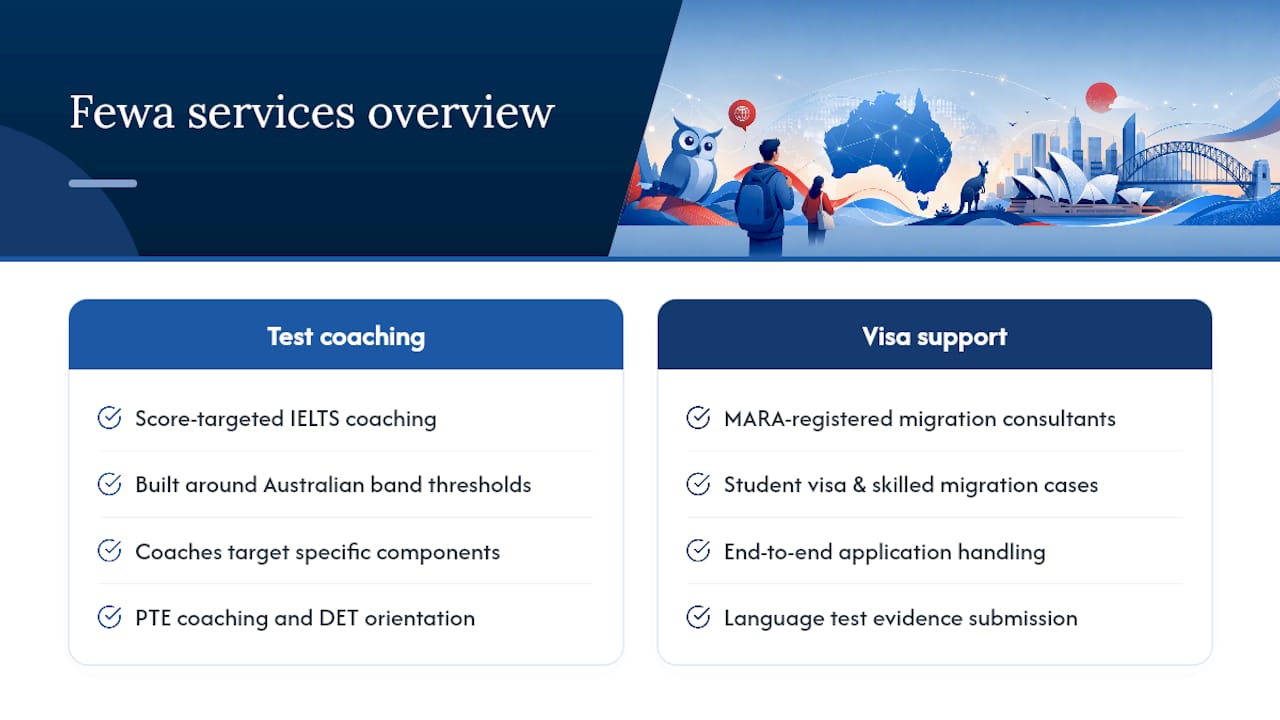
Fewa offers score-targeted IELTS coaching built around the band thresholds Australian universities and visa streams actually require, not generic preparation. Our coaches work with you on the specific components where you are losing points, whether that is IELTS Writing Task 1, Speaking fluency, or Reading timing. For clients considering computer-based alternatives, Fewa also provides PTE coaching and orientation sessions for DET.
Beyond test preparation, Fewa’s MARA-registered migration consultants handle student visa applications and skilled migration cases end-to-end, including language test evidence submission, document preparation, and deadline management. You get one team managing your test strategy and your visa, which removes the coordination risk that catches many applicants off guard.
Book a free consultation with Fewa today and get a clear answer on which test you need, what score you are targeting, and how to get there on your timeline.
Sources
Use these official pages and research documents to verify the details that matter most for your application:
- Understand Scoring – Duolingo English Test
- Comparison of IELTS Academic and Duolingo English Test – 2022
- IELTS (Australia) — test information
This article is general information, not a substitute for advice from a qualified lawyer. Consult a qualified legal professional about your own circumstances before acting on anything here.