


Yes. If you’re an internationally qualified engineer planning to migrate to Australia, you need a migration skills assessment from Engineers Australia before you can lodge most skilled visa applications. That outcome letter is what the Department of Home Affairs and SkillSelect use to confirm your occupation and qualification level. Your immediate move is straightforward.
- Confirm whether your degree is accredited under the Washington, Sydney, or Dublin Accords, or on Engineers Australia’s own program list.
- Pick the right pathway (accredited or Competency Demonstration Report) based on that answer.
- Start collecting your core documents now, since gathering transcripts and certified translations usually takes longer than applicants expect.
Key Takeaways
Getting an Engineers Australia migration skills assessment right the first time depends on matching your qualification to the correct pathway and building CDR evidence that maps to real Stage 1 competencies.
| Point | Details |
|---|---|
| Confirm accreditation first | Check the IEA accord database and EA program list before choosing a pathway. |
| Budget for several weeks minimum | Standard applications are typically assigned to an assessor after a period of time |
| Write CDRs in first person | Number paragraphs and map each career episode to real Stage 1 competency elements. |
| Watch the 2024 policy shift | Advanced Diploma and Associate Degree holders often now need the CDR pathway. |
| Submit assessment-ready | You generally get one 30-day window to fix flagged gaps, so prepare thoroughly first. |
Table of Contents
- Who Needs an Engineers Australia Skills Assessment?
- Which Assessment Pathway Fits Your Qualification?
- What Documents Does the Application Require?
- How Much Does the Assessment Cost and How Long Does It Take?
- How Do You Submit Your Application Through the EA Portal?
- What Happens After You Get Your Outcome Letter?
- What Changed for Advanced Diplomas and Associate Degrees in 2026?
- When Should You Bring in a Migration Consultant?
- Where Can You Verify These Rules Directly?
- What Most Applicants Get Wrong About This Process
- Frequently Asked Questions
- Sources
Who Needs an Engineers Australia Skills Assessment?
Anyone with an engineering qualification earned outside Australia, who wants a skilled visa in an engineering occupation, needs this assessment. It applies whether you trained in India, the Philippines, Nigeria, the UK, or anywhere else outside the Australian accreditation system.
Engineers Australia sorts applicants into four occupational categories, each tied to a specific ANZSCO code that determines which visa occupation list you fall under:
- Professional Engineer — bachelor’s degree level, ANZSCO codes like 233xxx (Civil, Mechanical, Electrical, and so on).
- Engineering Technologist — three or four year technologist qualifications, ANZSCO 233914.
- Engineering Associate — associate degree or advanced diploma level, ANZSCO 312xxx.
- Engineering Manager — for those managing engineering teams or projects, ANZSCO 133211.
Once EA assigns your category, that outcome letter becomes the document Home Affairs and SkillSelect rely on for your entire skilled migration application.
Which Assessment Pathway Fits Your Qualification?
The pathway you use depends almost entirely on where and how you studied, not on your job title or years of experience. Engineers Australia recognises qualifications through the Washington Accord (professional engineer degrees), the Sydney Accord (engineering technologist degrees), and the Dublin Accord (engineering associate qualifications), all maintained by the International Engineering Alliance. If your university and program appear on one of these accord lists, or on EA’s own accredited program register, you likely qualify for the faster Australian accredited pathway.
If your degree isn’t accredited, doesn’t match your target occupation, or combines multiple qualifications (say, a diploma plus work-based upgrading), you’ll need the Competency Demonstration Report (CDR) pathway instead. This is the route most applicants from non-signatory countries end up using.
- If your university and program appear on the IEA accord database, apply through the accredited pathway.
- If your qualification predates your country’s accord signing, or your program isn’t listed, use CDR.
- If you’re combining a diploma with extra study or experience to reach professional engineer level, use CDR.
- If you’re unsure, check the EA program list first. It takes ten minutes and saves weeks of rework.
Pro Tip: Don’t assume your university’s overall reputation guarantees accreditation. Accords cover specific programs, not entire institutions, so a mechanical engineering degree might be listed while a mechatronics degree from the same school isn’t.
What Documents Does the Application Require?
Every applicant uploads a core set of documents through the EA portal: your passport bio page, degree certificate (testamur), full academic transcripts, a current CV, passport-style photos, and certified translations for anything not originally in English. Engineers Australia’s own preparation booklet lays out these requirements in detail, along with formatting rules for each document type.
If you’re on the CDR pathway, you’ll add three career episodes, a summary statement, evidence of continuing professional development, and proof of relevant employment. Each career episode must be written in first person, with numbered paragraphs, describing real engineering work you personally performed or contributed to.
- Write each career episode as your own narrative (“I designed…”, “I calculated…”) rather than a generic project description.
- Number every paragraph so the assessor can reference specific sections in the summary statement.
- Map your summary statement against all 16 competency elements under Stage 1, not just a handful that seem obvious.
- Keep your CPD log current and specific, listing courses, conferences, or self-directed learning with dates and hours.
Career episodes that map real project work to Stage 1 competencies, written in first person with clear paragraph numbering, meaningfully improve your chances of a positive outcome, according to guidance from CDR preparation specialists. Templated, generic writing that doesn’t tie back to your actual work is one of the most common reasons applications stall or get sent back for clarification.
How Much Does the Assessment Cost and How Long Does It Take?
Engineers Australia publishes its current fee schedule on its assessment fees page, which lists the core migration skills assessment fee alongside add-on services. Add-ons include fast-track processing, relevant skilled employment review, overseas PhD assessment, and formal review or appeal fees, all GST-inclusive.
- Check the official fee table directly since costs are updated periodically and vary by service.
- Fast-track buys a quicker assignment to an assessor, not a guaranteed faster outcome.
- Budget separately for a possible review or appeal fee if your first outcome doesn’t land where you expected.
Standard applications are generally assigned to an assessor after a period of time, according to Engineers Australia. That’s assignment time, not total processing time. Document quality remains the biggest variable: a clean, assessment-ready CDR moves faster than one that triggers requests for more information. Fast-track services don’t guarantee a quicker final outcome either, since the assessor still needs complete, well-mapped evidence to reach a decision.
How Do You Submit Your Application Through the EA Portal?
The process runs entirely online, and getting the sequence right the first time saves you weeks.
- Create an account on the EA portal and record your account ID somewhere safe. You’ll need it for every future interaction with EA.
- Select “migration skills assessment,” then choose your occupational category and the correct pathway from the dropdown menu.
- Upload high-resolution scans of every required document, attaching certified translations wherever your originals aren’t in English.
- Submit only once you’re genuinely assessment-ready.
If EA flags a gap after submission, you generally get one 30-day window to supply the missing material. Missing that window can mean starting the clock over, so treat “assessment-ready” as a real standard, not a formality.
What Happens After You Get Your Outcome Letter?
A positive outcome letter states your occupational category and matching ANZSCO code, the information Home Affairs uses to confirm your visa occupation. You can verify any outcome letter’s authenticity directly through the EA portal.
- EA outcome letters don’t expire, but visa eligibility rules and occupation lists change, so confirm current visa timelines with Home Affairs separately.
- If your outcome category isn’t what you expected, you can request a formal review or lodge an appeal, both carrying their own fees.
- Engineers Australia assesses qualifications only. It doesn’t give visa advice, so questions about visa eligibility or timing belong with the Department of Home Affairs or a MARA-registered agent.
What Changed for Advanced Diplomas and Associate Degrees in 2026?
Effective September 1, 2024, Engineers Australia tightened its accreditation rules, and many Advanced Diploma and Associate Degree holders lost automatic access to the accredited Australian pathway. Most of these applicants now need to prepare a full CDR instead.

A limited interim arrangement covers some Civil Engineering Draftsperson applicants for a set period, but it won’t apply indefinitely. If this affects you, confirm your program’s current accreditation status with your RTO or EA directly, rather than relying on older advice you might find online.
Pro Tip: If your program was accredited when you enrolled but the rules shifted afterward, don’t assume grandfathering applies automatically. Check your specific case with EA before you build your application around an outdated assumption.
When Should You Bring in a Migration Consultant?
Plenty of straightforward CDRs succeed without outside help. But complex cases, combined qualifications, tight visa deadlines, or a prior refusal you’re appealing, benefit from experienced eyes before submission.
Fewa Education & Migration is MARA-registered and based in Sydney, working directly with engineers preparing CDRs and portal submissions.
- Document checks against EA’s own preparation checklist before you upload anything.
- CDR coaching that helps you map real project work to Stage 1 competencies properly.
- Guidance through the portal submission itself, so nothing gets flagged for a missing translation or wrong pathway selection.
If your case involves any of these complications, a visa service for migration is worth booking before you spend months on a CDR that misses the mark.
Where Can You Verify These Rules Directly?
Bookmark these official sources before you start your application.
- Engineers Australia migration skills assessment main page and fees page.
- EA’s Prepare your migration skills assessment application booklet.
- Department of Home Affairs visa finder for visa and SkillSelect rules.
- International Engineering Alliance accords information.
What Most Applicants Get Wrong About This Process
Most advice on this topic treats the CDR as a writing exercise. It isn’t. It’s a mapping exercise, and applicants who sit down to “write about their career” before they’ve mapped their actual project work against all 16 competency elements almost always produce something that reads generic, even when the underlying engineering was excellent.
The bigger blind spot is timing. Applicants fixate on the fee schedule and the fast-track option, when document quality is what actually drives how long your file takes to clear. Paying extra to get assigned to an assessor sooner doesn’t help if your career episodes still need clarification once they get there.
If you take one thing from this, prioritize the accreditation check before anything else. Knowing definitively whether you’re on the accredited pathway or CDR pathway changes every decision that follows, from which documents you gather to how much lead time you need. Skipping that step and assuming your degree “probably counts” is the single most avoidable mistake in this entire process.
Frequently Asked Questions
Do all engineers migrating to Australia need an Engineers Australia assessment?
Yes, if your engineering qualification was earned outside Australia and you want a skilled visa in an engineering occupation, you need this assessment before applying.
How long is an Engineers Australia outcome letter valid?
EA outcome letters don’t expire on their own, but visa rules and occupation lists change over time, so confirm current visa eligibility with Home Affairs separately.
Can I use CDR even if part of my degree is accredited?
Yes. If you’re combining qualifications, upgrading through additional study, or your accredited degree doesn’t match your target occupation, CDR is often the correct route.
Does Engineers Australia check English language ability?
English requirements are generally handled separately through Home Affairs visa rules rather than the EA assessment itself; check accepted English tests for current thresholds and exemptions.
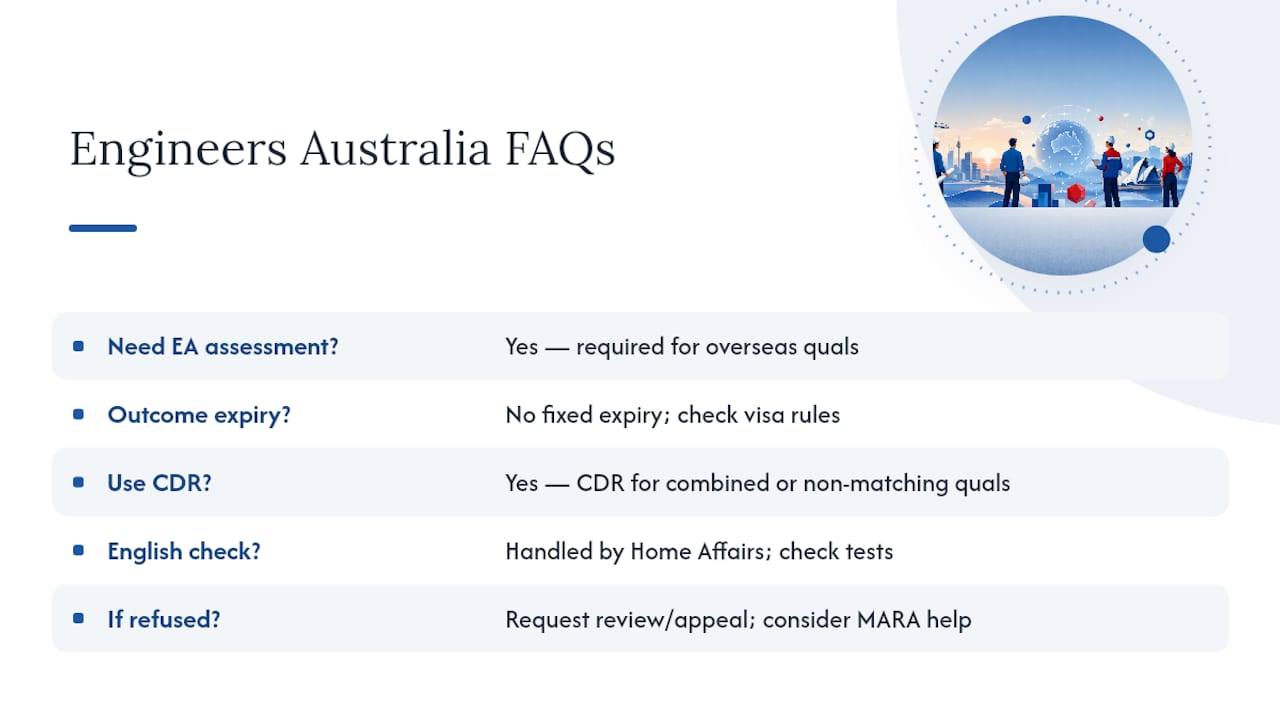
What if my application gets refused?
You can request a formal review or lodge an appeal through EA, each carrying its own fee, and a MARA-registered agent can help you assess whether reapplying with stronger CDR evidence makes sense.
Sources
- Migration skills assessment | Engineers Australia
- Assessment fees and additional services | Engineers Australia
- Prepare your migration skills assessment application | Engineers Australia
- Washington Accord | International Engineering Alliance