


Form 80 is the Department of Home Affairs’ personal particulars form used for character assessment, and if you’re 16 or older and your processing office has asked for it, your first move is simple: download the official Form 80 PDF today and start building a 10-year timeline of your travel, addresses, and employment.
You’ll need to complete it in English, whether you’re printing and writing by hand or typing directly into the PDF. This isn’t a form you can rush the night before an ImmiAccount deadline. The character questions, travel history fields, and address timelines ask for details most people don’t have memorized, which means the real work happens before you open the document.
Here’s what to do right now, before you type a single field:
- Download the current Form 80 PDF directly from Home Affairs, not from a third-party site that might host an outdated version.
- Pull together every passport you’ve held in the last ten years, plus any old visas or entry stamps that jog your memory on dates.
- List every address you’ve lived at and every employer you’ve worked for going back a decade, even short stints.
- If you have any police or court history anywhere in the world, start requesting certificates now. They often take longer to arrive than the rest of your application.
Pro Tip: Build your timeline in a spreadsheet before you touch the actual form. Trying to reconstruct ten years of addresses and travel dates while staring at a PDF field is how inconsistencies creep in.
Form 80 supports partner visa applications, skilled visas, and employer-sponsored visas most often, though the department can request it for other categories too. The sooner you treat it as a serious documentation exercise rather than a quick form, the fewer delays you’ll face later.
Key Takeaways
Form 80 requires accurate, English-language disclosure of your identity, travel, address, employment, and character history, and consistency across every supporting document is what determines how smoothly your visa application moves forward.
| Point | Details |
|---|---|
| Confirm the request | Form 80 is discretionary; check your correspondence or ImmiAccount for the specific request before assuming it applies. |
| Build a 10-year timeline first | Compile travel, address, and employment history in a spreadsheet before touching the actual PDF form. |
| Disclose fully, attach evidence | Any “yes” answer to character questions needs supporting court documents, not just a written explanation. |
| Submit through ImmiAccount | Upload Form 80 and attachments in ImmiAccount using accepted file formats and clear file names to avoid processing hiccups. |
| Get help for complex cases | Fewa Education & Migration’s MARA-registered team reviews disclosures, compiles timelines, and supports lodgment for applicants with complicated histories. |
Table of Contents
- Who Needs to Complete Form 80 in Australia?
- What Are the Main Sections of Form 80?
- How Do You Fill Out the Trickiest Parts of Form 80?
- What Documents Do You Need to Support Form 80?
- How Do You Submit Form 80: ImmiAccount or Paper?
- What Mistakes Cause Form 80 Delays, and How Does It Affect Your Visa Outcome?
- When Should You Get Professional Help With Form 80?
- Where Can You Find Official Form 80 Resources?
- What Actually Matters Most When Completing Form 80
- Get Expert Help Completing and Submitting Form 80
- Frequently Asked Questions About Form 80
- Sources
Who Needs to Complete Form 80 in Australia?
Form 80 isn’t automatically required for every visa application. The Department of Home Affairs requests it at its own discretion, which means two applicants in similar situations might not receive the same request. That said, patterns exist.
Partner visa applicants see this form regularly, since character assessment matters heavily for permanent partner and spouse visas. Skilled visa applicants, particularly those in the points-tested and employer-sponsored streams, are also commonly asked for it. Visitor visa and some student visa applicants may occasionally receive the request too, especially if something in their application history prompts a closer look.
Age is the other trigger. Anyone aged 16 or over connected to the application, whether that’s the primary applicant, a partner, or a dependent nearing adulthood, may need to complete their own Form 80. If an applicant turns 17 or 18 while the case is being processed, the case officer can ask for the form to be submitted or updated to reflect the applicant’s current age and circumstances.
Timing varies as well. Some applicants receive the Form 80 request as part of their initial lodgment checklist. Others get a follow-up request weeks or months into processing, often after a case officer has reviewed the file and decided a deeper character check is warranted. Either way, the purpose is consistent:
- Home Affairs uses the form to verify identity details, travel patterns, and any history of criminal or civil legal issues.
- It cross-references what you’ve already declared elsewhere in your application, so consistency matters more than most applicants realize.
- A request for Form 80 does not mean you’re under suspicion. It’s a standard verification step for many visa pathways.
Because the request can arrive at any stage, it pays to prepare your travel, address, and employment history early, even if nobody has asked for the form yet.
What Are the Main Sections of Form 80?
Form 80’s full title is “Personal particulars for assessment including character assessment,” and it runs through twenty sections labeled Parts A to T. Knowing what each part covers before you start typing saves you from constant backtracking.
- Part A: Your details. Full name, any name changes, date and place of birth, and basic identifying information.
- Part B: Passport information. Every passport you currently hold or have held, including numbers and expiry dates.
- Parts C to F: Addresses and family details. Current and previous residential addresses, plus information about your parents, siblings, and family composition.
- Parts G to I: Travel, education, and employment. A detailed account of international travel, schooling, and jobs held over the relevant period.
- Part J: Visa and immigration history. Previous visa applications, refusals, or cancellations in Australia or elsewhere.
- Part K: Character questions. Direct questions about criminal charges, convictions, and involvement in organizations linked to violence or extremism.
- Part L: Military service. Any service in defense forces, including conscripted or reserve service.
- Part Q: Associated persons. People connected to your application who may also need character checks.
- Part T: Additional information. Overflow space for anything that didn’t fit elsewhere.
Part T deserves special attention. Whenever an earlier section runs out of room, whether it’s a long employment history or a complicated travel pattern, you note “see Part T” in the original field and continue your answer there, clearly labeled with the question number it relates to. If Part T still isn’t enough space, attach a separate signed and dated page, and reference it the same way.
Formatting matters more than most applicants expect. The departmental forms page recommends opening the PDF in Adobe Acrobat Reader for the best compatibility, since some browser-based PDF viewers strip out form fields or misrender checkboxes. Everything must be in English. If you’re printing the form to complete by hand, use block letters throughout so there’s no ambiguity when a case officer or data-entry clerk reads your responses.
Pro Tip: Save a digital copy of your completed Form 80 before you sign or submit anything. If Home Affairs later asks a follow-up question, you’ll want your exact original answers on hand rather than trying to remember what you wrote months earlier.
How Do You Fill Out the Trickiest Parts of Form 80?
Most of Form 80 is straightforward data entry. A handful of sections cause the bulk of the delays, and they deserve extra care.
Names and identity details
Your name on Form 80 needs to match your passport exactly, including middle names and any suffixes. If you’ve legally changed your name, been known by an alias, or use a different name in daily life than what appears on official documents, list every version. Case officers cross-check names against police certificates, so a mismatch between “Robert J. Smith” on your passport and “Rob Smith” on a police check can trigger a request for clarification that adds weeks to processing.
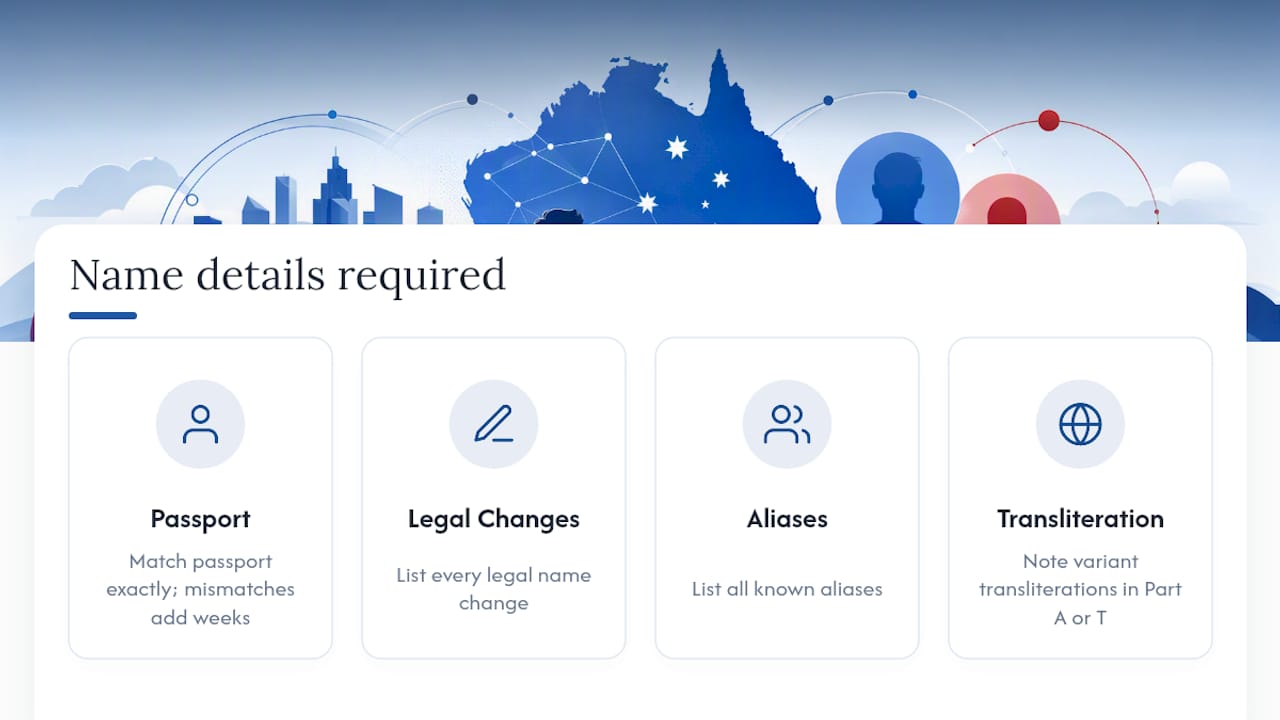
If your name has ever been transliterated differently across documents, common with names originally written in non-Latin scripts, note the variations explicitly in Part A or Part T rather than hoping the discrepancy goes unnoticed. It won’t.
Passport and travel history
This is where most applicants underestimate the task. Form 80 typically asks for a detailed travel history covering the past decade, including every entry and exit, even short trips. According to independent guidance on Form 80 completion, incomplete or inconsistent travel timelines are one of the most common reasons processing stalls.
Overlapping trips, back-to-back short stays, and business travel with unclear dates all cause problems if you’re reconstructing them from memory. Pull your passport stamps, boarding passes, and any travel booking confirmations you’ve kept. If you’ve held multiple passports over the period (common if one expired mid-decade), list travel from each passport separately, but present the combined timeline so there are no visible gaps.
If you can’t account for a period in your travel or address history, don’t leave it blank and hope it goes unnoticed. Write a short explanation instead. A gap explained is a minor note. A gap left silent looks like something you’re hiding.
Address and employment timelines
Same principle applies here. List every address for the required period, including share houses, temporary accommodations, and time spent living with family between leases. Use a consistent date format throughout, day, month, year, written the same way every time you fill in a start or end date.

Employment gaps deserve the same honesty as travel gaps. If you were unemployed, studying, or caring for family for six months, say so plainly rather than stretching the dates of your previous job to cover the gap. Case officers see that pattern often enough to recognize it immediately.
Pro Tip: Cross-check your Form 80 timeline against any other visa forms or statements you’ve already submitted for this application. Home Affairs compares documents, and a three-month discrepancy between your partner visa relationship statement and your Form 80 employment dates is exactly the kind of inconsistency that generates a request for more information.
The character questions
Question 36 and the surrounding character questions ask directly about criminal charges, convictions, and involvement with organizations tied to violence, terrorism, or people-smuggling. If the honest answer to any of these is “yes,” don’t leave it vague.

Provide the date, location, nature of the charge or conviction, and outcome. Then attach the relevant court documents, sentencing remarks, or official records that back up what you’ve written. A Form 80 finding on character disclosures makes clear that attaching supporting documents for any “yes” answer isn’t optional; it’s how the department verifies what you’ve disclosed. Skipping the paperwork doesn’t make the disclosure look better. It just delays the review while a case officer requests the documents anyway.
If the space provided isn’t enough to explain the full context, especially for older convictions where circumstances matter, use Part T to add a short, factual statement. You’re not writing a legal defense. You’re giving the case officer enough context to understand what happened without guessing.
What Documents Do You Need to Support Form 80?
Form 80 rarely stands alone. It works alongside a set of supporting documents that back up what you’ve disclosed, and gathering them early prevents your entire application from stalling while you wait on paperwork that can take months to arrive.
- Australian police certificates. If you’ve lived in Australia, an Australian Federal Police check covers your national criminal history and is usually processed within a couple of weeks once you apply through the official AFP channel.
- Overseas police certificates. For every country where you’ve lived for a defined period (commonly 12 months or more) in the last ten years, you’ll likely need a police certificate from that country’s issuing authority. These vary enormously in processing time. Some arrive within days; others take several months, particularly if you need to request them from overseas after relocating.
- Court documents for any disclosed history. Sentencing remarks, court orders, and official records of any charge or conviction you’ve noted on the character questions. Courts can take time to issue certified copies, so request these as soon as you know you’ll need them.
- Certified translations. Any document not originally in English needs a certified translation, typically from a NAATI-certified translator in Australia or an equivalent recognized authority overseas. Submit both the original-language document and the translation together.
- Certified copies where required. Some documents need certified copies rather than plain photocopies. Check the specific requirement for each document type before you submit.
Processing times for overseas police certificates are the single biggest wildcard in this entire process. Applicants who request their certificates the week they receive the Form 80 request often wait far longer for the certificate than for Home Affairs to process the rest of the application.
Before you submit anything, run through a short checklist:
- Every police certificate is current and within its validity window.
- Every non-English document has a matching certified translation attached.
- Court documents cover every disclosure you made in the character questions section.
- File names are clear and match what you’re describing in your ImmiAccount upload (for example, “AFP_Check_JohnSmith.pdf” rather than “scan001.pdf”).
- You’ve kept a personal copy of everything you’re submitting.
How Do You Submit Form 80: ImmiAccount or Paper?
Most applicants submit Form 80 through ImmiAccount, the department’s online portal, rather than mailing a paper copy. ImmiAccount is where the department prefers to receive attachments and correspondence, and uploading correctly there tends to move faster than any paper alternative.
To attach Form 80 in ImmiAccount, log in to your existing application, locate the document upload section, and attach the completed PDF along with your supporting evidence. A few practical points make this go smoothly:
- Keep individual file sizes reasonable. Large scanned documents sometimes fail to upload, so compress or split oversized files rather than resubmitting repeatedly.
- Stick to accepted file formats, generally PDF or JPEG, and avoid unusual formats that ImmiAccount might reject outright.
- Set up multi-factor authentication on your ImmiAccount early, since login issues at a critical deadline moment are entirely avoidable with a few minutes of setup in advance.
- Label each attachment clearly so the case officer reviewing your file doesn’t have to guess what “document3.pdf” contains.
Paper lodgment still exists for certain circumstances, particularly where a case officer has specifically requested a physical copy or where the applicant is completing the form for someone without ImmiAccount access. If that’s your situation, send the completed form directly to the office that requested it, following the mailing instructions in the correspondence you received.
Once you’ve submitted, the waiting period begins, but it isn’t entirely passive. Check ImmiAccount regularly for status updates or requests for additional information. If Home Affairs asks a follow-up question, respond promptly and completely, since a slow or partial response is one of the easiest ways to add months to an already lengthy process. Once a decision is made, you can check your visa status through VEVO to confirm the outcome and any conditions attached to your visa.
If an upload fails repeatedly, don’t assume it’s a system-wide issue. Try a different browser, clear your cache, or reduce the file size before contacting technical support. Keep a saved copy of every document you attempt to upload, successful or not, so you have a full record if a dispute over what was submitted ever arises.
What Mistakes Cause Form 80 Delays, and How Does It Affect Your Visa Outcome?
The mistakes that slow down Form 80 processing are rarely dramatic. They’re small inconsistencies that compound into a case officer requesting clarification, and every clarification request adds weeks.
- Incomplete travel, address, or employment timelines with unexplained gaps.
- Unsigned or undated forms, which some applicants overlook entirely before submission.
- Dates that don’t match between Form 80 and other documents in the same application.
- Missing supporting documents for character question disclosures.
- Names that don’t match exactly across your passport, police certificates, and the form itself.
There’s an important distinction between minor inconsistencies and genuine character concerns. A typo in a date or a slightly rounded employment start month is unlikely to affect your outcome, though it may prompt a quick clarification request. A disclosed conviction, an undisclosed one that surfaces through a police check, or a pattern of inconsistent answers across multiple documents is a different category entirely. These go to the substance of the character assessment itself.
If you do have something to disclose, presenting it with full context, dates, outcomes, rehabilitation evidence, or character references where relevant, gives the case officer a complete picture rather than a bare fact to interpret unfavorably.
Pro Tip: If your situation includes any disclosed history, write a short, factual cover statement summarizing what happened and what’s changed since. It won’t erase the disclosure, but it gives the decision maker context instead of a blank record they have to interpret on their own.
Processing timelines for applications involving character issues tend to run longer than standard cases, sometimes considerably so, because additional verification steps are involved. Always check the Home Affairs website for current processing guidance rather than relying on timeframes you’ve seen elsewhere, since these change based on caseload and policy updates.
When Should You Get Professional Help With Form 80?
Some Form 80 situations are genuinely simple: a clean record, a stable address history, and straightforward employment. Others aren’t, and recognizing which category you fall into early saves real time.
Consider getting professional help if any of the following apply to you:
- You have a criminal charge or conviction anywhere in the world, even one that feels minor or long resolved.
- Your travel, address, or employment history over the past decade is complicated, with frequent moves, overlapping periods, or gaps that are hard to explain cleanly.
- You’ve noticed inconsistencies between Form 80 and other documents you’ve already submitted for your application.
- You’re applying for a partner visa or skilled migration visa where character assessment carries significant weight in the decision.
Fewa Education & Migration works with applicants through exactly these scenarios. The team reviews Form 80 drafts line by line, helps compile accurate travel and employment timelines from scattered records, coordinates the collection of police certificates and court documents, and supports lodgment through ImmiAccount so nothing gets uploaded incorrectly or incompletely.
A form that looks simple on the surface can carry real consequences when a single inconsistent date triggers months of extra scrutiny. That’s the gap between filling out Form 80 and filling it out correctly.
Fewa’s migration advice is delivered through MARA-registered practitioners, which means the guidance you receive is grounded in the same regulatory framework Home Affairs itself recognizes. Booking a consultation gets you a review of your specific circumstances rather than generic instructions, and for applicants with any complexity in their history, that difference tends to matter far more than it seems at the outset.
Where Can You Find Official Form 80 Resources?
Rely on official Home Affairs sources for the current version of the form and for any updates to lodgment procedures, rather than third-party copies that may be outdated.
- Download the official Form 80 PDF directly from the Department of Home Affairs.
- Review the departmental forms page for guidance on opening and completing PDF forms correctly.
- Confirm submission steps through the ImmiAccount applying-online guidance.
- Visit Fewa Education & Migration to arrange a consultation if your situation needs professional review.
What Actually Matters Most When Completing Form 80
Most guidance on Form 80 treats it as a paperwork exercise: fill in the boxes, attach the documents, submit. That framing misses what actually determines outcomes. The form itself is simple. The discipline required to build an accurate, consistent decade-long record of your life is not.
The overrated advice is “just answer honestly.” Honesty matters, but it’s not sufficient on its own. Two honest applicants can produce very different outcomes depending on how completely they document gaps, how carefully they cross-check dates against other forms, and how clearly they present any disclosed history. Precision is the real differentiator, not just candor.
If you take one thing from this guide, prioritize the timeline work before you open the PDF. Every serious delay traced back through a Form 80 case usually starts with an inconsistency that a spreadsheet built in advance would have caught. Get that right first, and the rest of the form becomes administrative rather than stressful.
Get Expert Help Completing and Submitting Form 80
Fewa is the alternative to piecing together Form 80 alone. For applicants with any criminal history, complicated travel patterns, or a partner visa where character assessment carries real weight, a MARA-registered review catches the inconsistencies that self-review misses, before Home Affairs catches them instead.
Fewa’s team reviews your draft Form 80 against your actual documents, helps you compile a complete travel and employment timeline, and manages your ImmiAccount lodgment so attachments upload correctly the first time. That’s the difference between guessing whether your disclosures are complete and knowing they are, before you submit.
If your situation includes anything beyond a straightforward history, book a consultation through Fewa’s visa services page and get your Form 80 reviewed before it becomes a reason for delay.
Frequently Asked Questions About Form 80
Do all visa applicants need to complete Form 80?
No. Home Affairs requests Form 80 at its discretion, most commonly for partner visas, skilled visas, and employer-sponsored visas. Check your specific correspondence or ImmiAccount to confirm whether it applies to your application.
How far back does the Form 80 travel and address history go?
It typically covers the past ten years, including every address, employer, and international trip during that period. Gaps should be explained rather than left blank.
Can I submit Form 80 in a language other than English?
No. Form 80 must be completed in English. Any supporting documents not originally in English need certified translations attached alongside the originals.
What happens if I disclose a criminal conviction on Form 80?
You’ll need to provide details and attach relevant court documents, such as sentencing remarks. A disclosure alone doesn’t determine your outcome, but incomplete supporting evidence often leads to processing delays.
How long does Form 80 processing typically take?
Processing time varies depending on your visa category and whether character issues require additional review. Always check current Home Affairs guidance rather than relying on general estimates, since timeframes change with caseload.
Should I submit Form 80 through ImmiAccount or by paper?
ImmiAccount is the preferred method for most applicants and is generally faster for both submission and any follow-up correspondence. Paper lodgment is reserved for specific circumstances where a case officer requests it directly.
This article is general information, not a substitute for advice from a qualified lawyer. Consult a qualified legal professional about your own circumstances before acting on anything here.
Sources
- 80 – Personal particulars for assessment including character assessment
- Applying online or paper — Applying online in ImmiAccount
- Departmental forms PDF forms
- Form 80 Australia visa | Eligibility, Documents & Filing Guide (2026) | VisaMind
Recommended
- How to Extend Student Visa in Australia? Complete Guide – Fewa Consultancy
- What is GS Statement in Australia? How to write GS Statement (Example) – Fewa Consultancy
- How to Apply for Overseas Student Health Cover (OSHC) in Australia? – Fewa Consultancy
- Understanding Work Rights in Australia for International Students – Fewa Consultancy