


The fastest way to confirm a MARA registered agent is genuine is to search the Register of Migration Agents on the OMARA website and check their Migration Agent Registration Number (MARN) before you pay or sign anything. Under the Migration Act 1958, only registered migration agents, legal practitioners or exempt persons can lawfully give paid immigration advice. If you would rather have support from a registered consultancy, Fewa Education & Migration is MARA-registered and provides written service agreements with transparent fees.
TL;DR:
- Search the OMARA register by name or MARN before paying, then confirm the number matches the agent’s business communications exactly.
- Before work begins, require a written service agreement and statement of services; agents must separate client funds, retain records for seven years, and carry insurance.
- Consider an agent for partner visas, cancellations, tribunal reviews, or borderline skilled claims; routine visitor and student applications can often be filed yourself.
- Check the OMARA register for suspensions or cancellations, ask how past complaints were resolved, and keep agreements, correspondence, and payment records for any complaint.
- Use Form 956 to appoint an agent, and submit Form 956A or written notice promptly when ending the appointment so the department updates its contact.
Table of Contents
- What OMARA is and why it matters for consumer protection
- How to check an agent is genuine: verify the OMARA register and MARN
- What a registered agent must do before you pay anything
- When a registered agent helps most, and when you can apply yourself
- How to appoint or end an agent appointment
- How to check an agent’s complaint history or disciplinary record
- Our perspective: what MARA registration means for Fewa clients
- Want help now? Start with a free consult
- FAQ
- Sources
What OMARA is and why it matters for consumer protection
The Office of the Migration Agents Registration Authority, known as OMARA, sits within the Department of Home Affairs and regulates every registered migration agent (RMA) in Australia. Its role covers assessing who can register, monitoring how agents behave once registered, and investigating complaints when something goes wrong, as set out on the MARA website.
Registration is not optional for anyone charging a fee for immigration assistance. The Migration Act 1958 makes it an offence to provide paid immigration assistance without proper registration, and the penalties for unlawful practice can include imprisonment.
This framework exists because migration decisions carry serious personal stakes, so the law backs it with real oversight. Registration gives you several practical protections:
- A formal complaint pathway through OMARA if an agent falls short of their obligations.
- Published practice guides that set clear expectations for how agents should treat clients.
- Ongoing monitoring of conduct, not just a one-off check at registration.
- A public record you can search before you commit to paying anyone.
None of this guarantees a particular visa outcome. What it does guarantee is that someone is watching how the agent operates, and that you have somewhere to turn if they do not.
How to check an agent is genuine: verify the OMARA register and MARN
Before you hand over any money, take a few minutes to confirm the person you are dealing with is who they say they are. The process is quick and free.
- Go to the Register of Migration Agents and search by the agent’s name, business name, MARN or location, following the OMARA guidance on search fields and spelling tips.
- Compare the MARN shown on the register against the MARN printed on the agent’s business card, website footer or email signature. They must match exactly, and the Home Affairs guidance confirms MARNs must appear on all business communications.
- If the name does not appear on the register at all, stop. Do not pay a deposit or sign a service agreement, and consider reporting suspected unlawful assistance to OMARA.
Pro Tip: Take a screenshot of the OMARA register entry and the agent’s MARN the day you check it, and keep it with your file in case you need it later.
What a registered agent must do before you pay anything
A registered migration agent operates under a binding Code of Conduct, and you are entitled to expect certain things before any money changes hands.
- A written service agreement and statement of services, outlining exactly what work is included, before the engagement starts.
- Your money held in a separate client account, not mixed in with the agent’s general business funds.
- Client records kept for seven years, giving you a paper trail if a dispute arises later.
- Current professional indemnity insurance at the prescribed minimum level, plus an up-to-date professional library to support their advice.
These obligations come directly from the Code of Conduct, which requires seven years of record keeping and prescribed professional indemnity insurance for every registered agent.
If an agent has not given you a service agreement, has not disclosed their MARN or seems reluctant to answer basic questions about fees, raise it with them directly first. If that does not resolve things, you can lodge a complaint with OMARA.
When a registered agent helps most, and when you can apply yourself
Not every visa application needs professional help, and knowing which situation you are in saves time and money.
- Complex or high-risk matters benefit most from an agent: partner visas, employer-sponsored nominations, visa cancellations, tribunal reviews and skilled applications sitting close to the points threshold.
- You are not required to use an agent for most visa types; straightforward visitor visas or routine student visa applications can often be lodged yourself with the department’s own guidance.
- An agent can sharpen your evidence strategy and package your application well, but no agent can guarantee a visa will be granted or speed up how long the department takes to process it.
The harder your case, the more an experienced agent’s judgment tends to matter. A borderline skilled points claim or a partner visa with gaps in the relationship evidence is a different proposition to a simple tourist visa, and it is worth weighing that before deciding whether to go it alone.
How to appoint or end an agent appointment
Appointing an agent formally matters, because it determines who the Department of Home Affairs will correspond with about your case.
- Complete Form 956 to appoint a registered migration agent, legal practitioner or exempt person as your authorised recipient, which allows the department to deal directly with them on your behalf.
- To end the arrangement, submit Form 956A or written notice advising the department that the appointment has been withdrawn, so correspondence reverts to you or moves to a new agent.
- Notify the department promptly once you have made either change, so there is no confusion about who is authorised to act for you.
Keep a copy of every form, the date it was lodged and your service agreement together. If a dispute ever arises about what was agreed or when an appointment started or ended, that documentation is what protects you.
How to check an agent’s complaint history or disciplinary record
Verifying current registration is the first step, but it is also worth checking whether an agent has a history of complaints or sanctions before you commit to working with them.
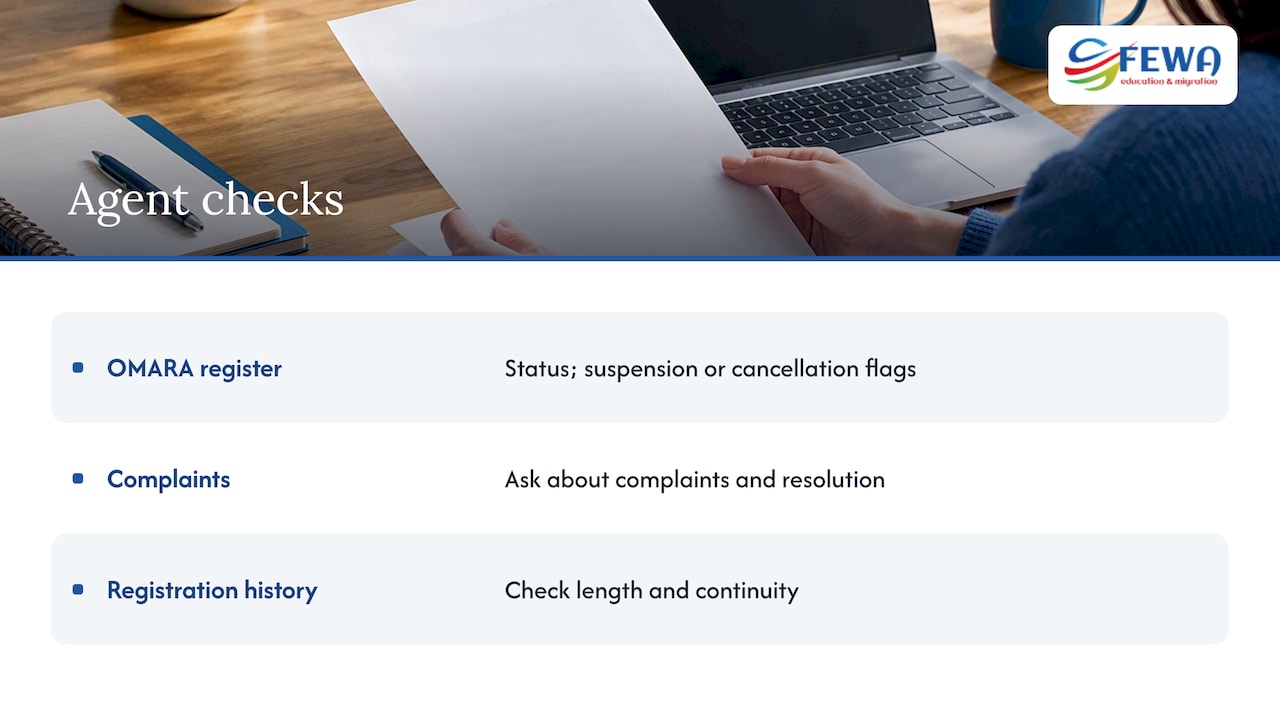
Start by searching the agent’s name and MARN on the OMARA register, which shows current registration status and will flag if someone has had their registration suspended or cancelled. OMARA has strengthened its enforcement activity in recent years and has sanctioned agents for breaches of the Code of Conduct, as outlined in recent legislative changes to the regulation of registered migration agents.
Beyond the register itself, ask the agent directly whether any complaints have been made against them and how those were resolved. A registered agent with nothing to hide will usually answer this plainly. You can also look at how long they have held registration, since a longer, unbroken registration history is a reasonable, if imperfect, signal of consistent compliance.
If you believe an agent has acted unprofessionally, breached the Code of Conduct or misused their MARN, you can lodge a complaint with OMARA directly. Keep your service agreement, correspondence and payment records on hand, since OMARA will ask for evidence when it investigates.
Our perspective: what MARA registration means for Fewa clients
We are registered through MARA, and that registration shapes how we work with every client, not just something we mention in passing. Following the Code of Conduct means every engagement starts with a written service agreement and a clear statement of services, so you know what you are paying for before any work begins. Our fees generally sit between $500 and $6,000 depending on the visa type and complexity of the case, and we set that out in writing rather than leaving it vague.
We also provide detailed checklists for the evidence each visa subclass requires, because most disputes between clients and agents come down to unclear scope or missing documentation rather than bad faith. Registration does not promise a particular outcome. What it promises is that someone is bound by the same obligations we have described throughout this guide, and that you have somewhere to turn if those obligations are not met.
— Ronit
Want help now? Start with a free consult
If you would rather have an expert walk through your options with you, we offer a free consultation to talk through your situation before anything is signed. We work across student visas, partner visas, skilled migration and employer-sponsored nominations, so wherever your case sits, there is a service page built around it.
If you are specifically weighing up a partner visa, our partner visa page sets out what evidence strengthens a case before you apply. Every engagement with us runs on a written, MARA-compliant service agreement with fees agreed upfront, so there are no surprises once the work starts. Visit our visa services page to find the option that matches your situation and book a time to talk.
FAQ
How do you become a migration agent in Australia?
You need to complete the Graduate Diploma in Australian Migration Law and Practice, pass OMARA’s assessment, and apply for registration before you can lawfully charge for immigration advice. Ongoing registration also requires meeting Code of Conduct obligations such as holding professional indemnity insurance.
Is Fewa a MARA registered agency?
Yes, Fewa Education & Migration is professionally registered through MARA, which means we operate under the Code of Conduct that governs all registered migration agents in Australia. You can verify any agent’s current registration, including ours, through the Register of Migration Agents.
What is a MARN number in Australia?
A MARN, or Migration Agent Registration Number, is the unique identifier OMARA issues to every registered migration agent. Agents must display their MARN on business cards, correspondence, websites and social media, and must notify OMARA within 14 days if it is misused, according to Home Affairs guidance.
How much does a registered migration agent cost in Australia?
There is no fixed fee scale for migration agents, so costs vary by agent experience and how complex your visa matter is. OMARA recommends getting multiple quotes before committing, since pricing guidance from Home Affairs notes some consumers have been charged well above typical market ranges; our own fees generally sit between $500 and $6,000 depending on the visa type.
What should I check before appointing a registered migration agent?
Confirm their MARN matches the OMARA register, ask for a written service agreement before paying anything, and check they hold current professional indemnity insurance. It is also reasonable to ask whether any complaints have been lodged against them and how those were resolved.