


NSW state nomination is invitation-only, so you cannot simply apply whenever you’re ready. If you want a real shot at subclass 190 or subclass 491, your first move is making sure you have a correctly coded, accurate Expression of Interest sitting in SkillSelect with a current skills assessment attached. Everything else, including timing and points, follows from getting that foundation right.
TL;DR:
- Meeting the minimum points and skills assessment validity is necessary but does not guarantee an invitation due to NSW’s selective and competitive process.
- Correctly matching your occupation to the ANZSCO unit group and ensuring your documentation aligns with the chosen pathway are crucial for timely invitations.
- NSW invitation rounds occur throughout the year without a fixed schedule, with highest-ranked EOIs in high-demand occupations being prioritized.
- Responding within 14 days of invitation and submitting full, accurate documentation is essential to avoid delays or disqualification.
- Exploring alternative visa options and treating NSW nomination as part of a broader immigration strategy improve chances of success.
Table of Contents
- Understanding NSW state nomination: subclass 190 vs. subclass 491
- Do you meet NSW 190 eligibility right now?
- How do you check the NSW Skills List for your occupation?
- How do NSW invitation rounds and pathways actually work?
- What documents do you need ready before an invitation?
- How long does NSW nomination take, and what usually goes wrong?
- What if NSW nomination doesn’t come through?
- What NSW applicants consistently get wrong
- How Fewa helps you get NSW nomination right the first time
- Sources
Understanding NSW state nomination: subclass 190 vs. subclass 491
NSW state nomination is the endorsement that lets a skilled worker apply for either the Skilled Nominated visa (subclass 190), a permanent visa, or the Skilled Work Regional visa (subclass 491), a five-year provisional visa tied to designated regional areas of NSW. Nomination itself comes from Investment NSW, the state agency that reviews your Expression of Interest and decides whether to invite you. The actual visa, once you’re nominated, is granted by the Department of Home Affairs through SkillSelect.
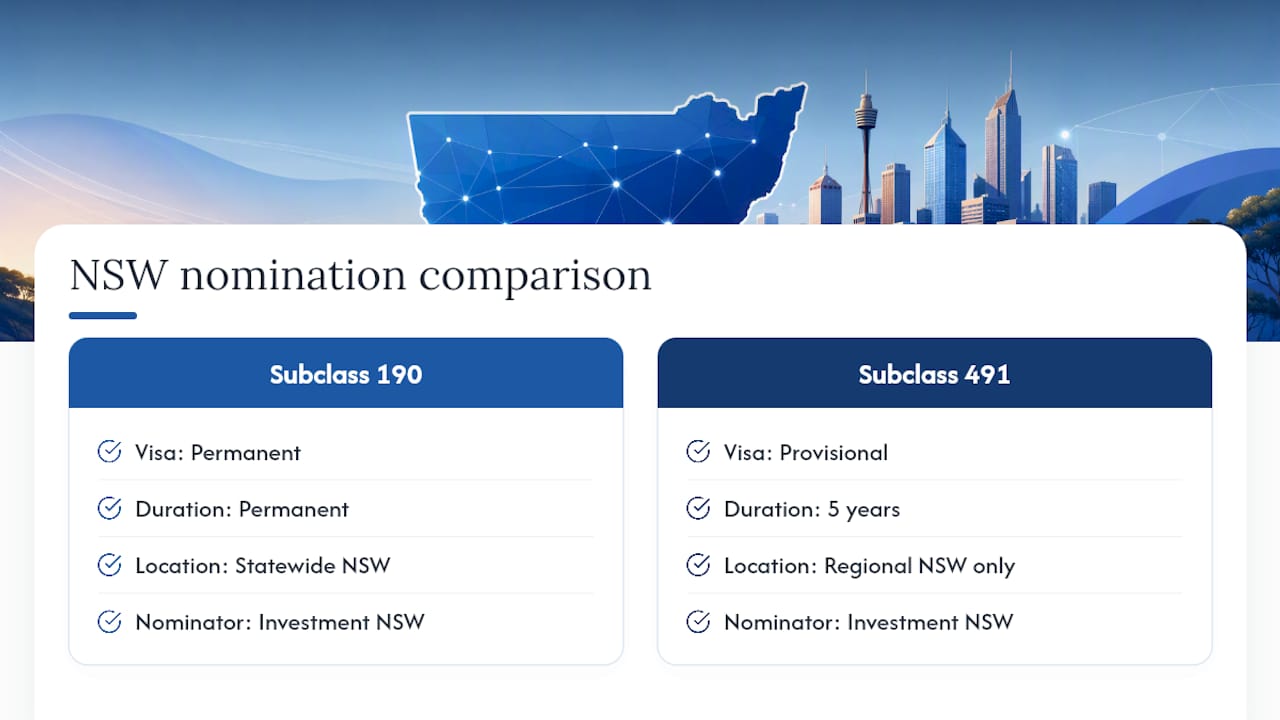
That split matters because it explains why two agencies can give you conflicting timelines. NSW controls who gets invited and ranks candidates against its own economic priorities. Home Affairs controls whether your visa application, once lodged, meets national criteria. NSW runs invitation rounds and maintains its own skills lists precisely because it’s trying to match nominations to labor gaps in specific sectors and regions, not just process applications in order of arrival.
Do you meet NSW 190 eligibility right now?
Before you build your hopes around an invitation that hasn’t arrived, run your own file through this checklist. NSW nomination is deliberately selective and discretionary, so meeting the minimum bar doesn’t guarantee anything. It just means you’re allowed into the pool.
- You meet the relevant Home Affairs points test and visa eligibility criteria for either subclass 190 or 491.
- You hold a valid, current skills assessment matching an ANZSCO unit group on the NSW Skills Lists.
- Your residency and employment history matches whichever category you’re applying under, whether onshore or offshore, including continuous employment evidence where required.
- Your EOI reflects accurate points across age, English ability, and skilled work experience, since NSW ranks EOIs on these factors when selecting who to invite.
Pro Tip: Skills assessments expire. If yours is more than a year or two old, check the validity period with your assessing authority before you rely on it for an EOI.
Some pathways are also periodically shut. NSW has repeatedly closed Pathway 1 and Pathway 3 under subclass 491 when allocations fill, and openly describes its nomination process as exceptionally competitive. If you’re relying on a pathway that’s currently closed, your energy is better spent on Pathway 2 or on a parallel visa strategy rather than waiting for a reopening date nobody can predict.
How do you check the NSW Skills List for your occupation?
NSW lists eligible occupations at the ANZSCO unit-group level, not by exact job title. That distinction trips up more applicants than almost anything else in the process. A “Software Engineer” and a “Software Tester” can sit inside the same unit group depending on how ANZSCO defines duties and skill level, which means your actual day-to-day tasks matter more than the title printed on your payslip.
To check where you stand:
- Search the NSW Skills Lists for the appropriate 190 or 491 list.
- Find your ANZSCO unit group code, not just a keyword match on your job title.
- Confirm your skills assessment references the same unit group listed as eligible.
- Cross-check the NSW Regional Skills List separately if you’re considering regional subclass 491.
Health, ICT, construction, and education occupations have appeared consistently on NSW’s priority lists in recent years, reflecting the state’s ongoing workforce gaps. Those priorities shift as labor market data updates, though, so an occupation that qualified last year isn’t guaranteed to qualify next round. For a broader look at how occupation lists work across Australia, Fewa’s guide to the skilled occupation list breaks down ANZSCO logic in more detail. Submitting an EOI against the wrong unit group is one of the fastest ways to waste months waiting for an invitation that was never coming.
How do NSW invitation rounds and pathways actually work?
NSW doesn’t publish a fixed public schedule for invitation rounds. Instead, SkillSelect invitation rounds run throughout the financial year, and NSW pulls from the pool of EOIs whenever it decides to issue invitations for a given occupation.
Three pathways exist under subclass 491, and each works differently:
- Pathway 1 covers workers already employed in regional NSW who apply directly, though this pathway is periodically closed once allocations are exhausted.
- Pathway 2 is the primary route for most applicants: you submit an EOI, NSW ranks it against others in your ANZSCO unit group, and competitive EOIs get invited.
- Pathway 3 applies to regional graduates, with specific study-location and timing requirements that limit how long after graduation you can use it.
Whichever pathway applies, NSW ranks EOIs using age, English proficiency, points score, and relevant work experience, and it invites the highest-ranking candidates within each occupation ceiling first. A borderline EOI in a high-demand ANZSCO code can still lose out to stronger applicants competing for the same limited spots.
What documents do you need ready before an invitation?
Everything you claim in your SkillSelect EOI needs to be backed by paperwork the moment NSW asks for it, and you cannot amend an EOI after you submit it. Accuracy at the point of lodging is what protects you later.
Keep these ready, not just gathered:
- Current, valid skills assessment matching your claimed ANZSCO unit group
- Passport and identity documents
- Employment reference letters listing exact start and end dates, hours worked, and duties performed
- Payslips and tax records that align with those employment dates
- Academic transcripts and qualification certificates
- English test results within their validity window
Pro Tip: Make sure your employment letters describe duties using language that mirrors your ANZSCO unit group’s description. A mismatch between “what you did” and “what your occupation requires” is one of the most common reasons nominations stall.
How long does NSW nomination take, and what usually goes wrong?
Once NSW invites you, you typically have 14 days to respond and lodge your nomination application with full supporting documentation. After payment, NSW’s stated assessment window is roughly six weeks, though allocations can fill mid-year, closing an occupation or pathway before you’d expect.
The most avoidable failures tend to repeat:
- Documentation mismatch, where employment dates or duties don’t line up with the ANZSCO description claimed
- Expired skills assessments or English test results submitted as if still valid
- Applying under a pathway that’s already closed for the financial year
- Holding multiple active EOIs or a prior NSW nomination that complicates a new application
Start assembling your document file the moment you lodge your EOI, not after an invitation lands. Fourteen days disappears fast when you’re chasing an employer for a reference letter.
What if NSW nomination doesn’t come through?
NSW is upfront that its nomination places are limited and its own advice is to explore other pathways rather than wait indefinitely. Reasonable alternatives include a points-tested subclass 189 visa if your score is high enough without state nomination, employer-sponsored options like subclass 186 or 494, nomination from another state, or a Temporary Graduate visa if you’ve recently finished study in Australia.
Ask yourself three questions: Do you already qualify for another visa outright? Could employer sponsorship or regional work realistically get you there faster? And would a professional review of your file catch problems before they cost you months? If you answered yes to that last one, that’s exactly where Fewa’s MARA-registered consultants step in.
What NSW applicants consistently get wrong
The single biggest mistake I see is applicants treating an invitation as inevitable rather than competitive. NSW says plainly that nomination is discretionary, yet plenty of EOIs sit in the pool for a year or more because the applicant assumed a strong points score alone would carry them through.
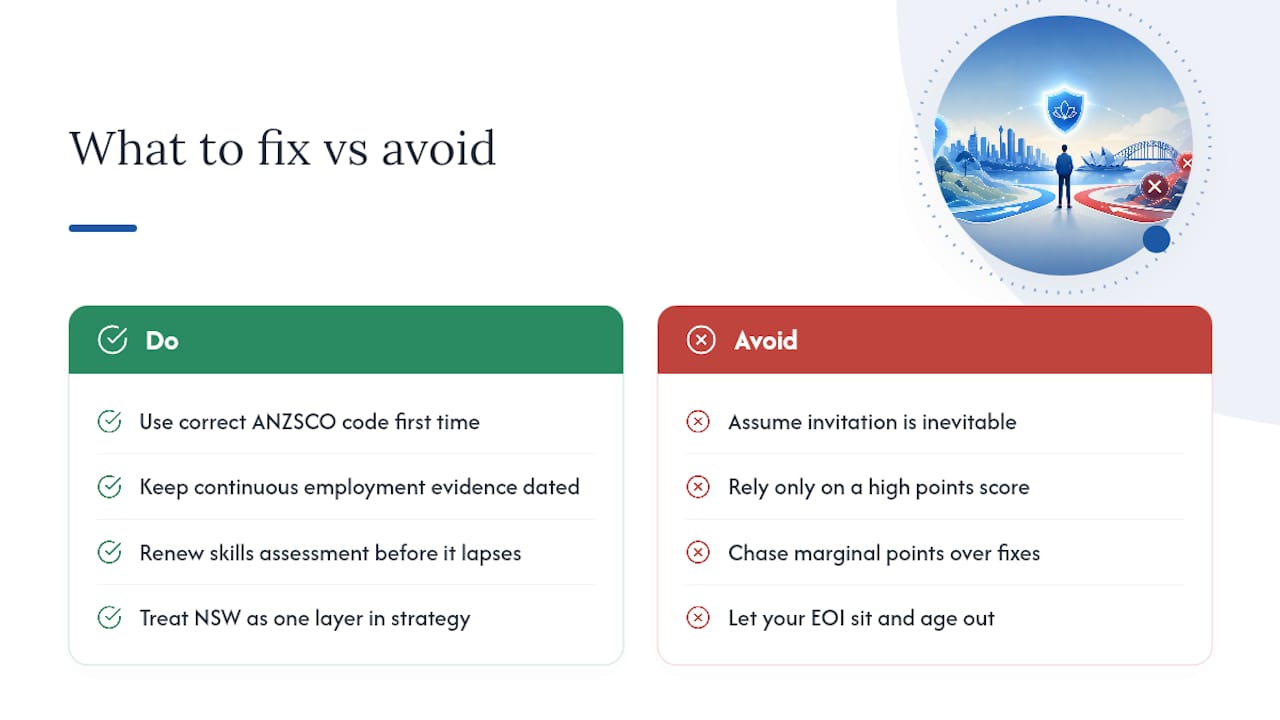
The fixes that actually move the needle are rarely dramatic. Getting the ANZSCO code right the first time, keeping continuous employment evidence that matches payslips down to the date, and renewing a skills assessment before it lapses do more for your odds than chasing marginal points. These are small, mechanical corrections, but they’re the difference between an EOI that competes and one that quietly ages out.
If there’s a pattern worth remembering, it’s this: applicants who treat NSW nomination as one part of a layered strategy, rather than the entire plan, tend to move through the system with far less stress and far fewer surprises.
— Ronit
How Fewa helps you get NSW nomination right the first time
Getting an EOI, ANZSCO code, and skills assessment perfectly aligned is exactly the kind of detail work that determines whether an invitation ever arrives. Fewa is Sydney-based and MARA-registered, and our skilled migration team audits EOIs, prepares documentation, and lodges nomination applications for clients navigating subclass 190 and 491.
If you’re unsure whether your occupation sits on the current NSW Skills List, or you want a second set of eyes on your employment evidence before you submit an EOI you can’t amend, that’s the exact gap our consultations fill. Before booking, gather your skills assessment, employment letters, and English test results so we can review your position properly. Start with a look at Fewa’s skilled migration visa services to see how an EOI audit and nomination support could apply to your file.
This article is general information, not a substitute for advice from a qualified lawyer. Consult a qualified legal professional about your own circumstances before acting on anything here.
Sources
- Skilled Nominated visa (subclass 190) | NSW Government
- NSW skills lists | NSW Government
- SkillSelect invitation rounds | Department of Home Affairs