


Australia offers three practical parent visa routes: the Sponsored Parent (Temporary) visa (subclass 870) for a queue-free stay, Contributory Parent visas (173/143/884/864) for a faster but expensive permanent outcome, and Parent and Aged Parent visas (103/804) for a cheaper permanent option with a much longer wait. The choice comes down to what your family can afford now versus how long you’re prepared to wait, and Home Affairs and Services Australia set the rules for both.
TL;DR:
- The Sponsored Parent (Temporary) visa 870 allows a three- or five-year stay without queueing but does not lead to permanent residency.
- Contributory visas (173/143/884/864) process faster due to higher annual allocations but require paying double fees and providing a 10-year Assurance of Support.
- Standard parent visas (103/804) are cheaper but entail long waits in capped queues, often extending over many years, and may restrict onshore movement.
- An Assurance of Support involves a $10,000 to $14,000 bank guarantee or deposit held for 10 years, impacting household finances and borrowing capacity.
- Proper family eligibility checks, especially the Balance of Family test, are essential before application to avoid delays or rejections.
Table of Contents
- Which parent visa category fits your situation?
- Sponsored Parent (Temporary) visa 870: a queue-free option with limits
- Contributory parent visas 173/143/884/864: paying for a shorter wait
- Parent and aged parent visas 103/804: cheaper, but the queue is long
- Assurance of Support and visa charges: what sponsors need to budget for
- The Balance of Family test: counting eligible children correctly
- How the parent visa queue actually works
- Choosing your family’s parent visa pathway
- Who’s behind this guide
- A practitioner’s view on the speed vs cost decision
- How Fewa Education & Migration can help your family
- Official pages to check before you lodge
- Sources
- FAQ
Which parent visa category fits your situation?
Before you dive into paperwork, it helps to see the full picture in one place. Each visa sits in a different category depending on whether you want a temporary reunion or permanent residency, and whether you’re prepared to fund an Assurance of Support.
- Subclass 870 (Sponsored Parent Temporary): temporary stay of 3 or 5 years, requires an approved sponsor, no queueing or capping, lodged through ImmiAccount.
- Subclass 173 and 143 (Contributory Parent, temporary then permanent): faster processing than non-contributory options, higher fees, mandatory Assurance of Support.
- Subclass 884 and 864 (Contributory Aged Parent): the aged-parent equivalent of 173/143, same fee and AoS structure.
- Subclass 103 (Parent) and subclass 804 (Aged Parent): permanent visas at lower cost, subject to heavy capping and queueing.
The Home Affairs parent visa overview groups these into Parent and Contributory Parent categories and confirms that contributory visas typically process faster because they receive more allocated places each year. Check the Visa Pricing Estimator on Immi before you commit to a pathway, since fees and queue release dates change.
Sponsored Parent (Temporary) visa 870: a queue-free option with limits
The 870 visa exists for families who want a parent in Australia without joining the permanent visa queue. It won’t lead to residency on its own, but it solves the immediate problem of physical separation while a longer-term plan takes shape.
To sponsor a parent, the sponsor must be an Australian citizen, permanent resident or eligible New Zealand citizen, and the applicant must genuinely be the sponsor’s parent. According to Home Affairs, the visa permits a stay of either 3 or 5 years and sits outside the capping and queueing system that governs permanent parent visas entirely.
- Sponsorship must be approved before the parent lodges a visa application, and both steps run through ImmiAccount.
- Repeat stays are possible, but each new sponsorship and visa application is assessed again on its own merits.
- Expect to provide identity documents, proof of the parent-child relationship, health checks and character clearances.
Pro Tip: If your parent’s stay is genuinely temporary, don’t assume 870 buys you time towards a permanent visa queue position: it’s a separate pathway entirely.
Contributory parent visas 173/143/884/864: paying for a shorter wait
Contributory visas trade a higher upfront cost for meaningfully shorter processing. Most applicants start on the temporary 173 or 884 visa while their permanent 143 or 864 application is finalised, and Home Affairs confirms this category receives more places each year than the standard Parent category, which is why waiting times are shorter.
- The temporary-to-permanent pairings run 173 to 143 for parent-age applicants, and 884 to 864 for aged parents.
- Fees are paid in two instalments: the first at lodgement, the second before grant, and the second instalment amount should always be confirmed on the current Visa Pricing Estimator.
- An Assurance of Support is mandatory, which means a sponsor commits to a legally binding financial guarantee for up to 10 years.
A bank guarantee or term deposit of $10,000 for one adult or $14,000 for two adults is currently required when Services Australia requests one for contributory parent visas. That money is locked away for a decade, which matters as much to your household budget as the visa application charge itself.
Parent and aged parent visas 103/804: cheaper, but the queue is long
Subclasses 103 and 804 lead to the same permanent outcome as the contributory pathway, at a lower headline cost. The catch is the wait: these visas sit in a capped and queued program, and Home Affairs is explicit that permanent parent visas overall are subject to this system, with the non-contributory stream receiving far fewer places than the contributory one.
- Both visas grant permanent residency once finalised, but the practical wait for that grant can run for many years.
- Onshore applicants typically hold a bridging visa while waiting, and some visas carry “no further stay” conditions that limit switching to another visa onshore.
- These visas often suit retirees who can wait, or families who simply cannot fund the contributory fees and the 10-year Assurance of Support bond.
Assurance of Support and visa charges: what sponsors need to budget for
An Assurance of Support is a formal, legal undertaking, not a box to tick. Services Australia can require a bank guarantee or term deposit for contributory parent and aged parent visas, and the assurer, who may be the sponsoring child or another eligible person, remains financially liable for the full term.
- Bank guarantees and term deposits currently sit at $10,000 for one adult or $14,000 for two adults, held for 10 years.
- The visa application charge is paid in two parts for contributory visas: an initial instalment at lodgement and a further instalment before grant.
- Use the Visa Pricing Estimator on Immi to check current charges before you lodge, since these figures are reviewed regularly.
An Assurance of Support means the assurer agrees to repay the Australian Government for certain income support payments made to the visa holder during the assurance period.
Services Australia, How an Assurance of Support works
Sponsors who treat the AoS as a formality rather than a genuine liability often find the 10-year commitment reshapes their own borrowing capacity and savings plans.
The Balance of Family test: counting eligible children correctly
The Balance of Family test applies to subclasses 103, 143, 804 and 864, and Home Affairs is clear that it cannot be waived under any circumstances. Getting the count wrong is one of the more avoidable reasons an application stalls.
- Confirm who counts as an “eligible child”: this includes biological, step and adopted children, not just those with the applicant’s surname.
- Check that at least half of your children are usually resident in Australia, or that more of your children live in Australia than in any other single country.
- Gather birth certificates, adoption papers and residency evidence for every child, not just the ones supporting your application.
Pro Tip: Applicants often forget adult children or stepchildren living overseas: leaving them out of the count can fail the test even when the family’s overall situation looks straightforward.
How the parent visa queue actually works
Permanent parent visas are capped and queued, and Home Affairs assesses valid applications in the order they’re received, then assigns each one a queue date. Places are released for final processing as they become available within the annual program.
- Your queue date, not your lodgement date alone, determines roughly when your application reaches the front of the line.
- Immi publishes queue release milestones, but exact wait times for non-contributory visas remain genuinely unpredictable and can extend well beyond a decade.
- While you wait, stay compliant with any bridging visa conditions and keep contact details current in ImmiAccount so you don’t miss a request for further documents.
If the wait becomes impractical, switching your attention to the contributory pathway or the 870 for interim reunion is worth reassessing partway through.
Choosing your family’s parent visa pathway
Picking a route isn’t just about cost. It’s about matching the visa to how urgently you need your parent here and what your household can genuinely commit to financially.
- Define your urgency first. If reunion within the next year or two matters most, the 870 or a contributory visa are your only realistic options.
- Assess your capacity for an Assurance of Support. A contributory visa only makes sense if a sponsor can commit $10,000 or $14,000 in locked funds for a decade without straining the household budget.
- Confirm Balance of Family eligibility early. A failed test on a 103, 143, 804 or 864 application ends that pathway outright, so check it before you spend on fees.
Pro Tip: Book a professional review before lodging if your family includes stepchildren, previous visa refusals, or income that makes the Assurance of Support tight: these are the cases most likely to trip up a self-prepared application.
Complex family structures, an earlier refusal on any visa, or genuine doubt about meeting AoS obligations are all good reasons to get advice before you lodge rather than after a rejection.
Who’s behind this guide
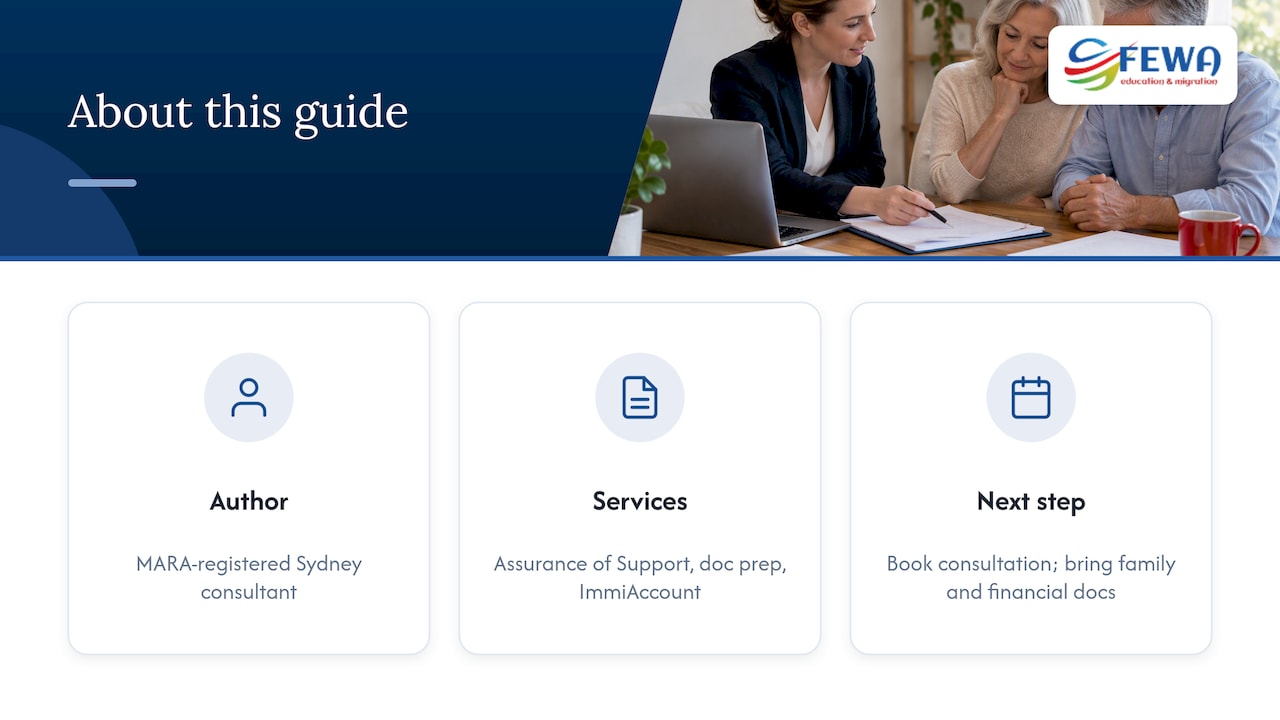
This guide was prepared by Ronit at a Sydney-based consultancy registered with MARA and experienced in supporting families through the family migration and parent visa process. Their services cover Assurance of Support guidance, document preparation and lodgement support through ImmiAccount.
If you want a second opinion on your documents, current fees or which pathway suits your family, a consultation is the practical next step, and bringing your family composition details and financial documents makes that conversation far more useful.
A practitioner’s view on the speed vs cost decision
Families who choose contributory visas are usually buying certainty, not luxury: they’d rather pay more now than watch years pass in a queue. Others simply can’t stretch to the Assurance of Support and plan around the long wait instead. Either choice is reasonable, but only when the sponsor genuinely understands what a 10-year bond commits them to before they sign anything.
— Ronit
How Fewa Education & Migration can help your family
Choosing between speed and cost isn’t something you have to work out alone. The consultancy is MARA-registered and works directly with families on parent, partner and other family visa applications, including Assurance of Support guidance and ImmiAccount lodgement support.
- Documents can be reviewed against the Balance of Family test before you spend on fees.
- Sponsors can be guided through Assurance of Support obligations so there are no surprises about the 10-year commitment.
- Assistance is available to weigh the 870, contributory and non-contributory pathways against your own timeline and budget.
A free consultation covers your family’s circumstances, which pathway fits best and what documents to prepare first. Visit our visa services page to book a consultation and get a clear next step for your parent visa application.
Official pages to check before you lodge
Always verify current fees, queue dates and Assurance of Support terms directly with the source before lodging.
- About parent visas (Home Affairs)
- Parent visa queue and processing priorities
- Form 47PA and Sponsored Parent (Temporary) visa 870
- Sponsors budgeting an Assurance of Support alongside other commitments may also find this guide to the First Home Guarantee useful for broader household financial planning.
This article is general information, not a substitute for advice from a qualified lawyer. Consult a qualified legal professional about your own circumstances before acting on anything here.
Sources
- About parent visas – Department of Home Affairs
- Bank guarantee and term deposit for an Assurance of Support – Services Australia
- Parent visa queue and processing priorities – Department of Home Affairs
- Form 47PA – Application for a parent to migrate to Australia – Department of Home Affairs
FAQ
What is the $5000 parent visa?
There’s no official Australian parent visa priced at this amount: visa charges vary by subclass and are regularly updated. Always check the Visa Pricing Estimator on Immi for the exact current charge for the specific subclass you’re applying for.
What is the best parent visa in Australia?
There’s no single “best” visa: it depends on whether your priority is speed, cost or a temporary reunion. Contributory visas (173/143/884/864) process faster for a higher fee and a mandatory Assurance of Support, while 103/804 cost less but involve a much longer queue. The 870 offers a temporary stay without any queueing at all.
What is the new 10 year parent visa in Australia?
There is no dedicated “10-year parent visa” as a distinct subclass. The 10-year reference usually relates to the Assurance of Support term required for contributory parent visas, where a sponsor’s bank guarantee or term deposit is held for 10 years, not to the length of any visa itself.
What is the fastest parent visa for Australia?
For a temporary stay, the Sponsored Parent (Temporary) visa 870 is fastest since it sits outside the queueing system entirely. For permanent residency, contributory visas (173/143/884/864) process faster than the non-contributory 103/804 pathway because Home Affairs allocates more places to that category each year.