

Yes — eligible Australian citizens or permanent residents can sponsor close relatives under the Sponsored Family stream of the Visitor visa (subclass 600), but the sponsor must meet eligibility rules and sign form 1149 while the applicant still needs to satisfy genuine temporary stay, health, and character checks. A security bond may also be requested. Sponsorship helps the application, but it never guarantees a grant.
TL;DR:
- Sponsors must be Australian citizens or permanent residents over 18 with a clean sponsorship history to avoid additional scrutiny or rejection.
- Signing form 1149 creates legal responsibility for the sponsor, including potential financial liability and the possibility of a security bond, which is refundable if conditions are met.
- A strong application requires comprehensive relationship evidence, clear travel plans, and financial proof, especially if previous visa issues or breaches exist.
- Processing times vary, typically up to 12 months, with no work rights and limited study allowance, so applicants should confirm current fees and conditions beforehand.
- Addressing past refusals or breaches with professional advice and thorough documentation significantly reduces rejection risks.
Table of Contents
- Who Can Sponsor a Family Visitor?
- What Signing Form 1149 Actually Commits You To
- How Do You Apply for Sponsor Visitor Visa Approval?
- Which Documents Strengthen a Sponsored Family Application?
- How Long Does Processing Take and What Does the Visa Allow?
- Why Do Sponsored Family Applications Get Refused?
- How Fewa Supports Sponsors Through the Process
- A Sponsor’s Final Checklist Before Lodging
- Get Sponsor Visitor Visa Help From Fewa
- Sources
Who Can Sponsor a Family Visitor?
To sponsor a family visitor, you must be an Australian citizen or permanent resident (certain Australian government officials posted overseas also qualify), and you must be at least 18 years old. Age and residency status are checked first, before anything else is considered.
The relationship rules are strict, and this is where a lot of well-meaning sponsors trip up. You can sponsor a close relative such as a parent, child, sibling, grandparent, grandchild, or spouse, but the Sponsored Family stream is not open to friends, cousins, in-laws, or a fiancé. If your relative doesn’t fit one of the recognized categories, this pathway is not available, regardless of relationship evidence.
Your own sponsorship history matters too:
- If you have previously sponsored a visitor who breached their visa conditions (overstaying, working illegally, or similar), you may be barred from sponsoring again for a period.
- Multiple concurrent sponsorships can raise scrutiny from case officers.
- A history of unresolved immigration issues, even indirectly, can complicate a new application.
If your situation involves a prior breach, a complicated family structure, or any past refusal, talk to a registered migration agent before you lodge anything. Getting this wrong early costs far more time than getting advice upfront.
What Signing Form 1149 Actually Commits You To
Form 1149 isn’t a formality you tick off and forget. It’s a legal undertaking to the Commonwealth of Australia, and signing it means accepting financial responsibility connected to your relative’s compliance while they’re in the country. The form itself spells out who can and cannot sponsor, and it warns plainly that neither sponsorship nor a bond guarantees the visa will be granted.
The Department can also request a security bond at its discretion. It’s refundable if your relative departs on time and follows every condition. If they don’t, you risk losing the bond and facing that five-year sponsorship bar mentioned earlier.
Key obligations to keep in mind:
- Financial responsibility tied to the sponsorship undertaking, not just a signature exercise.
- Bond amounts vary and are set case by case, not on a fixed schedule.
- Breach consequences fall on you, the sponsor, not only the visitor.
Pro Tip: Keep a dated record of your relative’s return flight booking and any written statement of their travel plans. Case officers weigh clear, verifiable return intentions heavily when deciding whether a bond is necessary at all.
How Do You Apply for Sponsor Visitor Visa Approval?
The applicant lodges their own Visitor visa (subclass 600) application through ImmiAccount, the Department’s official online portal. As the sponsor, your job is to complete form 1149, scan it, and attach it directly to that application. There’s no separate sponsor-only portal. It all runs through the applicant’s ImmiAccount.
Here’s the sequence that works in practice:
- Gather documents first — relationship evidence, proof of your residency status, and financial records, before anyone opens ImmiAccount.
- Applicant starts the ImmiAccount application for the Visitor visa (subclass 600), Sponsored Family stream.
- Sponsor completes form 1149 in full, signs it, and scans it as a clear PDF or JPEG.
- Attach the form to the applicant’s application and lodge together, checking every field twice before submission.
- Monitor ImmiAccount for requests from the Department. If a case officer needs to confirm sponsorship details, they’ll usually correspond with the applicant unless you’ve authorized direct contact.
If you want the Department to communicate with you directly rather than only through the applicant, form 1419 authorizes that. Keep local copies of everything you upload. ImmiAccount doesn’t always preserve every attachment in an easily retrievable format later.
Which Documents Strengthen a Sponsored Family Application?
A thin file is the fastest way to invite a refusal or a request for more information, which then stretches out processing. Build the file thick from the start.
For the relationship itself, gather birth certificates, marriage certificates, photos spanning years rather than a single event, and communication records like message threads or call logs that show an ongoing connection. For your side as sponsor, have your citizenship certificate or passport ready, or your permanent residency evidence if that applies to you.
If you’re providing financial support, bank statements and recent payslips demonstrate you can actually cover the cost. Add:
- Accommodation proof, such as a lease or a letter confirming where your relative will stay.
- Travel itinerary or a return ticket, where you already have one booked.
- Police checks and any requested medical documents for health and character clearance.
- Certified translations for any document not already in English.
Package everything into clearly labeled files before uploading to ImmiAccount. A folder of fifteen unlabeled scans slows down the case officer and slows down your outcome.
How Long Does Processing Take and What Does the Visa Allow?
Processing times for the Visitor visa (subclass 600) vary by stream, individual circumstances, and the completeness of the application. Home Affairs publishes current ranges on its global visa processing times page, and it’s worth checking that page directly before you make any firm plans around a date.
Once granted, the visa typically allows a stay of up to 12 months, though the exact length is set case by case. Standard conditions apply:
- No work rights under this visa.
- Study is capped, generally to three months, without separate permission.
- Some grants cannot be extended from within Australia, so check your outcome letter carefully.
Fees change periodically, so confirm current charges through the Department’s Visa Pricing Estimator rather than relying on a figure you saw somewhere else last year.
Why Do Sponsored Family Applications Get Refused?
Most refusals trace back to a handful of recurring problems, and nearly all of them are preventable with better preparation.
The biggest one: the case officer isn’t convinced the visit is genuinely temporary. Thin travel plans, no clear return date, or a pattern of prior overstays all feed that doubt. Insufficient relationship evidence is close behind. A single wedding photo and a birth certificate rarely satisfy a case officer who’s seen thousands of applications. Weak financial evidence, prior immigration breaches by either party, and fraudulent or altered documents round out the list, and that last one can trigger consequences far beyond a single refusal.
Practical steps to reduce your risk:
- Build a full documentary timeline of the relationship, not just a handful of snapshots.
- Disclose past visa issues honestly rather than hoping they go unnoticed.
- Show a clear return plan: booked flights, ongoing employment overseas, property, or family ties left behind.
- Use certified translations for every non-English document.
Pro Tip: If your relative was refused a visitor visa before, don’t just resubmit the same application with a new date. Address the specific refusal reason in writing, with new evidence attached. If your case involves a past breach or a previous refusal, pause and speak with a registered migration agent before lodging again.
How Fewa Supports Sponsors Through the Process
Fewa Education & Migration operates with MARA registration, which means the advice you get has to meet the same accountability standards the Office of the Migration Agents Registration Authority sets for every registered agent. In practice, that means document review, help navigating ImmiAccount, and guidance on how likely a bond request is given your specific relationship and travel history.
Sponsors come to Fewa with a wide range of situations: a prior refusal that needs addressing head on, questions about bond amounts, or family relationships that don’t fit neatly into a standard checklist.
Booking a consultation is straightforward. Bring your relationship evidence, your residency proof, and any prior refusal letters, and a consultant can tell you quickly where your file stands.
A Sponsor’s Final Checklist Before Lodging
Sponsorship is a legal undertaking with your name attached, not a signature you forget about once you’ve lodged. Every record you keep now, from bond receipts to departure confirmations, is protection for you later if questions come up.
Before you lodge, confirm three things: your own eligibility as sponsor, a complete file of relationship and return evidence, and your readiness to respond if a bond is requested. If your history includes a prior breach, a refusal, or anything unusual, get registered migration advice before you submit, not after a rejection letter arrives.
— Ronit
Get Sponsor Visitor Visa Help From Fewa
Fewa gives sponsors something a generic checklist can’t: a MARA-registered second set of eyes on your form 1149, your relationship evidence, and your bond risk before you lodge, not after a refusal letter forces a rebuild. That review, done once, upfront, is usually the difference between a smooth ImmiAccount submission and months of back-and-forth with a case officer.
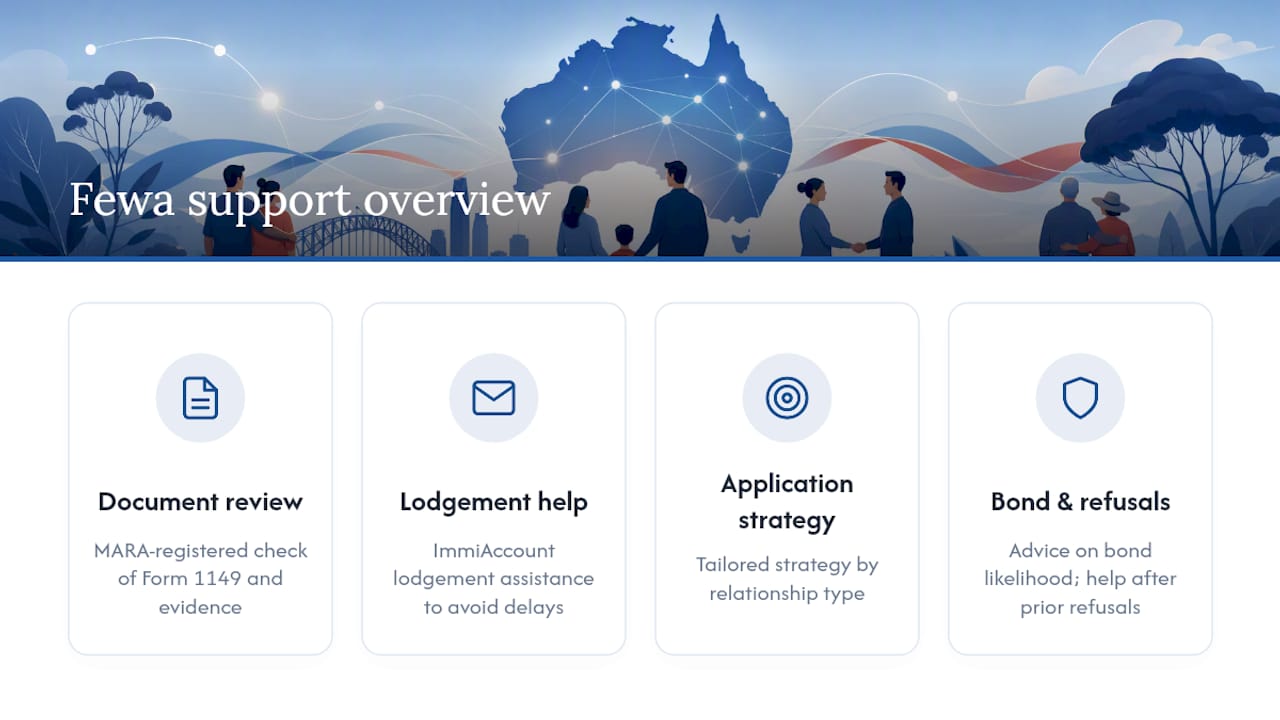
Fewa’s support for the Sponsored Family stream covers document review, ImmiAccount lodgement assistance, application strategy tailored to your relationship type, and practical advice on whether a bond is likely in your case. If you’ve had a previous refusal or your family relationship doesn’t fit a standard mold, that’s exactly the kind of file worth a second look before resubmission.
Start by visiting the visitor visa services page to book a consultation and bring your relationship evidence, residency proof, and any prior correspondence from the Department. A consultant can tell you within one session whether your file is ready to lodge or needs strengthening first.
This article is general information, not a substitute for advice from a qualified lawyer. Consult a qualified legal professional about your own circumstances before acting on anything here.