


Use a Commonwealth statutory declaration for any Australian visa evidence. You can create one three ways: through myGov with a Digital Identity (no witness needed), in person with an approved witness, or remotely via video link with an approved witness. Once signed, attach the completed PDF to your ImmiAccount application or follow the exact submission instructions in your request from the Department.
TL;DR:
- Using a state form instead of the federally approved Commonwealth statutory declaration can cause delays or refusals because they are not interchangeable under Australian law.
- Completing the declaration via myGov with Digital Identity requires no witness, but proof of identity verification must be confirmed before uploading the PDF with your application.
- A valid Commonwealth statutory declaration must be signed in the presence of an approved witness, such as a legal practitioner or Justice of the Peace, with remote witnessing requiring clear video evidence.
- The declaration should follow a clear, factual timeline with specific dates and documented evidence, avoiding vague statements or unsupported claims to prevent delays.
- Reviewing a draft declaration with a professional before signing significantly decreases the risk of errors, inconsistencies, or legal issues that can delay or jeopardize your visa application.
Table of Contents
- Understanding the statutory declaration visa process
- How do you make a valid Commonwealth statutory declaration?
- Who can witness your stat dec for a visa?
- How do you write a statutory declaration for a partner visa?
- What mistakes cause delays or refusals?
- Where and how do you submit your stat dec with a visa application?
- Fewa’s pre‑submission checklist for stat decs
- Why clarity in your statutory declaration matters more than length
- Get your statutory declaration reviewed before you lodge
- Sources
- FAQ
Understanding the statutory declaration visa process
A statutory declaration is a sworn written statement, made under the Statutory Declarations Act 1959, that carries the same legal weight as evidence given under oath. For visa purposes, it fills the gaps that documents alone cannot. If you and your partner have shared a life but don’t have every bill in both names, a well‑drafted declaration explains the reality the paperwork misses.
Visa officers rely on these declarations to confirm facts they cannot otherwise verify: relationship history, financial support, household arrangements, or timelines of events. Because the statement is made knowing that lying in it is a criminal offence, it holds genuine evidentiary weight in the eyes of the Department of Home Affairs.
Here’s where applicants trip up: Australia has state and territory statutory declaration forms as well as a federal one, and they are not interchangeable.
- State and territory declarations are governed by separate legislation and are meant for state matters, like some tenancy or licensing processes.
- Commonwealth statutory declarations are governed by the federal Act and are what the Department of Home Affairs expects for visa applications.
- Federal case law has already confirmed that substituting a state form for a Commonwealth one in a federal process can be treated as invalid, which is exactly the kind of avoidable error that stalls a visa decision.
Always reach for the Commonwealth form. It’s the only version built for federal migration processes.
How do you make a valid Commonwealth statutory declaration?
You have three legitimate paths, and all three produce a document Home Affairs will accept. The right one for you depends on your access to a witness and your comfort with digital identity tools.
- myGov and Digital Identity. Set up a Digital ID linked to your myGov account, then complete the Commonwealth statutory declaration online. Because your identity is already verified through the platform, no witness is required. Once finished, download and save the PDF for your records and for your visa application.
- In person with an approved witness. Fill in every section of the official form except your signature. Sign only when your witness is physically present and watching. Your witness then completes their own section, confirms your identity, and signs every page, not just the last one.
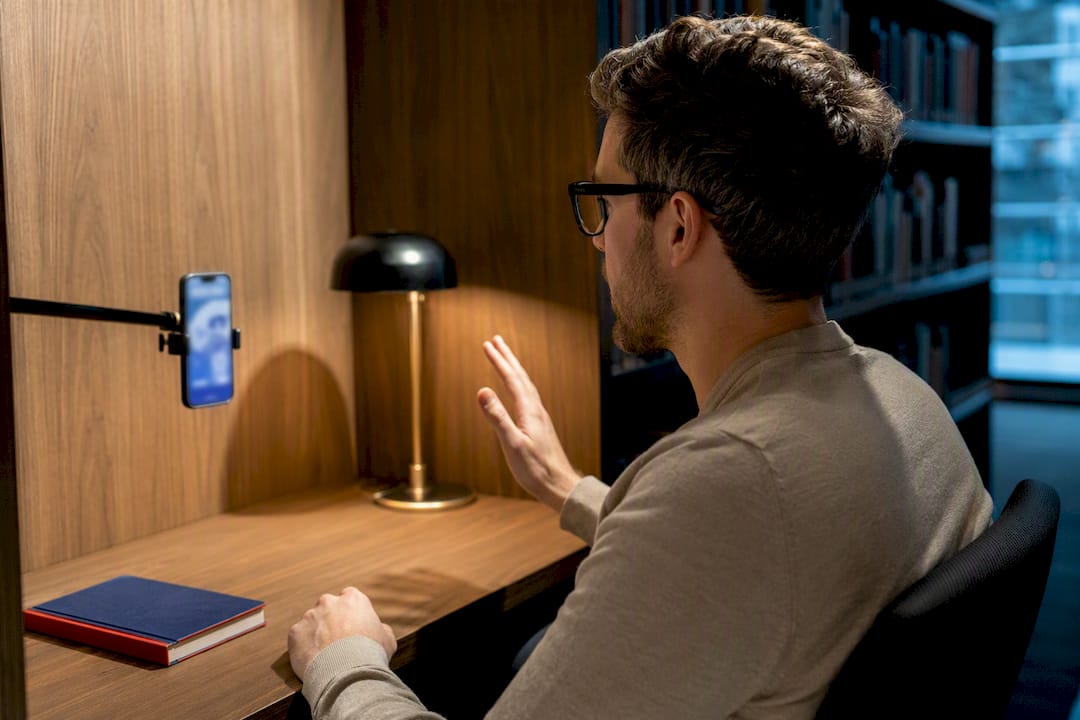
- Remote video witnessing. Position your camera so the witness can clearly see your face, hands, and the document as you sign. The witness observes the signing live, then you send them the signed copy so they can complete and sign the witness sections themselves before returning it to you.
The Act makes signing technology neutral, so an electronic signature is valid provided it clearly identifies you and shows your intention to be bound by the statement, under sections 7A, 9 and 9A.
Pro Tip: If you’re using remote video witnessing, do a test call first. A blurry signature or a witness who can’t see your hands clearly can mean redoing the whole process.
Who can witness your stat dec for a visa?
Not just anyone can witness a Commonwealth statutory declaration. The Attorney‑General’s Department publishes a schedule of prescribed persons, and it’s broader than most applicants expect.
- Legal practitioners currently holding a practising certificate.
- Medical practitioners, dentists, pharmacists, and nurses registered in Australia.
- Teachers employed on a full‑time basis at a school or tertiary institution.
- Police officers.
- Bank, credit union, or building society officers with sufficient continuous service.
- Justices of the Peace (JPs), who remain one of the most accessible options for everyday applicants.
Finding a willing witness is often more of a hurdle than filling out the form itself. Call ahead before you turn up. Some professionals witness documents only during set hours, and a few charge a fee for the service, particularly private practitioners rather than community volunteers.
Local libraries and council offices frequently run free JP services on set days, and community legal centres can often point you toward one nearby. If none of that works for your schedule or location, don’t force it. Fall back to myGov Digital Identity or remote video witnessing, both of which are just as legally valid when done correctly.
How do you write a statutory declaration for a partner visa?
A strong statutory declaration reads like a timeline, not a love letter. Visa officers assess dozens of these a week, and the ones that get flagged for follow‑up questions are usually the vague, emotional, or inconsistent ones, not the plain factual ones.
- Open with your identity and your connection to the matter. State your full name, date of birth, and how you relate to the visa application, such as being the partner or sponsor.
- Present the facts in chronological order. Note the date you met, when you started living together, and key milestones like a joint lease or the birth of a child.
- Reference your evidence directly. Rather than describing a document, point to it: “as shown in the joint lease agreement dated March 2024, attached as Annexure A.”
- Stick to what you know for certain. If you’re estimating a date, say so plainly rather than guessing with false confidence.
A short example for a partner visa might read: “I have lived with [partner’s name] at [address] since June 2023. Our joint residential lease, attached as Annexure A, confirms this tenancy. We hold a joint bank account opened in August 2023, with statements attached as Annexure B. Household bills, including electricity and internet, are addressed to both of us at this property, as shown in Annexure C.”
Notice what’s missing: adjectives, feelings, and vague claims like “we have always been very close.” None of that helps a visa officer verify anything.
Pro Tip: List your attachments as annexures with clear labels (A, B, C) that match exactly what you name in the declaration text. Mismatched references between your statement and your evidence bundle are one of the most common causes of delay.
If you want another example of how to structure a formal statement for Home Affairs, Fewa’s guide on writing a GS Statement covers similar drafting discipline for study‑related declarations.
What mistakes cause delays or refusals?
Most problems with statutory declarations aren’t about dishonesty. They’re about carelessness, and carelessness reads suspiciously to a busy case officer.
- Using a state stat dec template instead of the Commonwealth form, or an outdated version of the form.
- Signing before the witness is present, or leaving a page unsigned by the witness.
- Dates that contradict other documents in your application, such as a lease starting after a declared cohabitation date.
- Vague statements with no supporting evidence, like claiming financial interdependence without referencing a single account or bill.
Any one of these can trigger a request for further information, which adds months to processing, or in serious cases, contributes to a refusal.
There’s a sharper risk underneath all of this. Section 11 of the Statutory Declarations Act makes it a criminal offence to include a statement you know to be false in a Commonwealth statutory declaration, carrying real legal penalties, not just visa consequences. It’s rarely deliberate fraud that trips people up. It’s exaggeration, guesswork stated as fact, or copying language from a template that doesn’t quite match their actual circumstances. When in doubt, understate rather than embellish, and let your attached evidence do the persuading.
Where and how do you submit your stat dec with a visa application?
Scan quality matters more than applicants expect. A rejected upload because a witness signature is illegible costs you time you don’t get back.
- Save your declaration as a PDF, with every page, including witness signatures, clearly legible.
- Name the file something specific and searchable, like
StatDec_Partner_Smith_2026.pdf, rather than a generic scan name. - Check the file size limit in ImmiAccount before uploading. Split large attachment bundles if needed rather than compressing scans until text blurs.
- Upload the declaration in the relevant evidence category within ImmiAccount, or attach it to your paper lodgement exactly as instructed in your application checklist.
- If the Department later requests certified copies or original documents, follow that specific instruction to the letter and keep a copy of everything you send, such as for degree attestation and background checks for GCC jobs.
Fewa’s pre‑submission checklist for stat decs
Before you sit down with a witness, Fewa recommends running through two short checklists. It saves a second appointment and a second round of witnessing.
Before you meet your witness: confirm you have the correct Commonwealth form, valid photo ID, every attachment referenced in your draft, a witness who has confirmed availability, and spare copies for your own records.
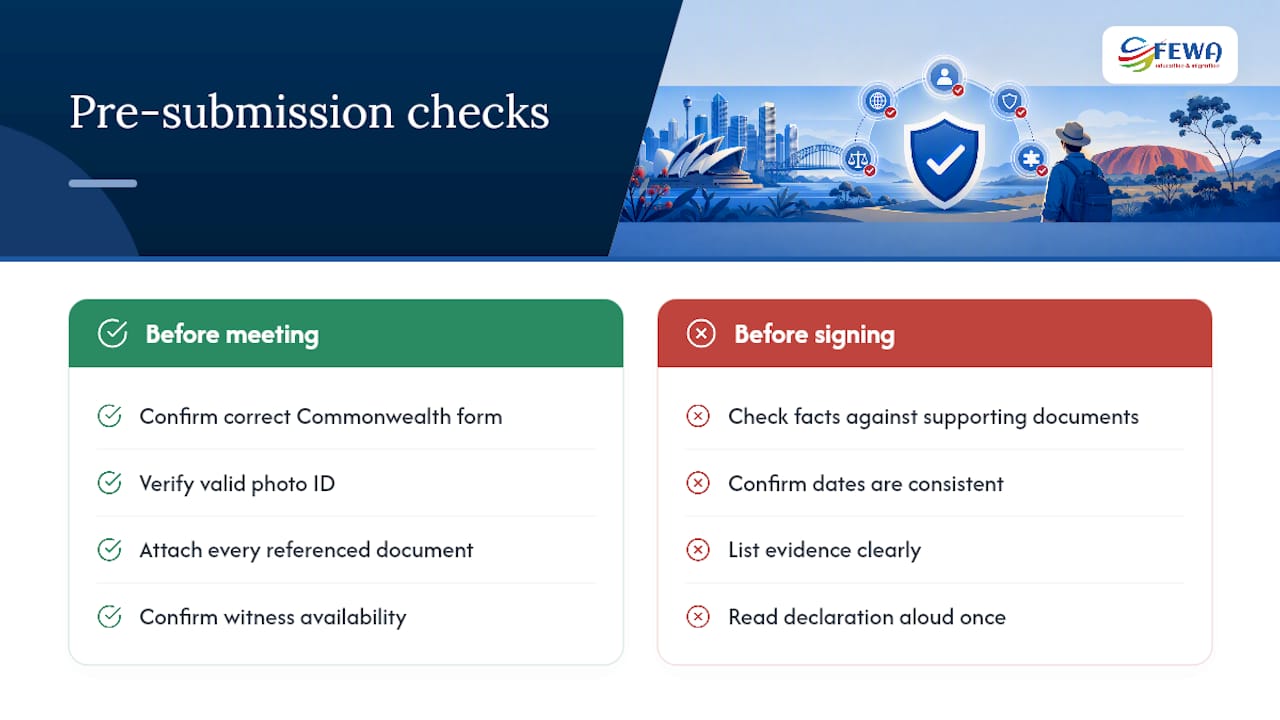
Before you sign anything: check every fact against your supporting documents, confirm dates are consistent across your whole application, list your evidence clearly, and read the whole declaration aloud once to catch contradictions.
A worked example: a partner visa applicant listing a joint lease, a joint bank account, and two years of shared bills, cross‑referenced clearly to three annexures, tends to move through assessment with far fewer follow‑up questions than a similar case with a vague, undocumented statement. If you want a second set of eyes on your draft before you lodge, that’s exactly what a professional review is for.
Why clarity in your statutory declaration matters more than length
Most refused or delayed statutory declarations I’ve seen aren’t dishonest. They’re just imprecise. Applicants write what they feel instead of what they can prove, and a case officer has no way to verify a feeling.
The gap between a declaration that sails through and one that gets queried usually comes down to specificity: dates, named documents, consistent facts. That’s a drafting skill, not a legal one, and it’s learnable. What surprises people most is how often a stat dec fails not because the relationship or the facts were weak, but because the document didn’t do the facts justice.
If you’re unsure whether your draft reads as evidence or as a narrative, get it reviewed before you sign it in front of a witness. That’s the point where a second opinion is cheapest, both in time and in stress.
— Ronit
Get your statutory declaration reviewed before you lodge
If you want a professional review of your stat dec to ensure your wording, dates, and attachments meet the relevant evidentiary standards before you sign it in front of a witness, consulting an expert can help.
A typical session covers your draft declaration, your supporting evidence list, and your overall application timeline, so gaps get caught while they’re still easy to fix. This sits alongside our broader support for partner visa applications and other visa categories, from student to skilled migration. If you have a draft or documents but need help structuring them, booking a consultation with a qualified migration consultant might help clarify what is solid and what needs improvement before submission to Home Affairs.
This article is general information, not a substitute for advice from a qualified lawyer. Consult a qualified legal professional about your own circumstances before acting on anything here.
Sources
- My
- Statutory declarations (Attorney‑General’s Department)
- Legislation
- Making a Commonwealth statutory declaration with a witness (Attorney‑General’s Department)
FAQ
How do I get a statutory declaration in Australia?
Download the official form from the Attorney‑General’s Department, then complete it via myGov Digital Identity, in person with an approved witness, or remotely via video link, whichever suits your circumstances.
Who can do a statutory declaration in Australia?
Approved witnesses include legal practitioners, doctors, nurses, teachers, police officers, bank officers with sufficient service, and Justices of the Peace, as listed in Schedule 1 of the Statutory Declarations Regulations.
What is the fee for an Australian statutory declaration for a visa?
The Commonwealth form itself is free to download and complete. Some private witnesses charge a fee for their service, so it’s worth asking beforehand, though community JPs and library services are typically free.
What is the statutory declaration for a visitor visa?
For a visitor visa, a statutory declaration is often used to confirm details like the purpose of the visit, financial support, or accommodation arrangements when other documentary evidence is incomplete. It follows the same Commonwealth form and process as any other visa category.