


The subclass 189 visa grants permanent residency to skilled workers without needing a sponsor, state nomination, or employer. To qualify, you need an occupation on the relevant skilled list, a positive skills assessment, competent English, and enough points to receive an invitation through SkillSelect. Start by checking your occupation against the Medium and Long Term Strategic Skills List, then book your skills assessment.
TL;DR:
- Most applicants need an occupation on the Medium and Long Term Strategic Skills List and a positive skills assessment before applying for a subclass 189 visa.
- Age limitation restricts applicants to under 45 at the time of invitation, and they must provide verified documents for all claims, including English proficiency and health and character clearances.
- The points test considers age, English ability, employment, qualifications, and other factors, with invitation rounds typically prioritizing those with higher scores and earlier effect dates.
- Applying efficiently involves completing skills assessments first, submitting a current EOI, and having all paperwork ready before an invitation is received.
- To avoid delays, overclaim points, claim employment only after the skill level met date, and organize translations, police checks, and health exams early.
Table of Contents
- What is the subclass 189 visa?
- Eligibility checklist: what you must lock in before applying
- How does the 189 points test work?
- From skills assessment to visa grant: the application sequence
- What does a subclass 189 visa cost, and how long does it take?
- What rights and benefits come with a 189 grant?
- Common mistakes that delay or sink a 189 application
- How a migration consultant approaches a 189 strategy
- Get hands-on help with your Subclass 189 pathway
- Sources
- FAQ
What is the subclass 189 visa?
The subclass 189 visa is Australia’s points-tested, independent permanent residency stream for skilled workers. Unlike sponsored options, you don’t need a nominating state or an employer willing to back your application. The Department of Home Affairs confirms it grants permanent residence outright, with unrestricted work and study rights across the country.
Most applicants choose 189 over subclass 190 or 491 because there’s no ongoing state commitment attached to it. Here’s why that matters:
- No requirement to live or work in a specific state or territory
- No employer nomination, so no dependency on a job offer
- Occupations typically come from the Medium and Long Term Strategic Skills List (MLTSSL)
If your occupation appears only on a state or regional list, 190 or 491 may be your only realistic option. That distinction shapes almost every decision that follows.
Eligibility checklist: what you must lock in before applying
Before you touch an Expression of Interest, secure every item on this list. Missing one won’t just slow you down, it can end the application before it starts.
- Age. You must be under 45 at the time you receive your invitation, not when you submit your EOI.
- Occupation and skills assessment. Your nominated occupation must sit on the relevant skilled list, and you need a positive assessment from the correct authority, such as the Australian Computer Society (ACS) for ICT roles, Engineers Australia for engineering, VETASSESS for a broad range of trades and professions, or AHPRA for registered health practitioners.
- English competency. Competent English is the floor. Proficient or superior scores unlock extra points, which often makes the difference at invitation time.
- Health and character. Medical examinations and police clearances from every country you’ve lived in for 12 months or more within the past ten years.
- Documentary evidence. Every claim, employment, qualifications, English scores, needs to be backed by certified documents, not just asserted.
- Invitation via SkillSelect. You cannot lodge a 189 application unrequested. An invitation must arrive first, and it only goes to those who submit a competitive EOI.
Skip the ordering here at your own risk. A skills assessment that hasn’t started yet is the single biggest reason applicants miss invitation rounds they were otherwise ready for.
How does the 189 points test work?
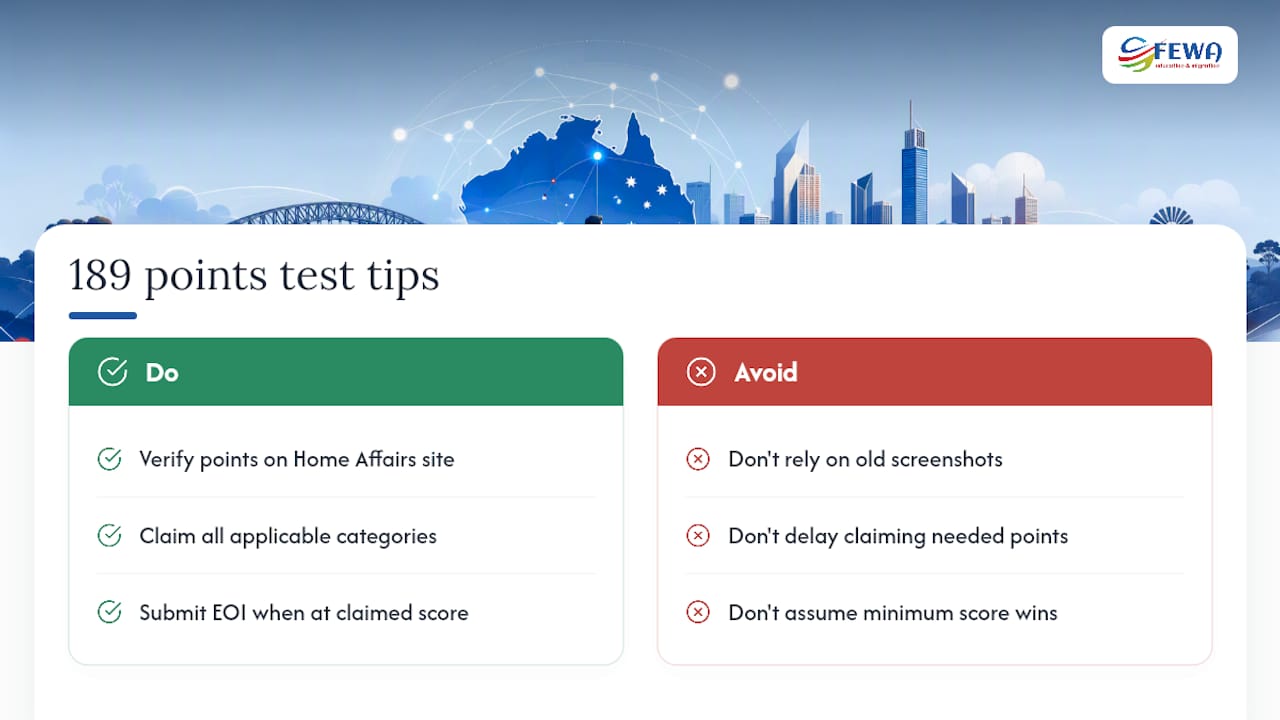
Points come from seven main categories: age, English language ability, skilled employment (onshore and offshore), qualifications, partner skills, Australian study, and specialist factors like a professional year, NAATI accreditation in community language, or regional study. The official points table from Home Affairs lists every current value, and it’s worth checking directly rather than trusting a screenshot from last year.
Competitive occupations frequently see invitation rounds close out well above that floor. Your EOI’s “date of effect”, the date you hit your claimed points score, determines your place in the queue when scores tie. Two applicants both sitting at 85 points get ranked by whoever reached that score first, so waiting to add a point you don’t need can cost you a round.
From skills assessment to visa grant: the application sequence
Every successful 189 application follows the same order, and jumping ahead rarely works.
- Get your skills assessment first. ACS, Engineers Australia, VETASSESS, and AHPRA each check qualifications and work history against their own criteria, and the outcome sets your “skill level met date”, the point from which you can legally claim employment points.
- Submit your EOI through SkillSelect. It’s free to lodge, and the system ranks every EOI by points score and date of effect.
- Keep your EOI current for 24 months. After that, it expires and you must resubmit from scratch, so don’t let it go stale while you wait.
- Wait for an invitation round. The Department has signalled it may move toward more frequent, regularised invitation rounds to cut wait times for competitive occupations.
- Lodge within 60 days of invitation. This window is strict. Miss it, and the invitation lapses.
Pro Tip: Have police checks, health exams, and certified translations ready before you’re invited, not after. The 60-day clock doesn’t pause for paperwork.
What does a subclass 189 visa cost, and how long does it take?
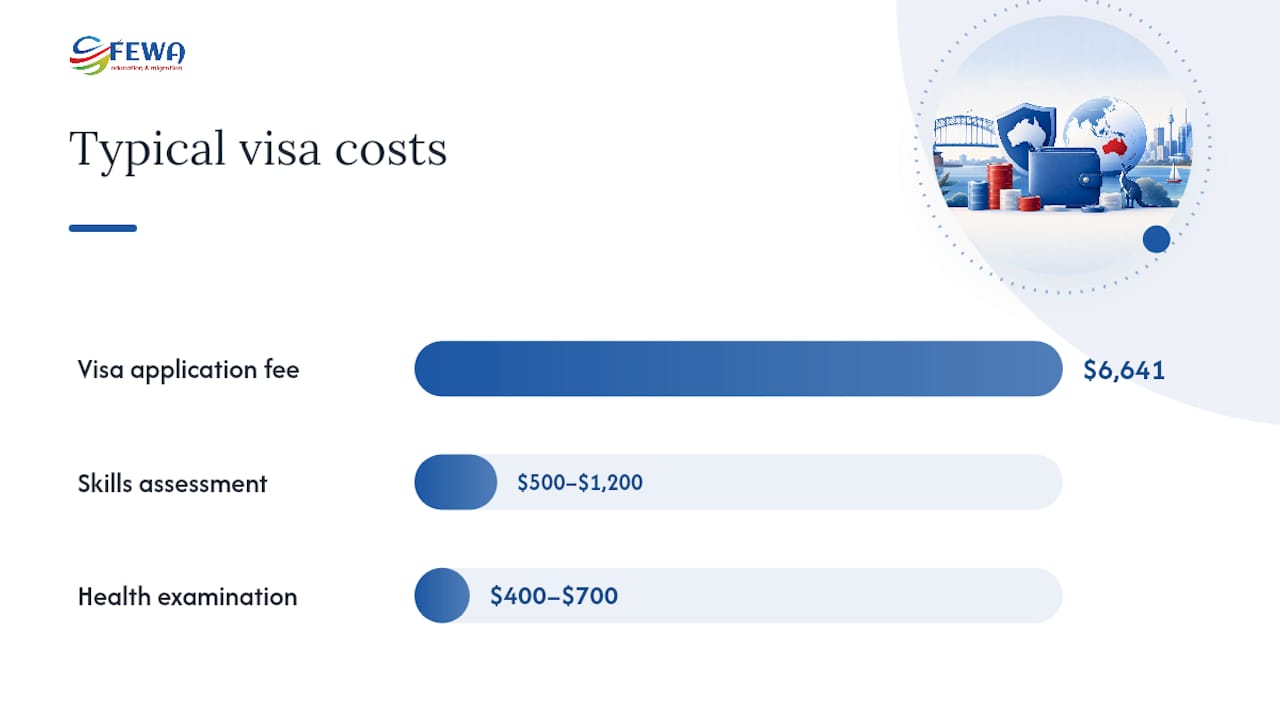
Budget for more than just the visa application charge. Government fees for the primary applicant typically run into the thousands, with indicative figures around $6,641 commonly cited, though you should confirm the current amount on the Home Affairs fee estimator before lodging.
Processing after lodgement commonly falls in the 6 to 12 month range, though occupation, application completeness, and whether Home Affairs issues a Section 56 request for more information all affect the timeline. Beyond the visa fee itself, factor in:
- Skills assessment fees, often $500 to $1,200 depending on the assessing authority
- English test fees for IELTS, PTE, or an equivalent test
- Health examination costs, typically $400 to $700
- Police certificate fees for every relevant country
- Migration agent fees, if you engage one
What rights and benefits come with a 189 grant?
A subclass 189 grant hands you permanent residence immediately, no waiting period, no conditions attached. From day one, you get:
- Unrestricted work and study rights anywhere in Australia
- Medicare access for you and your included family members
- The ability to include your partner and dependent children on the same application
- A pathway to Australian citizenship, generally after four years of lawful residence including 12 months as a permanent resident
- A travel facility, usually valid for five years, letting you leave and re-enter freely
Compare that against subclass 190 or 491, which involve state ties or regional living conditions even though they lead toward similar long-term outcomes. If you check our 491 visa requirements breakdown, you’ll see why some applicants accept those conditions for a lower points threshold, while others hold out for the freedom 189 offers.
Common mistakes that delay or sink a 189 application
Overclaiming points is the mistake that causes the most damage, and it’s entirely avoidable. Employment points calculated from before your skill level met date won’t hold up, and if Home Affairs catches the discrepancy, you’re looking at delays at best and refusal at worst.
- Don’t claim employment points for years worked before your assessing authority’s skill level met date
- Get police checks and health exams moving before your invitation arrives, not after
- Certified translations take time, organise them early
- Look at superior English scores, NAATI CCL, partner points, or a completed professional year to build a buffer above the legal minimum
- Set your expectations against realistic invitation cut-offs for your occupation, not the 65-point floor
Pro Tip: Check your occupation’s current standing on the skilled list before you invest in a skills assessment. Lists get revised, and a career that qualified last year isn’t guaranteed to qualify this year.
How a migration consultant approaches a 189 strategy
Strategy matters more than form-filling. Where you can self-lodge through ImmiAccount for straightforward cases, a registered migration agent earns their fee when your points are borderline or your work history needs careful framing against assessment criteria.
— Ronit
Get hands-on help with your Subclass 189 pathway
A migration consultancy can turn the 189 checklist above into a managed process, so you’re not chasing skills assessment authorities and police checks on your own timeline. A registered migration agent or team may handle skills assessment coordination, EOI strategy to target realistic points thresholds, document preparation, lodgement, and monitoring after you submit.
A free consultation covers your occupation’s eligibility, a realistic points estimate, and what documents to start gathering immediately. Bring your qualifications, employment history, and English test results if you have them, and you’ll leave with a clear sequence rather than a guess. Fewa doesn’t guarantee outcomes the Department alone controls, points thresholds and invitation rounds shift, but it does guarantee your application is built correctly the first time. Visit the skilled migration visa page to book your consultation and get started.
Sources
- Skilled Independent visa (subclass 189) — Department of Home Affairs
- Proposal for invitation rounds – Skilled Independent visas — Department of Home Affairs FOI release
- Skilled Independent visa (subclass 189) — Visa Atlas
FAQ
Is the subclass 189 visa a permanent residency visa?
Yes. It grants permanent residence in Australia immediately on grant, with unrestricted work and study rights and no conditions attached.
When is the next 189 invitation round?
Home Affairs runs invitation rounds periodically through SkillSelect, and proposals suggest rounds may become more frequent and regularised; check SkillSelect directly for the current schedule.
Is a 189 or 190 visa better?
Subclass 189 doesn’t tie you to a state and typically needs a higher points score, while 190 requires state nomination but often accepts a lower score. Choose 189 if your occupation qualifies and you want no residency conditions, otherwise 190 may get you invited sooner.
How much does a 189 visa cost?
Government charges commonly run around $6,641 for the primary applicant, plus separate costs for skills assessment, English testing, health exams, and police checks. Confirm the exact current fee through Home Affairs before lodging.