


TAFE suits you if you want job-ready skills, hands-on training and a faster, cheaper route into work, especially in trades, hospitality or technical fields. University suits you if your career needs a professional degree, such as nursing, law or engineering, or if you’re aiming for research or management roles. Many students combine both, since the Australian Qualifications Framework allows credit to move between them.
TL;DR:
- Completing a TAFE diploma or trade qualification typically costs less and takes less time, allowing faster entry into entry-level roles.
- University courses may require higher fees, especially with future degree ambitions, and are funded through HELP loans with strict borrowing caps.
- Transferring credits from TAFE to university is common and relies on formal agreements, but university credit approval remains at the institution’s discretion.
- VET qualifications at AQF levels 1 to 6 emphasize practical skills with competency-based assessment, while university degrees focus on academic and theoretical knowledge.
- The total cost, including fees and HELP limits, should be carefully mapped out before enrolment, especially if combining TAFE and university pathways.
Table of Contents
- What each sector actually delivers: AQF placement, learning focus and regulation
- Fees, loan support and the HELP borrowing cap you must plan for
- Time to finish and what graduates earn and achieve after study
- Bridging routes: articulation, recognition of prior learning and what to expect
- Decision checklist and two short worked examples to apply it
- Why we built our advice around Australian pathways, not textbook categories
- What the research actually tells us about this choice
- Getting your visa and paperwork right once you’ve chosen your path
- FAQ
- Sources
What each sector actually delivers: AQF placement, learning focus and regulation
The Australian Qualifications Framework sets ten levels that cover every recognised qualification in the country, and it’s the reason TAFE and university aren’t as separate as they look. VET, delivered mostly through TAFE, sits across levels 1 to 6, covering Certificates I through IV, Diploma and Advanced Diploma. Higher education runs from levels 5 to 10, so Diploma and Advanced Diploma qualifications actually overlap both sectors, which is exactly where most TAFE-to-university pathways happen.
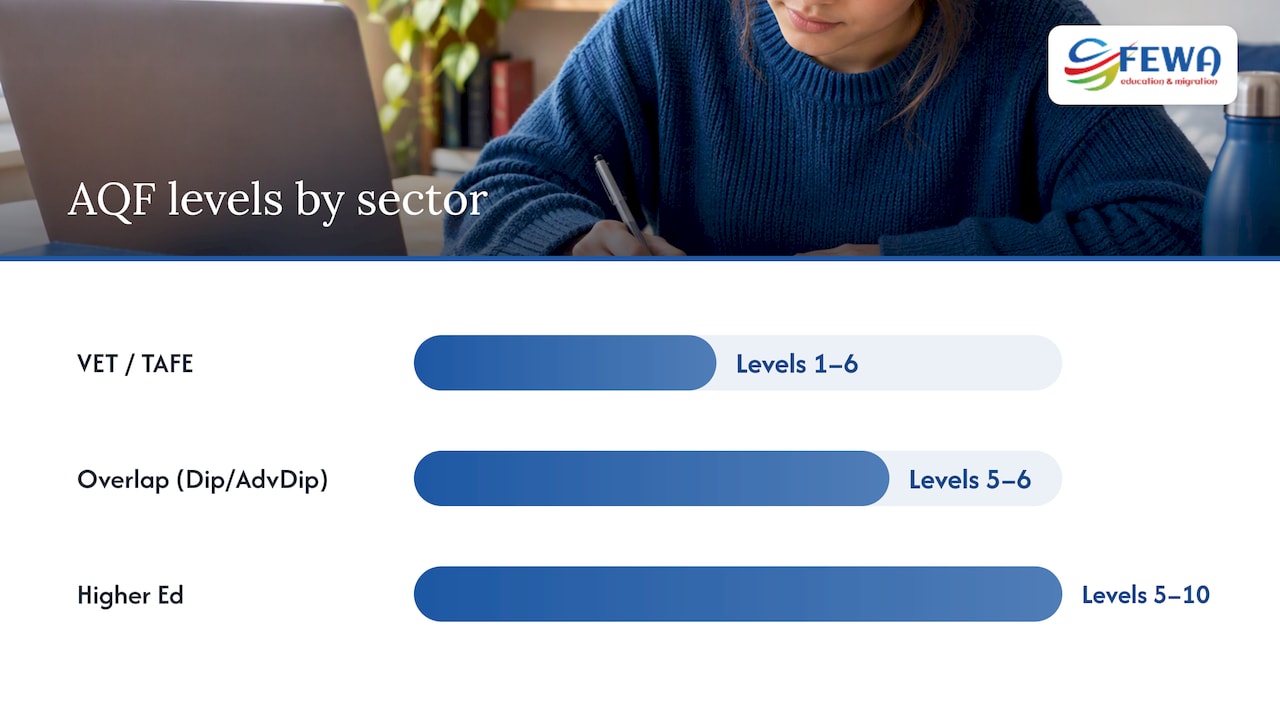
The learning approach differs more than the levels suggest. VET courses use competency-based assessment: you’re marked as competent or not yet competent against an industry skill standard, with less emphasis on theory and more on demonstrated ability. University uses graded coursework, assignments and exams, with a heavier academic and research component.
Regulation reflects that split too. TAFE institutes and private colleges operate as Registered Training Organisations under the VET quality standards, while universities and other higher education providers answer to the Tertiary Education Quality and Standards Agency (TEQSA).
In practice, this means:
- Certificate III and IV: entry-level trade and service qualifications, AQF levels 3 to 4, typically delivered by TAFE.
- Diploma and Advanced Diploma: AQF levels 5 to 6, offered by TAFE and some universities, often used as a stepping stone into a bachelor’s degree.
- Bachelor degree: AQF level 7, delivered by universities, with graduate and postgraduate study continuing up to level 10.
Knowing where a qualification sits on the AQF helps you judge how it will be recognised later, whether by an employer or by a university assessing your application for credit.
Fees, loan support and the HELP borrowing cap you must plan for
Money shapes this decision as much as career goals do. University students in a Commonwealth supported place pay a subsidised contribution through HECS-HELP, while full-fee and some postgraduate students use FEE-HELP. TAFE students typically pay course fees directly or borrow through VET Student Loans, depending on the course and provider.
For 2026, the HELP loan limit for most students is $129,883, rising to $186,544 for courses such as medicine, dentistry and some aviation programs. That cap matters because HECS-HELP, FEE-HELP and VET loans all draw from the same limit, so a TAFE diploma funded by a VET loan reduces what you can later borrow for a university degree.
A few practical points worth checking before you enrol:
- Confirm whether your TAFE course is funded by a VET Student Loan or paid upfront, since only the former counts against your HELP cap.
- Ask your university or TAFE for the exact annual fee, not just the Commonwealth contribution band.
- Factor in that some undergraduate degrees now can cost high fees per year, and the total for a three-year degree can be substantial.
Time to finish and what graduates earn and achieve after study
Course length is often the deciding factor for students who need to start earning sooner rather than later. A Certificate III or IV can take as little as six months to two years, a Diploma or Advanced Diploma usually runs one to two years, and a bachelor’s degree takes three years or more full-time.
Outcomes data gives a clearer picture of what that time investment returns. According to Jobs and Skills Australia’s VNDA outcomes data, VET graduates from 2019 to 2020 recorded an 84% post-completion employment rate and a median annual income uplift of $11,800, with apprentices seeing some of the strongest gains.
- Short certificates get you working faster but usually in narrower, entry-level roles.
- Diplomas and Advanced Diplomas often sit at a sweet spot of time, cost and employability.
- Bachelor degrees take longer but open pathways into regulated professions and higher-level roles.
- Graduates who were already employed before finishing their course tend to see the biggest income gains afterwards.
Bridging routes: articulation, recognition of prior learning and what to expect
Moving between TAFE and university is built into the system, not an exception to it. National recognition rules require RTOs to accept qualifications and statements of attainment issued by other RTOs, which keeps VET study portable. University credit, by contrast, is granted at the institution’s discretion, so a Diploma or Advanced Diploma might earn you six months to a year of credit toward a related Bachelor degree, depending on the course and provider.
If you’re planning to use TAFE as a stepping stone, follow these steps:
- Check whether your TAFE course has a formal articulation agreement with a specific university course.
- Ask the university’s admissions office for a written credit outcome before you enrol in the TAFE course.
- Keep your unit outlines, assessment records and transcripts, since these support any later credit or recognition of prior learning application.
Pro Tip: Get any credit or pathway promise in writing from the university, not just from a TAFE brochure or open day conversation.
Decision checklist and two short worked examples to apply it
Before you commit, run through a short checklist:
- What does your target career actually require: a trade qualification, a licence, or a degree in an in-demand job?
- How long can you realistically study before you need an income?
- What’s your total budget, including fees, HELP limits and living costs?
- Do you meet the entry requirements now, or would a TAFE pathway help you qualify later?
- Does the course suit how you learn best: hands-on practice or academic study?
When comparing providers, ask about work placements, industry partnerships, guaranteed credit arrangements and the total cost of the course, not just the headline fee.
- School leaver aiming for a professional degree: a Year 12 graduate wanting to become a nurse applies directly for a Bachelor of Nursing, since the profession requires a degree and registration.
- Adult changing careers for fast job entry: someone leaving retail to become an electrician enrols in a Certificate III in Electrotechnology at TAFE, prioritising speed and lower cost over a degree pathway.
Why we built our advice around Australian pathways, not textbook categories
The AQF and the funding system treat TAFE and university as one connected ladder, not two competing tracks, and we built our guidance around that reality rather than the old idea that university is the default and TAFE is the fallback. We provide education and migration consultancy services, working with students and families planning study and visa pathways to Australia.
Our role is practical: checking whether a course and provider meet visa and study requirements, reviewing documentation and talking through timelines before you apply. We offer consultations for anyone weighing up a TAFE or university pathway as part of a visa application.
What the research actually tells us about this choice
Most advice on TAFE versus university treats it as a binary, trade school or ivory tower when the funding, regulation and outcomes data all point to a connected system. The conventional wisdom that university is always the safer long-term bet ignores that VET graduates post strong employment rates and meaningful income gains, particularly in apprenticeships, often with a fraction of the debt.
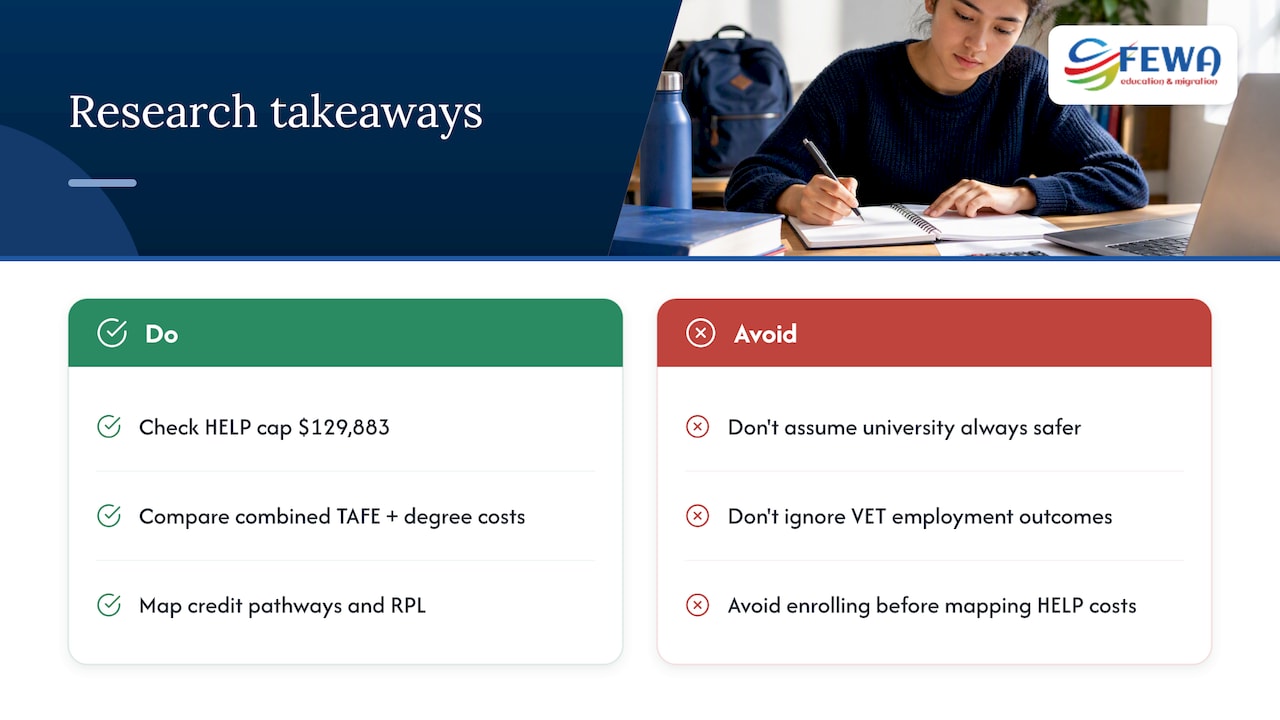
What’s overrated is the idea that your first choice locks you in. Credit pathways and recognition of prior learning exist precisely so a TAFE qualification can feed into a degree later, once you’ve confirmed your direction and built some income along the way.
What we’d prioritise first is the HELP borrowing limit, because it’s the detail most families overlook until they hit it. If you’re combining a TAFE diploma with a future degree, map out both costs against the $129,883 cap before you enrol in either, not after.
— Ronit
Getting your visa and paperwork right once you’ve chosen your path
Once you’ve settled on TAFE, university or a staged pathway between them, the next hurdle for many students is the student visa application itself: proving financial capacity, meeting entry requirements and preparing the right documents. We support that process directly through our visa services, including student dependent visas, and through IELTS, PTE and other exam coaching if you need to meet an English test requirement first.
We don’t choose your course or provider for you. What we do is check your eligibility, review your documents and talk you through what a visa application actually needs, starting with a free consultation.
FAQ
Is TAFE considered higher education in Australia?
No, TAFE primarily delivers vocational education and training (VET), sitting at AQF levels 1 to 6. Higher education covers AQF levels 5 to 10 and is delivered by universities, though Diploma and Advanced Diploma qualifications can sit in both categories.
Is Year 12 harder than the ATAR?
Year 12 and the ATAR aren’t separate difficulties, the ATAR is a ranking calculated from your Year 12 results compared against other students in your state. Whether either feels harder depends on your subject choices and the specific course requirements of the university or TAFE program you’re aiming for.
Is it worth going to university in Australia?
It depends on your career goal: for regulated professions such as law, medicine or teaching, a university degree is generally required and tends to support stronger long-term career progression. For trade and technical careers, a TAFE qualification can get you working sooner with lower fees and, according to VNDA outcomes data, solid employment results.
What is the hardest university to get into in Australia?
There’s no single official ranking of “hardest” universities, since entry difficulty depends on the course, its ATAR cut-off and the number of applicants each year. Competitive courses like medicine and law at research-intensive universities typically have the highest entry requirements, rather than the institution overall.
Sources
- VNDA 2019–20 outcomes (Jobs and Skills Australia)
- Your borrowing limit (Study Assist)
- AQF framework and qualifications
- Analysis of Job‑ready Graduates fee impacts (IRU commentary)