


If you have an unconditional offer from a licensed UK sponsor and secure your Confirmation of Acceptance for Studies, you’re eligible to apply for a UK student visa from Australia. The single most urgent step is locking in that CAS, because everything else, your funds evidence, your application timing, your biometric booking, flows from that one document. Australians also benefit from a couple of quiet advantages most guides skip over, including a common TB screening exemption.
TL;DR:
- You must secure and confirm your unique CAS reference number before applying, as application timing is linked to its issue date and can be up to six months prior.
- Your financial evidence must show the required funds have remained in your bank account for a continuous 28-day period without dips or vague transaction descriptions, or it risks rejection.
- Applying from Australia requires completing the online form, verifying identity via the ID Check app or booking a biometrics appointment, and submitting all documents within the relevant application window.
- Processing times average around three weeks for standard applications, but priority services can reduce decision time to five days, and super priority offers next-day results; no visa switch is permitted after entry.
- Australian applicants benefit from exemptions from TB screening and often from English language tests, but early booking of appointments and thorough document review are crucial for a smooth process.
Table of Contents
- Eligibility and the CAS: who qualifies and what your sponsor must provide
- Documents and evidence you must supply (including the 28-day funds rule)
- How to apply from Australia: online steps, ID app and timing
- Fees, Immigration Health Surcharge and estimated costs from Australia
- Length of stay, work rights, dependants and extending or switching visas
- Genuine student requirement, interviews and refusal risks
- Australia-specific practical notes (TB, English exemptions, processing from Australia)
- Practical checklist and when to get professional help
- How Fewa Education & Migration supports your application
- Sources
- FAQ
Eligibility and the CAS: who qualifies and what your sponsor must provide
Before you touch the online application, confirm you tick three boxes: you’re 16 or over, you’re enrolled in a qualifying course at the right RQF or SCQF level, and your sponsor has issued you a CAS. The CAS is not just a confirmation email. It’s a unique reference number your university generates once you’ve accepted your offer, and it carries course details, tuition figures, and your personal information exactly as it appears on your passport.
Timing matters more than most applicants realise. You can submit your application up to six months before your course start date, and that six-month window runs from the point your CAS is issued, not from when you first applied to the university.
Think of the requirements as three pillars UKVI checks together:
- The CAS itself, proving a licensed sponsor has accepted you onto a genuine course
- Financial evidence, showing you can cover tuition and living costs
- English language proficiency, either through a recognised test or a documented exemption
Miss any one of these and the application stalls, regardless of how strong the other two are.
Documents and evidence you must supply (including the 28-day funds rule)
Your core document set is fairly standard: a valid passport, your CAS reference number, evidence you’ve held the required funds for 28 consecutive days, and proof of English ability where it applies. Depending on your course and personal situation, you may also need:
- An ATAS certificate, if your course falls under specific science or technology subjects
- Parental or guardian consent, if you’re under 18
- Previous passport pages showing UK travel history
- Certified academic transcripts, particularly if your offer is conditional on prior results
The 28-day rule trips up more applicants than any other document requirement. Your bank statement needs to show the required balance sitting there for 28 straight days, and if the balance dips even briefly during that window, UKVI can reject the evidence outright. Financial evidence guidance also warns against vague transaction descriptions on statements, since caseworkers need to clearly identify the source of funds. Documents not in English need certified translations, not a quick Google Translate printout.
Pro Tip: Check your bank statement’s closing date against your application date before you submit. A statement that’s even one day too old outside the 28-day window can trigger a refusal, and reapplying costs you the fee and weeks of delay.
If your finances involve family support, multiple accounts, or savings recently transferred between currencies, it’s worth reviewing the financial capacity requirements properly before you compile evidence.
How to apply from Australia: online steps, ID app and timing
Applying from Australia follows a fairly linear sequence, but the order matters:
- Complete the online form on GOV.UK once your CAS is confirmed and your documents are gathered.
- Choose your identity verification method. Eligible passport holders use the ‘UK Immigration: ID Check’ app to scan their passport and take a selfie from home. If your passport isn’t supported, you’ll need to book a biometric appointment at a Visa Application Centre.
- Submit up to six months before your course starts if you’re applying from outside the UK. Applicants already in the UK switching visa categories face a tighter three-month window instead.
- Consider a priority service if your timeline is tight. Standard processing for applications lodged outside the UK typically takes around three weeks, though university visa teams often quote a standard decision window closer to 15 working days after biometrics are confirmed, with priority services cutting that to around five working days and super priority to the next working day, according to Oxford University’s visa guidance.
One warning worth repeating: you cannot fly to the UK as a visitor and switch to a student visa once you’re there. Cambridge’s international student guidance is blunt about this. Entry clearance has to be sorted from Australia, before you board.
Fees, Immigration Health Surcharge and estimated costs from Australia
Budgeting for a UK student visa involves two separate costs stacked together: the application fee itself and the Immigration Health Surcharge, which covers your access to the NHS for the length of your stay. The IHS is charged upfront, in one lump sum, for your entire visa period, so a three-year degree means paying three years of surcharge in a single transaction at the time you apply.
Cost snapshot: University visa teams commonly cite monthly maintenance figures around £1,483 for London-based study and £1,136 outside London, which most applicants need to demonstrate for up to nine months of study.
If you’re paying from an Australian bank account, factor in currency conversion timing. Exchange rate movements between the day you check your funds and the day you pay fees can shift the AUD equivalent noticeably, so it pays to pay early rather than right on a deadline. Priority and super-priority services carry additional fees on top of the standard application charge, and GOV.UK’s own fee pages remain the only figures worth trusting for exact current amounts.
Length of stay, work rights, dependants and extending or switching visas
Your visa length is tied directly to your course length, not a fixed standard period. Longer degree programs at higher study levels often come with a short period of leave after course completion, giving you time to transition to work or a further visa category.
Work rights depend on your course level and provider type, and during official vacation periods some restrictions ease. Key points to check against your own CAS:
- Part-time work limits during term time vary by course level, so confirm your specific cap with your sponsor
- Vacation periods generally allow more flexible work arrangements
- Dependants are only permitted for certain course levels and durations, typically postgraduate research
- Extending or switching visas usually requires a new CAS from a new or continuing sponsor
Guidance on dependants and guardianship arrangements shifted through 2026, so anyone bringing family should confirm the current rules directly rather than relying on last year’s advice.
Genuine student requirement, interviews and refusal risks
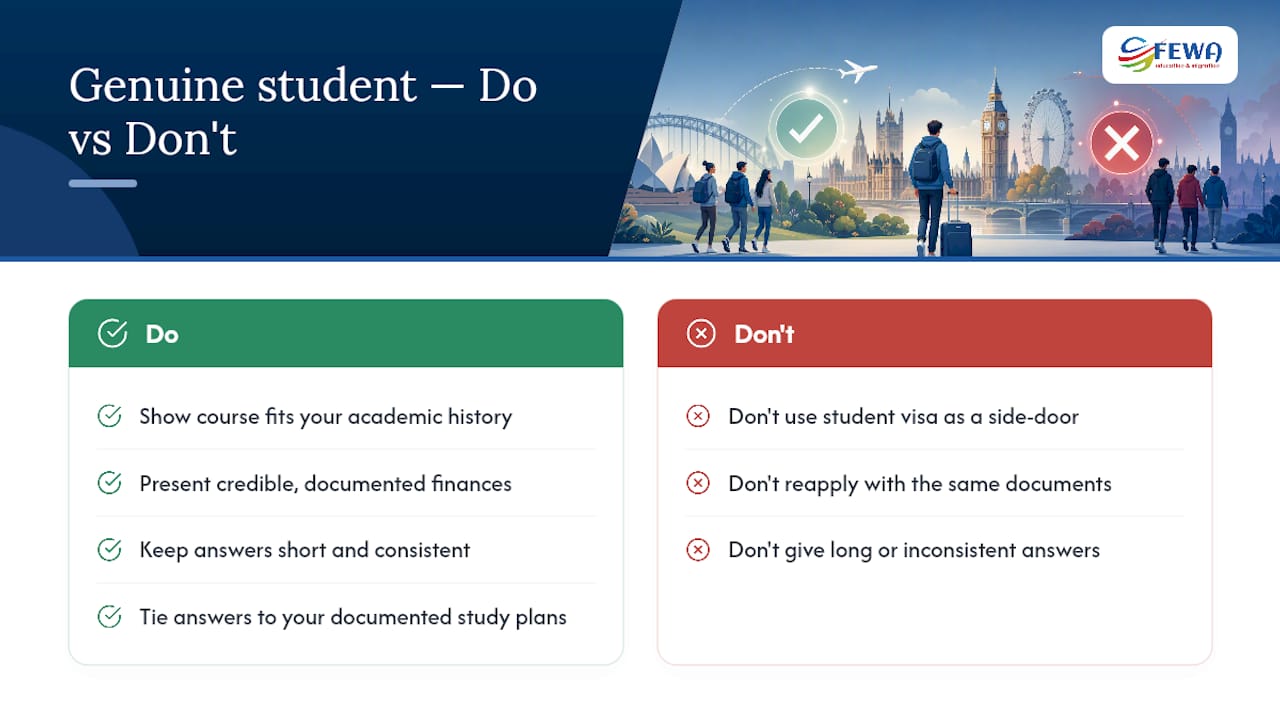
UKVI wants to see that you genuinely intend to study, not that you’re using a student visa as a side door into the UK. Caseworkers assess this through your Student route eligibility alongside your documents, weighing whether your course fits your academic history, whether your finances look credible, and whether your stated plans hang together logically.
Not every applicant gets called for an interview, and the genuine student test functions more as a background credibility check than an active filter for most people. If you are invited to speak with a caseworker, keep your answers short, consistent, and directly tied to your documented study plans.
Pro Tip: If you’ve been refused before, don’t simply reapply with the same documents and hope for a different outcome. Address the exact refusal reason in writing and strengthen that specific piece of evidence, or get guidance on what to do next before you resubmit.
Australia-specific practical notes (TB, English exemptions, processing from Australia)
A few rules work in your favour as an Australian applicant. You’re generally exempt from mandatory TB screening, which most other regions don’t get. Australia’s status as a majority English-speaking country often means a SELT exemption applies too, though individual sponsors sometimes still ask for separate proof of English ability for academic admission purposes.
Practically, this means:
- Skip TB screening appointments unless your recent travel history changes your exemption status
- Confirm your English exemption with both UKVI rules and your specific university’s admission requirements
- Book any priority service booking early, since Visa Application Centre appointment slots in Australia can fill up during peak intake periods
Practical checklist and when to get professional help
Once your CAS lands, move through this checklist immediately: confirm your 28-day funds window, check your passport’s validity against your intended stay, test whether your passport works with the ID Check app, and organise certified translations or an ATAS certificate if your course needs one.
Complex finances, dependants, a previous refusal, or unusual study arrangements are exactly the situations where a second set of experienced eyes catches the detail that a first-time applicant misses.
— Ronit
How Fewa Education & Migration supports your application
Professional migration consultancy services offer support to help you prepare your student visa application thoroughly, review your CAS, funds evidence, and genuine student documentation, build a realistic application timeline around your course start date, and manage lodgement to ensure completeness before submission.
Some migration consultants are registered with professional migration authorities in Australia and are experienced with applicants navigating the 28-day funds rule, ID Check app requirements, and Visa Application Centre bookings. Many offer initial consultations to discuss CAS status, document preparation, and timelines before application fees are paid. Start with the student visa service if you’re applying independently, or check the visa services overview if your situation involves dependants or a more complex migration pathway.
FAQ
Can I get a UK student visa from Australia?
Yes. You apply for entry clearance from Australia before travelling, using the standard online process, once your sponsor has issued your CAS. You cannot enter as a visitor and switch to a student visa after arrival.
What are the new rules for UK student visas in 2026?
The Student route caseworker guidance was updated through 2026, with changes affecting dependant and guardianship arrangements. Confirm current settings directly with GOV.UK or a registered migration adviser if your situation involves family members.
Do Australians need a TB test for a UK student visa?
No, Australian applicants are generally exempt from mandatory TB screening for UK visa purposes. Recent travel to certain other countries can change this, so check your specific travel history against current requirements.
How long does a UK student visa take to process from Australia?
Standard processing outside the UK typically runs around three weeks, though some university visa teams quote closer to 15 working days after biometrics. Priority services can reduce this to around five working days, with super priority offering next working day decisions.
What happens if my UK student visa application is refused?
You’ll receive a written explanation of the refusal reason, and reapplying without addressing that exact issue rarely succeeds. Review what to do after a refusal and strengthen the specific weak point before resubmitting.