


Subclass 820 is the temporary onshore partner visa. Subclass 801 is the permanent partner visa granted later, once the Department of Home Affairs is satisfied your relationship has stood the test of time. They’re not two competing options. They’re two stages of one pathway, and if you’re applying onshore, you’ll almost always lodge for both at once.
Most couples reach the 801 decision point after a significant period from when you lodged your application, though the Department can grant it sooner if you’ve been together for a longer time or meet other criteria, such as having a child of the relationship. Processing times and fees shift often, so treat any number you read (including here) as a starting point, not gospel — for a contrasting example of visa comparisons, check this Non-Lucrative Visa vs Digital Nomad Visa overview.
- 820 = temporary, decided first, gives you work rights and a foothold in Australia
- 801 = permanent, decided later, based on ongoing evidence of your relationship
- Check current figures on the Partner visa (subclass 820 and 801) page before you plan around them
Pro Tip: Bookmark the Home Affairs processing times page now. You’ll want to check it more than once during your application, and figures change without much warning.
TL;DR:
- The onshore partner visa process involves lodging a combined application for both the temporary 820 and the permanent 801 stages, often with a single payment and evidence set.
- Applicants must be in Australia when applying for the 820 visa, while the 801 grant depends on relationship duration and can sometimes be approved earlier if specific criteria are met.
- The strength of a partner visa application relies heavily on consistent, ongoing evidence of relationship commitment rather than last-minute document gathering.
- The typical processing timeline involves an initial grant of the 820, with the 801 review occurring after several years or under specific conditions like having a child.
- Engaging a MARA-registered agent ensures case continuity, expert review, and strategic advice throughout the entire partner visa journey.
Table of Contents
- 820 vs 801: Who Actually Qualifies?
- How the 820 and 801 Pathway Actually Works
- What Evidence Actually Moves the Needle
- What to Budget for in Time and Money
- Work Rights, Travel, and What Changes When You Go Permanent
- If Your Relationship Ends or Your Application Gets Refused
- Why Fewa’s MARA Registration Matters Here
- What the Checklists Don’t Tell You
- Getting Expert Help With Your Partner Visa Application
- Key Takeaways
- Sources
820 vs 801: Who Actually Qualifies?
You qualify as an applicant if you’re the spouse or de facto partner of an Australian citizen, permanent resident, or eligible New Zealand citizen. For the temporary 820 visa, you must be physically in Australia when you lodge, which trips up more couples than you’d expect. If you’re offshore, you need the equivalent 309/100 visas instead.
Relationship duration matters most for the 801 stage:
- Standard applicants wait a considerable period from their 820 lodgement date before Home Affairs assesses the permanent grant.
- Couples married or in a de facto relationship for a longer duration can sometimes skip the waiting period.
- Couples with a certain length of relationship plus a child of the relationship also qualify for earlier assessment.
Your sponsor carries real obligations too, not just a signature on a form. They need to be eligible to sponsor (citizen, permanent resident, or eligible New Zealand citizen), and Home Affairs limits how many times someone can sponsor a partner visa in their lifetime.
- Sponsors generally can’t sponsor more than two partners, ever, or one within five years of a previous sponsorship
- A sponsor with an unresolved criminal history can trigger delays or refusal
- Sponsor withdrawal after lodgement can stall or end your application, which is why couples should discuss this seriously before committing
How the 820 and 801 Pathway Actually Works
Most onshore couples lodge one combined application covering both the 820 and 801 stages, which saves paperwork later. You pay the visa application charge once, submit your evidence once, and Home Affairs uses that same file for both decisions.
- You lodge the combined 820/801 application while in Australia, alongside your sponsor’s sponsorship form.
- A Bridging Visa A (BVA) activates once your current substantive visa expires, letting you stay legally while your case is processed.
- Home Affairs grants the 820 first, once satisfied your relationship is genuine at that point in time.
- After a significant period (or earlier under the exceptions above), the department reviews updated evidence and decides the 801.
The bridging visa detail catches people out constantly. A standard BVA doesn’t include travel rights. If you leave Australia without a Bridging Visa B or another valid travel authorization, your bridging visa ceases and you may not be able to re-enter on it.
Pro Tip: Need to travel while your bridging visa is active? Apply for permission before you book flights, not after. Retroactive fixes are far harder than upfront requests.
What Evidence Actually Moves the Needle
Home Affairs wants proof your relationship is genuine and ongoing, and the strongest applications treat evidence-gathering as an ongoing project, not a one-off scramble before lodgement.
Start with identity documents: passports, birth certificates, your marriage certificate if you’re married, and police checks from every country you’ve lived in for 12 months or more in the past decade. Health checks (arranged through a Home Affairs-approved panel doctor) round out the compliance side.
Relationship evidence is where applications get won or lost. Strong files typically include:
- Joint bank accounts or shared financial commitments (a lease, a car loan, utility bills in both names)
- Evidence of cohabitation, like mail addressed to both partners at the same address over time
- Photos and travel records spanning different periods, not just one holiday
- Statutory declarations from friends or family who’ve known you as a couple
- Records of family involvement, like attending weddings, funerals, or festivals together
Pro Tip: Build a simple relationship timeline document, year by year, and attach supporting evidence under each entry. Case officers process hundreds of files; a well-organized timeline makes yours easier to assess quickly.
What to Budget for in Time and Money
Processing times for both 820 and 801 vary by case complexity, not just volume, and the global visa processing times page shows live figures broken into percentiles. That range exists because some files sail through and others need extra checks.
Delays usually trace back to a handful of causes:
- Missing or thin relationship evidence that prompts a request for more information
- Health or character checks flagging something that needs clarification
- Sponsor eligibility issues discovered partway through processing
- Incomplete police certificates from countries you’ve lived in
Fees change periodically, so run your numbers through the Visa Pricing Estimator before you commit to a lodgement date, and check the current visa pricing page for the base charge. Budget separately for translations, medical exams, and police certificates. These add up fast and rarely get mentioned until you’re deep into the process.
Work Rights, Travel, and What Changes When You Go Permanent

Holding the 820 generally gives you full work rights in Australia while your case is processed, which matters if you’re supporting yourself or your family during the wait. The 801, once granted, makes you a permanent resident with the full entitlements that come with that status.
Travel is the sharpest practical difference between the two stages:
- On a Bridging Visa A, you generally cannot leave and return to Australia without separate travel permission
- Once your 801 is granted, you can travel freely as a permanent resident, subject to normal passport and visa rules for your destination
- Access to Medicare typically opens up once you’re a permanent resident; check current eligibility with Services Australia rather than assuming automatic enrollment
- Social security access for permanent residents usually involves waiting periods, so don’t assume day-one entitlement
If Your Relationship Ends or Your Application Gets Refused
Relationships change, and Home Affairs has processes for that reality, even if they’re not comfortable to think about mid-application.
- If your relationship genuinely ends before the 801 is granted, you generally need to notify Home Affairs, and your case may be assessed on different grounds or refused.
- If family violence is a factor, safety net provisions may let you continue your application independent of the relationship’s status. This is complex territory, and getting advice quickly matters more than getting it perfectly.
- If your application is refused, you typically have review rights through the Administrative Review Tribunal, with strict time limits attached.
Pro Tip: Don’t wait until a refusal letter arrives to seek advice. If your circumstances have shifted (separation, sponsor withdrawal, safety concerns) talk to a MARA-registered agent or immigration lawyer while you still have options on the table.
Why Fewa’s MARA Registration Matters Here
Anyone can call themselves a migration adviser. Only agents on the MARA register are bound by a formal code of conduct, and you can verify that registration yourself before paying anyone for advice.
Fewa’s team works within that framework on partner visa cases, offering:
- Document review against current Home Affairs evidentiary standards
- Application lodgement support for combined 820/801 files
- Case management through bridging visa periods and the eventual 801 review
Client circumstances discussed in consultations remain confidential; details here are kept general by design.
What the Checklists Don’t Tell You
Most partner visa guides read like a document scavenger hunt: gather these fifteen things, submit, wait. That framing undersells the real risk, which is timing, not paperwork. Couples lose momentum on relationship evidence between the 820 grant and the 801 review, treating the temporary grant as a finish line instead of the halfway point it actually is.
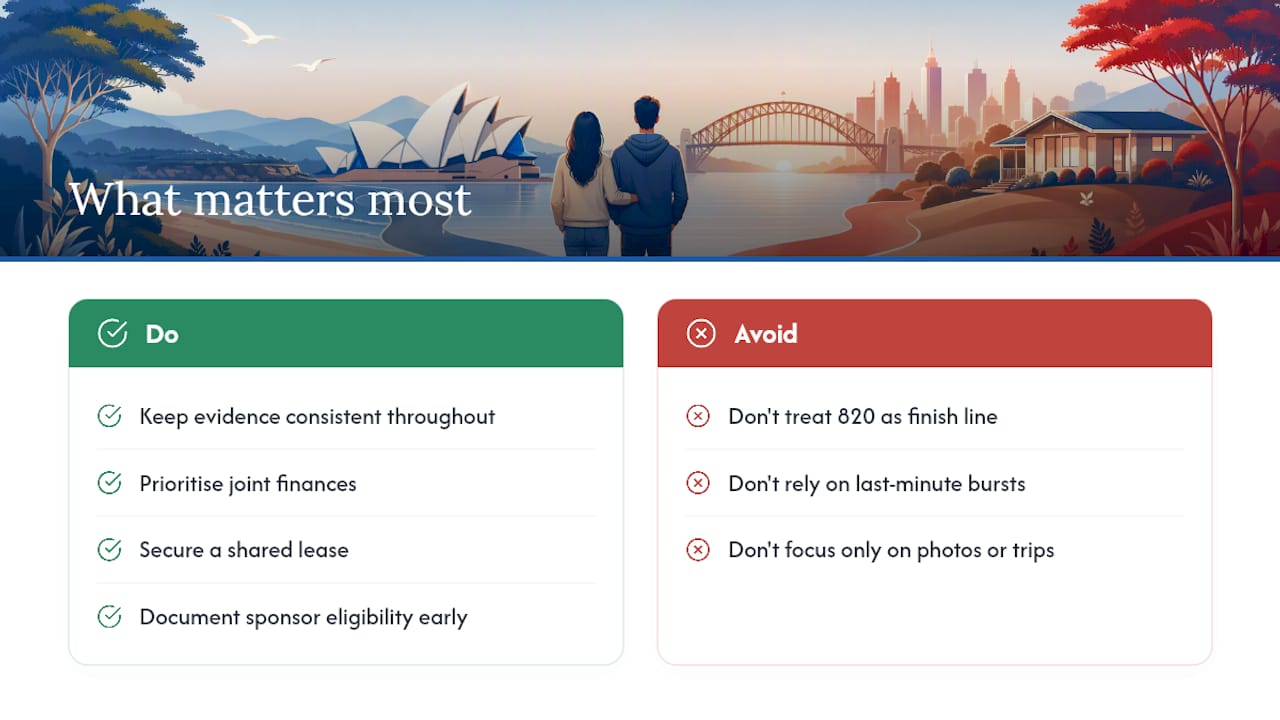
The conventional advice to “just keep records” is technically correct and practically useless. What separates strong 801 files from weak ones is consistency over the full waiting period, not a burst of evidence right before lodgement. If you’re two years into a relationship and only just started a joint bank account, that gap will show.
Prioritize the boring stuff first: joint finances, a shared lease, and documentation of sponsor eligibility before your sponsor’s circumstances change. The dramatic evidence (photos, trips, family events) matters less than the department’s own guidance on relationship assessment suggests most applicants assume. Genuine, ongoing, boring commitment is what gets read as real.
— Ronit
Getting Expert Help With Your Partner Visa Application
Fewa gives you a MARA-registered agent handling your file from lodgement through to the 801 decision, so you’re not re-explaining your relationship history to a new caseworker every time your circumstances shift. That continuity matters most in exactly the situations this article flagged as risky: a previous refusal, a complicated relationship history, sponsor concerns, or a family violence claim that needs careful, timely handling.
The team reviews your evidence against current Home Affairs standards before lodgement, prepares your combined 820/801 file, and manages your case through the bridging visa period and eventual permanent review. If your situation is straightforward, you may only need a document check. If it’s complicated, having a registered agent from day one avoids costly rework later. Start with a free consultation through Fewa’s Partner Visa page and get a clear read on where your application stands before you lodge anything.
Key Takeaways
The 820 visa lets you stay and work in Australia while your relationship is assessed for the permanent 801 grant, typically after an extended period.
| Point | Details |
|---|---|
| 820 is temporary, 801 is permanent | Both are stages of one combined onshore application, not separate visa choices. |
| Onshore requirement for 820 | You must be in Australia when you lodge the temporary partner visa. |
| Two-year review is standard | Exceptions apply for three-year relationships or two years plus a child. |
| Bridging visa travel needs checking | A standard Bridging Visa A doesn’t include travel rights by default. |
| Fewa offers MARA-registered support | Document review, lodgement, and case management for 820/801 applications through Fewa. |
This article is general information, not a substitute for advice from a qualified lawyer. Consult a qualified legal professional about your own circumstances before acting on anything here.