


Plan for a timeline that can vary substantially depending on your subclass, though many applicants spend an average amount of time navigating the process. The Department of Home Affairs counts processing time from the date you lodge a complete application to the date a decision is made, and its published figures reflect recently decided cases, not a promise about yours. Onshore applicants also face a two-stage process, temporary then permanent, which adds its own timing quirk worth understanding before you lodge.
TL;DR:
- Most partner visa processing times fall within the 25th to 90th percentile, with median estimates providing a general timeline but no guarantee for individual cases.
- Onshore applicant timelines differ between the temporary subclass 820 and the permanent subclass 801, with the latter starting from the date of eligibility, not lodgement.
- Complete documentation, early medical and police checks, and prompt responses to requests significantly influence processing speed, especially for straightforward cases.
- Variations in case complexity, previous refusals, or overseas evidence can extend processing times, making early and thorough preparation crucial.
- Regularly monitoring official tools like ImmiAccount, the visa processing times page, and VEVO helps applicants stay informed but does not reveal individual case statuses.
Table of Contents
- What Do Official Partner Visa Processing Time Percentiles Mean?
- How Long Do Subclass 820, 801, 309, 100, and 300 Visas Take?
- What Slows Down or Speeds Up a Partner Visa Application?
- How Do You Check Your Partner Visa Status?
- Can You Speed Up a Partner Visa Decision?
- What Fewa Sees in Real Partner Visa Cases
- How Fewa Helps You Manage Your Partner Visa Timeline
- Where to Check Partner Visa Processing Information
- Sources
What Do Official Partner Visa Processing Time Percentiles Mean?
Home Affairs doesn’t publish a single number for partner visa processing time. It publishes four, arranged as percentiles: 25%, 50%, 75%, and 90%. Each one tells you the proportion of recently decided cases that were finalized within that timeframe. If the 50th percentile for your subclass is around the median processing time, half of recently decided applicants got a decision faster than that, and half waited longer.
The Global visa processing times tool is where these figures live, and Home Affairs updates it monthly. It’s worth knowing what the tool doesn’t do: it won’t look up your specific application, check your file status, or tell you why your case is taking longer than the median.
Pro Tip: *Read the 75th and 90th percentile columns, not only the median.
Here’s how the percentiles typically map to real expectations:
- 25th percentile: the fastest quarter of applicants, usually with clean, complete files
- 50th percentile: the median, most useful for general planning
- 75th percentile: common for cases needing extra checks or clarification
- 90th percentile: the long tail, often complex or offshore cases
How Long Do Subclass 820, 801, 309, 100, and 300 Visas Take?
Subclass differences matter more than most applicants realize going in. Onshore partner visas run through subclass 820 (temporary) first. You’re generally eligible to apply for the permanent subclass 801 visa two years after your initial application date, unless you qualify earlier, and the subclass 820 and 801 page confirms the permanent-stage clock starts from that eligibility date rather than your original lodgement. That’s why two people who lodged on the same day can end up with very different total timelines once the second stage kicks in.
Offshore applicants apply for subclass 309 (temporary), which converts to subclass 100 (permanent) using the same two-year eligibility structure. Third-party data collated by MIGI from Home Affairs figures provide percentile estimates for subclass 309 processing times, showing variation across faster, median, and slower cases as of mid-2026. Subclass 300, the prospective marriage visa, tends to move somewhat faster at the initial decision stage but still carries wide variation depending on caseload and evidence complexity.
In practice, three scenarios show up again and again:
- A straightforward case with complete evidence often receives an initial decision sooner
- A typical case with requests for more information may take longer
- More complex cases involving issues such as prior visa refusals or missing documentation can take considerably more time
What Slows Down or Speeds Up a Partner Visa Application?
Some delays are within your control. Others aren’t, and knowing which is which saves you a lot of frustration.
- Documentation completeness. Missing relationship evidence or incomplete forms are the single biggest cause of avoidable delay, and responding fast to a request for information keeps your file moving.
- Health and police checks. Book medicals and character checks early. These often run in parallel with assessment but can become the bottleneck if left until late.
- Case complexity. Prior visa refusals, a sponsor’s own immigration history, or evidence gathered from overseas all add assessment time.
- Caseload and policy shifts. Processing posts experience surges, and documentation completeness and case complexity materially affect timelines regardless of how well-prepared you are.
- Red flags. Inconsistent statements, thin financial co-mingling evidence, or a short relationship history often trigger a formal request for further evidence, which resets your position in the queue.
Pro Tip: Submit certified translations and joint financial evidence at lodgement, not after a request. Waiting for the case officer to ask usually costs you months, not weeks.
How Do You Check Your Partner Visa Status?
Three official tools give you everything you’re entitled to see. ImmiAccount is where you lodge, receive correspondence, and see status updates or requests for information. Check it regularly and never let a notice sit unanswered.
The Global visa processing times tool lets you find your subclass and read the current percentiles, though it won’t reflect your individual file. VEVO shows your visa entitlements and conditions once a decision is made, and it’s the tool prospective employers or landlords may ask you to demonstrate.
- Log into ImmiAccount weekly to catch requests early
- Cross-check your subclass percentile monthly, since figures update
- Use VEVO to confirm entitlements once your visa is granted
- Contact Home Affairs directly for account issues, or a MARA-registered agent for strategic questions about your specific case
Can You Speed Up a Partner Visa Decision?
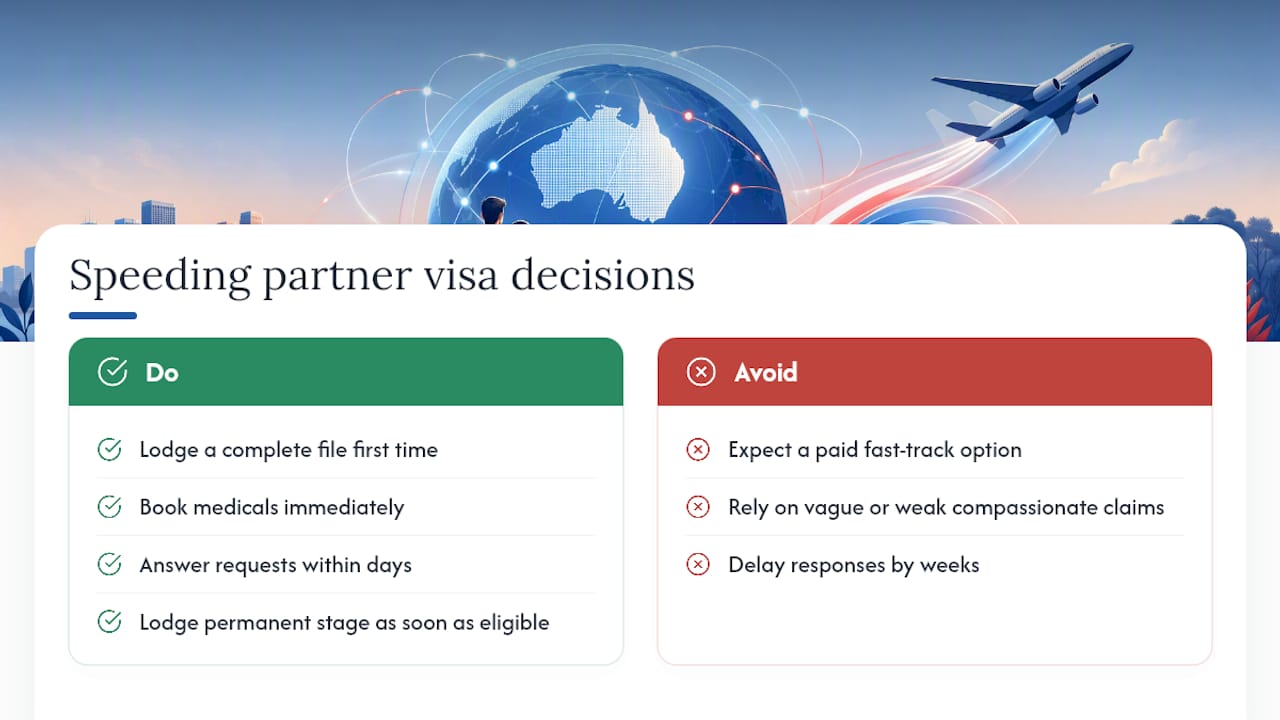
Priority processing exists, but the criteria are narrow, generally limited to compassionate or urgent circumstances backed by strong supporting evidence, not general impatience. Home Affairs doesn’t offer a paid fast-track for partner visas the way some other countries do.
What actually helps: lodging a complete file the first time, booking medicals immediately, and answering every request within days rather than weeks. If you’re onshore and approaching your two-year eligibility mark, lodging the permanent stage as soon as you qualify avoids losing time at the back end.
What Fewa Sees in Real Partner Visa Cases
Most delays we encounter trace back to two things: incomplete relationship evidence at lodgement and slow replies to requests for information. A document quality check before lodgement, catching gaps in financial or cohabitation evidence, has repeatedly moved cases from the 75th percentile range back toward the median in cases we’ve supported.
— Ronit
How Fewa Helps You Manage Your Partner Visa Timeline
Fewa is the alternative to guessing your way through Home Affairs paperwork alone. For couples navigating a partner visa timeline in Sydney and across Australia, the real advantage is having a MARA-registered migration agent review your file before lodgement, not after a case officer flags a gap months later.
Our services cover document review against current evidence checklists, full lodgement support through ImmiAccount, and ongoing case follow-up so you’re not left checking your inbox alone for months. MARA registration means agents work to a professional code of conduct, which matters when a small oversight can add months to your wait. If you want a clear-eyed assessment of where your application stands and what to fix before you lodge, visit our partner visa page or book a free consultation through Fewa’s visa services to get started.
Where to Check Partner Visa Processing Information
Bookmark these before you lodge:
- Global visa processing times for current percentiles by subclass
- ImmiAccount for lodgement and case correspondence
- MARA’s public register to confirm any agent’s registration before engaging their services
This article is general information, not a substitute for advice from a qualified lawyer. Consult a qualified legal professional about your own circumstances before acting on anything here.