

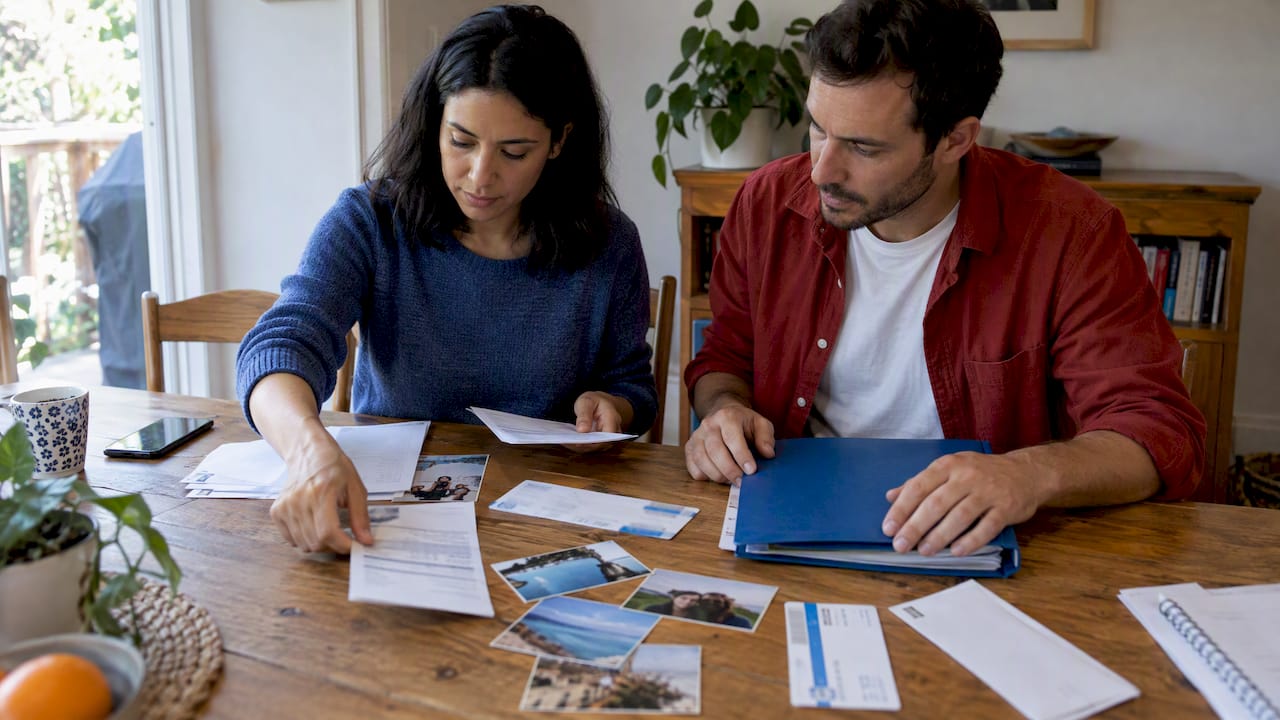
The Department of Home Affairs assesses your partner visa application by looking at the cumulative picture across four pillars: financial, household, social and commitment. A well-organised lodgement through ImmiAccount, with certified documents and NAATI translations where needed, helps avoid the delays that come with incomplete evidence. Start today with a dated, labelled list of what you already have.
TL;DR:
- Build a dated chronology across all four pillars; statements and dated sequences over time carry more weight than isolated transactions or undated photos.
- Form 888 witnesses should be over 18, describe firsthand observations, sign their statements, and attach certified identity documents; the Department may request up to three statements.
- Documents written in another language need NAATI translations; certified copies, clear scans, and matching names and dates also help prevent upload problems.
- As of August 2026, Partner visas showed processing times of about 23 months; incomplete files can add delays, so check ImmiAccount and answer requests promptly.
- For de facto couples or periods of separation, prioritize shared household history, ongoing communications, financial support, and clear explanations for gaps in cohabitation or public evidence.
Table of Contents
- At-a-glance checklist: the documents you should gather now
- The four evidence pillars explained with specific examples you can upload
- Supporting witnesses and Form 888: who can be a witness and what they must attach
- Translations, certified copies and document quality: make sure attachments meet Home Affairs’ standards
- How to organise and present evidence in ImmiAccount and what to expect after lodgement
- Common mistakes applicants make with relationship evidence (and how to fix them)
- Practitioner perspective: what a MARA-registered consultant checks before lodgement
- How to address de facto relationships and same-sex partnerships in your evidence
- Handling evidence when you’ve spent time apart
- Compiling evidence for relationships involving children
- What the conventional advice on partner visa evidence gets wrong
- How we can help you prepare and lodge your partner visa evidence
- FAQ
- Sources
- Primary Department pages, forms and official guidance
At-a-glance checklist: the documents you should gather now
Before you dive into the detail of each evidence category, it helps to see everything you might need in one place. Most applicants already hold some of these documents; the task is pulling them together and labelling them so an assessor can follow your story without guessing.
Here’s what to collect first:
- Identity and baseline documents: passports, birth certificates, your marriage certificate if you’re married, and any previous visa or passport records.
- Financial evidence: joint bank statements, joint loans, shared bills and anything that shows you rely on each other financially, as outlined in the Department’s relationship evidence guidance.
- Household evidence: a joint lease or mortgage, utility bills in both names, mail addressed to both of you, and documents showing shared responsibilities or children.
- Social evidence: travel bookings, joint invitations, photos with dates and captions, joint memberships and messages with family or friends.
- Commitment evidence: wills, joint insurance policies, joint plans for the future, and communication history that shows an ongoing relationship.
- Witnesses and statutory declarations: completed Form 888 statements where possible, each with the witness’s identity documents attached.
- Technical items: NAATI translations for any document not in English, certified copies, and clear, high-quality scans ready for upload.
Once you’ve gathered the basics, label each item with a date and a one-line note explaining what it proves. Something like “joint bank account, shared household expenses, over time” tells an assessor exactly why that document matters without them having to work it out themselves.
The four evidence pillars explained with specific examples you can upload
Each pillar answers a different question about your relationship, and the Department expects you to address all four rather than leaning heavily on one. Understanding what sits where helps you spot gaps before you lodge.
Financial pillar. This is about whether you and your partner rely on each other financially, not just whether you occasionally split a bill. Joint bank accounts, regular transfers between personal accounts, shared direct debits for rent or insurance and joint loans all count. Submit full statements showing both names and a run of dates, not a single screenshot of a balance, since the Department’s relationship evidence guidance treats a pattern over time as far more persuasive than a one-off transaction.
Household pillar. Here the question is whether you actually share a home and the work that comes with it. A lease or mortgage contract in both names is the clearest document, backed by utility bills addressed to both partners and mail received at the same address over time. If you share chores, caring duties or co-parenting responsibilities, documents that show this (school enrolment forms, medical consent forms, rosters) add weight.
Social pillar. This pillar looks at how you present as a couple to the people around you. Joint travel itineraries and boarding passes, invitations addressed to both of you, and photos with dates and short captions all help, as do records showing you’ve told government bodies or businesses about the relationship, such as updating a next of kin. A handful of undated holiday snaps won’t carry much weight on their own; a dated, captioned sequence across several years tells a far stronger story.
Commitment pillar. This is where you show the relationship has a future, not just a past. A marriage certificate belongs here if you’re married. So do joint wills, insurance policies naming each other as beneficiary, and long-term plans such as a shared mortgage application or joint superannuation nominations. If you’ve spent time apart, communication records that show the relationship continued through that period matter here too.
A practical way to present all of this is a concise chronology, with exhibits labelled Exhibit A, Exhibit B and so on, each referenced by date. Attach a brief cover statement that ties each exhibit back to the pillar it supports. Assessors work through many files; a clear index saves them time and saves you from a request for more information later.
Supporting witnesses and Form 888: who can be a witness and what they must attach
Form 888 is a statutory supporting statement completed by someone who knows you and your partner well. It’s one of the main tools the Department uses to assess the social side of your relationship, and it can ask for up to three separate statements from different witnesses during processing.
Keep these points in mind when choosing and briefing witnesses:
- Witnesses should be over 18, know the two of you personally, and be prepared to provide identity proof such as an Australian passport, birth certificate or evidence of permanent residency.
- A strong statement explains how the witness knows you, how long they’ve known you, how often they see you, and includes specific examples rather than general impressions.
- Witnesses should stick to what they’ve personally observed and avoid repeating things they’ve only been told, since hearsay carries less weight than firsthand knowledge.
Pro Tip: Ask each witness to attach a certified copy of their identity document when they return the signed Form 888, so you’re not chasing it later.
Translations, certified copies and document quality: make sure attachments meet Home Affairs’ standards
A genuine relationship can still run into delays if the paperwork around it isn’t properly prepared. For documents not in English, check the Department’s current translation requirements before lodging.
Certified copies also trip people up more often than they should:
- Check the Department’s current requirements for certifying copies before lodging.
- Blurry scans, partial pages and unsigned certifier statements are among the most common reasons documents get sent back.
- Scan at a resolution that keeps names, dates and stamps legible and save as a clear PDF so names, dates and stamps are all legible once uploaded.
Before you upload anything, check that names and dates match across every document and that each translation carries its accreditation details, since Home Affairs applying for family visa guidance treats a complete, legible file as part of a properly lodged application.
How to organise and present evidence in ImmiAccount and what to expect after lodgement
Getting your documents ready is only half the job. How you file them in ImmiAccount and what you do afterwards matters just as much.
- Build a labelled exhibit index before you start uploading, so you know exactly which document goes into which field.
- Attach each item to the correct ImmiAccount category, uploading originals and certified copies separately where the system asks for both, as set out in the Department’s guidance on applying for family visa.
- Include a short relationship timeline that cross-references your exhibits by date, so an assessor can verify your story quickly against the relationship evidence pillars.
- Check ImmiAccount regularly after lodgement and respond to any document requests promptly, since missed requests are a common cause of delay.
- Remember that Ministerial Direction 117 gives priority to complete onshore lodgements, and as of August 2026 processing times for Partner (Provisional/Temporary) visas sit at around 23 months, with incomplete files adding further delay.
If you’re waiting on a document you can’t get in time, keep receipts or booking confirmations that show you’ve tried, and use the Partner processing enquiry form to request extra time while explaining the hold-up. Our guide on partner visa processing times walks through what affects that 23-month figure in more detail.
Common mistakes applicants make with relationship evidence (and how to fix them)
A handful of errors show up again and again in partner visa files, and most are easy to fix once you know to look for them.
- Relying on a single type of evidence, usually photos, instead of a balanced set across all four pillars: spread your evidence so no single category is doing all the work.
- Submitting unsigned Form 888 statements or forgetting witness identity documents: check every signature and attachment before you upload, since immi.homeaffairs.gov.au notes that missing witness identity proof is a common cause of delay.
- Uploading blurry scans or untranslated documents without NAATI accreditation: scan clearly and get accredited translations before you lodge, not after a request comes back asking for them.
- Letting dates or details drift between documents: build a timeline early and explain any apparent gaps in a short cover letter rather than leaving an assessor to guess.
Pro Tip: Read back through your own exhibit list as if you were a stranger meeting your relationship for the first time. Gaps and inconsistencies tend to jump out once you do.
Practitioner perspective: what a MARA-registered consultant checks before lodgement
A thorough pre-lodgement review tends to follow the same pattern regardless of how straightforward the relationship is. We check the chronology against the exhibit index, confirm each Form 888 is signed with identity documents attached, verify NAATI translation details on every non-English document, and double-check file names and upload fields before anything goes to the Department.
Under Ministerial Direction 117, the priority is making sure an onshore lodgement is complete from day one, so we focus first on financial and household documents, since these are usually the easiest to gather and the hardest to argue with. Social and commitment evidence can then fill out the picture.
If you come to a consultation, bring your exhibit list, scanned documents, witness contact details and any translations you already have. It gives us a clear starting point rather than piecing things together from scratch.
How to address de facto relationships and same-sex partnerships in your evidence
If you’re applying as a de facto couple rather than a married couple, the same four pillars apply, but you’ll need to work a little harder to establish how long you’ve lived together and the nature of your commitment, since there’s no marriage certificate to anchor the timeline. Lease agreements, joint bills and a clear household history become even more important here.
The Department’s relationship evidence guidance applies to the evidence you provide, and the Department’s relationship evidence guidance applies equally regardless of gender or sexuality. If your relationship wasn’t always publicly acknowledged, perhaps because of family circumstances or the legal position in a previous country of residence, it’s worth explaining that context briefly in your cover statement rather than leaving a gap in your social evidence unaddressed. What matters is that the evidence you do have, across finances, household, social life and commitment, tells a consistent and genuine story.
Handling evidence when you’ve spent time apart
Couples separate temporarily for all sorts of reasons: work postings, family obligations, visa delays or study commitments. A period apart doesn’t weaken your application as long as you can show the relationship continued through it.
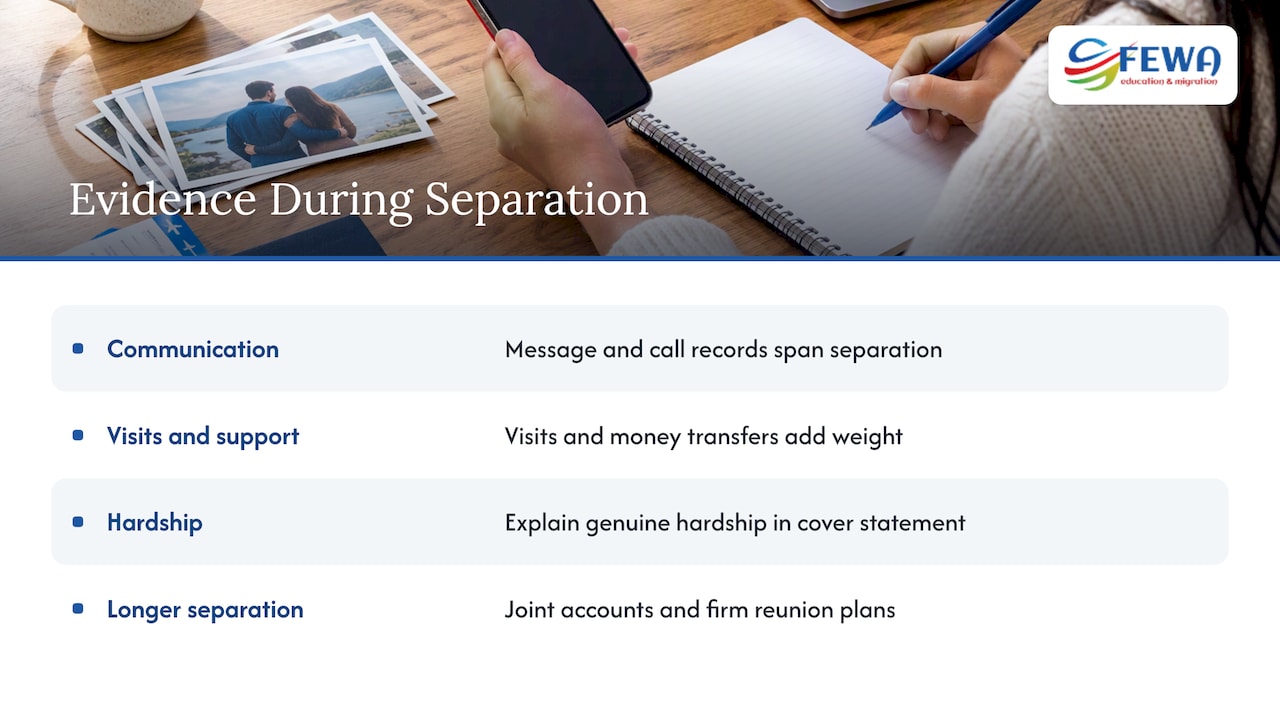
Communication records become your strongest evidence during a separation. Message histories, call logs and video call records that span the period apart help show the relationship stayed active rather than lapsing. Travel records showing visits during the separation, and evidence of ongoing financial support such as money transfers, add further weight. If the separation involved genuine hardship, a short explanation in your cover statement helps an assessor understand the context rather than wondering about a gap in your household evidence.
Where a separation was longer or more significant, lean more heavily on the commitment pillar: shared financial planning, maintained joint accounts or insurance policies, and firm plans to reunite all help demonstrate that the relationship remained a continuing one rather than something that paused indefinitely.
Compiling evidence for relationships involving children
Shared children are some of the strongest evidence of a genuine, continuing relationship, provided the documentation is complete. A child’s birth certificate naming both parents is a good starting point, alongside school enrolment forms, medical records listing both parents as guardians, and any shared custody or parenting arrangements if you’ve previously separated.
Day-to-day evidence matters too: photos of family activities, school communication addressed to both parents, and records of shared parenting responsibilities such as pick-ups, medical appointments or extracurricular costs. If one partner isn’t the biological parent, evidence of their involvement in the child’s life, such as being listed as an emergency contact or attending school events, helps show the family functions as a genuine unit. Keep children’s documents in their own labelled section of your exhibit index so they’re easy for an assessor to find alongside the rest of your household evidence.
What the conventional advice on partner visa evidence gets wrong
Most guidance treats the four pillars as a box-ticking exercise: tick financial, tick household, tick social, tick commitment, done. That misses the point. Home Affairs isn’t counting document types, it’s reading for a consistent, dated story across years, and a thin file with a few well-chosen, clearly dated documents often reads more convincingly than a thick one stuffed with undated photos.
The other thing applicants underestimate is presentation. Files with identical underlying evidence can get different outcomes depending on whether that evidence arrives as an indexed, chronological package or as a pile of scans with no explanation. If we had to name one priority above all others, it’s this: build the timeline before you build the file. Everything else, from Form 888 statements to NAATI translations, exists to support that timeline, not to replace it.
— Ronit
How we can help you prepare and lodge your partner visa evidence
Pulling together a complete partner visa file while working, studying or managing family life is genuinely demanding, and a single missing signature or unsigned Form 888 can add months to an already long wait. We work through this with clients regularly, and we focus on getting your evidence pack right the first time rather than fixing problems after a request for more information arrives.
Our Partner Visa (SC 820/801) service includes:
- We help you prepare your partner visa evidence before you lodge.
- We help you prepare your partner visa application.
- We provide guidance as part of our visa application support.
- Support lodging and managing your file through ImmiAccount from start to finish.
If you’d like a second set of eyes on what you’ve gathered, book a free consultation through our Partner Visa page and we’ll talk through a lodgement checklist tailored to your situation.
This article is general information, not a substitute for advice from a qualified lawyer. Consult a qualified legal professional about your own circumstances before acting on anything here.
FAQ
What documents do I need for an Australian partner visa?
You need identity documents, financial evidence such as joint bank statements, household evidence like a joint lease or utility bills, social evidence such as dated photos and travel records, and commitment evidence like wills or joint insurance. At least two Form 888 statements from people who know you well add further weight, alongside NAATI translations for any non-English documents.
How do I check why a partner visa was refused?
Refusal reasons are explained in the written decision Home Affairs sends, which sets out which requirements weren’t met and why. If the decision isn’t clear, a migration agent can review it against your original evidence to identify exactly where the gap was.
How much money is required for a partner visa in Australia?
The Department considers evidence of how you and your partner share and manage money, such as joint accounts and shared bills, rather than a set dollar figure. Instead, the Department looks at whether you and your partner share and manage money together over time, through joint accounts, shared bills and financial interdependence rather than a set dollar figure.
What can lead to problems with partner visa evidence?
Incomplete or inconsistent evidence can be an issue, particularly relying on one evidence type instead of a spread across all four pillars, or submitting unsigned witness statements and documents without proper translations. A clear, dated chronology that cross-references your exhibits helps avoid both problems.
Sources
- Visa processing times
- Relationship evidence
- 888 – Supporting statement in relation to a Partner or Prospective Marriage visa application
- Applying for family visa
Primary Department pages, forms and official guidance
Before you lodge, it’s worth checking these official pages directly for the current wording and any updates:
- Relationship evidence sets out the four pillars and example documents for each.
- 888 – Supporting statement in relation to a Partner or Prospective Marriage visa application is the form witnesses complete, with identity document requirements.
- Applying for family visa covers ImmiAccount lodgement and ongoing account management.
- Visa processing times lists current processing times for Partner visa subclasses.
For NSW clients working through commitment evidence such as wills, De facto relationships and wills in NSW is a useful legal resource to read alongside the Department’s own guidance.