


If you have lodged a permanent partner visa application (subclass 820/801 or 309/100), you can generally enrol in Medicare without waiting for the visa to be granted. Services Australia says you need either a permanent resident visa or an application for one. For a combined partner visa, that means your lodged application is the starting point.
That is good news if you have been paying for private cover or putting off a doctor’s visit. The detail still matters, though. The right documents, the right timing and a clear picture of what stays your responsibility will help you avoid a rejected enrolment or a gap in cover.
TL;DR
- Lodged a combined partner visa (820/801 or 309/100)? You can enrol in Medicare from the date you applied, or from the date you arrived to live in Australia if you applied from overseas.
- You need to be in Australia to enrol. Bring your passport or ImmiCard and proof from the Department of Home Affairs that your application is lodged.
- There is no fee to enrol. Enrolments are individual, so each family member needs their own documents.
- Check your visa conditions before you drop private cover. Condition 8501 can still apply until Medicare is confirmed, so confirm it first.
- Medicare does not cover everything. Ambulance, dental and optical costs usually remain yours.
Table of Contents
- Who can enrol in Medicare while a partner visa is pending
- Documents you need to enrol
- How to enrol, step by step
- Your partner and children: enrolments are individual
- Do you still need private health insurance?
- What Medicare does and does not cover
- Where this can go wrong
- Our view on Medicare and partner visas
- Getting help with your partner visa
- FAQ
- Sources
Who can enrol in Medicare while a partner visa is pending
Medicare is not open to every visa holder. Home Affairs explains that in most cases visitors to Australia are not eligible and are responsible for their own costs. A partner visa application is one of the situations where the rule changes.
Services Australia’s list of who can enrol includes people who are applying for permanent residency, alongside citizens, New Zealand citizens, permanent residents and certain temporary residents. A combined partner visa application is a permanent residency application, so it counts.
Here is how that plays out for the common partner visa situations.
| Your situation | Medicare position |
|---|---|
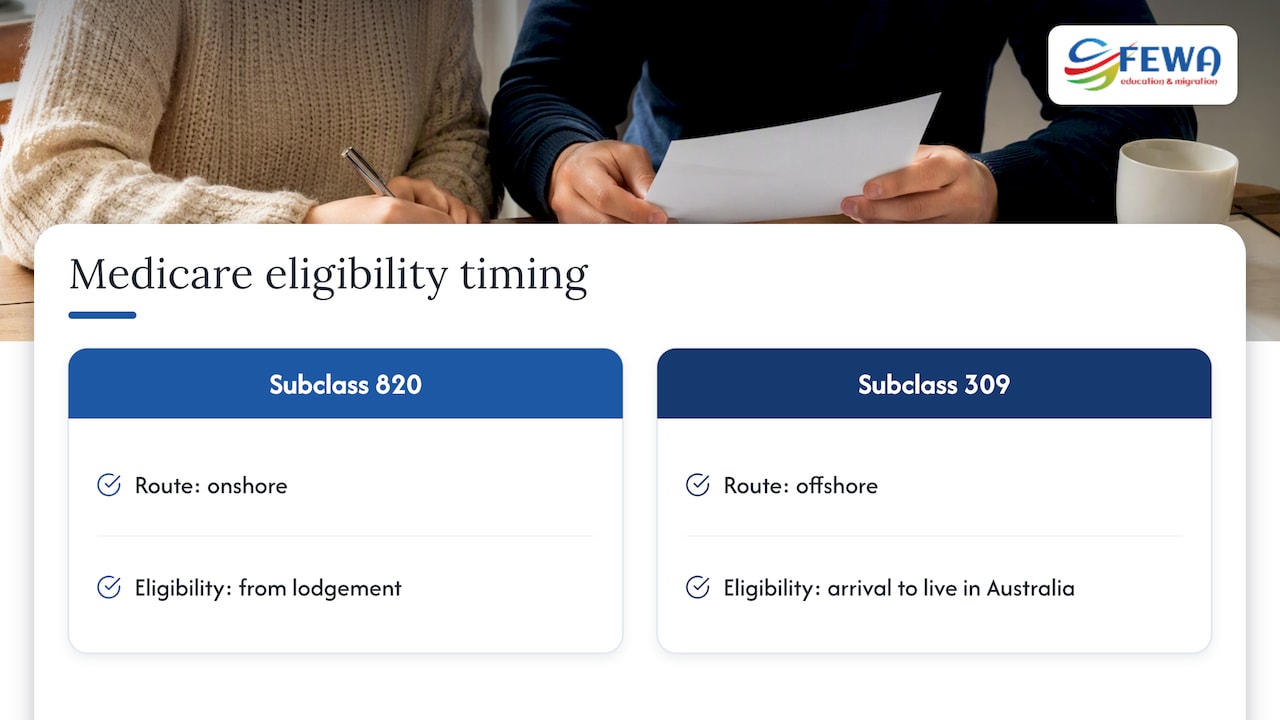
| Onshore, lodged an 820/801 | You can enrol from the date you lodged the application for permanent residency. |
| Offshore, lodged a 309/100, now living in Australia | You can enrol from the date you arrived in Australia to live. |
| Offshore, lodged a 309/100, still overseas | You cannot enrol yet, because you must be in Australia. |
| Temporary visa not covered by the above | Eligibility depends on your visa. Check before assuming. |
The dates in the first two rows come from the Services Australia permanent residency page. If your circumstances are unusual, for example a visa refusal or a review pending, read that page’s notes or speak to a registered migration agent before you act.
What if you are on a bridging visa
Most onshore applicants move onto a bridging visa when they lodge the 820/801. The bridging visa is not what gives you access. Your pending permanent residency application is. Check your visa status and conditions first. Our guide to checking your visa status online with VEVO walks through it. For how bridging visas work in practice, see our article on the bridging visa in Australia and BVB rules.
309 or 820: why it matters here
Both lodgement routes lead to Medicare access, but the timing differs. An onshore applicant is eligible from lodgement. An offshore applicant becomes eligible on arrival to live in Australia. If you are still deciding which route suits you, we explain the differences in 309 vs 820 and Direction 117.
Documents you need to enrol
Services Australia asks for proof of identity and residency. For a partner visa applicant, the core list is short:
- Your current passport or ImmiCard.
- Official proof from the Department of Home Affairs that you have lodged a permanent residency application. This is usually the acknowledgement you receive after lodging. Keep it safe.
- Relationship evidence, in some cases. If your visa does not automatically give you work rights, you may need to show your relationship to an Australian citizen, permanent resident or eligible New Zealand citizen. Examples are a marriage certificate or evidence of a de facto relationship.
The full, current list sits on the documents page for people who have applied for permanent residency. That page also covers what happens if your visa application fails.
Expert note: the relationship evidence Services Australia asks for is not the same bundle as your partner visa evidence. Enrolment needs enough to show the relationship exists. The visa application needs much more. If you are still building that file, our guide to the four pillars of partner visa evidence covers what to check before lodging.
How to enrol, step by step
You can enrol online through myGov or by completing an enrolment form. Here is a practical order of work.
- Confirm you are in Australia and your application is lodged. You must be in Australia to enrol.
- Gather your documents. Passport or ImmiCard, proof of lodgement, and relationship evidence if asked.
- Choose your method. Online through your myGov account is usually the simplest, and it lets you track progress. If you prefer paper, the Medicare enrolment form (MS004) is for first-time enrolment in Australia.
- Submit. Services Australia’s own guidance describes sending the form and supporting documents by email or post to Medicare Enrolment Services, so a service centre visit is not always needed.
- Wait for confirmation. Do not cancel any private cover you hold until you have official confirmation.
There is no fee to join Medicare, as Services Australia states.
Your partner and children: enrolments are individual
A common assumption is that once one person is enrolled, the household is covered. It does not work that way. Each person enrols on their own status or application. You can lodge for yourself and family members at the same time, but each person needs their own supporting documents and must meet the criteria that apply to them. The MS004 form is the reference for how an enrolment is assessed.
If you have a child included in your visa application, check that their documents are ready too. If you are weighing up other family pathways, our family visa page sets out the options.
Do you still need private health insurance?
This is where people get caught. Many temporary visas carry condition 8501, which requires you to maintain adequate health insurance. Home Affairs says you can check your own visa conditions through VEVO, and breaching a condition can have serious consequences for your visa.
The safe approach:
- Check VEVO to see whether 8501 applies to your current visa.
- Keep your cover until Medicare is confirmed in writing or on your account.
- Ask before cancelling. If you are unsure whether your visa lets you rely on Medicare alone, speak to a registered migration agent or Home Affairs before you cancel a policy.
Australia’s overseas visitor and student policies are priced by insurer, age and level of cover, so there is no single figure to quote. Once you are enrolled and eligible, Medicare itself costs nothing to join.
What Medicare does and does not cover
Medicare is a federal service that helps pay for health care and medicines. The Home Affairs health and wellbeing page describes it as giving access to health care services and programs. It does not cover every cost. Typical gaps include:
- Ambulance transport
- Dental care
- Optical services
Budget for these, or consider a supplementary private policy once you are enrolled. That is a personal choice, not a visa requirement in itself.
Where this can go wrong
These are the patterns we see most often, and each one is avoidable.
- Assuming any visa gives access. Eligibility depends on your category, not simply on holding a visa.
- Enrolling before you have proof of lodgement. Without it, Services Australia cannot confirm your application.
- Cancelling private cover too early. A gap can put you in breach of an 8501 condition.
- Forgetting the rest of the family. Each person needs their own enrolment.
- Not updating your details when your visa changes. Medicare eligibility is linked to your status, so changes in your application or visa matter. If your application fails, read the guidance on the Services Australia page rather than assuming nothing changes.
Our view on Medicare and partner visas
When a couple comes to us mid-application, health cover is rarely the first question. It tends to surface after a GP visit, a pregnancy, or a letter about insurance renewal. By then the stress is already high, and a clear checklist helps more than a long explanation.
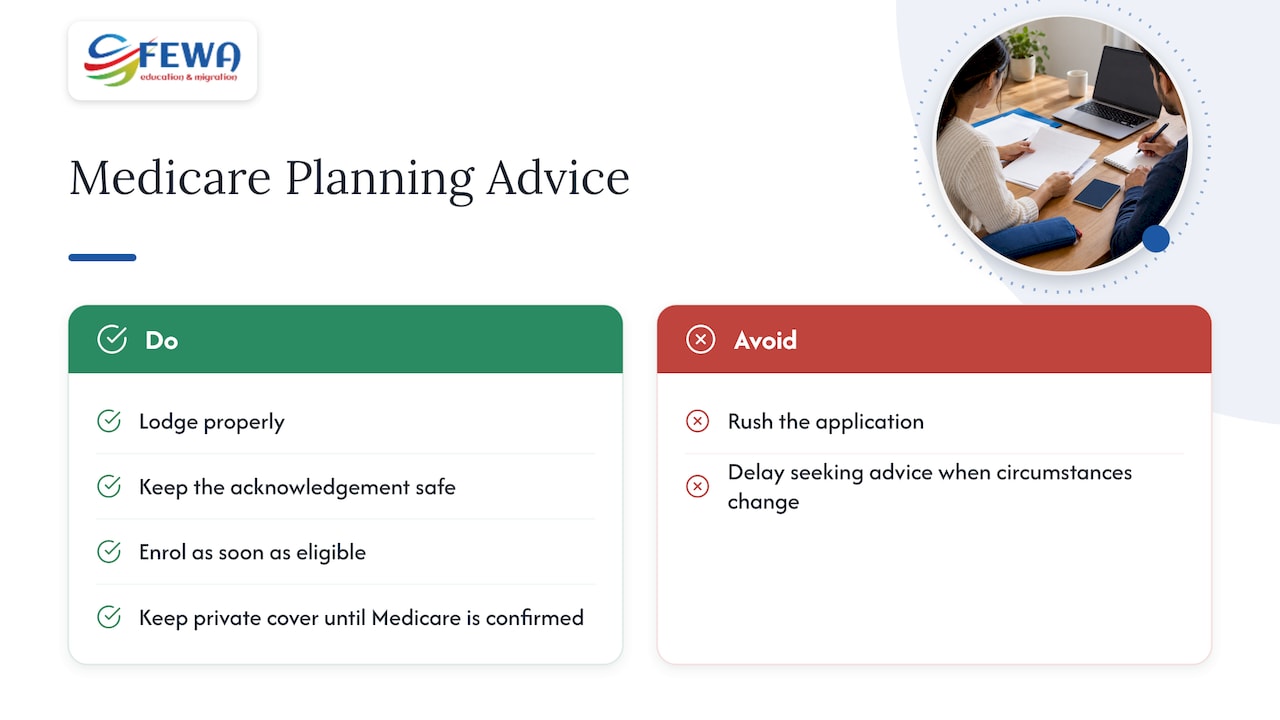
We treat Medicare as part of the same planning as the visa itself. The date you lodge, the route you chose (309 or 820), your bridging visa conditions and the evidence of your relationship all connect. A tidy application with its acknowledgement kept safe makes the Medicare enrolment simple. A rushed one can make both harder.
Our advice is simple. Lodge properly, keep the proof, enrol as soon as you are eligible, and keep your private cover until Medicare is confirmed. If a refusal, a delay or a change of circumstances appears, speak to a registered adviser early. Delay rarely makes it easier.
— Ronit
Getting help with your partner visa
We are a Sydney-based consultancy, and our team is registered with MARA. We help individuals and couples with the partner visa (820/801 and 309/100), from checking eligibility and evidence through to lodgement. If you want to understand your timeline too, our article on partner visa processing times is a useful read. You can also see all our services on the visa services page and ask about a free consultation.
Prices for our services are not published on the site, so ask us about fees when you get in touch.
FAQ
Can I get Medicare as soon as I lodge a partner visa application?
In most cases, yes, if you are in Australia and have applied for permanent residency through a combined partner visa such as the 820/801. You enrol from the date you lodged, or from the date you arrived to live in Australia if you applied from overseas. You will need your passport or ImmiCard and proof of lodgement from Home Affairs. See the Services Australia guidance.
Can I add my de facto partner to my Medicare?
Medicare enrolments are individual, so your de facto partner enrols on their own status or application, with their own documents. Where your relationship needs to be shown, evidence of a de facto relationship may be requested. Check the documents page for the current requirements.
Does Medicare cost anything to join?
No. There is no fee to join Medicare, according to Services Australia. Private health insurance, which you may need to keep until you are enrolled, is priced by the insurer, your age and your level of cover.
Do I need to visit a Services Australia centre to enrol?
Not necessarily. You can start online through myGov, or send a completed form and documents to Medicare Enrolment Services by email or post, as Services Australia describes. Check the current instructions before you send anything.
Should I cancel my private health insurance once I enrol?
Wait until Medicare is confirmed, and check your visa conditions in VEVO first. If condition 8501 applies, Home Affairs expects you to keep adequate cover. If you are unsure, ask a registered migration agent before cancelling.
Sources
- Enrolling in Medicare if you’re an Australian permanent resident, Services Australia
- Enrolling in Medicare, Services Australia
- Documents to enrol in Medicare if you’ve applied for permanent residency, Services Australia
- Enrolling in Medicare if you’re a temporary resident covered by a Ministerial Order, Services Australia
- Medicare enrolment form (MS004), Services Australia
- Adequate health insurance for visa holders, Home Affairs
- Health and Wellbeing, Home Affairs