
Consular officers look for three things: a genuine plan to study full-time, funds that cover your Form I-20 costs, and a clear intention to return home afterwards. Your first step is to line up your documents with a short, honest study rationale you can say in your own words. Concise, consistent answers beat long rehearsed ones.
TL;DR:
- Check every document against your application and school forms, since mismatched course names, dates, or funding details can trigger further questions.
- Bring your passport, valid six months beyond your stay, the signed eligibility form, SEVIS receipt, acceptance letter, compliant photo, and copies.
- Show funding for tuition, books, living expenses, and travel over the academic year or program length, whichever is shorter, and explain each source.
- Wait until the visa is in your passport before booking nonrefundable travel; entry is allowed only within 30 days before the program starts.
- When explaining your school choice, name a specific course feature, faculty area, or facility instead of relying on general prestige or a memorized script.
Table of Contents
- How do consular officers assess F-1 applicants?
- Which F1 visa interview questions come up most, and how should you answer?
- What documents should you bring, and how should you organise them?
- How do you explain your finances at the interview?
- What are the best interview-day tips, and which mistakes should you avoid?
- How do Australian applicants book an interview and contact the consulate?
- Who wrote this guide, and when should you get professional help?
- What should you know about interview logistics, fingerprints, photos and travel timing?
- What I’d tell a friend preparing for the F-1 interview
- How can Fewa help you prepare for a US F-1 visa?
- FAQ
- Sources
How do consular officers assess F-1 applicants?
The consular officer’s primary task is to confirm that you are a genuine student who will study full-time and go home afterwards. The interview is a holistic assessment, so overly rehearsed answers or a weak link between your course and your career plan can hurt you. Think of it as a short conversation where your words and your paperwork must tell the same story.
Officers work to a tight clock. That is why practising short, specific responses for questions like “Why this school?” works better than memorising a script. You want to sound like someone who knows their own plan.
Several themes sit behind almost every question:
- Genuine student intent: you will attend full-time and finish the programme.
- Programme fit: the course makes sense given your past study and your goals.
- Financial sufficiency: you can pay the costs on your I-20 without working illegally.
- Ties to home: you have reasons to return, such as family, a career path or property.
Your documents must line up with your I-20 and your DS-160 entries. A different course name, a mismatched start date or a funding story that does not match the bank statements will prompt extra questions. Check every document against those two forms before your appointment.
Pro Tip: Read your DS-160 confirmation page the night before and say your answers aloud, so what you tell the officer matches what you submitted.
Which F1 visa interview questions come up most, and how should you answer?
Questions fall into several categories. The model answers below are short on purpose, about 30 seconds each. Swap in your own details, and never recite them word for word.
Study plans and motivation
Officers want a specific link between the programme and your career plan. Common questions:
- Why do you want to study in the United States?
- What will you study, and why that field?
- How does this course connect to your career?
A model answer: “I’m doing a Master of Data Science because I work in retail analytics and want stronger machine learning skills. The programme’s capstone with industry partners matches what I’ll need when I return to lead our analytics team.”
University choice
The question officers commonly ask is why you chose this particular institution. Name something concrete about the course, a faculty area or a facility, not general prestige.
A model answer: “I applied to three schools and chose this one because of its applied statistics stream and the research lab in healthcare analytics, which is exactly my field.”
Academic capability
Briefly show you can handle the work. Mention your degree, your marks or relevant experience, and any test scores.
A model answer: “I completed a Bachelor of Commerce with a credit average and a statistics major, and I scored above the school’s English requirement.”
Finances
Be the one to explain, even when someone else pays. Say who funds you, how, and that the documents match your I-20.
A model answer: “My parents are paying for my first year, about what my I-20 lists. They’ve provided bank statements and an affidavit, and I have a scholarship letter covering part of the tuition.”
Post-study plans and ties to home
Describe concrete plans, not vague statements. This is where officers test your intent to depart.
A model answer: “After graduating I plan to return to Sydney. My current employer has said I can resume my role, and my family runs a business I’ll help with.”
Here are a few more questions to rehearse, in the order they often arise:
- Why this country rather than studying at home?
- Who is paying for your studies, and what do they do?
- What did you study before, and why this change or step up?
- Do you have relatives in the United States?
- What do you plan to do after you finish?
Don’t treat these as a checklist to memorise. Treat them as prompts to prepare honest talking points, and keep each answer to a few sentences so the officer can ask follow-ups.
What documents should you bring, and how should you organise them?
The core documents are a passport valid for six months beyond your intended stay, your DS-160 confirmation page, the original Form I-20 signed by you and your designated school official, the I-901 SEVIS fee receipt, a photograph that meets U.S. standards, and your acceptance letter. Add transcripts, test scores and financial documents that match the I-20.
Mandatory items:
- Valid passport
- DS-160 confirmation page
- Signed original Form I-20
- I-901 SEVIS fee receipt
- Acceptance letter and a compliant photograph
If you are unsure how to pay the SEVIS fee from here, our guide on paying the SEVIS fee from Australia walks through it, so you hold a receipt before your appointment.
Supporting evidence:
- Academic transcripts and test scores
- Bank statements, sponsor letters and scholarship award letters
- Proof of ties to home, such as an employment letter or property documents
Organisation projects readiness. Use a clear folder with two tabbed sections, one for mandatory items and one for supporting evidence. Applicants who bring everything in an organised folder can produce any requested item quickly. Bring originals plus one set of copies, and check that both you and your school official have signed the I-20, because an unsigned form can cause delays or a rejection.
Pro Tip: Put the I-20 and DS-160 confirmation on top, since the officer may ask for them.
How do you explain your finances at the interview?
Your evidence needs to cover the costs on your I-20 for the academic year or the programme length, whichever is shorter. The financial ability guidance says you must show resources for tuition, books, living expenses and travel, and that your school official may have school-specific rules about acceptable evidence.
Acceptable documents include:
- Recent family bank statements
- Sponsor affidavits and proof of the sponsor’s ability to pay
- Employer salary letters
- Scholarship, financial aid or loan documentation
Every figure should match the I-20. A very large balance with no explanation of where it came from invites questions, because officers care about the source of funds as much as the amount.
If someone sponsors you, be ready to explain the relationship, what the sponsor does, and how the money is held. Even when parents or sponsors fund your studies, the officer expects you to speak for yourself and to know your school and programme details.
A simple structure works well:
- Who pays: name the person and the relationship.
- How: savings, salary, scholarship or loan.
- Proof: point to the document that backs it up.
The same habits help when you deal with Australian visa assessments, and our guide to the student visa financial capacity test shows how to document funds clearly. Clear, traceable evidence is what both systems reward.
Pro Tip: Prepare a one-page summary listing each funding source and the matching document, so you can answer in one sentence and hand over the page if asked.
What are the best interview-day tips, and which mistakes should you avoid?
Be concise and speak for yourself. Practise 30-second answers to the big questions, but keep them natural. Overly rehearsed answers can count against you, so listen to the question and answer only that.
Follow this order on the day:
- Arrive early with your confirmation pages and your organised folder.
- Expect fingerprint scans and a photo check before you see the officer.
- Greet the officer, answer directly and keep your hands free of papers until asked.
- Hand over documents only when requested.
- Hold off on non-refundable travel until your passport is back with the visa in it.
That last point matters. A visa can be issued up to 365 days before the course start, but you may enter the U.S. only within 30 days before the programme start date, so book flexible flights.
Common mistakes:
- An unsigned I-20
- Statements that contradict your DS-160 or your documents
- A missing SEVIS fee receipt
- Presenting only a large, unsupported bank balance
If things go badly, don’t panic. Our guide to what to do after a student visa refusal explains how to think about a next step calmly, and the principle of fixing the specific gap in your evidence applies here too.
Pro Tip: If you don’t understand a question, ask the officer to repeat it. A clear answer to the right question is better than a quick answer to the wrong one.
How do Australian applicants book an interview and contact the consulate?
If you live here, start with the DS-160 and then schedule through the official portal at ustraveldocs.com/au. Bring your DS-160 confirmation page to the interview.
Local contact points, per the US Embassy’s visa guidance for Australia:
- US Embassy in Canberra
- US Consulate in Sydney
- US Consulate in Melbourne
- US Consulate in Perth
The Department of Foreign Affairs also lists consulate details by state, including the consulate-generals in North Sydney, Melbourne and Perth with phone numbers and appointment hours. Check these pages for current details before you call.
If your regular appointment falls after your programme start date, look at the consulate’s guidance on emergency appointments and prepare evidence of urgency, such as your I-20 start date and a letter from your school. Don’t leave this to the last week.
Who wrote this guide, and when should you get professional help?
I’m writing for Fewa Education & Migration, a Sydney consultancy registered with MARA that supports students with visas, education placement and migration pathways.
- This guide draws on official U.S. Department of State and Department of Homeland Security student guidance, which you should check for updates.
- Your local US consulate is the final authority on your appointment.
- Professional help makes sense if you have a complicated funding situation, a prior refusal, or you simply want a document review and interview practice session.
What should you know about interview logistics, fingerprints, photos and travel timing?
Scheduling comes first. Complete your DS-160, pay any required visa fee and book your slot, then print the confirmation pages. Fingerprint scans are part of the process, and the consular officer decides whether to issue the visa.
For photographs, bring one that meets U.S. visa photo standards in addition to the image you uploaded. A non-compliant photo is an easy problem to avoid and an annoying one to fix at the counter.
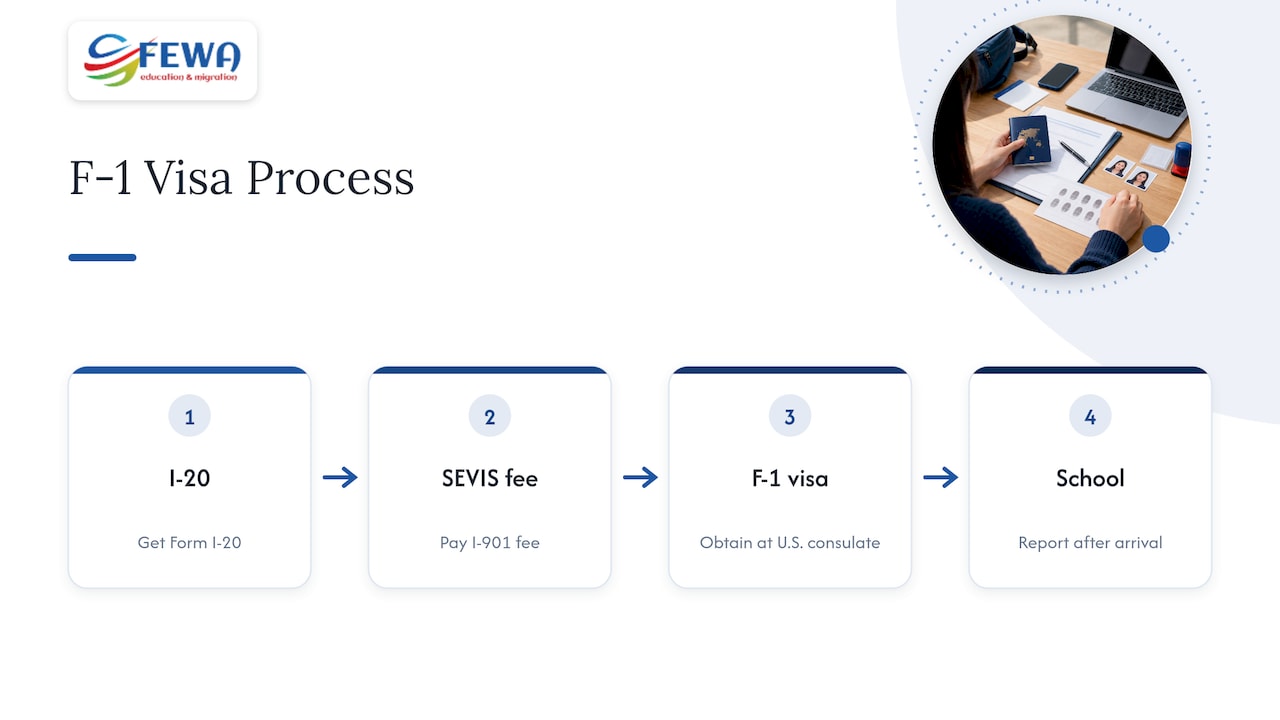
The basic process runs in a clear sequence: get your I-20, pay the I-901 SEVIS fee, obtain your F-1 visa at a U.S. consulate, and report to your school on arrival. Your Form I-20 lists the programme start date, which governs when you may travel. Bring the original to the interview, and book non-refundable flights only after the visa is in your passport.
What I’d tell a friend preparing for the F-1 interview
Most advice online obsesses over the perfect script. I think that’s the wrong priority. The officer is sorting genuine students from risky ones, and a polished speech doesn’t signal sincerity, it can signal coaching. What reads as genuine is a clear plan, matching paperwork and the ability to explain your own funding without looking at your parents.
Spend time on documents before focusing on delivery. Make sure the I-20, the DS-160 and the financial evidence all tell the same story. Then practise saying your answers out loud until they sound like you, not like a pamphlet.
Overrated: obsessing over the exact wording of one tricky question. Underrated: knowing your course content, your school’s location and why you didn’t choose a cheaper option closer to home. Those details prove you’ve thought it through. If you prepare that way, the individual questions stop feeling like traps.
— Ronit
How can Fewa help you prepare for a US F-1 visa?
We help Australian applicants prepare for their interview. Our student visa team can discuss your visa application and help you understand the process. If you also need English testing, we run IELTS and PTE coaching.
As a MARA-registered consultancy, we take a personal approach. In a first consultation we look at your plan, your funding and your timeline, then tell you plainly what to fix and what is already solid. Bring your I-20 and DS-160 confirmation so the review is focused from the first minute.
Ready to start? Book a free consultation with us to discuss your situation.
FAQ
What are the most common questions asked during an F1 visa interview?
Officers usually ask why you chose your school and course, how you will pay, and what you plan to do after you graduate. Common focuses are programme choice, funding that covers your I-20 costs and your post-graduation plans.
How do you pass an F1 visa interview?
Show that you are a genuine full-time student with funds to cover your costs and a reason to return home. Keep answers short and honest, and make sure your documents match your I-20 and DS-160.
Is an F1 visa interview difficult?
It is usually short, and it feels hard mainly when answers and documents don’t match. Preparation fixes most of that: know your course, your funding and your plans, and speak for yourself.
What if my appointment is after my programme starts?
Check the consulate’s guidance on emergency appointments and gather evidence of urgency, such as your I-20 start date and a school letter. You can enter the U.S. only within 30 days before your start date, so raise it early.