

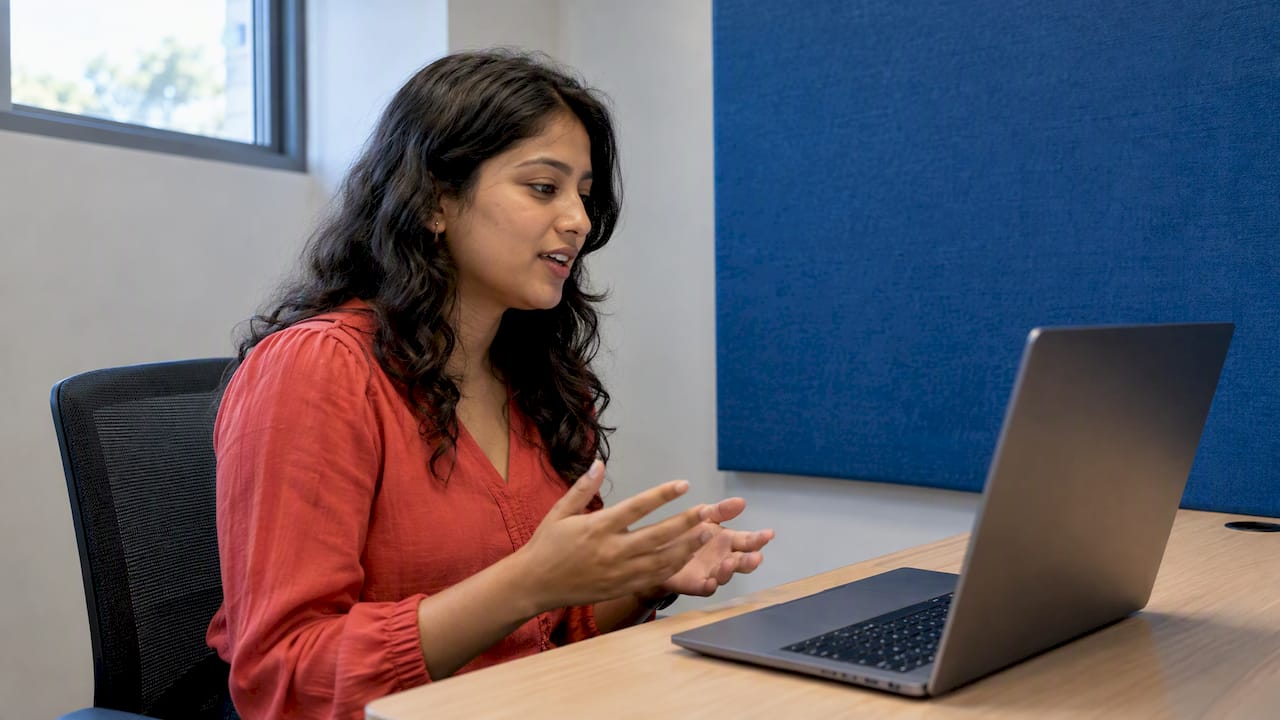
Not every applicant for an Australian Student visa (subclass 500) is interviewed, but some are, and the interview is where your Genuine Student (GS) answers are tested in your own words. If you are invited, it is usually a short conversation about your course, your reasons for studying in Australia, your finances and your plans afterwards. The good news: if your application is honest and your evidence is in order, you are already most of the way there.
This guide explains when an interview can happen, who conducts it, the questions you should expect, how to prepare, and what to do afterwards. We are a Sydney-based consultancy, and we have written it the way we would explain it to a student sitting across the desk from us.
TL;DR
- An interview is not required for everyone. Some applicants are asked for more information or invited to an interview as part of the Genuine Student assessment.
- The questions follow the GS requirement: why this course, why Australia, why this provider, how you will pay, your ties to home and what you will do after you finish.
- Answer in your own words, with evidence ready. Do not read from a script.
- Keep your Statement of Purpose, financial documents and Confirmation of Enrolment consistent, because interviewers compare what you say with what you lodged.
- Always confirm the current rules on the official Home Affairs website before you act.
Table of Contents
- Is there a student visa interview in Australia?
- What the Genuine Student requirement actually asks
- Who may interview you: your provider or the department
- Questions you should expect
- How to prepare, step by step
- Interview day: conduct and documents
- Get the paperwork right before any interview
- Our perspective: what we tell students before an interview
- Get help with your preparation
- What happens after the interview
- Common mistakes that hurt interviews
- FAQ
- Sources
Is there a student visa interview in Australia?
There is no blanket interview for every Student visa applicant. What exists is a Genuine Student assessment that applies to everyone, and an interview can be one tool within it. Murdoch University explains that its GS assessment may ask for additional information or documents and, in some cases, invite an applicant to an interview, while not all applicants are required to provide more information or attend one.
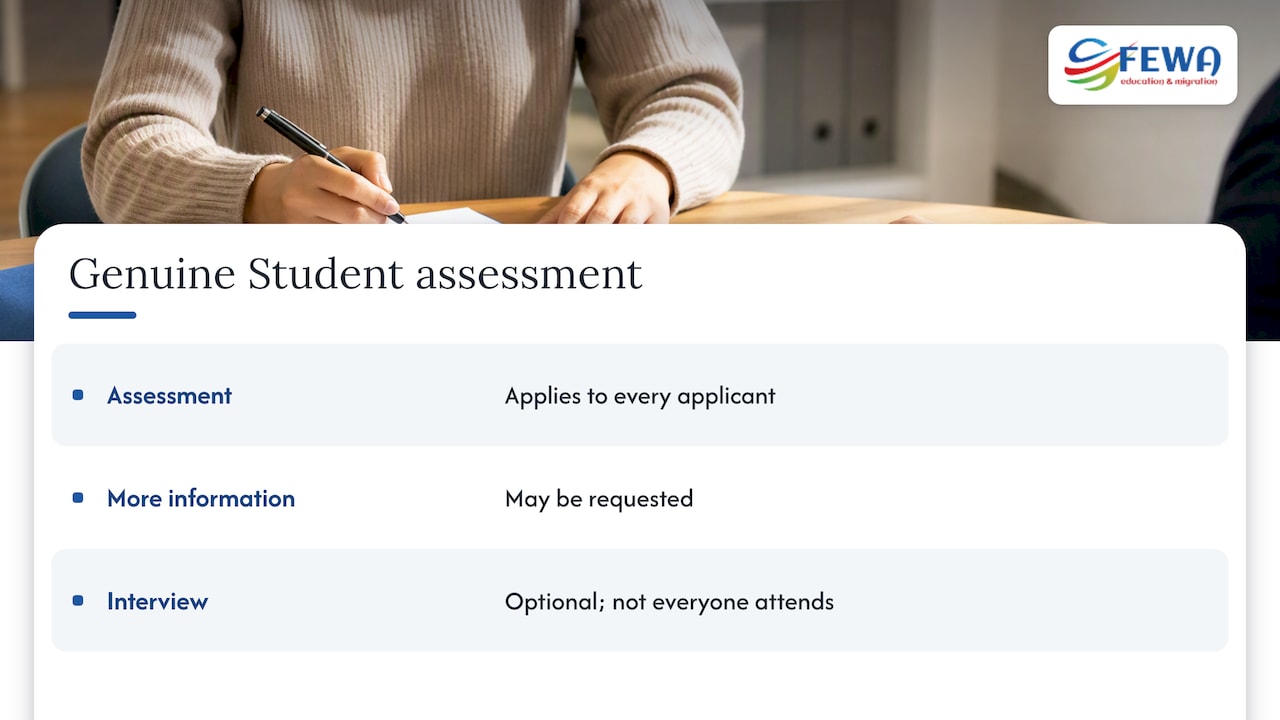
That matches what many students experience. Some are never contacted. Others receive an email from their education provider asking them to book an online interview. A smaller number are contacted about their visa application itself. In every case, the purpose is the same: to help the decision maker be satisfied that you are a genuine student.
Note on older advice. Plenty of web pages, including some that rank for this topic, were written years ago and describe an older process. The rules changed for applications lodged on or after 23 March 2024, so treat anything undated with caution.
What the Genuine Student requirement actually asks
The interview only makes sense once you understand what it is testing. The Department of Home Affairs says the Genuine Student requirement applies to Student visa applications lodged on or after 23 March 2024. Earlier applications were assessed under the former Genuine Temporary Entrant requirement.
Under the same page, you must be a genuine applicant for entry and stay as a student, and you must show that study in Australia is the primary reason you are applying. Decision makers are guided by Ministerial Direction No. 106, which commenced on 23 March 2024 and sets out the factors they weigh when assessing the genuine student and genuine student dependent criteria for subclass 500 applications.
In practice, that means you should be ready to talk about:
- your current circumstances and ties to your home country
- why you chose this course, this provider and Australia
- your understanding of the course and of studying and living in Australia
- how completing the course will benefit you
That list comes straight from the Home Affairs guidance, which also says your responses should be supported by evidence. If you want a deeper walk-through of how to assemble that evidence, see our guide to preparing subclass 500 Genuine Student answers with a document checklist.
Who may interview you: your provider or the department
Students often search for “GS interview” and are unsure who is asking. Education providers run their own GS assessments before issuing a Confirmation of Enrolment, and some use an interview as part of that. Curtin University describes its GS interview as one part of a broader assessment, considered together with other documents such as a financial-capacity declaration.
So you might face either of two situations:
| Situation | Who asks | What it is for |
|---|---|---|
| Provider GS interview | Your university or college | To assess your genuineness before enrolment is confirmed |
| Request from the visa decision maker | The Department of Home Affairs | To clarify points in your visa application |
The subject matter overlaps heavily, so one good preparation covers both. If the invitation arrives by email, read it closely for the date, the platform and the documents you must have with you. Reply promptly and keep a copy.
Questions you should expect
No two interviews are identical, but the themes are consistent. Curtin’s published guidance says its interview covers the chosen course and future goals, the reasons for choosing Western Australia and Curtin, financial arrangements, post-study plans, and family, social, cultural and economic ties to the home country. Those are a reliable map of what other providers ask too.
About your course and goals
- Tell us about yourself and your educational background.
- Why did you choose this course?
- How does it connect to your previous study or work?
- What do you want to do when you finish?
The interviewer is looking for academic progression: a course that makes sense after what you have already done. If you are changing direction, explain why in a sentence or two and show the link, such as relevant work experience, a short course or a clear career reason.
About Australia and your provider
- Why Australia rather than another country?
- Why this university or college, and why this city?
- What do you know about the course structure, subjects and assessments?
Generic answers such as “Australia has good education” sound rehearsed and tell the interviewer nothing. Name something specific: a unit you will study, a staff member’s research area, an industry placement, a campus facility. Show that you read the course page rather than a brochure summary.
About money
- Who is paying for your tuition and living costs?
- What is your sponsor’s occupation and income?
- How will you cover costs if something changes?
Know your own numbers. If a parent or relative is funding you, you should be able to explain the source of funds without checking a document. Our page on meeting the student visa financial capacity test covers how to organise this evidence.
About your ties and plans afterwards
- Who is in your family and where do they live?
- What work, property or community connections do you have at home?
- What will you do after graduating?
This is the section that worries students most, and it deserves an honest approach. You do not have to say you will definitely return home forever. You do need to give a credible, specific plan that shows study is your main purpose, and describe your real circumstances without exaggeration.
How to prepare, step by step
- Re-read your own application. Open your Statement of Purpose, your Confirmation of Enrolment and your financial documents. The interviewer may have all of them in front of them, so your answers must match.
- Research your course in detail. Know the duration, the major units, the campus and the study mode.
- Write bullet points, not scripts. Note your key facts for each theme, then practise saying them aloud in your own words. Curtin’s guidance specifically says not to read from scripts.
- Prepare evidence. Gather documents showing your ties and finances so you can refer to them if asked. Your SOP should already reflect the same factors, as we explain in matching Australia’s five genuine student factors in your SOP.
- Do a mock interview. Ask a friend, teacher or adviser to question you for 15 minutes, then listen to your own recording.
- Test your setup. For an online interview, check your camera, microphone, lighting and internet connection the day before.
Interview day: conduct and documents
For Curtin’s online interview, the university says you must keep your camera on, be alone, display your passport and confirm your application details. It also asks for a reliable internet connection and says not to read from scripts. It states the interview takes approximately 10 to 15 minutes. Other providers may set different rules, so follow the instructions in your own invitation.
A few practical habits help whichever provider is asking:
- Sit in a quiet, well-lit room with nothing distracting behind you.
- Have your passport next to you.
- Listen to the whole question before you answer.
- If you do not understand, ask politely for it to be repeated.
- Keep answers short, usually 30 to 60 seconds, then stop. Interviewers will ask follow-ups.
- If you do not know something, say so honestly rather than guessing.
You might be tempted to memorise polished answers from a list online. Resist that. A fluent but identical answer to what the interviewer has heard from other applicants is more likely to raise doubts than a simple, slightly imperfect, truthful one. Students also search for American F-1 interview tips; the style is different, and our note on F1 visa interview answers is a useful contrast if you are weighing destinations.
Get the paperwork right before any interview
Many refusals and delays have nothing to do with the conversation. Home Affairs’ Check twice, submit once guidance says applicants should:
- use the Document Checklist tool
- upload a current Confirmation of Enrolment to ImmiAccount
- provide the required English language evidence
- translate documents that are not in English
- respond promptly to requests for further information
The same page also asks you to check that your identity details match your passport, provide all previous names, enter the correct date of birth, agree to electronic communications in ImmiAccount and monitor correspondence there. An interview invitation or request for information may arrive in that account, so check it regularly. If you are still deciding on an English test, our comparison of PTE and IELTS may help.
Our perspective: what we tell students before an interview
We see the same pattern again and again. Students who struggle in interviews are rarely dishonest. They are usually over-prepared in the wrong way: they have memorised paragraphs, and when the question changes slightly, they freeze.
As a Sydney consultancy registered with MARA, we start with the student’s real story. Why this course? What have you studied? Who is supporting you? What do you want your life to look like in five years? When the story is true, it is consistent across the application, the SOP and the interview, and consistency is what a decision maker is checking.
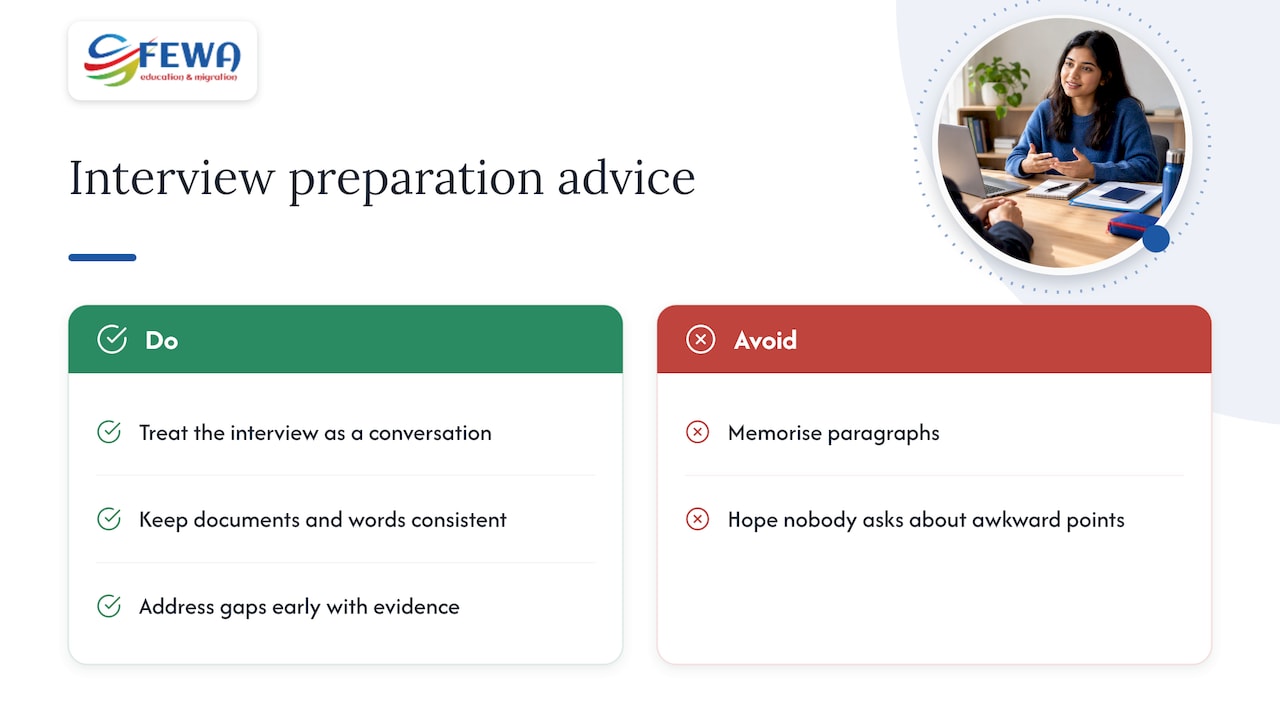
Our advice has three parts. First, treat the interview as a conversation about decisions you have already made carefully, not an exam. Second, make sure your documents and your words tell the same story. Third, if a point in your history looks awkward, such as a study gap or a course change, address it directly and early, with evidence, rather than hoping nobody asks.
We cannot promise an outcome, and nobody honestly can. What we can do is help you present a true case clearly. Many of our students are from the Nepalese community in Sydney, and we understand the specific questions about family ties, sponsors and finances that often arise.
— Ronit
Get help with your preparation
If an interview invitation has landed in your inbox and you are unsure how to respond, we can help you review your application, run a practice interview and check your evidence before the day. Our team supports students from the first course choice through to visa lodgement. Learn more on our student visa page, or see all our visa services. Free online consultations are available for individuals and families.
If your English test score is the part holding you back, we also offer IELTS and PTE coaching.
What happens after the interview
After an interview, the provider or decision maker weighs it with the rest of your file. Home Affairs says applications with all required information and documents can receive a faster outcome, while common mistakes can delay an application or lead to refusal. That is why it pays to keep every document complete and every answer consistent.
While you wait:
- Check ImmiAccount regularly, and respond to any request quickly.
- Do not change details of your course or funding without advice.
- Keep copies of everything you submitted.
If the outcome is not what you hoped, it is a setback, not the end of the road. Read our guide on what to do after a student visa refusal, and if a review is possible, our page on lodging an appeal within the time limit explains the next step. Always check the current official requirements on the Home Affairs Student visa page, because rules and processes change.
Common mistakes that hurt interviews
- Rehearsed, identical answers. They sound memorised and do not survive follow-up questions.
- Inconsistent facts. A different course start date, sponsor or intended career from the one in your SOP is a red flag.
- Vague finances. Not knowing who is paying or how much is a common weak point.
- No knowledge of the course. If you cannot name a single unit, it looks as if you chose the course only to get a visa.
- Technical problems. A poor connection, a second person in the room or a camera turned off can end an online interview or count against you.
- Overstating. Claiming ties or achievements you cannot document damages trust.
FAQ
Is there an interview for the Australian student visa?
Not for every applicant. Some are asked for more information or invited to an interview as part of the Genuine Student assessment, either by their education provider or during visa processing. If you receive no invitation, that is not a sign of a problem.
What is a GS interview?
It is a short conversation, often online, in which a provider checks that you are a genuine student. Curtin, for example, says its online interview takes roughly 10 to 15 minutes and is one part of a wider assessment alongside your documents.
What questions are asked in an Australian student visa interview?
Expect questions on your course and goals, why you chose Australia and your provider, how you will fund your studies, your plans after graduation, and your family and economic ties to your home country. Prepare honest, specific answers and have your supporting evidence ready.
Can I use a script or notes?
It is better not to. Curtin tells applicants not to read from scripts. Prepare key points instead and speak naturally, so you can handle follow-up questions.
Does the interview apply to all countries and all applications?
The Genuine Student requirement applies to Student visa applications lodged on or after 23 March 2024. How a provider conducts its own interview can differ, so follow the instructions in your invitation and check the official site.
Sources
- Genuine Student requirement, Department of Home Affairs
- Ministerial Direction No. 106
- Genuine Student (GS) requirements, Murdoch University
- Genuine Student Interviews, Curtin University
- Applying for a student visa, Department of Home Affairs
- Student visa (subclass 500), Department of Home Affairs