


If your Australian student visa was refused, your first move is simple: read the refusal letter carefully and find the deadline for review. That single document tells you which legislative clause was cited, whether you have review rights, and how many days you have to act. Everything else, including whether you appeal or reapply, flows from what that letter says.
You need to move fast, but not blindly. Here’s what to lock down in the next 24 to 72 hours:
- Record the exact refusal date and note the clause or reason cited (often Genuine Student concerns, insufficient evidence, or PIC 4020).
- Preserve every original document you submitted, plus your lodgement receipts.
- Confirm your current visa status. Are you still lawfully in Australia, or has your bridging visa or student visa already expired?
- Check whether the letter mentions Administrative Review Tribunal rights, and find the exact deadline. It will not be extended for most cases.
Pro Tip: Call your university’s international student office before you do anything else. They’ve seen refusals before, can request your interview transcript, and will tell you fast whether a MARA-registered agent should get involved.
Key Takeaways
A refused Australian student visa is recoverable when you read the refusal letter closely, meet the review deadline, and rebuild your evidence around the specific reason cited.
| Point | Details |
|---|---|
| Read the letter first | Identify the exact clause cited, the decision date, and the review deadline before doing anything else. |
| Know your two paths | Choose ART review when evidence was overlooked onshore; choose reapplication when evidence needs rebuilding. |
| Fix the specific gap | Address financial provenance, GS credibility, or documentation errors, not everything at once. |
| Watch Section 48 | Onshore applicants without a substantive visa may be barred from lodging new applications, so act on deadlines fast. |
| Get MARA support when it counts | Fewa’s MARA-registered agents handle PIC 4020 cases, ART bundles, and reapplication strategy for refused student visa applicants. |
Table of Contents
- Why Australian Student Visas Get Refused
- How to Read Your Refusal Letter Properly
- Appeal or Review Options: ART, Judicial Review, and Ministerial Intervention
- Reapplying: The Evidence and Fixes That Actually Matter
- Onshore Refusals: Section 48 and Bridging Visa Status
- When a MARA-Registered Migration Agent Makes a Real Difference
- What Timelines, Costs, and Outcomes to Expect
- Why Refusals Are Rising and How to Respond
- Get Help Rebuilding Your Application With Fewa
- Frequently Asked Questions
- Sources
Why Australian Student Visas Get Refused
Most refusals trace back to a handful of recurring issues, and knowing which one applies to you changes your entire strategy. The Department of Home Affairs assesses applications against the Genuine Student requirement, financial capacity, and documentary consistency, and a weakness in any one of these can sink an otherwise solid application.
Genuine Student (GS) concerns sit at the top of the list. This replaced the old Genuine Temporary Entrant test, and it asks whether your study plans, career goals, and personal circumstances add up to a credible reason for choosing this course in Australia. Case officers frequently cite Clause 500.212 when they are not convinced, particularly when a Statement of Purpose reads like a template rather than a personal account.
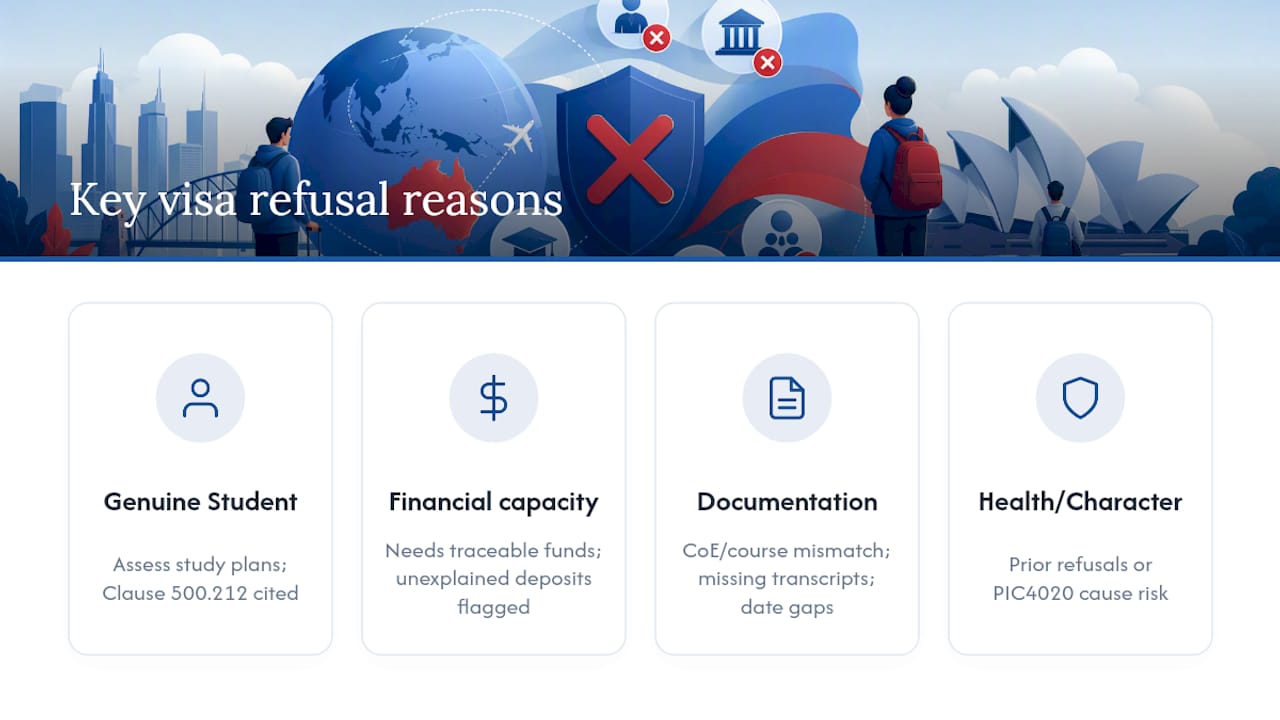
Financial capacity is the second major trap. Officers look for a clear, traceable history of funds, not just a bank balance on the day of lodgement. Sudden large deposits with no explanation, sponsor income that cannot be verified against tax records, or a savings account that appeared six weeks before lodgement all raise questions.
Incomplete or inconsistent documentation causes refusals that are entirely avoidable. A Confirmation of Enrolment (CoE) that lists a different course than the one described in your SOP, missing academic transcripts, or dates that don’t line up across documents all signal carelessness at best and fabrication at worst.
Health, character, and prior visa history round out the list. A previous visa refusal, cancellation, or an unresolved health or character requirement can trigger a fresh refusal even when your new application looks strong on paper. The Department’s guidance on providing accurate information makes clear that false or misleading information, known as PIC 4020, can create consequences that outlast the current application.

Australia’s refusal environment has also shifted noticeably. In February 2026, the offshore refusal rate for higher education student visas reached 32.5 percent, with even higher refusal shares for applicants from certain source countries under the Simplified Student Visa Framework’s risk-based evidence tiers. Applicants assessed at higher evidence levels face tougher documentary scrutiny across the board, which means the margin for sloppy paperwork has shrunk.
Pro Tip: Case officers are trained to spot red flags: unexplained deposits, sponsor income that doesn’t match a tax return, and SOPs that read like they were copied from a template or generated by AI. If your original application had any of these, assume it was noticed.
How to Read Your Refusal Letter Properly
The refusal letter is the most important document you’ll receive in this entire process, and treating it as a formality rather than a legal instrument is the most common mistake applicants make. It dictates your deadlines, your rights, and which pathway makes sense next.
Pull out these details the moment you open it:
- The decision date, which starts your review clock.
- The specific clause or clauses cited as the basis for refusal.
- Whether you have a right to apply for merits review, and the exact date that right expires.
- Any factual findings the case officer relied on, particularly around credibility or financial evidence.
Once you’ve captured that information, gather everything else you’ll need if you go down the review path: the refusal letter itself, your original lodgement receipts, and copies of every document you submitted the first time. Universities like the University of Huddersfield advise students to request a copy of their refusal notice and any interview transcript immediately, since this evidence often becomes central to a review application.
Pro Tip: If you attended a credibility interview before the refusal, request a transcript or file summary. That record can reveal exactly which answer triggered the officer’s doubt, and it’s often the single most useful piece of evidence for an ART submission.
Appeal or Review Options: ART, Judicial Review, and Ministerial Intervention
Not every refusal can be appealed, and the option that applies to you depends heavily on where you were when the decision was made and what the refusal letter says about review rights.
Merits review at the Administrative Review Tribunal (ART) is the main pathway for most onshore student visa refusals. The ART evaluates the merits of the original decision and can consider new evidence you didn’t include the first time. As of June 1, 2026, most reviews lodged from that date are decided on written material rather than an oral hearing, unless a hearing was already listed. That procedural shift means your written submission now carries more weight than ever, since you may never get to explain yourself in person.
Judicial review through the Federal Court is narrower and rarer. It only examines whether the Department made a legal error, not whether the decision was fair or correct on the facts. This route matters mainly when there’s a clear procedural failure, not simply a disagreement with the outcome.
Ministerial intervention sits outside normal review processes entirely and is used only in exceptional, compelling circumstances after other options are exhausted.
Use this quick decision guide:
- If you’re onshore, have review rights, and believe the officer overlooked or misread evidence you already submitted, lodge an ART review.
- If you’re offshore, or if the missing piece is new evidence you didn’t have at lodgement, reapplying is usually the faster and more effective route.
- If there’s no review right listed and no legal error to point to, focus your energy on building a stronger reapplication instead.
Pro Tip: The ART generally cannot extend a missed deadline. If your refusal letter states 21 days or any other window, treat that number as immovable and start your submission the same week.
Reapplying: The Evidence and Fixes That Actually Matter
A reapplication only works if it’s materially different from the one that got refused. Submitting the same documents with a new cover letter almost guarantees the same result.
Start with the fixes that carry the most weight:
- Financial provenance: Replace one-off deposits with a consistent bank history, matching salary slips, and tax records that a case officer can trace back at least six months.
- A new CoE if needed: Universities cannot reuse an old Confirmation of Enrolment. If your course, provider, or start date has changed, you’ll need a fresh CoE before you lodge again.
- Aligned academic progression: Make sure your new course logically follows your previous study, rather than looking like a random change of direction.
- Medical and police certificates: Update anything that’s expired or was flagged as incomplete.
- A genuinely personal GS response: Name the specific units or specializations in your course, explain why that pathway exists in Australia and not elsewhere, and connect it to a concrete career plan back home or through a recognized industry pathway.
A stronger evidence package doesn’t mean a thicker one. It means each document answers the specific doubt the officer raised in your refusal letter. If financial capacity was the issue, a stack of new photos or references won’t help. If GS was the issue, restating your bank balance won’t either.
Pro Tip: Keep your evidence chronology clean. Case officers notice large deposits that appear right before lodgement, and if you were refused once already, always declare it candidly in your new application. Hiding a previous refusal risks a PIC 4020 finding, which is far harder to overcome than the original issue.
Onshore Refusals: Section 48 and Bridging Visa Status
If you’re still in Australia when your visa is refused, Section 48 of the Migration Act can bar you from lodging most new visa applications onshore unless you hold what’s called a substantive visa. This is one of the most misunderstood consequences of a refusal, and it catches people off guard because it limits your options right when you need them most.
In practice, this means your bridging visa timeline and conditions become critical, and lodging an ART review promptly is often the only way to preserve your lawful status while you sort out next steps.
Move through this checklist immediately:
- Confirm whether Section 48 applies to your situation before assuming you can simply reapply while onshore.
- Check your bridging visa conditions, including any work or study restrictions.
- Get advice from a MARA-registered agent on whether ART review or an offshore reapplication makes more sense for you.
Pro Tip: Don’t let your bridging visa lapse while you’re deciding. Even a short gap without lawful status can seriously complicate every option available to you afterward.
When a MARA-Registered Migration Agent Makes a Real Difference
Some situations genuinely call for professional representation, and pretending otherwise wastes time you don’t have. If your refusal involves a PIC 4020 allegation, a complex credibility finding from an interview, a Section 48 onshore bar, or an ART review that hinges on legal argument rather than simple paperwork, a MARA-registered agent changes your odds meaningfully.
A registered agent prepares your review bundle, gathers new evidence in the format ART expects, drafts the written submission, and advises honestly on whether reapplying beats appealing in your specific case. Fewa is a MARA-registered migration consultancy with direct experience handling refusal cases for international students.
Pro Tip: Before hiring anyone, check their MARA registration number directly on the MARA register, and have your refusal letter, CoE, and financial documents ready for your first consultation.
What Timelines, Costs, and Outcomes to Expect
ART review deadlines are typically short, often measured in days rather than weeks, and decisions can take several months once lodged. Reapplications generally move at standard visa processing speed, but only after you’ve rebuilt the weak parts of your case, which itself can take weeks of document gathering.
Budget for several cost categories: the visa application charge, any ART filing fee, and agent fees if you engage representation.
- With the offshore refusal rate hitting 32.5 percent in February 2026, some source countries face materially higher scrutiny than others.
- Prioritize a review when your original evidence was strong but overlooked; prioritize reapplying when your evidence genuinely needs rebuilding.
Why Refusals Are Rising and How to Respond
Integrity checks have tightened sharply, and Evidence Level assessments now scrutinize the whole applicant journey, not just the offer letter. The answer is evidence-led applications, not template answers. Fix your documentation first, then decide your pathway.
Get Help Rebuilding Your Application With Fewa
A refusal doesn’t mean your options are gone. It means your next application has to be sharper, and that’s exactly where a MARA-registered team earns its keep, handling your ART review bundle, your evidence gaps, and your reapplication strategy in one coordinated effort instead of leaving you to piece it together alone.
Fewa Education & Migration works with students across Sydney and Greater Western Sydney who’ve been refused and need a clear-eyed assessment of whether to appeal or reapply. The team reviews your refusal letter, identifies exactly which clause was cited, and builds a document package addressing that specific gap, whether it’s financial provenance, a Genuine Student rewrite, or a new CoE. If your language test scores need strengthening too, Fewa’s PTE and IELTS preparation sits alongside its visa services. Start with a free consultation through the student visa services page and get a straight answer on your best next step.
Frequently Asked Questions
What’s the most common reason for student visa refusal in Australia?
Genuine Student concerns, often cited under Clause 500.212, and insufficient financial evidence are the two most frequent grounds, followed by inconsistent documentation.
How do I know if I can appeal my student visa refusal?
Your refusal letter will state whether you have merits review rights and the exact deadline. If it doesn’t mention a review right, reapplying is usually your path forward.
What happens if I’m onshore when my student visa is refused?
Section 48 of the Migration Act may bar you from lodging most new applications while onshore without a substantive visa, making your bridging visa status and review deadline urgent priorities.
Do I need a MARA-registered agent to appeal or reapply?
It’s not mandatory, but it’s strongly advisable for PIC 4020 allegations, credibility findings, or Section 48 situations, since these cases often turn on legal argument and evidence presentation.
Can I reuse my old Confirmation of Enrolment (CoE) if I reapply?
No. A CoE tied to a refused application generally can’t be reused, so you’ll need to request a new CoE from your provider before lodging again.
How long does an ART review take?
Deadlines to lodge are typically short and strictly enforced, while decisions themselves can take several months, particularly since most cases are now decided on written submissions rather than hearings.
This article is general information, not a substitute for advice from a qualified lawyer. Consult a qualified legal professional about your own circumstances before acting on anything here.
Sources
- Immi
- Applying for review — Immigration and citizenship | Administrative Review Tribunal
- Australia’s student visa crackdown hits record highs — what it means for who gets in | SBS News
- Visa refusals – University of Huddersfield
- Australia Student Visa Refusal Reasons 2026: Clause 500.212 and What Triggers It | Immigration Start Guide
Recommended
- How to apply for student visa in Australia? – Fewa Consultancy
- How to Extend Student Visa in Australia? Complete Guide – Fewa Consultancy
- What is the English Requirement for Student Visa in Australia? – Fewa Consultancy
- Understanding Work Rights in Australia for International Students – Fewa Consultancy