


The ACS Migration Skills Assessment is the mandatory skills-validation step for most ICT, Data Science, and Cyber Security occupations before you can apply for an Australian skilled visa. If your job title falls under an ANZSCO code that the Australian Computer Society assesses, this is your gate. Skip it, get it wrong, or submit weak evidence, and your entire migration timeline stalls behind it.
You don’t need to guess your way through this. Before you touch the application portal, work through three things: confirm your occupation actually sits on the ACS assessment list, choose the ANZSCO code that matches your real duties, and start gathering evidence now rather than the week before your visa deadline.
- Confirm ACS is your assessing authority — check your occupation against the ACS-assessed list before assuming General Skills or RPL applies to you.
- Choose your ANZSCO code carefully — this single decision shapes your entire outcome, from qualification comparison to work-experience deduction.
- Start collecting documents early — degree certificates, transcripts, and employer references take weeks to certify and translate properly.
Once you’ve ticked those three boxes, head to the ACS Migration Skills Assessment portal to confirm your occupation and begin your application.
Key Takeaways
A positive ACS outcome depends less on your seniority than on how precisely your ANZSCO code, employer references, and qualification evidence align with what ACS actually checks.
| Point | Details |
|---|---|
| Verify your occupation | Confirm your role is ACS-assessed and matches an ANZSCO code before choosing a pathway. |
| Match the right pathway | Choose between Temporary Graduate, PAS, General Skills, or RPL based on your qualification and study history. |
| Build precise documents | Prepare certified transcripts, unit descriptions, and detailed employer references mapped to ANZSCO tasks. |
| Budget realistic time and cost | Check current fees on the ACS Info Hub and allow two to three months for verification and processing. |
| Get a second review when unsure | Fewa offers document and ANZSCO mapping reviews for ICT applicants preparing an ACS assessment. |
Table of Contents
- What Is an ACS Skills Assessment and Why Does It Matter?
- How Do You Check Your ANZSCO Code Is Right for ACS?
- Which ACS Assessment Pathway Fits Your Situation?
- What Documents Do You Need for the ACS Portal?
- What Does an ACS Assessment Cost and How Long Does It Take?
- What Are the Most Common Reasons ACS Applications Get Refused?
- Where Can You Get Help With Your ACS Application?
- An Australian Migration Consultant’s Take on Realistic Timelines
- How Fewa Helps You Prepare a Stronger ACS Application
- Where to Verify ACS and Visa Facts Yourself
- Frequently Asked Questions
- Sources
What Is an ACS Skills Assessment and Why Does It Matter?
The Australian Computer Society is the peak professional body for ICT in Australia, and the Department of Home Affairs has designated it the official assessing authority for IT, Data Science, and Cyber Security occupations under the skilled migration program. That designation is the whole reason this process exists: without a positive ACS outcome, you cannot lodge an Expression of Interest for most ICT-classified skilled visas.
ACS runs two parallel checks. First, it compares your qualification against the Australian Qualifications Framework (AQF), the reference system that maps overseas degrees onto Australian qualification levels. Second, it evaluates your employment history against the Skills Framework for the Information Age (SFIA) and cross references it with ANZSCO occupation definitions. The result determines whether your qualification counts as a “Major,” “Minor,” or “Insufficient” match for ICT content, and how many years of professional experience you’ll need to demonstrate on top of it.
What ACS does not do is give visa advice. It assesses whether your skills and qualifications meet the standard for a nominated occupation, full stop. Anything to do with visa subclasses, points thresholds, or the Australian Study Requirement sits with the Department of Home Affairs, not ACS. Keep that boundary in mind. Plenty of applicants assume a positive ACS letter guarantees visa eligibility. It doesn’t. It’s one input into a much larger equation that Home Affairs controls.
How Do You Check Your ANZSCO Code Is Right for ACS?
Your ANZSCO code is the backbone of your entire assessment. Get it wrong, and ACS may assess you against duties you’ve never performed, which drags down your outcome or triggers an outright refusal. This is not a box you tick quickly. It’s worth an hour of honest comparison between what you actually do at work and what the occupation description says.

Start with your own role description, written plainly, without job-title fluff. Then pull the ANZSCO unit group description for the occupation you think fits (Software Engineer, Developer Programmer, ICT Security Specialist, Data Scientist, and so on) and line up your core tasks against its listed duties. If seven out of ten tasks match closely, you’re probably looking at the right code. If you’re stretching to make three tasks fit, you’ve likely picked the wrong one.
The consequence of choosing badly is bigger than most applicants expect. ACS won’t just mark you down. A mismatched occupation can affect how your qualification is classified as Major or Minor, which in turn changes how many years of experience you need before you hit your skill level requirement met date. That date matters enormously for points, because you can’t claim skilled employment points on your EOI for work performed before it.
Pro Tip: When you ask your employer for a reference letter, don’t let them write a generic job title summary. Ask them to describe your actual day-to-day duties using verbs and outcomes that mirror the ANZSCO task list word for word where accurate. “Designed and implemented database schemas for a 12-person engineering team” maps far better to an ANZSCO task statement than “worked on databases.”
Which ACS Assessment Pathway Fits Your Situation?
ACS runs several distinct pathways, and picking the right one before you apply saves weeks of back-and-forth. Each one has its own eligibility trigger, and mixing them up is one of the most common reasons applications stall.
- Temporary Graduate (TG): for applicants with a completed Australian ICT qualification who are applying mainly for the subclass 485 visa.
- Post Australian Study (PAS): for graduates of an accredited Australian ICT degree who meet the Australian study requirement and want a faster, study-based assessment route.
- General Skills: the standard pathway for anyone assessing a qualification (Australian or overseas) plus relevant employment history against ANZSCO and SFIA criteria.
- Recognition of Prior Learning (RPL): for applicants without a formal ICT qualification who rely instead on documented professional experience and a written RPL project report.
| Pathway | Who it’s for | Core proof required | Typical outcome focus |
|---|---|---|---|
| Temporary Graduate | Recent Australian ICT graduates targeting subclass 485 | Australian degree, transcript, proof of study completion | Qualification comparability, minimal work-experience scrutiny |
| Post Australian Study | Graduates meeting the Australian Study Requirement | AQF-recognized Australian qualification, enrollment records | Faster qualification-only assessment |
| General Skills | Applicants with tertiary ICT qualifications, Australian or overseas | Degree, transcript, employer references mapped to ANZSCO | Qualification classification (Major/Minor) plus deducted work-experience years |
| Recognition of Prior Learning | Applicants without a formal ICT degree | RPL project report, detailed employment history, evidence of continuous professional practice | Suitability based almost entirely on demonstrated experience |
Your skill level requirement met date is calculated differently depending on which pathway you choose, since it reflects when ACS considers your combination of qualification and experience to have reached occupational competence. Under General Skills, ACS often deducts a portion of your early career years if your degree is classified as Minor. Under RPL, the whole assessment hinges on how convincingly your project reports and employment evidence demonstrate sustained, professional-level ICT work.
Pro Tip: If you hold a genuine ICT-focused bachelor’s or master’s degree with subjects like data structures, software engineering, or network security, General Skills is almost always the stronger route. If your strongest asset is ten years of hands on experience with a business or unrelated qualification, RPL usually gives you a fairer hearing.
What Documents Do You Need for the ACS Portal?
Document preparation is where most applications either move smoothly or grind to a halt. ACS reviews paperwork closely, and incomplete or vaguely worded submissions are the single biggest cause of processing delays. Work through this checklist well before your intended lodgment date.
- Proof of identity — passport photo page, certified and clear.
- Degree certificate and full academic transcript — including unit or subject names, not just a final grade summary.
- Unit descriptions or course syllabi for any degree where ICT content isn’t obvious from the transcript alone, especially for combined or business-adjacent degrees.
- Employer reference letters on company letterhead, signed by a supervisor or HR representative, stating your job title, dates of employment, hours worked per week, and a detailed list of duties.
- Payslips or tax records as secondary evidence supporting your employment references, particularly for older roles.
- Certified translations for any document not originally in English, completed by a NAATI-accredited translator or an equivalent recognized authority in the country of issue.
- Statutory declarations where an employer is no longer contactable or a business has closed, explaining the gap and supported by whatever secondary evidence exists.
- RPL project report, if applying via Recognition of Prior Learning, detailing a real project you led or contributed to substantially.
When drafting employer references, specificity beats politeness every time. A letter that says “a valued and hardworking team member” tells ACS nothing. A letter that says “responsible for designing REST APIs, managing CI/CD pipelines using Jenkins, and mentoring two junior developers” gives an assessor something concrete to map against SFIA and your nominated ANZSCO code.
Pro Tip: For unit descriptions, don’t just list subject titles. Include a short paragraph on what each subject actually covered, especially for units with generic names like “Special Topics” or “Capstone Project.” ACS reviewers can’t infer ICT content from a vague title alone, and a two-line explanation from your university’s course handbook can be the difference between a Major and a Minor classification.
What Does an ACS Assessment Cost and How Long Does It Take?
Fees and processing times shift periodically, so always check the current figures directly on the ACS Migration Skills Assessment Info Hub before budgeting, since that page carries the live fee schedule ACS actually charges. As a general structure, expect the following fee categories, all listed by ACS as excluding GST.
Processing times vary largely because of how much verification your file needs. If your degree comes from a university ACS has assessed thousands of times before, comparability checks move fast. If it’s from an institution ACS rarely sees, or your employer is difficult to reach for verification, expect a longer wait. Overseas document verification and employment checks are consistently the two biggest sources of delay across ACS applications.
If your visa deadline is inside 12 weeks, ACS offers priority processing, though you should allow at least two weeks’ notice before your actual cutoff to request it. Priority processing doesn’t guarantee a faster favorable outcome. It only guarantees your file gets reviewed sooner in the queue. It won’t fix a file that’s missing certified translations or has a vague employer reference sitting in it.
What Are the Most Common Reasons ACS Applications Get Refused?
Most negative or partial outcomes trace back to a handful of repeat mistakes, and nearly all of them are avoidable with better preparation rather than luck.
- Wrong ANZSCO code selection that doesn’t reflect actual job duties, leading ACS to assess you against the wrong task list entirely.
- Insufficient ICT content in the qualification, where subjects are too generic or too business-focused to satisfy the Major classification threshold.
- Vague or templated employer references that describe a job title rather than daily responsibilities, giving ACS nothing concrete to map to ANZSCO or SFIA.
- Missing certified translations, or translations from an unaccredited translator, which ACS won’t accept as valid evidence.
- Counting part-time, unpaid, or under 20 hour per week roles as full professional experience, which ACS typically discounts or excludes outright.
One detail catches a lot of experienced applicants off guard: even a genuine ICT degree can be classified as Minor or Insufficient if the individual course units don’t carry enough professional ICT content closely related to the nominated occupation. A computer science degree heavy on theoretical mathematics with only a couple of programming units, for instance, may not satisfy ACS’s Major threshold for a Software Engineer assessment.
ACS also applies a technical evaluation that can discount your earliest career years, particularly if your qualification lands in the Minor category. That’s why the skill level requirement met date on your outcome letter matters so much. Read it carefully. It tells you exactly when ACS considers you to have become competent in the occupation, and any work before that date won’t count toward points on your EOI.
Pro Tip: Before submitting, read every employer reference aloud and ask yourself: could a stranger who’s never met me understand exactly what I did every day from this letter alone? If the answer is no, send it back for a rewrite before it goes anywhere near the ACS portal.
If your file is complex (multiple employers, a career change, gaps in employment, or a qualification from an institution ACS rarely assesses) it’s worth a quick decision check: can you confidently map every duty to ANZSCO tasks yourself, and does your evidence already satisfy the Major/Minor distinction? If either answer is uncertain, that’s the moment to bring in a MARA registered migration agent or a document reviewer before you lodge, not after a refusal letter arrives.
Where Can You Get Help With Your ACS Application?
ACS itself offers solid self-service resources: the Info Hub, portal-based FAQs, and published policy documents that answer most procedural questions about fees, evidence, and pathway rules. Start there for anything relating to how ACS itself operates. For anything relating to visa subclasses, points thresholds, or occupation list eligibility, the Department of Home Affairs is the authority, not ACS.
Where a lot of applicants need more hands-on support is in the space between those two systems: translating a messy employment history into evidence ACS will accept, and then turning a positive ACS outcome into an actual visa strategy. That’s the territory of MARA registered migration agents.
Before engaging anyone, verify their registration directly on the MARA register. It takes two minutes and confirms the person is legally authorized to give immigration assistance in Australia.
When you’re vetting an agent or consultant, ask direct questions:
- Will you personally review my employer references against ANZSCO task statements, or just check that documents are present?
- What’s included in your fee, and is document review separate from full visa lodgment support?
- Are you MARA registered, and can you confirm your registration number?
- What happens if my ACS outcome comes back Minor or partial: do you help with a review or appeal?
A consultation like the ones Fewa Education & Migration offers typically covers exactly this ground: a document review against your nominated ANZSCO code, guidance on drafting or strengthening employer references, and clarity on how your ACS outcome will translate into EOI timing once it’s in hand.
An Australian Migration Consultant’s Take on Realistic Timelines
Most applicants underestimate how much lead time an ACS assessment genuinely needs. It’s rarely the ACS review itself that eats the calendar. It’s the weeks spent chasing an old employer for a reference, waiting on a certified translation, or discovering too late that a transcript doesn’t list individual subject names. Build in at least two to three months before you need a result, not two to three weeks.
The pattern I see most often isn’t a lack of qualification. It’s a lack of specificity. Applicants with genuinely strong careers get Minor outcomes or unnecessary experience deductions because their employer references read like a job advertisement instead of a factual account of daily duties. Fixing that costs nothing but attention to detail, and it’s entirely within your control before you submit anything.
If you’re unsure whether your documents will hold up to scrutiny, get a second set of eyes on them before you lodge, not after a refusal letter forces the issue.
How Fewa Helps You Prepare a Stronger ACS Application
Fewa gives you what a self-guided ACS application usually lacks: someone checking your ANZSCO mapping and employer references before ACS does, not after a refusal costs you months. As a Sydney based consultancy with MARA registered advisors, Fewa reviews the exact weak points that trip up ICT applicants: vague duty descriptions, missing unit-level evidence, and pathway selection that doesn’t match your actual career history.
A typical engagement covers a document review against your nominated occupation code, practical guidance on drafting employer references that hold up under SFIA scrutiny, support with RPL project reports where relevant, and advice on timing your ACS outcome against your EOI and points position. This isn’t a replacement for ACS itself. It’s the preparation layer that stops a strong career from turning into a Minor outcome over a poorly worded reference letter.
If you’re planning a skilled migration application built around an ACS assessment, start with a free consultation to review your documents and pathway before you touch the ACS portal.
Where to Verify ACS and Visa Facts Yourself
Don’t take any guide, including this one, as the final word on fees or eligibility rules that change over time. Confirm details directly against these official sources before you lodge anything.
- ACS Migration Skills Assessment — the landing page for pathway overviews and eligibility criteria.
- ACS Migration Skills Assessment Info Hub — the live fee schedule, evidence checklists, and processing guidance.
- ACS Skills Assessment Guidelines for Applicants — the full policy document explaining pathway rules and ACS’s discretion.
- Department of Home Affairs — visa policy, occupation lists, points calculator, and SkillSelect guidance.
- Australian Qualifications Framework — the reference standard for comparing overseas qualifications to Australian levels.
- MARA register — for confirming a migration agent’s registration before engaging their services.
Frequently Asked Questions
Does every ICT professional need an ACS skills assessment to migrate to Australia?
Only if your nominated occupation falls under ACS’s designated ICT, Data Science, or Cyber Security occupation list. Check the current list on the ACS MSA portal before assuming it applies, since not every tech-adjacent role is assessed by ACS.
Can I apply for RPL if I have a completely unrelated degree?
Yes. Recognition of Prior Learning exists specifically for applicants without a formal ICT qualification, provided you can document sustained, professional-level ICT work experience through detailed references and a project report.
How long should I budget for the whole ACS process?
Plan for two to three months from gathering documents to receiving an outcome, allowing extra time if your employer is hard to reach or your degree needs translation.
What happens if my ACS assessment comes back negative or partial?
You can request a review or lodge an appeal through ACS, generally by submitting stronger or additional evidence addressing the specific gap identified in your outcome letter. A MARA registered agent or consultant can help identify exactly what evidence will move the needle.
Do I need to redo my ACS assessment if I get a new job or qualification later?
If your circumstances change significantly, such as a new degree or a substantial shift in your occupation, you may need an updated or fresh assessment to reflect your current evidence, particularly if your original outcome letter is approaching its validity limit.
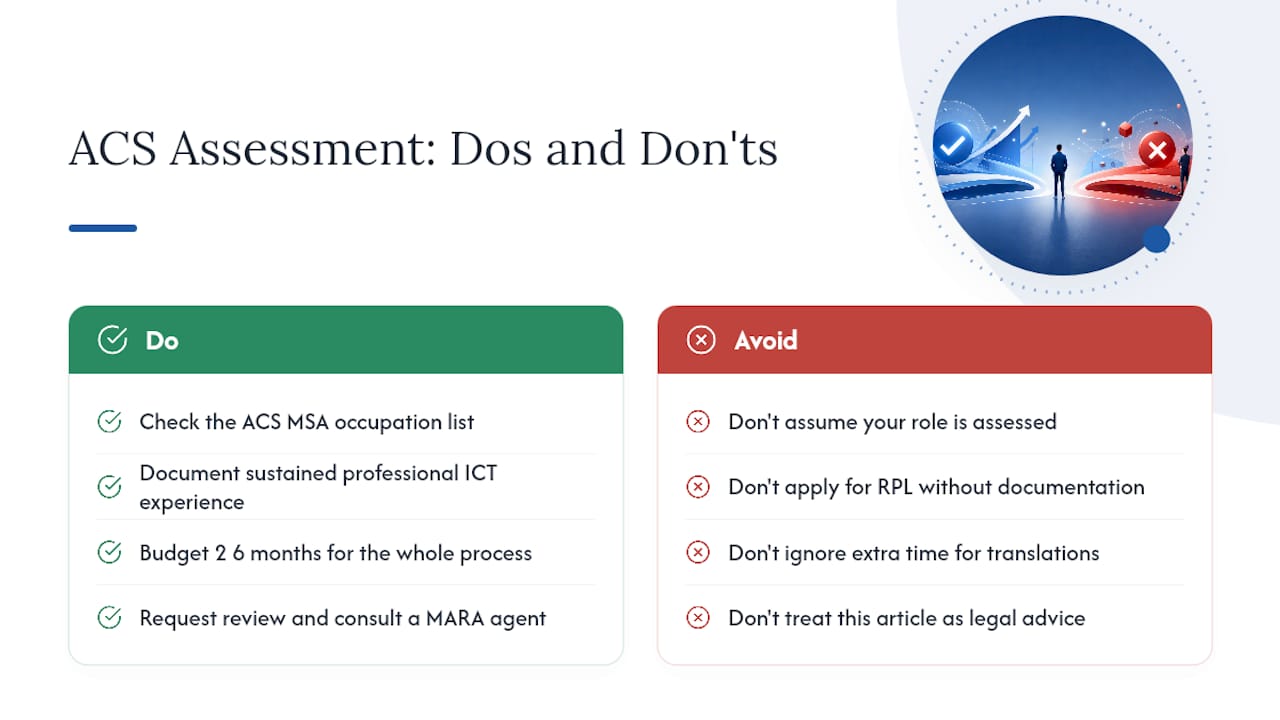
This article is general information, not a substitute for advice from a qualified lawyer. Consult a qualified legal professional about your own circumstances before acting on anything here.
Sources
- ACS Migration Skills Assessment
- ACS Migration Skills Assessment Info Hub
- ACS | Skills Assessment Guidelines for Applicants | V8.0 | April 2023
- Department of Home Affairs
- Australian Qualifications Framework (AQF)
Recommended
- Immigration Skilled Occupation List Australia 2025 – Fewa Consultancy
- New English Language Tests Accepted for Australian Visas – Fewa Consultancy
- Why Study in Australia? Key Things to Know Before Moving to Australia – Fewa Consultancy
- How to Apply for Overseas Student Health Cover (OSHC) in Australia? – Fewa Consultancy