

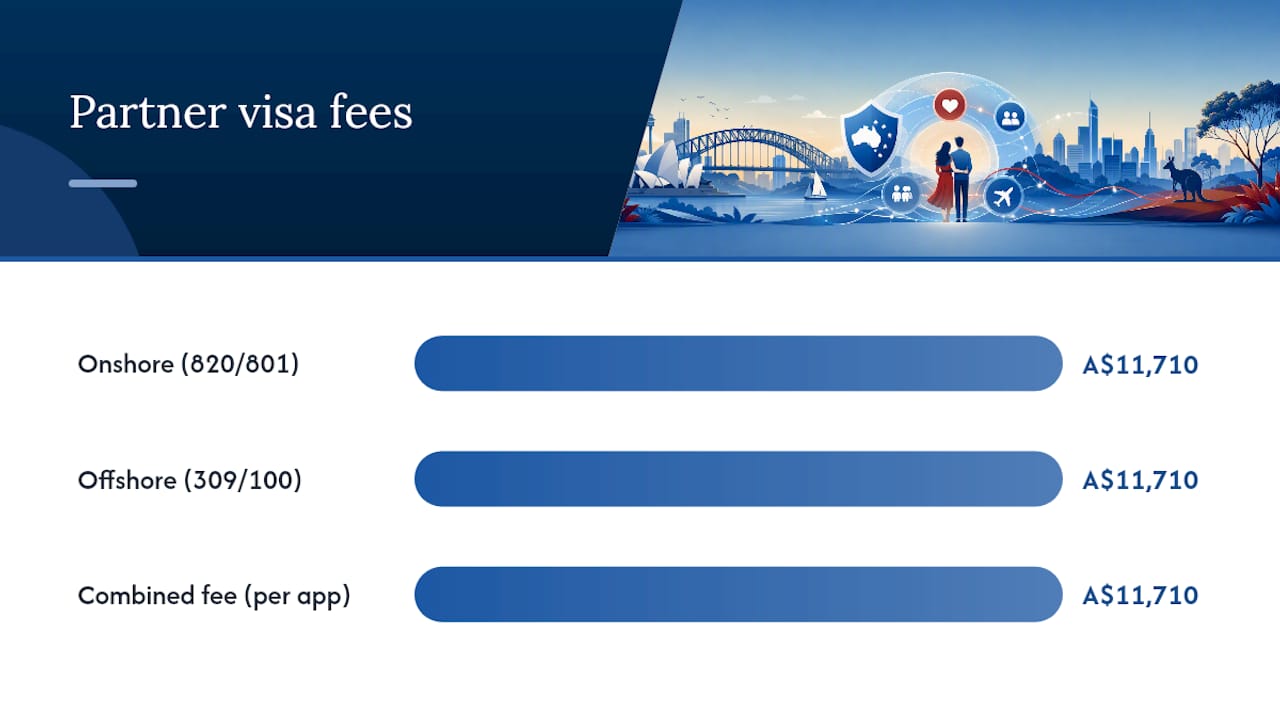
The headline application charge for an Australian partner visa is A$11,710, as reported by SBS News following the 2026 fee increase, and confirmed through the legislative instrument published on Legislation. This single charge applies to both the onshore pathway (subclasses 820 and 801) and the offshore pathway (subclasses 309 and 100). To verify the current fee and start your application, go directly to the Department of Home Affairs and use the Visa Pricing Estimator before lodging through ImmiAccount.
A few things to know upfront:
- The A$11,710 application charge covers both the temporary and permanent stages of the partner visa pathway — you do not pay twice.
- Additional mandatory costs (health checks, police clearances, translations) sit on top of this figure.
- A MARA-registered migration agent, verified through the Migration Agents Registration Authority, can help you avoid costly errors before you pay.
Key Takeaways
The A$11,710 application charge is the single most important figure to know, but your realistic total budget will be meaningfully higher once mandatory extras are added.
| Point | Details |
|---|---|
| Headline application charge | A$11,710 covers both temporary and permanent stages for onshore (820/801) and offshore (309/100) pathways. |
| Top extra costs to budget | Health exams, police clearances, and document translations typically add A$800–A$1,000 or more before agent fees. |
| How to pay | Lodge and pay through ImmiAccount at online.immi.gov.au using a Visa, Mastercard, or Amex card. |
| Where to verify the fee | Check the Home Affairs fee page and the legislative instrument on legislation.gov.au for the current effective date. |
| Fewa’s role | Fewa’s MARA-registered consultants provide document review, lodgement support, and progress tracking for partner visa applicants. |
Table of Contents
- ## What the partner visa cost in Australia actually covers
- Beyond the application charge: other costs to budget for
- How to pay and lodge your partner visa application
- Processing times and the 2026 fee increase in context
- Fee changes, refunds, and whether concessions exist
- How these figures were verified and when to get professional help
- A frank perspective on the cost and what it means for your planning
- How Fewa can support your partner visa application
- Sources
## What the partner visa cost in Australia actually covers
The A$11,710 application charge is a combined fee. For the onshore pathway, it covers both the temporary subclass 820 and the permanent subclass 801 in a single payment. Offshore applicants pay the same combined amount covering the temporary subclass 309 and the permanent subclass 100. You are not billed separately when your application moves from the temporary to the permanent stage.
What the charge includes:
- Processing of the primary applicant’s application across both stages
- Assessment of relationship evidence, character, and health at each stage
- The decision itself (grant or refusal) for both the temporary and permanent streams
What it does not include:
- Secondary applicant charges (dependent children added to the application attract an additional per-person fee — check the Visa Pricing Estimator for the current dependent charge)
- Health examinations, police checks, or biometric collection
- Document translation or certification costs
- Migration agent professional fees
Here is a quick reference for the main partner visa subclasses:
| Pathway | Subclasses | Application Stage | Combined Fee (AUD) |
|---|---|---|---|
| Onshore | 820 (temporary) + 801 (permanent) | Single combined payment | A$11,710 |
| Offshore | 309 (temporary) + 100 (permanent) | Single combined payment | A$11,710 |
The onshore partner visa page and the offshore partner visa page both confirm the applicable subclasses and lodgement requirements for each pathway.
Pro Tip: Use the Visa Pricing Estimator on the Home Affairs website before you start your ImmiAccount application. It calculates the exact charge for your specific applicant composition — including any dependents — so you are not surprised at the payment screen.
Beyond the application charge: other costs to budget for
The A$11,710 is the largest single line item, but the realistic total cost of a partner visa application runs higher once you account for mandatory extras. Here is what to plan for:
Mandatory costs:
- Health examinations: Required for all applicants. Costs vary by provider and location, but a standard adult medical with chest X-ray typically runs A$300–A$500 per person through a Home Affairs-approved panel physician.
- Police clearances: You need a clearance from every country where you have lived for 12 months or more in the past 10 years. Australian Federal Police checks cost around A$42 online. International clearances vary widely by country.
- Biometric collection: Required for some nationalities. Where applicable, this is usually collected at an Australian Visa Application Centre and costs roughly A$50–A$100.
- Document translation: Any document not in English must be translated by a NAATI-accredited translator. Expect A$80–A$200 per document depending on length and language.
Common additional costs:
- Migration agent fees: Registered agents typically charge fees for full partner visa services, varying significantly by firm and case complexity.
- Statutory declarations and notarization: Low cost individually but can accumulate across a full evidence bundle.
- Travel for medicals or biometrics: Travel costs may apply if you are not near an approved panel physician or visa application centre.
Sample planning estimate (single applicant, onshore):
This is a planning estimate, not a guaranteed figure. Your actual costs depend on your nationality, how many dependents are included, and whether you engage a migration agent.
How to pay and lodge your partner visa application
Payment and lodgement happen in the same place: ImmiAccount, the Department of Home Affairs’ online portal. Here is how the process works:
- Create or log in to your ImmiAccount at online.immi.gov.au. If you are a new applicant, registration takes a few minutes and requires a valid email address.
- Start a new application by selecting the correct visa subclass (820 for onshore, 309 for offshore). The system will guide you through the application form.
- Complete the Visa Pricing Estimator within the application to confirm the exact charge for your applicant group, including any secondary applicants.
- Upload your supporting documents before reaching the payment screen. Home Affairs expects key documents to be present at lodgement.
- Pay the application charge using an accepted payment method. Home Affairs accepts Visa, Mastercard, and American Express credit and debit cards. Payment is made in Australian dollars.
- Submit the application. Once payment clears, you receive a Transaction Reference Number (TRN) and an acknowledgement email confirming lodgement.
Pro Tip: Save your ImmiAccount draft frequently and screenshot the payment confirmation page immediately after paying. The TRN is your proof of lodgement — store it somewhere safe, because Home Affairs uses it to track your application. If you do not receive an acknowledgement email within 24 hours, log back into ImmiAccount to confirm the payment status before assuming lodgement was successful.
Processing times and the 2026 fee increase in context
Paying the application charge starts the lodgement clock, but it does not guarantee a fast decision. Partner visa processing is among the longest in the Australian migration program, and current wait times reflect sustained demand.
What happens after you pay:
- Acknowledgement of lodgement (usually within days)
- Health examination request (if not already completed)
- Character check initiation (police clearances reviewed)
- Substantive relationship assessment by a case officer
- Decision on the temporary stage (subclass 820 or 309)
- Permanent stage assessment (subclass 801 or 100) — typically triggered around the two-year mark
Processing time bands change regularly. Check the Home Affairs global processing times page for current estimates before making any plans that depend on a visa grant date. Published bands represent the time taken to finalize a percentage of applications — they are not guarantees.
The 2026 fee increase has drawn significant public attention. SBS News reported on the A$11,710 figure and its real-world impact, describing couples whose plans have been delayed by the combination of high fees and long processing waits. The Conversation also noted that the fee raises questions about affordability for couples on modest incomes. Whether or not the fee increase affects lodgement volumes in the short term, the processing time bands you see today already reflect a large existing caseload.

Fee changes, refunds, and whether concessions exist
How fee changes are announced:
- The Department of Home Affairs updates its fee page when a new charge takes effect.
- The formal legal record is a legislative instrument published on legislation.gov.au. The explanatory statement for the 2026 change (document F2026L00874) sets out the effective date and the statutory basis for the increase.
- Fee changes apply from the effective date stated in the instrument — applications lodged before that date are charged at the old rate.
Refund rules:
- Home Affairs does not routinely refund application charges once an application has been lodged and assessed.
- A partial refund may be available in limited circumstances, such as a duplicate payment or a processing error — not for a change of mind or a refusal.
- Fees are not transferable between applications. If you withdraw and re-apply, you pay again.
Scenarios to know:
- Fee change after you applied: If you lodged before the effective date, you pay the old rate. No top-up is required.
- Withdrawing an application: Refunds are not standard. Contact Home Affairs directly if you believe a refund applies to your situation.
- Duplicate payment: Contact Home Affairs immediately with your TRN and payment receipt. Duplicate charges are generally corrected.
How these figures were verified and when to get professional help
The figures and processes in this article are drawn from primary official sources:
- Department of Home Affairs onshore partner visa page for subclass 820/801 requirements and fee details
- Department of Home Affairs offshore partner visa page for subclass 309/100 specifics
- ImmiAccount for lodgement and payment confirmation
- Legislation for the formal fee-change instrument
- Home Affairs global processing times for current wait bands
You can verify any of these directly by visiting the linked pages. Fee figures on third-party sites, including migration blogs, may lag behind official updates by weeks or months — always cross-check against the Home Affairs fee page before lodging.
When a MARA-registered migration agent is worth the cost:
- Your relationship history is complex (previous marriages, long separations, or gaps in cohabitation)
- You or your partner have a criminal record or prior visa refusals
- Your documentary evidence is thin or hard to obtain
- You are unsure which pathway (onshore vs offshore) applies to your situation
- English is not your first language and you are concerned about form accuracy
Pro Tip: Before paying any migration agent, search their name or registration number on the MARA register. Registration is mandatory for anyone charging for migration advice in Australia. An unregistered person offering paid migration advice is operating illegally — and you have no consumer protection if things go wrong.
A frank perspective on the cost and what it means for your planning
The A$11,710 application charge is a significant financial commitment, and the SBS News reporting captures something real: for couples on average incomes, this fee can genuinely delay a life together. What often gets missed in the conversation, though, is that the fee is only one part of the affordability picture. The longer risk is a poorly prepared application that results in a refusal — because you do not get that money back, and you pay again if you re-apply.
The couples who navigate this most successfully tend to treat the application charge as the floor of their budget, not the ceiling. They account for health checks, translations, and agent fees from the start, and they do not rush lodgement just to get the payment made. A well-documented, carefully prepared application filed at the right time is worth far more than a fast one filed with gaps.
If you are weighing whether to engage a migration agent, the honest answer is that straightforward cases with strong evidence and no character issues can often be lodged without one. Complex cases — previous refusals, criminal history, thin relationship evidence — are where professional help pays for itself many times over. Use the VEVO check guide to understand your current visa status before you decide on timing.
How Fewa can support your partner visa application
Fewa Education & Migration offers end-to-end partner visa support for couples navigating the onshore and offshore pathways. Where a traditional approach leaves you sorting through Home Affairs guidance alone, Fewa’s MARA-registered consultants review your documents, identify gaps before lodgement, and manage the ImmiAccount submission on your behalf.
A paid engagement with Fewa typically covers an initial case assessment, a full document review against the partner visa checklist, lodgement through ImmiAccount, and progress updates throughout processing. Fewa’s MARA registration means you have full consumer protection and a registered professional accountable for the advice you receive. To get started, visit the Fewa visa services page or book a free consultation directly to discuss your situation and get a clear picture of what your application will involve.
Sources
Use these primary sources to confirm current figures and read recent reporting:
- Partner visa (apply in Australia) (subclass 820 and 801)
- Partner visa (apply overseas) (subclass 309 and 100)
- Online
- Legislation
- ‘Life delayed’: The $11710 bill keeping some couples apart
- Immi
This article is general information, not a substitute for advice from a qualified lawyer. Consult a qualified legal professional about your own circumstances before acting on anything here.