


The China X2 visa covers short-term study of up to 180 days. To apply from Australia, you need a passport valid for six months with two blank pages, a signed application form, a compliant photo and your school’s Admission Notice, plus proof of legal stay if you are not an Australian citizen. You must pass the online review before you submit anything in person.
TL;DR:
- Since September 15, 2025, applicants must pass online review before submitting documents in person; clearance permits filing but does not guarantee visa approval.
- Use a recent 48 mm by 33 mm color photo on a white background; upload a JPEG within the portal’s pixel and file size limits.
- Applicants who are not Australian citizens must include proof of legal stay, such as a VEVO printout, ImmiCard, or valid Australian visa.
- CVASC describes processing as several working days, but timing can change, so wait until your visa is issued before booking nonrefundable travel.
- The visa checklist does not require medical or language test records, but schools may set separate health or course language requirements; confirm these with admissions.
Table of Contents
- What do you need to have in your X2 visa file?
- How does the two-stage CVASC application work?
- What are the exact photo, passport and file specifications?
- What extra documents do special cases need?
- Where do you lodge in Australia, how long does it take and what does it cost?
- Which mistakes slow down an X2 application?
- Do you need a medical examination for the China student visa?
- Do you need English or Chinese language proficiency?
- Why do X2 applications get refused, and can you reapply?
- Our view: preparation beats persuasion
- How can Fewa help with your China X2 student visa application?
- FAQ
- Sources
What do you need to have in your X2 visa file?
Start with the documents below, in this order. Collect the originals first, then scan them for the online upload. The X2 requirements published by the Chinese Visa Application Service Centre (CVASC) repeat the same core list, and the X2 visa is defined there as a study visa of no more than 180 days.
- Passport. Bring the original and a photocopy of the data page with your photo and signature. It must be valid for at least six months and carry at least two blank visa pages.
- Visa application form. Complete it online through the CVASC system, then print and sign the V.2013 form as instructed.
- Passport photo. Use a recent colour photo that meets the CVASC specifications, and attach a printed copy to the form where it asks for one.
- Admission Notice. You need the original and a photocopy from your Chinese school or institution.
- Proof of legal stay in Australia. This applies only if you hold a non-Australian passport.
- Previous Chinese visas or passports. Include copies if you have held any.
- Supporting financial or school documents. Keep them ready in case a consular officer asks.
Some items need a little more detail:
- Proof of legal stay: a VEVO printout, an ImmiCard or a copy of your valid Australian visa all work. If you are not applying in your country of citizenship, this proof is required.
- Admission Notice: it should be clear, readable and printed on A4, with your name, course and registration dates visible.
- Supporting evidence: bank statements, proof of payment to the school and any invitation letters are the usual requests. You do not hand them in by default, but having them to hand saves days if you are asked.
- Certified copies: if any copy you plan to submit needs certifying, our note on certified copies for visa applications explains how that works in Australia.
How does the two-stage CVASC application work?
Since 15 September 2025, every application in Australia runs in two stages: an online review followed by offline submission. The CVASC online system now handles the form and the uploads, and only applications completed through it are accepted, as the online processing notice explains.
- Register and complete the online form. Create your account on the CVASC site and fill in every field accurately.
- Upload all documents and photos. Check each file against the file-type, pixel and size limits before you upload.
- Wait for the online review to pass. The Brisbane consulate notice confirms that physical submission is not permitted until this stage is cleared. Incomplete or incorrect uploads hold you up here.
- Book your appointment. Choose the CVASC office that covers your state or territory.
- Attend with your originals. Bring everything in checklist order. The centre scans and retains copies, and you collect your passport when it is due.
- Respond to any extra requests. A consular officer may ask for supplementary documents or an interview. Reply promptly and bring originals as instructed.
Passing the online review is a gate, not an approval. It lets you lodge, but the consular officer still makes the final call.
Pro Tip: Save your online confirmation and a full scanned copy of everything you uploaded in one folder. If an officer asks a question months later, you can answer from the same file.
If you want a longer walkthrough, see our guide on how to apply for a student visa in China.
What are the exact photo, passport and file specifications?
Online reviews fail on small details more often than on missing documents. Get these right before you upload.
- Passport copy: photocopy the data page that shows your photo and signature. If you hold or previously held other passports, bring them too, because officers can ask for previous passports.
- Photo size: the CVASC pages give 48mm x 33mm. Some site guidance writes it as 3.3cm x 4.8cm, which is the same size.
- Photo style: a recent colour photo on a white background, taken within the last six months, bare-headed and without glasses.
- Photo upload: use JPEG format and stay inside the pixel and file-size range shown in the online system. If the system rejects a file, resize it rather than uploading a screenshot.
- Admission Notice: print the original and a copy on A4, and make sure the student name, course and registration dates are legible. If the centre asks for a DQ form, bring it too.
- Scanned files: name each file clearly, such as “Passport_Surname”, “Photo_Surname” and “AdmissionNotice_Surname”. Scan at a resolution where every line of text is readable, because a blurry scan is a common reason for a failed review.
- Fee payment evidence: if you have already paid the school, a receipt or Chinese tax invoice is useful supporting evidence to have on hand.
Applicants must provide an original and photocopy of the Admission Notice issued by the educational institution in China. The Embassy’s X2 notice says this document is the anchor of your whole file, so check it for typos in your name and passport details before you do anything else.
What extra documents do special cases need?
Some applicants carry additional paperwork. Sort it out early, because certificates and consent letters take longer to organise than a photo.
- Under 18: add the child’s birth certificate, photocopies of the parents’ passports or ID, and a parental consent letter if the parents are not travelling with the child.
- Former Chinese citizens: supply your last Chinese passport (original and photocopy) or a photocopy of your previous Chinese visa. If your name differs between passports, official name-change documentation is required.
- Dual nationals: present all current valid passports, and previous ones where the centre requests them.
- Non-Australian nationals applying in Australia: include the original and a photocopy of your current Australian visa or other proof of legal stay, such as VEVO or an ImmiCard. Leaving this out is one of the most avoidable causes of refusal.
- Name changes across borders: if your documents involve overseas legal formalities, a specialist such as Simons George Legal can help with certified paperwork for cross-border documents. That firm works on estate and succession matters, so use it only for the document-formalities side, not for the visa itself.
Where do you lodge in Australia, how long does it take and what does it cost?
CVASC centres in Canberra, Sydney, Melbourne, Perth and Brisbane accept ordinary applications, and each covers set service areas. The CVASC instructions for Australia list those centres and explain that you print, sign and attach your photo to the V.2013 form. Check which centre serves your state before you book.
- Processing time: CVASC describes it as several working days and subject to change. Do not book non-refundable travel until you hold the visa. For a wider view of student visa timing, see our page on average processing times for student visas.
- Fees: the Embassy and Consulates of China in Australia are reducing regular visa fees until 31 December 2026, and the notice carries a fee table for Australian citizens. Fees vary by nationality, so confirm yours on the CVASC site on the day you apply.
- Passport collection: collect your passport on the date given. Check your local CVASC instructions, because passports that are not collected can be cancelled.
Which mistakes slow down an X2 application?
Most delays trace back to a short list of errors. A few minutes of checking before you lodge removes nearly all of them.
- Blurry scans or wrong photo size: use the CVASC photo template and keep the printed originals beside you.
- Missing proof of legal stay: if you are not an Australian citizen, upload it every time.
- Leaving out previous Chinese visas or passports: if you have held them, include them, because omitting them can slow approval.
- Unsigned or incomplete V.2013 form: print it, sign it and complete every field exactly as instructed.
- A messy packet: officers work through documents in order, and a jumbled folder invites questions.
Pro Tip: Prepare a single A4 packet with your documents in checklist order, originals on top and copies behind each one. It speeds up the offline submission and shows the officer you are organised.
Our notes on common China X2 visa mistakes for Australians go deeper on common mistakes.
Do you need a medical examination for the China student visa?
For an X2 visa of up to 180 days, the CVASC and Embassy X2 checklists we reviewed do not list a medical examination among the documents you lodge. The core file is your passport, form, photo and Admission Notice, with extra evidence on request.
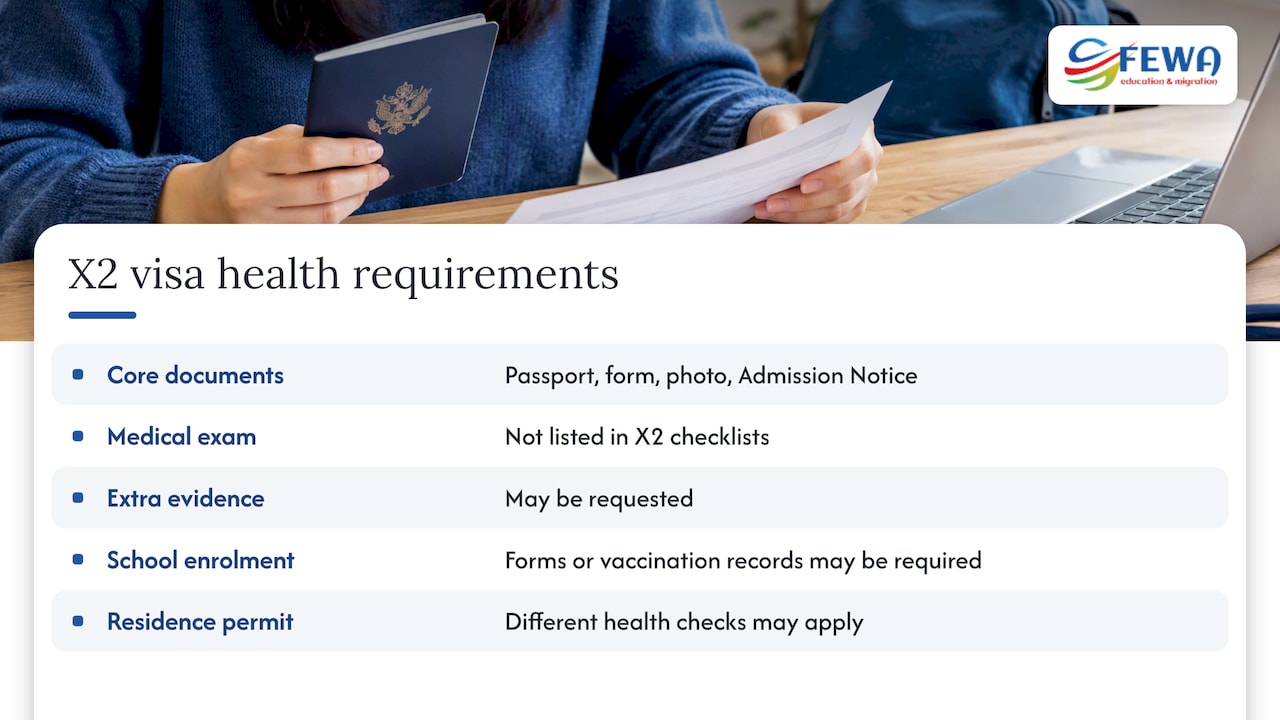
That said, your Chinese school can set its own health requirements for enrolment, and some institutions ask for a health form or vaccination record on arrival or before the course starts. Ask your admissions office what it needs, and keep any such document in your packet in case an officer asks for it. Because requirements can be updated, confirm the position on your local CVASC page the week you apply. If a longer stay later turns into a residence permit application inside China, different health checks can apply, so treat the X2 checklist as the rule for the visa itself and your school as the rule for enrolment.
Do you need English or Chinese language proficiency?
The X2 checklists we reviewed do not ask for a language test result such as HSK, IELTS or PTE as part of the visa file. The visa decision rests on your passport, your form and your Admission Notice from the Chinese institution.
Language rules usually sit with the school, not the visa centre. A programme taught in English may ask for proof of English, while a Mandarin-taught course may expect a minimum HSK level or a placement test on arrival. Those requirements are set out in your offer or admission documents, so read them closely and do not assume the visa office will waive them.
If your school does ask for a score and you need to prepare, our team runs coaching for tests like IELTS and PTE. Keep any language certificate in your supporting folder, because it can help if an officer asks about your study plans.
Why do X2 applications get refused, and can you reapply?
This section is general information, not legal advice. CVASC checklists state that consular officers may request supplementary documents or an interview on a case-by-case basis, and passing the online review does not guarantee issuance. The decision stays with the officer.
The problems that most often stall or sink a file are practical ones:
- an Admission Notice with a name or passport detail that does not match your passport
- missing proof of legal stay for non-citizens
- unreadable scans or photos that miss the specifications
- an unsigned or incomplete application form
- previous Chinese visas or passports that you did not disclose
If your application is refused or held, ask for the reason where the centre can give one, and fix that specific gap. A reapplication runs through the same two-stage process, so you complete the online review again with corrected documents. Do not resubmit the same file unchanged. If the cause is unclear, a document review before you lodge again is worth the time.
Our view: preparation beats persuasion
Most people treat the visa interview as the hard part, but with the X2 the file does most of the talking. A tidy, consistent packet, where every name and date matches, can help answer questions before an officer thinks to ask them. Prepare your originals early, and if you want a second pair of eyes on your package, we are happy to review it.
— Ronit
How can Fewa help with your China X2 student visa application?
We are a consultancy, and we help Australians who plan to study in China with their applications.
- Tailored study-visa counselling for your course and travel dates
- A document check against the CVASC checklist before you upload
- Application guidance through the online review and your appointment
Book a consultation and we will go through your package line by line. See our student visa service page to get started.
FAQ
What are the requirements for a Chinese visa application?
You need a valid passport with at least two blank pages, a signed application form, a compliant photo and the supporting document for your visa type. For the X2 study visa, that supporting document is the Admission Notice. If you are not an Australian citizen, you also need proof of legal stay in Australia, as CVASC guidance sets out.
Does Australia have visa-free access to China?
The sources we reviewed do not state a general visa-free arrangement for Australian travellers, and they describe a visa application process with fee reductions in place instead. Entry rules can change, so check the Embassy or CVASC pages before you book. A study stay of up to 180 days needs the X2 visa in any case.
Can you work while on a China student visa?
The X2 is a short-term study visa, and the checklists we reviewed cover study, not employment. Do not assume you can work on it. Ask your school and the Embassy, and check the visa terms before you take any paid work.
How long does an X2 application take to process?
CVASC describes processing as several working days and subject to change. Allow time for the online review first, because you cannot lodge in person until it passes. Do not buy non-refundable flights until your visa is issued.
Sources
- Us
- Bio
- (X2) Short term study (no more than 180 days)|Chinese Visa Application Service Center
- (X2) Short term study (no more than 180 days)|Chinese Visa Application Service Center
- The Embassy and Consulates of China in Australia to Reduce Regular Visa Fees|Chinese Visa Application Service Center