


You may be eligible for the Prospective Marriage (subclass 300) visa if you’re outside Australia, aged 18 or over, and have an eligible Australian sponsor. Your main obligation is entering Australia, marrying within nine months, then applying for a partner visa. Your first move is gathering sponsor evidence and creating an ImmiAccount application.
TL;DR:
- Ensure your sponsor is an Australian citizen, permanent resident, or eligible New Zealand citizen, at least 18, with no recent sponsorship violations or unresolved obligations.
- Provide comprehensive relationship evidence, including statements, photos, travel records, and certified translations of foreign documents, all filed with original copies.
- Complete health and character checks early by booking medical exams and police certificates from all relevant countries to avoid processing delays.
- Lodge your application through ImmiAccount with high-resolution scans of all required documents, paying the current visa fee, and keep originals ready for verification.
- Enter Australia within nine months of approval, marry with a registered authorised celebrant, and submit a partner visa application promptly to maintain lawful status.
Table of Contents
- What are the prospective marriage visa requirements?
- Who can sponsor you, and what limits apply?
- What documents do you need for a marriage visa?
- What health and character checks does subclass 300 require?
- How do you apply for a marriage visa through ImmiAccount?
- What happens after your visa is granted?
- Why do prospective marriage visa applications get refused?
- A practitioner’s view on getting this right the first time
- Get help preparing your subclass 300 application
- Where to verify these requirements
- Sources
- FAQ
What are the prospective marriage visa requirements?
You need to satisfy several conditions at once, and the Department of Home Affairs checks every one of them carefully before granting subclass 300.
Here’s what the Department actually looks for:
- You must be outside Australia both when you lodge the application and when it’s granted.
- You must be at least 18 years old.
- There must be no legal impediment to your marriage under Australian law.
- You need an eligible sponsor (an Australian citizen, permanent resident, or eligible New Zealand citizen).
- You and your partner must have met in person, as adults, before lodging.
- You must show a genuine intention to marry and to build a life together, not just tick a box.
That last point trips up more applicants than any other. The Department doesn’t want a wedding photo and a hopeful statement. Reviewing officers weigh how the relationship developed, how you communicate, and whether your account matches your partner’s. Community legal advice on prospective marriage visas confirms the meeting in person requirement is strict. Video calls alone won’t satisfy it. You need evidence you were physically together at some point, as adults, before you filed your paperwork.
Who can sponsor you, and what limits apply?
Your sponsor carries real legal weight in this process, and the Department scrutinises them almost as closely as it scrutinises you.
Your sponsor must be:
- An Australian citizen, permanent resident, or eligible New Zealand citizen.
- At least 18 years old at the time of sponsorship.
- Free of recent sponsorship history that would breach the limits on how often someone can sponsor a partner or fiancé.
- Clear of outstanding sponsorship obligations from a previous approved application.
- Willing to undergo character checks, which can include police history in Australia and overseas.
Sponsorship isn’t a formality. It’s a formal legal commitment, and the Department scrutinises a sponsor’s history closely. Someone who has sponsored a partner before, or who has unresolved obligations from an earlier visa, faces a much harder path.
Pro Tip: Get your sponsor’s paperwork sorted before you touch your own application. If your sponsor’s eligibility is shaky, no amount of relationship evidence on your side will fix it.
What documents do you need for a marriage visa?
Your document pack is where most applications succeed or fail, and country-specific rules make this trickier than it looks on paper.
- Identity documents. Passport bio-data pages, recent photos, and certified copies of both. Certification standards vary, so check your country’s requirements before you start.
- Relationship evidence. Statements from both of you describing your history, supported by Form 888-style statutory declarations from friends and family who know you as a couple.
- Supporting proof. Photos together, travel records, message histories, and any joint financial arrangements you’ve already started.
Keep every original document ready. Officers can request them at any point in the assessment, and a delay here stalls your whole file.
What health and character checks does subclass 300 require?
Health and character clearances run alongside your document preparation, and they take longer than most applicants expect.
- Book a medical examination with an approved panel physician once you’ve started your application. Don’t leave this until the last month.
- Provide police certificates from every country where you’ve lived for 12 months or more across the past decade, as the Department requires.
- If you’ve spent time in Australia previously, an Australian Federal Police check may also apply.
Some countries take weeks to issue a police certificate. Others take months, particularly if you’ve lived somewhere with limited consular services. Start these checks the day you decide to apply, not after your other documents are ready.
How do you apply for a marriage visa through ImmiAccount?
Every subclass 300 application runs through ImmiAccount, the Department’s online lodgement portal. There’s no paper alternative for standard applications.
The practical sequence looks like this:
- Your sponsor creates an ImmiAccount and lodges their sponsorship first.
- Once that’s approved or submitted, you lodge your own application as the primary applicant.
- Upload clear, legible scans of every document. The embassy checklist guidance.pdf) recommends high-resolution colour scans over photos taken on a phone.
- Pay the visa application charge listed on the Department’s fees page at the time of lodgement. Fees change periodically, so check the current figure rather than relying on an old quote.
- Keep your original documents accessible in case Home Affairs requests further identity checks.
Processing time is the part most applicants ask about first, and the honest answer is that it varies widely, with some guides citing ranges of roughly 14 to 26 months depending on individual circumstances and caseload. Subclass 300 is a single-entry visa, so plan your travel around that: entering Australia early, then leaving before the wedding, can create complications with your Bridging visa B if you need to travel again.
What happens after your visa is granted?
Getting the grant is a milestone, not the finish line. From here, timing becomes everything.
- You must enter Australia and marry within your visa’s validity, usually nine months from grant. There’s no routine extension, and waivers are genuinely exceptional.
- Lodge your Notice of Intended Marriage with an authorised celebrant at least one month before your ceremony, and no more than 18 months before it.
- Your marriage must be conducted by an authorised celebrant and registered with the relevant state Births, Deaths and Marriages office.
- Apply for the Partner visa (subclass 820/801) onshore as soon as possible after the wedding to preserve your lawful status in Australia.
- If you have dependent children joining you, they’ll need their own identity documents, and in some cases separate health and character checks.
Why do prospective marriage visa applications get refused?
Refusals almost always trace back to the same handful of gaps, and most of them are avoidable with proper preparation.
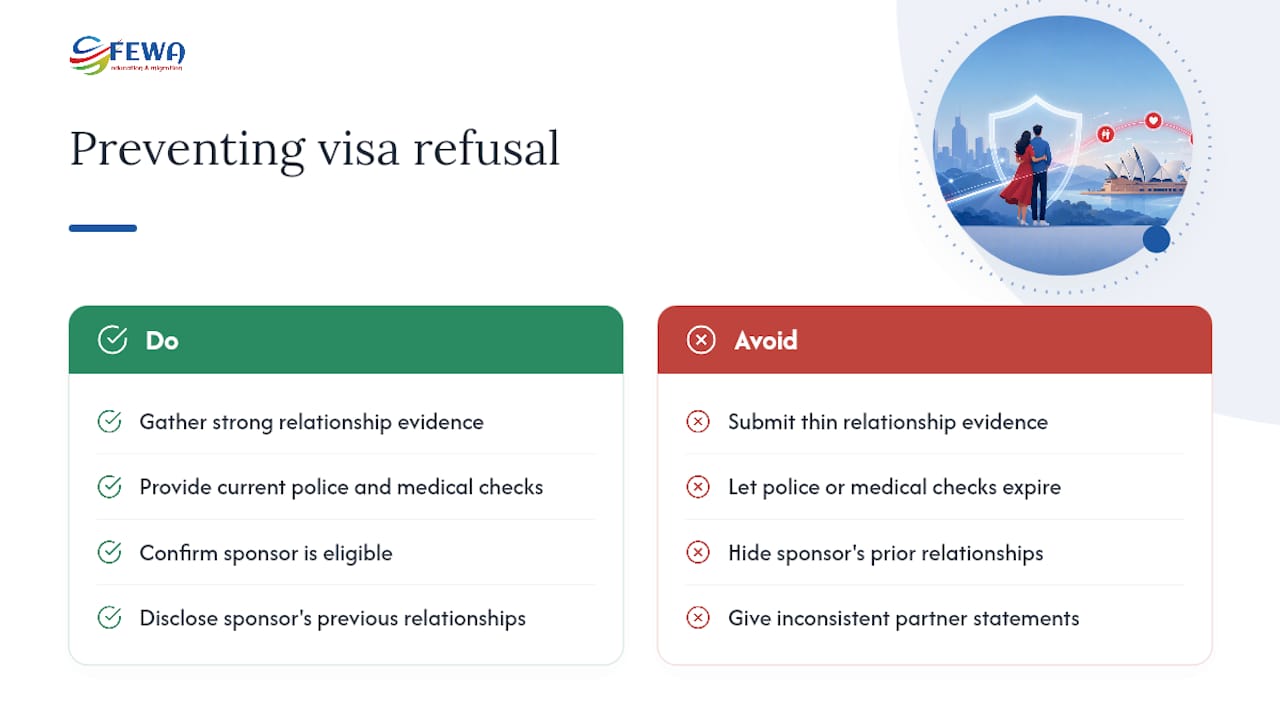
The most common causes are thin relationship evidence, missing or expired police and medical checks, sponsor ineligibility, or a failure to disclose a sponsor’s previous relationship history. Practitioner reviews of subclass 300 cases point to inconsistent statements between partners as a recurring red flag.
If you’re refused, you generally have review rights through the Administrative Appeals Tribunal, with strict time limits for lodging that review. Given how tight those deadlines are, this is the point where speaking with a MARA-registered migration adviser or a lawyer is worth serious consideration rather than an afterthought.
A practitioner’s view on getting this right the first time
Get your sponsor approved before you touch anything else. That single sequencing decision prevents more delays than any document you could add later.
The applications that stumble almost always share the same gaps: a NOIM lodged too late, translations that weren’t properly certified, or witness statements that read as generic rather than specific to your relationship. None of these are hard to fix on their own. The trouble is applicants often don’t spot them until an officer asks a follow-up question, and by then you’ve lost months.
Paying for professional guidance makes the most sense when your situation has any complexity at all, a previous visa refusal, a sponsor with a prior sponsorship, or documents from a country with unusual certification rules. In straightforward cases, careful self-preparation using the Department’s own checklist can work perfectly well.
— Ronit
Get help preparing your subclass 300 application
Professional migration consultancies can help avoid the pitfalls of piecing this together alone from scattered information. Expert services typically include reviewing sponsor eligibility, checking document packs against current Department standards, advising on certified translations for country-specific requirements, and supporting ImmiAccount lodgement from sponsorship through to grant.
Where self-preparation runs into trouble, usually a sponsor history question, an inconsistent translation, or uncertainty about how much relationship evidence is enough, having someone check your file before you submit it saves months, not days. Fewa’s team works through your situation in a free consultation, flags gaps before Home Affairs does, and keeps your application moving through each stage without guesswork on your end. If you’re ready to start, book a consultation through Fewa’s visa services page and get your sponsor paperwork reviewed first.
Where to verify these requirements
Confirm every requirement against the Department of Home Affairs subclass 300 page and lodge through ImmiAccount. Country-specific document rules, like the Vietnam checklist, and community guidance from IARC fill in the practical detail. For your next step after marriage, see Fewa’s partner visa page.
This article is general information, not a substitute for advice from a qualified lawyer. Consult a qualified legal professional about your own circumstances before acting on anything here.
Sources
- Subclass 300 Prospective Marriage visa
- Prospective Marriage Visas
- Prospective Marriage Visa Australia (Subclass 300) | Collins Quarters
- Prospective Marriage Visa Subclass 300 Guide
FAQ
What are the requirements for a marriage visa in Australia?
You must be outside Australia at lodgement and grant, at least 18, and have an eligible sponsor who is an Australian citizen, permanent resident, or eligible New Zealand citizen. You also need to show you’ve met your partner in person and intend to marry and live together, as the Department outlines.
How long does it take to get a prospective marriage visa in Australia?
Processing times vary by individual circumstances, with some sources citing a range of roughly 14 to 26 months. Starting your health and character checks early, and lodging a complete document pack, helps avoid unnecessary delays on your end.
Is a prospective marriage visa better than a partner visa?
Neither is universally “better”, they serve different situations. Subclass 300 suits couples who aren’t yet married and one partner lives outside Australia, while a partner visa suits couples already married or in a de facto relationship who want to apply directly for that pathway.
What are the new partner visa rules for Australia in 2026?
Current subclass 300 eligibility criteria are set out on the Department of Home Affairs page, which is the authoritative source for any rule changes. Always check that page directly before lodging, since visa charges and processing guidance are updated periodically.
Do I need a Notice of Intended Marriage before I apply?
A NOIM isn’t strictly required at the time you lodge your subclass 300 application, but having one already filed with a celebrant strengthens your evidence of genuine intent. You do need to lodge the NOIM at least one month before your ceremony once you’re in Australia.