


To apply for an Australian Visitor visa (subclass 600), you must lodge online through ImmiAccount from outside Australia and provide verified identity documents, proof of funds, evidence of your visit purpose, and any health or character checks the Department requests. You’ll pull together documents across a handful of categories before you ever open the application form.
- Identity documents (passport, national ID, name-change evidence)
- Financial evidence (bank statements, payslips, tax records)
- Proof of ties to home (job letter, enrollment, property)
- Evidence of your travel purpose (itinerary or invitation letter)
- Health and character documents, if requested
The Department of Home Affairs is the only authoritative source for current visitor visa rules, forms, and fees. Everything in this guide reflects official subclass 600 guidance, but requirements do shift, so double-check before you submit.
Key Takeaways
A complete Australian Visitor visa application requires online lodgement through ImmiAccount plus verified proof of identity, funds, ties to home, and travel purpose.
| Point | Details |
|---|---|
| Lodge online only | Applicants outside Australia must apply through ImmiAccount; paper lodgement isn’t available for most visitor visa cases. |
| Match your stream to your trip | Tourist, Business Visitor, and Sponsored Family streams each require different supporting evidence. |
| Prove funds and ties together | Bank statements alone aren’t enough; pair them with employment or enrollment letters showing you’ll return home. |
| Certify and translate carefully | Non-English documents need accredited translations, and some evidence must be certified before upload. |
| Get professional review for complex cases | Fewa Education & Migration, a MARA-registered consultancy in Sydney, checks documents and lodgement details before submission. |
Table of Contents
- Quick Document Checklist for an Australia Visitor Visa
- What Identity and Passport Documents Do You Need?
- How Do You Prove You Can Afford Your Trip and Will Return Home?
- How Do You Prove the Purpose of Your Visit?
- When Are Health Checks, Police Certificates, and Biometrics Required?
- How Do You Apply for a Visitor Visa Through ImmiAccount?
- What Are the Most Common Reasons for Visitor Visa Refusal?
- What Happens After Your Visitor Visa Is Granted?
- When Should You Use a MARA-Registered Migration Consultant?
- Why This Checklist Matters
- Get Your Visitor Visa Application Reviewed Before You Submit
- Where to Check Official Visitor Visa Rules
- Sources
Quick Document Checklist for an Australia Visitor Visa
Before you touch ImmiAccount, gather your paperwork into one folder. It saves you from the frustrating start-stop cycle of uploading a form, realizing you’re missing something, and hunting for it mid-application.
- Passport and identity: current passport bio page, any prior Australian visa pages, national ID, and name-change evidence (marriage certificate or deed poll) if your documents don’t match.
- Financial proof: bank statements covering several months, recent payslips, or tax records. Self-employed applicants should add business financials.
- Ties to home: an employer letter confirming approved leave, a study enrollment letter, or evidence of property or family obligations that show you’re coming back.
- Purpose of visit: a day-by-day itinerary, flight and hotel reservations, or an invitation letter from your Australian host.
- Health and character: police certificates or medical exam results if the Department requests them.
- Translations: certified English translations for any document not originally in English.
What Identity and Passport Documents Do You Need?
Your passport needs to have your photo page and, ideally, any pages showing prior travel to Australia. If your current legal name differs from your passport, upload documentary evidence, a marriage certificate, deed poll, or court order works. National ID cards or birth certificates are sometimes requested to confirm identity details that a passport alone doesn’t capture.
- Scan the bio page in color, not black and white.
- Provide certified copies where the form specifically asks for them.
- Any document not in English needs an accredited translation attached alongside the original.
- Keep files under typical upload size limits (usually a few megabytes per document) and use PDF or JPEG where possible.
Pro Tip: Photograph or scan documents in good lighting on a flat, dark background. A blurry phone photo of a passport page is one of the most common, and most avoidable, reasons for a request for more information.
How Do You Prove You Can Afford Your Trip and Will Return Home?
Case officers look for two things at once: can you fund the trip, and do you have real reasons to go home afterward. Bank statements covering the last three to six months, recent payslips, or audited accounts for business owners all count as acceptable proof of funds. If someone else, a relative or host, is covering your costs, include their financial evidence and a signed sponsorship declaration.
- Recent bank statements showing a stable balance, not a one-time deposit
- Payslips or an employer letter confirming your salary and approved leave dates
- Tax records or business financials for self-employed applicants
- A sponsorship letter and the sponsor’s bank statements, if applicable
Ties to home matter just as much as your bank balance. An employment letter stating your return-to-work date, evidence of enrollment in ongoing study, or documentation of property and family obligations all signal genuine temporary intent.
The Visitor visa (subclass 600) typically grants a stay typically ranging from a few months up to about a year, and the exact length is decided case by case based on your circumstances, travel history, and the strength of your documentation. Don’t assume a longer stay just because you asked for one.

How Do You Prove the Purpose of Your Visit?
Tourist and family-visit applications get evaluated differently. If you’re traveling for leisure, hotel bookings and a clear day-by-day itinerary do the job. If you’re visiting family, you need an invitation letter from your Australian host plus their supporting documents: a copy of their passport or visa, and proof of their address.
- Firm bookings carry more weight than fully refundable, provisional ones. If everything in your itinerary can be canceled without penalty, it looks thin to a case officer.
- Your invitation letter should state the relationship, the exact dates of the visit, and who is covering costs during the stay.
Dear Department of Home Affairs, I am writing to invite my [relationship, e.g., sister], [full name], to visit me in Australia from [start date] to [end date]. I am an Australian [citizen/permanent resident/visa holder], residing at [address]. I will be covering accommodation and living expenses during her stay. Attached are copies of my passport, visa status, and proof of residence.
When Are Health Checks, Police Certificates, and Biometrics Required?
Not every applicant needs a medical exam or police check, the Department requests these based on your nationality, planned length of stay, and any flags in your travel history. When a health exam is required, you’ll be directed to book with an approved panel physician in your country.
- Police certificates typically need to cover your full residence history over the past ten years and come from each country where you lived for 12 months or more.
- Biometrics (fingerprints and a facial photo) are commonly required for applicants from certain countries and are collected at a designated visa application center.
- Every certificate or record not issued in English needs a certified translation attached, missing this step is a common cause of processing delays.
Pro Tip: Order police certificates early. Some countries take four to six weeks to issue them, and a stalled certificate can hold up an otherwise complete application.
How Do You Apply for a Visitor Visa Through ImmiAccount?
Applicants outside Australia are required to lodge online, there’s no paper-based option anymore for most visitor visa applicants. The mandatory online lodgement rule applies specifically to those applying from overseas.
- Create an account on ImmiAccount.
- Select “New application” and choose Visitor visa (subclass 600).
- Choose the correct stream for your situation.
- Complete form 1419 (the standard internet application form for most streams) with accurate personal, travel, and financial details.
- Upload every supporting document in the required format.
- Pay the visa application fee through the secure payment gateway.
- Submit and note your Transaction Reference Number for tracking.
Which stream applies to you depends on why you’re traveling:
- Tourist stream: for holidays, recreation, or visiting friends casually, documented on the overseas tourist-stream page.
- Sponsored Family stream: for visiting relatives, often needs a sponsor and their supporting documents.
- Business Visitor stream: for short-term business activities like meetings or conferences.
- eVisitor or ETA: faster, simpler alternatives for eligible passport holders who don’t need the full subclass 600 process.
Migration regulations set out which forms apply to each stream, form 1419 for most, form 48G for the Approved Destination Status stream. Check processing times and your application status directly through ImmiAccount once you’ve submitted.
What Are the Most Common Reasons for Visitor Visa Refusal?
Most refusals trace back to fixable gaps, not unbeatable circumstances. Knowing the pattern helps you avoid it.
- Uncertified documents or missing English translations for foreign-language paperwork.
- Weak or inconsistent evidence of financial capacity, a single large deposit right before applying raises questions rather than answering them.
- Thin evidence of ties to home, no employment letter, no return commitments, nothing showing you’re expected back.
- Contradictory statements about your travel purpose across your form, itinerary, and invitation letter.
- Ignoring or delaying a response to a Department request for more information; these requests usually come with a firm deadline.
Before you submit, reread every document for consistency: names, dates, and addresses should match across your passport, bank statements, and invitation letter.
What Happens After Your Visitor Visa Is Granted?
Once granted, check the details in ImmiAccount and confirm them through VEVO, which shows your visa conditions, grant date, and expiry.
- Read every condition attached to your grant; some visitor visas restrict work entirely or limit study to short courses.
- Your length of stay is decided individually, if you got three months instead of the twelve you hoped for, plan your trip around that reality rather than assuming an extension.
- Print or save a digital copy of your grant notice, notify your host of your confirmed dates, and only book flights and accommodation after the visa is actually granted.
When Should You Use a MARA-Registered Migration Consultant?
Straightforward tourist applications rarely need outside help. Complexity changes that calculation, previous visa refusals, character issues, sponsorship complications, or unclear ties to home all raise your risk of a refusal that a second set of eyes could have caught.
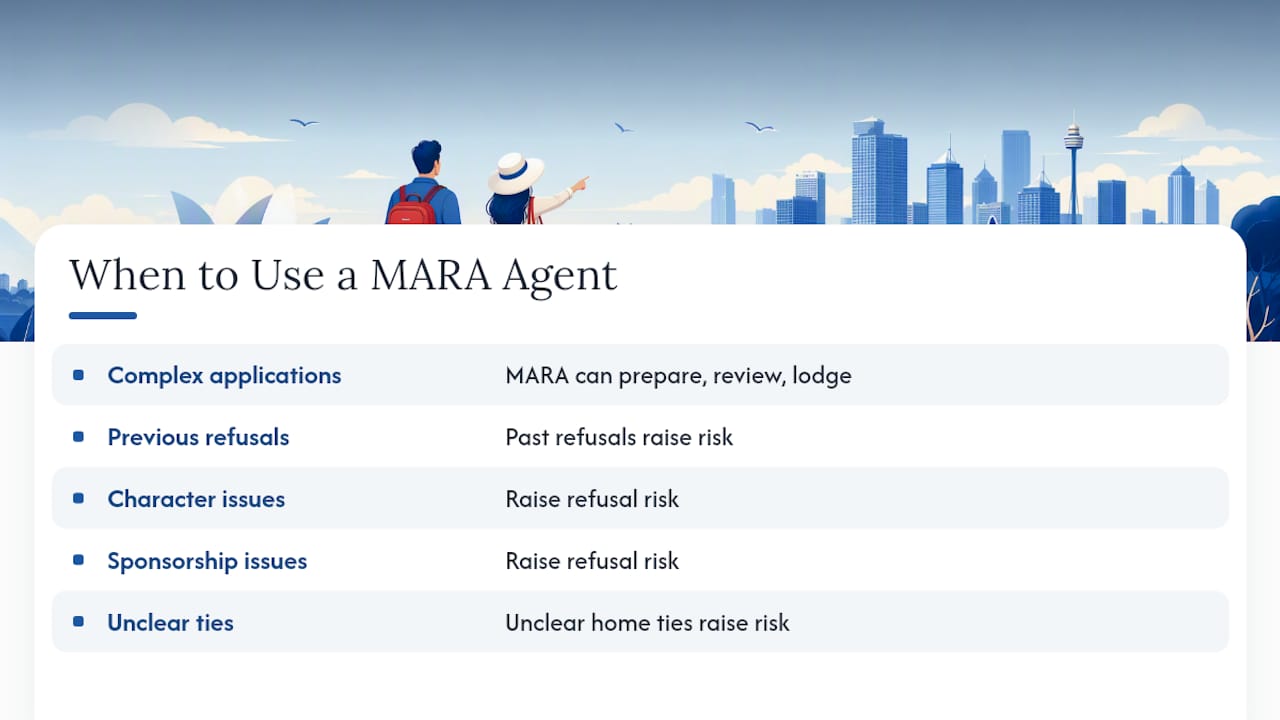
A MARA-registered agent can prepare, review, and lodge your application, and must disclose fees and credentials upfront. They cannot guarantee an outcome, no legitimate consultant can, but they can flag weak evidence before a case officer does. Fewa Education & Migration reviews documents and lodgement details before submission for exactly this reason.
Pro Tip: Write a one-page summary of your visa history, travel purpose, and any past refusals before contacting a consultant. It cuts review time significantly.
Why This Checklist Matters
I’ve seen how a single missing bank statement or an uncertified translation turns a simple visit into a months-long wait. Following the Department of Home Affairs’ own guidance closely, and knowing when to bring in a professional, is what actually prevents that.
Get Your Visitor Visa Application Reviewed Before You Submit
Fewa is the alternative to guessing your way through ImmiAccount alone, our MARA-registered consultants based in Sydney check your documents, streams, and forms against current Department of Home Affairs requirements before you submit anything.
Fewa Education & Migration works directly with tourists and families across Australia to review evidence of funds, invitation letters, and identity documents so a fixable gap doesn’t turn into a refusal. That local, MARA-registered presence means you’re getting advice grounded in current Australian regulations, not a generic overseas template. If your case involves a prior refusal, a sponsorship arrangement, or documents you’re unsure about, visit the Fewa Visitor Visa service page or book a free consultation to get your application checked before you lodge it.
Where to Check Official Visitor Visa Rules
Always verify current requirements directly with the government before you apply, rules and fees do change.
- Visitor visa (subclass 600) — Department of Home Affairs
- ImmiAccount lodgement portal
- Tourist Refund Scheme for post-travel purchase refunds
- Visas to visit Australia — DFAT
This article is general information, not a substitute for advice from a qualified lawyer. Consult a qualified legal professional about your own circumstances before acting on anything here.
Sources
- Visitor visa (subclass 600)
- Visitor visa (subclass 600) — Tourist stream (overseas)
- Visas to visit Australia | Australian Government Department of Foreign Affairs and Trade
- Legislation
- Mandatory online lodgement for Visitor visa (subclass 600)