


Subclass 190 grants permanent residence as soon as it’s approved, making it the more direct route for skilled migrants with a state nomination. Subclass 491 is a provisional regional visa: you must live and work in designated regional Australia and meet set conditions before you can move to permanent residence through subclass 191. If you want immediate PR and can secure a state nomination, 190 usually suits you better. If you need extra points to get invited, or you’re genuinely open to regional life, 491 can be the smarter play.
TL;DR:
- Subclass 190 grants permanent residency immediately upon approval, while subclass 491 requires living and working in regional Australia for a qualifying period before applying for subclass 191.
- A 190 nomination adds 5 points to the points test, whereas a 491 nomination or family sponsorship usually provides a larger points boost, often improving chances in competitive rounds.
- Nomination in the 190 does not mandate regional residence, while 491 applicants must reside and work in designated regional areas throughout the eligibility period.
- Processing times for 491 are longer due to the staged pathway to permanent residence, with evidence of regional employment and residence needed for the eventual 191 application.
- Ensuring your skills assessment is finalized before submitting your EOI is crucial, as delays and occupation list changes can impact nomination availability.
Table of Contents
- 190 vs 491: a head-to-head comparison
- Eligibility checklist: how points and the EOI process work
- State and territory nomination: allocations and criteria
- Processing times and the staged pathway from 491 to 191
- Visa costs and other practical factors before you lodge
- Which visa actually suits you: a decision framework
- What a registered migration consultancy sees clients get wrong
- When we recommend 190 over 491, and when we don’t
- How we can help you choose and apply
- FAQ
- Sources
190 vs 491: a head-to-head comparison
The two visas sit in the same points-tested skilled migration framework, but they ask very different things of you. Subclass 190 is a permanent visa from the day it’s granted. Subclass 491, by contrast, is a five-year provisional visa, and it only becomes a pathway to permanence once you’ve met residence and work conditions tied to subclass 191.
Points matter here too. A 190 nomination adds 5 points to your test score, confirmed on the Department’s own points table. A 491 nomination or eligible family sponsorship typically adds more, which is often the reason applicants who are short on points choose the regional route over 190 in the first place.
Where you’re required to live is the other major split. Subclass 190 doesn’t require you to settle in a specific region once granted. Subclass 491 does: you must reside and work in a designated regional area for the whole qualifying period before you can apply for subclass 191.
- Outcome on grant: 190 is permanent immediately; 491 is a provisional visa valid for five years.
- Points contribution: 190 nomination adds 5 points; 491 nomination or family sponsorship generally adds more to your total.
- Residence requirement: 190 has none attached to the visa itself; 491 requires living and working in regional Australia throughout the qualifying period.
- Nomination routes: both use state or territory nomination; 491 also allows eligible family sponsorship as an alternative route.
- Pathway length: 190 is a single-step grant; 491 requires an additional application (subclass 191) once conditions are met.
None of this makes one visa objectively “better”. It makes them suited to different circumstances, which is the whole point of comparing them properly before you commit to an Expression of Interest.
Eligibility checklist: how points and the EOI process work
Before either visa becomes a realistic option, you need to lodge an Expression of Interest through SkillSelect. This is where the Department records your occupation, points score, and visa preferences, and it’s the pool that states and territories browse when they’re looking for candidates to nominate.
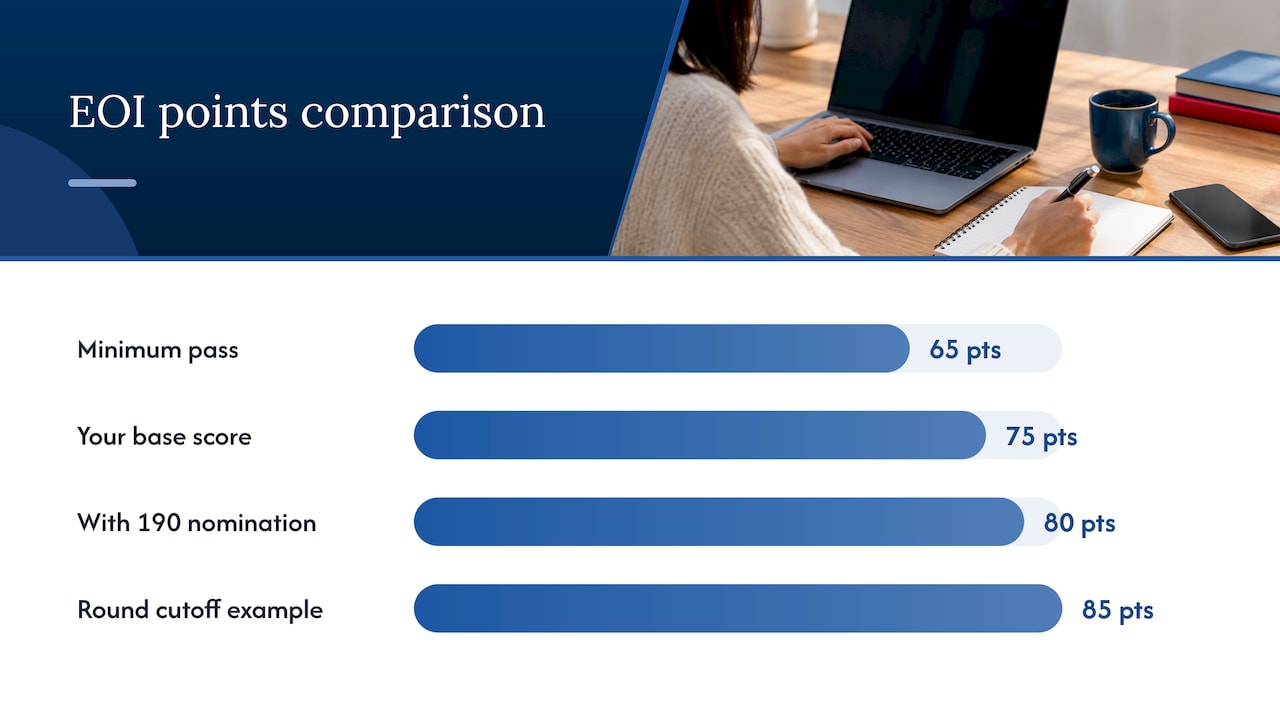
The points test itself draws on several factors: your age, English language ability, skilled employment experience, qualifications, partner skills, and any nomination or sponsorship points you can add. You need a minimum of 65 points to be considered at all, but meeting that threshold is a gate, not a guarantee. The Department is explicit that reaching 65 points does not mean you’ll receive an invitation, since places in each round are limited and competition varies by occupation.
Here’s a practical illustration: say your points without nomination total 75. Adding a 190 state nomination brings you to 80. If your occupation and state ceiling favour applicants scoring above 85 in a given round, that 5-point boost from 190 nomination may not be enough, whereas a 491 nomination or family sponsorship, which typically carries a larger points value, might tip you over the line.
Your eligibility rests on more than points, though. Before you even submit an EOI you need:
- A positive skills assessment from the relevant assessing authority for your nominated occupation.
- Proof your occupation sits on the relevant skilled occupation list for the visa and state you’re targeting.
- Evidence of English language proficiency at the level required for your points claim.
- Documentation covering age, qualifications and employment history that matches what you’ve declared in your EOI.
Getting your skills assessment sorted early matters more than most applicants realise, because assessing authorities can take weeks to months depending on the occupation, and a stale or incorrect assessment can stall your entire EOI. Our guide on skills assessments in Australia covers which authority applies to which occupation and typical timing.
Pro Tip: Submit your EOI only after your skills assessment is finalised and your occupation ceiling is confirmed open, since editing an EOI after a state nomination invitation can cost you your place in that round.
State and territory nomination: allocations and criteria
Nomination places aren’t unlimited, and they’re not evenly spread. The Department publishes state and territory nomination allocation tables each program year, showing how many places each jurisdiction has for 190 and 491 nominations. These figures are planning numbers, not promises: NSW and Victoria, for instance, typically manage differing numbers of 190 and 491 places, and each state sets its own occupation lists and criteria on top of the federal points test.
This is where a lot of applicants trip up. Meeting the Department’s 65-point minimum tells you nothing about whether Victoria wants your occupation this year, or whether NSW requires recent local work experience you don’t have. Each jurisdiction runs its own assessment on top of SkillSelect, often asking for:
- Evidence your occupation appears on that state’s current skilled occupation list.
- Proof of ties to the state, such as study, work history or family connections.
- A commitment statement explaining why you intend to live and work there.
- Financial evidence showing you can support yourself while settling in.
If you’re eligible for nomination in more than one jurisdiction, prioritise strategically rather than applying everywhere at once. Check which state’s occupation list and allocation numbers best match your profile first, since applying to a state with no demand for your occupation wastes time you can’t get back in a competitive round. Our 491 visa requirements checklist walks through the state-by-state documentation differences in more detail.
Regional nomination decisions also hinge on something the allocation table doesn’t show: whether the regional labour market can actually support you. A useful outside resource here is this overview of regional recruitment in Australia, which explains how employment demand in regional areas varies by sector, a factor worth weighing before you commit to a 491 pathway tied to a specific region.
Processing times and the staged pathway from 491 to 191
Processing times for skilled visas are published as medians on the Department’s visa processing times page, and they should be read as planning indicators rather than fixed promises. Completeness of your application, current ministerial directions, and whether your occupation sits in a priority sector can all shift your timeline in either direction.
One figure worth noting: skilled permanent visas have shown markedly longer median processing times than temporary skilled visas, according to the Department’s own processing data, which matters directly when you’re weighing a single-step 190 grant against the staged 491 to 191 route.
A realistic scenario looks like this: you lodge your 491 application after a successful nomination, wait for processing and grant, then spend the required period living and working in a designated regional area. Only once you’ve met that residence and work condition can you lodge your 191 application for permanent residence, which then goes through its own processing queue. Compare that with 190, where a single grant gets you to permanent status immediately, and the time difference becomes obvious.
To support a future 191 application, start collecting evidence of your regional life from day one:
- Employment records showing continuous work in your nominated regional occupation.
- Tax statements confirming income earned while living regionally.
- Rental agreements or mortgage documents tied to a regional address.
- Utility bills that corroborate your residence over the qualifying period.
Processing order isn’t always first-come, first-served either. Current ministerial directions can prioritise certain sectors, so applicants in fields like construction, healthcare, teaching or resources may see faster handling than others in the same queue.
Visa costs and other practical factors before you lodge
Don’t lodge based on a fee figure you saw somewhere last year. Visa charges change, sometimes more than once annually, and the only reliable number is whatever the Department’s current Visa Pricing Table or estimator shows on the day you apply. Additional applicant charges can also apply depending on your family situation, so check the estimator against your own circumstances rather than a generic quote.
Beyond the visa application charge itself, budget for a handful of costs that catch people off guard:
- Skills assessment fees, which vary by assessing authority and occupation.
- Health examinations and police checks, both of which have their own costs and validity windows.
- Certified translations for any documents not already in English.
- Migration advice fees, if you engage a registered consultant to manage your application.
- Relocation and settling-in costs, especially significant if you’re moving to a regional area for a 491.
There are non-financial checks worth doing too. If you’re considering 491, look honestly at housing availability and employment prospects in the specific regional area you’re targeting, and factor in schooling if you’re relocating with family. Travel facility conditions also differ between a provisional and a permanent visa, so check what that means for any travel you’re planning before and after grant.
Which visa actually suits you: a decision framework
Before you lock in a direction, sit with a few honest questions. Do you need permanent residence immediately, or can you work with a staged pathway? Can you genuinely commit to living in a designated regional area for several years, not just on paper? Do you meet a specific state’s criteria, not just the federal points threshold? And how does your points score look without any nomination boost at all?
Watch for these red flags before you commit:
- Assuming subclass 491 delivers immediate permanent residence: it doesn’t, PR only comes via subclass 191 after you meet the conditions.
- Relying on thin or inconsistent evidence of regional work and residence, which can undermine a future 191 application.
- Ignoring published allocation numbers and applying to a state with no real demand for your occupation.
If you’re ready to move forward, work through these steps in order:
- Check your occupation against the relevant skilled occupation list for each visa and state you’re considering.
- Calculate your points honestly, with and without a nomination or sponsorship boost.
- Contact a state nomination authority or a MARA-registered migration consultant to confirm current criteria.
- Prepare your evidence pack, including skills assessment, English results, and employment records, before submitting your EOI.
Pro Tip: Time your skills assessment so it’s finalised well before EOI submission windows open for your target state, since assessment delays are one of the most common reasons applicants miss a nomination round entirely.
What a registered migration consultancy sees clients get wrong
Consultancies registered with MARA often see similar patterns in client mistakes repeating across occupations and states. The most common one is treating 65 points as a finish line rather than a starting point: applicants build an EOI, hit the threshold, then wait for an invitation that doesn’t come because their occupation ceiling filled or their state had no allocation room that round.
The second recurring error shows up later in the process. Applicants on a 491 often under-document their regional employment, assuming a job contract alone will satisfy subclass 191 requirements. In practice, a stronger file includes continuous payslips, tax records, and a rental or utility history that together tell a consistent story of regional living, not just regional working.
The third mistake is applying to a state without checking whether that state’s occupation list and allocation numbers genuinely support the application. We help clients work through nomination checklists for subclass 491, time skills assessments to line up with EOI windows, and build an evidence trail early rather than scrambling for documents once a 191 application is already underway. Early professional review tends to catch gaps in English evidence, qualification recognition or occupation mismatches well before they cost an applicant an invitation round, which is often the difference between a smooth nomination and months of rework.
When we recommend 190 over 491, and when we don’t
In our experience, 190 suits applicants with strong occupation demand in a specific state, a need for immediate permanent residence, and an EOI that already aligns closely with that state’s nomination criteria. If you’re in that position, there’s little reason to take on the extra steps and regional commitment that 491 requires.
We lean towards recommending 491 when a client’s points fall short without a larger nomination boost, or when they’re genuinely able to commit to regional life for the years it takes to reach subclass 191, or when they qualify through eligible family sponsorship rather than state nomination at all. The visa that fits is the one matching your real capacity to meet a state’s or region’s conditions, not the one that sounds fastest on paper. Choosing based on genuine fit, rather than assumptions about speed, is what tends to produce a smoother outcome either way.
— Ronit
How we can help you choose and apply
Working out whether 190 or 491 fits your situation is easier with someone checking your points, your occupation list status and your state options against current criteria, rather than guessing from forum posts or outdated fee tables.

Our skilled migration visa service covers the parts of this process that trip people up most: reviewing your Expression of Interest before submission, mapping your occupation against current state nomination criteria, coordinating your skills assessment timing, and managing lodgement once you’re ready to apply.
A first consultation typically covers:
- A review of your current points score and where a nomination or sponsorship boost could help.
- Which states or territories realistically suit your occupation and circumstances.
- What documents you’ll need to gather for skills assessment, EOI and eventual nomination.
- A clear view of next steps for either the 190 or 491 pathway, based on your actual situation.
Bring your qualifications, employment history and any prior skills assessment results, and we’ll work through the rest with you. You can also browse our full range of visa services, including partner, family and employer-sponsored options, if your pathway turns out to involve more than one visa type. Book a consultation when you’re ready to move from research to a real application strategy.
This article is general information, not a substitute for advice from a qualified lawyer. Consult a qualified legal professional about your own circumstances before acting on anything here.
FAQ
Is 491 visa better than 190?
Neither is “better” outright. They suit different situations: 190 gives you permanent residence immediately, while 491 suits applicants who need extra points or are willing to commit to regional living in exchange for a staged path to permanence.
Does 491 guarantee PR?
No. Subclass 491 is a provisional visa, and it only leads to permanent residence once you apply for and are granted subclass 191 after meeting the required regional residence and work conditions. Treating 491 as automatic PR is one of the most common planning mistakes applicants make.
What happens after 5 years of a 190 visa?
Subclass 190 is already a permanent visa from the date it’s granted, so there’s no five-year condition attached to your residency status itself. Any ongoing requirements relate to travel facility validity or citizenship eligibility timing, not to maintaining your permanent resident status.
Is 70 points enough for a 190 visa?
A score above the 65-point minimum threshold is required to submit an EOI, but meeting the minimum doesn’t guarantee an invitation. Competition within your occupation, state allocation numbers and the points of other applicants in the pool all affect whether your points score is enough in any given round.